Best UPSC and MPPSC IAS Coaching Classes in Gwalior

Great Nicobar Development Plan

1. The Great Nicobar Project aims to develop Great Nicobar Island into a strategic maritime and economic hub by leveraging its location near the East-West international shipping route.

2. The project site lies about 40 nautical miles from the East-West shipping route, giving it strong potential for transshipment activity and strategic maritime relevance in the Indian Ocean region.

More Details

World Wildlife Day 2026 and Medicinal Plant Conservation

1. World Wildlife Day is observed on 3 March, marking adoption of CITES, while the 2026 theme focuses on medicinal and aromatic plants, health heritage, and livelihoods.

2. India is among the world’s 17 mega biodiversity rich countries and holds nearly 7 percent of global biodiversity, giving special significance to medicinal plant conservation.

More Details

India’s Expanding Clean and Strategic Energy Framework

1. India’s energy system is being reshaped to provide reliable, affordable, cleaner, and more secure power for households, farms, industries, transport systems, and public services.

2. Average electricity availability in rural areas increased from 12.5 hours in 2014 to 22.6 hours, while urban power supply improved from 22.1 hours to 23.4 hours.

More Details

Waste-to-Wealth in Agriculture: Circular Solutions and Key Numbers

1. India generates about 350 million tonnes of agricultural waste annually, including crop residues, husk, straw, and food-processing by-products, creating serious air, soil, and water contamination risks when mismanaged.

2. MNRE estimates agricultural residues could generate over 18,000 MW of power annually, alongside producing nutrient-rich organic fertilisers that improve soil health and significantly reduce dependence on chemical inputs.

More Details

From Record Heat to COP30: Global and India Climate Snapshot 2025

1. From 2015 to 2025, every year ranked among the eleven warmest in a 176-year record; 2023, 2024, and 2025 were the three warmest years observed globally on record.

2. January to August 2025 mean near-surface temperature reached 1.42°C above the pre-industrial average, sustaining exceptional warmth and reinforcing the decade’s persistent global temperature anomaly across multiple observations worldwide.

More Details

From Winter Smog to Year-Round Clean-Air Governance: January 2026 Delhi–NCR High-Level Review and Sectoral Action Plan

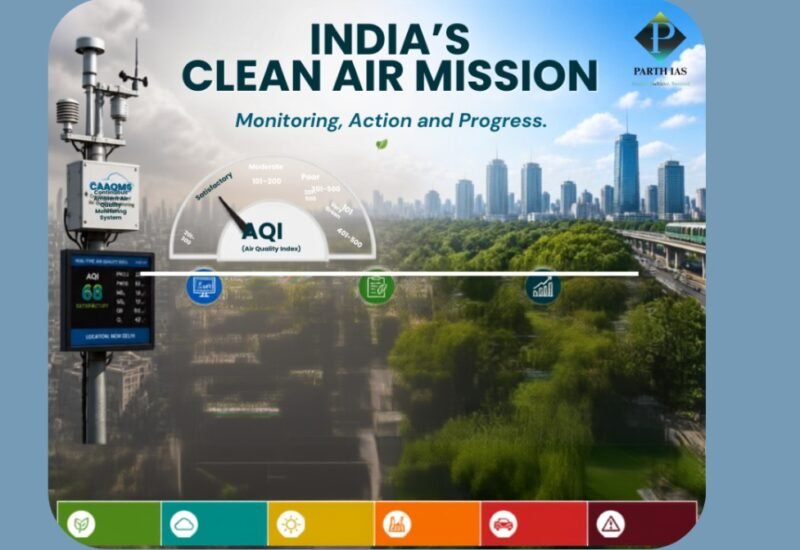
1. Delhi–NCR’s winter pollution remains extreme; on 28 December 2025, Delhi recorded “hazardous” air with AQI 530, highlighting repeated seasonal spikes and worsening multi-year deterioration trends.

2. Short-term controls have included GRAP (Graded Response Action Plan) and routine mist-spray systems on central road verges to suppress dust, yet overall ambient air quality has not improved to acceptable levels.

More Details

Big-Cat Conservation as Climate Resilience: Integrated Governance, Technology, and Community Stewardship

1. Climate action is described as increasingly linking conservation, technology, and diplomacy into a holistic governance approach, reducing fragmented planning and improving coherence across sectors and landscapes.

2. Biodiversity protection is treated as a climate instrument, aligning habitat security with mitigation, adaptation, and long-term resilience, supported by statutory protections for continuity beyond political cycles.

More Details

India’s Climate Diplomacy: Coalition Leadership Across Solar, Resilience, and Biofuels

1. India’s climate diplomacy balances development for 1.4 billion people with climate goals, using low per-capita emissions and equity framing to argue for developmental space with ambition.
2. India commits to cut GDP emissions intensity 45% from 2005 by 2030 and targets net zero by 2070; early 50% installed non-fossil electricity capacity strengthens credibility internationally.

More Details

Indian Ocean Region: Trade Artery, Climate Stress, and Cooperative Security

1. The Indian Ocean spans Bay of Bengal to Antarctica and South Africa to Western Australia; it covers about 21.45 million square nautical miles, roughly one-fifth of Earth’s water surface.

2. The Indian Ocean Region includes 36 countries and about 2.5 billion people, around 35% of global population, forming a vast canvas linking littorals, islands, and major trade routes.

More Details

Free IAS Guidance
Start Your Journey Today 🇮🇳

Fill out the form below, and we will be in touch shortly.