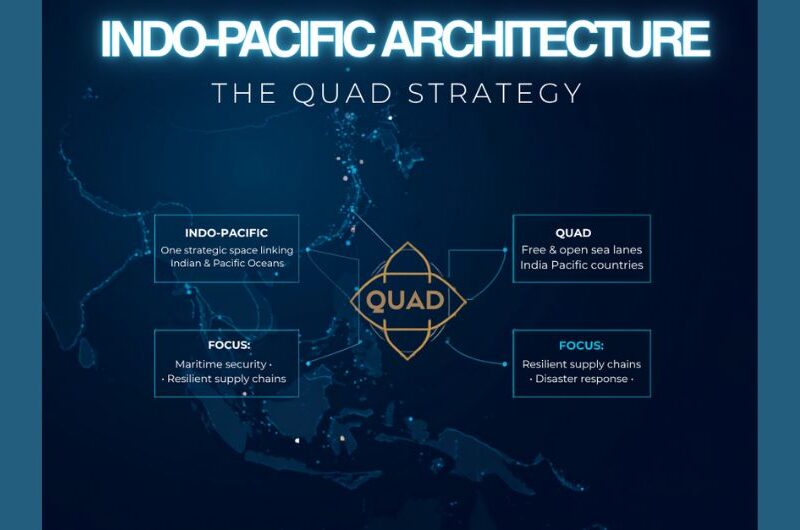
Indo-Pacific Architecture and the Quad Strategy
1. Indo-Pacific Strategic Shift
The Indo-Pacific framework combines the Indian Ocean and Pacific Ocean into one strategic space. It has strengthened India’s maritime role alongside its traditional continental focus.
2. Earlier Hub-and-Spoke Model
Earlier regional security was based mainly on bilateral United States alliances with Japan, South Korea and Australia.
3. Lattice-work Framework
The region is now moving towards a decentralized and multi-layered network of smaller cooperative groups, called minilaterals.
4. Multilateral Core of the Region
ASEAN centrality, the East Asia Summit (EAS), ASEAN Regional Forum (ARF), Indian Ocean Rim Association (IORA) and Indian Ocean Naval Symposium (IONS) remain important regional platforms.
5. Major Minilateral Groups
Key minilateral arrangements include the Quad, AUKUS, iCET, India–Middle East–Europe Economic Corridor (IMEC), and the Squad involving the United States, Japan, Australia and the Philippines.
6. Quad: Meaning and Vision
The Quadrilateral Security Dialogue includes India, the United States, Japan and Australia. It is an informal forum working for a free, open, prosperous and inclusive Indo-Pacific.
7. Quad 1.0: Origin and Collapse
The Quad emerged from the Tsunami Core Group of 2004 and was formally proposed by Japanese Prime Minister Shinzo Abe in 2007. It weakened after Australia withdrew amid Chinese diplomatic pressure.
8. Quad 2.0: Revival
The Quad was revived in 2017 on the sidelines of the ASEAN Summit. It responded to China’s expansionist actions, South China Sea tensions and debt-based infrastructure projects.
9. Expanding Quad Agenda
The Quad has moved beyond maritime security. It now focuses on critical technologies, supply chain diversification, climate resilience, infrastructure and delivery of regional public goods.
10. Maritime Domain Awareness
The Indo-Pacific Maritime Domain Awareness (IPMDA) initiative helps detect dark shipping, monitor grey-zone coercion and share satellite-based maritime information with regional countries.
11. Geoeconomic and Infrastructure Cooperation
The Supply Chain Resilience Initiative (SCRI) aims to reduce critical dependence on Chinese manufacturing and build secure mineral partnerships. The Blue Dot Network and transparent port projects offer high-standard alternatives to the Belt and Road Initiative.
12. Defence and Naval Cooperation
The Malabar Exercise and Quad at Sea strengthen naval interoperability, logistics coordination and underwater surveillance capabilities among partner countries.
13. Strategic Importance for India
Cooperation with external naval powers improves India’s ability to protect sea routes and strategically important choke points such as the Malacca Strait. It also supports the Act East Policy and SAGAR—Security and Growth for All in the Region.
14. Strategic Autonomy and Networked Hedging
The Quad enables India to respond to aggressive actions without joining a formal military alliance. This helps India preserve strategic autonomy while strengthening maritime security.
15. Challenges and Way Forward
India and other Quad members have different threat priorities: India focuses on land borders and the Indian Ocean, while the United States, Japan and Australia focus more on the Western Pacific and Taiwan. India’s defence ties with Russia, Western sanctions, dependence on China, ASEAN concerns over reduced centrality, the “Asian NATO” image, and the lack of a treaty or secretariat remain challenges. India should lead decentralized cooperation through the Information Fusion Centre–Indian Ocean Region, provide public goods such as green technology, space cooperation and vaccines, and maintain balance through forums such as Russia–India–China and the Shanghai Cooperation Organisation.
Must Know Terms :
1. Indo-Pacific
It is a strategic region connecting the Indian Ocean and the Pacific Ocean. It highlights India’s growing maritime importance in regional security and trade.
2. Quad
The Quadrilateral Security Dialogue includes India, the United States, Japan and Australia. It works for a free, open, prosperous and inclusive Indo-Pacific.
3. ASEAN Centrality
It means that ASEAN should remain at the centre of regional dialogue and cooperation. ASEAN-led platforms include the East Asia Summit and ASEAN Regional Forum.
4. AUKUS
AUKUS is a security partnership among Australia, the United Kingdom and the United States. It focuses on nuclear-powered submarine capability and advanced defence technologies for Australia.
5. IPMDA
Indo-Pacific Maritime Domain Awareness improves maritime monitoring through satellite and other technologies. It helps identify dark shipping, illegal activities and grey-zone operations at sea.
6. SCRI
The Supply Chain Resilience Initiative aims to make supply chains more reliable and diversified. It seeks to reduce excessive dependence on a single country for critical products and minerals.
MCQ :
1. With reference to the Indo-Pacific concept, consider the following statements:
1. It links the Indian Ocean and the Pacific Ocean into a single strategic space.
2. It has increased the importance of maritime strategy in India’s foreign policy.
3. It is limited only to countries located on the Pacific coast.
Which of the statements given above are correct?
(a) 1 and 2 only
(b) 2 and 3 only
(c) 1 and 3 only
(d) 1, 2 and 3
2. The earlier “Hub-and-Spoke” model in the Asia-Pacific region was primarily based on:
(a) ASEAN-led regional institutions
(b) Bilateral United States alliances with regional partners
(c) A formal military alliance among all Indo-Pacific countries
(d) A single regional parliament
3. The “Lattice-work” framework in the Indo-Pacific is best described as:
(a) A centralized security system led by one country
(b) A network limited to economic cooperation
(c) A decentralized and multi-layered network of partnerships
(d) A replacement for all multilateral institutions
4. Which of the following are important multilateral platforms in the Indo-Pacific region?
1. East Asia Summit
2. ASEAN Regional Forum
3. Indian Ocean Rim Association
4. Indian Ocean Naval Symposium
Select the correct answer using the code below:
(a) 1 and 2 only
(b) 2, 3 and 4 only
(c) 1, 3 and 4 only
(d) 1, 2, 3 and 4
5. With reference to the Quad, consider the following statements:
1. It includes India, the United States, Japan and Australia.
2. It is a formal military alliance with a binding collective-defence treaty.
3. It supports a free, open, prosperous and inclusive Indo-Pacific.
Which of the statements given above are correct?
(a) 1 and 3 only
(b) 2 and 3 only
(c) 1 only
(d) 1, 2 and 3
6. The Quad initially emerged from cooperation among countries after:
(a) The 1997 Asian Financial Crisis
(b) The 2004 Indian Ocean tsunami
(c) The 2008 global financial crisis
(d) The COVID-19 pandemic
7. The Quad was revived in 2017 on the sidelines of the:
(a) G20 Summit
(b) BRICS Summit
(c) ASEAN Summit
(d) Shanghai Cooperation Organisation Summit
8. Which of the following is NOT a major area of present Quad cooperation?
(a) Critical technologies
(b) Climate resilience
(c) Supply chain diversification
(d) Establishment of a common currency
9. Indo-Pacific Maritime Domain Awareness (IPMDA) is mainly intended to:
(a) Regulate international trade tariffs
(b) Monitor maritime activities and identify dark shipping
(c) Create a common naval command for all regional states
(d) Replace national coast guard agencies
10. With reference to the Supply Chain Resilience Initiative (SCRI), consider the following statements:
1. It aims to make supply chains more reliable and diversified.
2. It seeks to reduce excessive dependence on a single country for critical products.
3. It focuses only on agricultural commodities.
Which of the statements given above are correct?
(a) 1 and 2 only
(b) 2 and 3 only
(c) 1 and 3 only
(d) 1, 2 and 3
11. The Blue Dot Network and transparent port-development projects are viewed as alternatives to:
(a) the Malabar Exercise
(b) the ASEAN Regional Forum
(c) China’s Belt and Road Initiative
(d) the East Asia Summit
12. The Malabar Exercise primarily contributes to:
(a) agricultural technology cooperation
(b) naval interoperability and maritime security cooperation
(c) establishment of a common Indo-Pacific market
(d) settlement of land-border disputes
13. AUKUS consists of:
(a) Australia, United Kingdom and United States
(b) Australia, United States and Japan
(c) United Kingdom, India and Australia
(d) United States, Japan and South Korea
14. Which one of the following best explains India’s “networked hedging” approach through the Quad?
(a) Joining a binding military alliance against all neighbouring countries
(b) Avoiding all maritime partnerships in the Indo-Pacific
(c) Balancing regional security concerns while preserving strategic autonomy
(d) Replacing ASEAN-led institutions with the Quad
15. Consider the following statements regarding challenges faced by the Quad:
1. The Quad has no formal treaty or permanent secretariat.
2. Its members have identical threat perceptions in every region.
3. Some Southeast Asian countries fear that minilateral groups may weaken ASEAN centrality.
4. India’s ties with Russia create a strategic balancing challenge.
Which of the statements given above are correct?
(a) 1, 2 and 3 only
(b) 1, 3 and 4 only
(c) 2 and 4 only
(d) 1, 2, 3 and 4




0 comment