Agrivoltaics and India’s Sustainable Agriculture and Solar Energy Transition
1
Agriculture provides livelihoods to approximately 46.1% of India’s population, while the Gross Value Added (GVA) of Agriculture and Allied Sectors is estimated at ₹52.08 lakh crore in 2025–26. According to Land Use Statistics 2023–24, India’s reported area was 306.96 million hectares, with approximately 55% classified as agricultural land. The net sown area was 138.99 million hectares, while the gross cropped area was 217.88 million hectares.
2
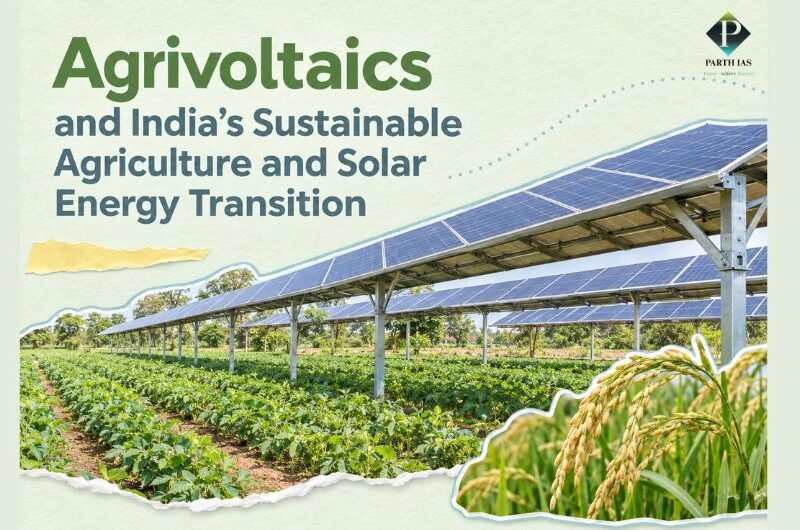
Agrivoltaics, also called AgriPV, Agrisolar or Dual-Use Solar, combines agricultural production and solar electricity generation on the same land. Solar panels are installed above crops or between crop rows, allowing farming activities to continue alongside electricity generation. These systems can also support livestock rearing, improve land-use efficiency and contribute to food and energy security.
3
Agrivoltaic systems use elevated solar structures, interspace layouts and tracking technologies adapted to local agricultural conditions. Elevated panels allow sunlight, rainfall and agricultural machinery to pass underneath. Partial shading can protect suitable crops from excessive heat and reduce soil moisture loss. Solar electricity can power irrigation pumps, reduce diesel dependence and generate additional income through surplus electricity sales to the grid.
4
As of August 2025, India had 36 operational agrivoltaic projects with a combined installed capacity of 37.54 megawatts (MW), along with 10 pilot projects under development. These projects operate across different agroclimatic regions and demonstrate various approaches to combining solar power generation with agricultural production.
5
India’s estimated agrivoltaic power generation potential ranges from approximately 3,000 gigawatts (GW) to nearly 14,000 GW. Agrivoltaic installations can diversify agricultural income, with some estimates suggesting that annual earnings may increase from approximately ₹60,000 per acre to more than ₹1 lakh per acre under suitable conditions.
6
Geographic Information System (GIS)-based national screening identified approximately 47.35 million hectares of restricted cropland suitable for agrivoltaics after applying environmental, agronomic and technical filters. Fruits, vegetables, spices and medicinal plants are considered promising crops for cultivation alongside solar installations.
7
Maharashtra, Rajasthan, Andhra Pradesh, Madhya Pradesh, Karnataka and Uttar Pradesh are identified as high-potential states for agrivoltaic development, collectively accounting for nearly 50% of India’s estimated AgriPV power generation potential. Odisha, Tamil Nadu, Kerala, Telangana, Bihar and West Bengal have moderate potential. Southern, western and central India offer favourable combinations of solar irradiance, cropland availability and horticultural intensity.
8
Pradhan Mantri Kisan Urja Suraksha evam Utthaan Mahabhiyan (PM-KUSUM) was launched in February 2019 to promote solar energy in agriculture, reduce dependence on diesel and diversify farmers’ income. The scheme envisages approximately ₹34,422 crore in central financial assistance and supports decentralised solar power generation and solarisation of agricultural pumps.
9
The National Institute of Solar Energy (NISE), in collaboration with the Indian Council of Agricultural Research’s Indian Agricultural Research Institute (ICAR-IARI), established a Centre of Excellence (CoE) on Agrivoltaics. The centre supports research, field demonstrations and capacity building. Its pilot initiatives include a 100-kilowatt agrivoltaic installation at the Indian Agricultural Research Institute.
10
The India Agrivoltaics Alliance (IAA), launched in 2023 and anchored by the National Solar Energy Federation of India (NSEFI), is a multi-stakeholder platform promoting the combined use of agricultural land for farming and solar electricity generation. It has expanded to more than 40 members and works with government ministries and industry stakeholders on policy advocacy, research, pilot projects and scalable business models.
11
Maharashtra’s Mukhyamantri Saur Krushi Vahini Yojana 2.0 promotes solar electricity generation for agricultural consumers through approximately 16,000 MW of solar projects across nearly 35,000 acres of government and private land. The initiative aims to improve electricity availability for agricultural activities through solar power development.
12
Gujarat’s Kisan Suryoday Yojana aims to provide daytime electricity for agricultural activities through phased development of solar and other non-conventional energy generation facilities. Its planned electricity supply window extends up to 16 hours daily, from 5:00 AM to 9:00 PM.
13
Karnataka’s Surya Raitha Scheme promotes solar-powered irrigation pumps and enables farmers to earn additional income by supplying surplus electricity. The scheme aims to improve access to irrigation energy while reducing dependence on diesel-powered pumps and supporting renewable energy adoption in agriculture.
14
The Bharat Renewable Energy Summit & Expo (Bharat RE) 2026 is being held from 2–5 November 2026 at Bharat Mandapam, New Delhi, under the theme “Invest. Innovate. Inspire.” The four-day event brings together participants from more than 130 countries, including over 40 Ministers, policymakers, investors, financial institutions and industry leaders. Thirteen Indian States and Union Territories are participating, and the exhibition features more than 400 exhibitors.
15
Nine Country Partners are participating in Bharat RE 2026: Australia, Denmark, the European Union, France, Germany, the Netherlands, Norway, Sweden and the United Kingdom. The summit focuses on solar and wind energy, green hydrogen, energy storage, grid integration, domestic manufacturing, digitalisation and artificial intelligence applications in energy. It is being held alongside the 9th International Solar Alliance Assembly and the 4th International Conference on Green Hydrogen.
Must Know Terms
1. Agrivoltaics (AgriPV)
Agrivoltaics, also known as Agrisolar or Dual-Use Solar, combines agricultural production and solar electricity generation on the same land. Solar panels are installed above or between crop rows, allowing farming and electricity generation to continue together. It improves land-use efficiency and creates opportunities for additional farm income.
2. Elevated Solar Structures
Elevated Solar Structures are solar panel installations raised above agricultural land to allow crop cultivation and movement of farming equipment underneath. They permit sunlight and rainfall to reach crops while generating electricity. Partial shading can also reduce excessive heat and soil moisture loss under suitable conditions.
3. Restricted Cropland
Restricted Cropland refers to agricultural land identified as suitable for agrivoltaic development after applying environmental, agricultural and technical suitability filters. Geographic Information System (GIS)-based national screening identified approximately 47.35 million hectares of such land in India.
4. Dual Land Productivity
Dual Land Productivity refers to obtaining agricultural output and solar electricity from the same land. Agrivoltaic systems combine crop cultivation or livestock rearing with power generation, reducing competition for land and potentially increasing farmers’ earnings through the sale of surplus electricity.
5. PM-KUSUM Scheme
Pradhan Mantri Kisan Urja Suraksha evam Utthaan Mahabhiyan (PM-KUSUM) was launched in February 2019 to promote solar energy in agriculture. It supports decentralised solar power generation and solarisation of agricultural pumps, reduces diesel dependence and creates additional income opportunities for farmers. The scheme envisages approximately ₹34,422 crore in central financial assistance.
6. India Agrivoltaics Alliance (IAA)
The India Agrivoltaics Alliance was launched in 2023 and is anchored by the National Solar Energy Federation of India (NSEFI). It promotes the combined use of agricultural land for farming and solar electricity generation. With more than 40 members, it supports policy advocacy, research, pilot projects and scalable agrivoltaic business models.
Multiple-Choice Questions
1. With reference to India’s agricultural land and economic contribution, consider the following statements:
1. The Gross Value Added of Agriculture and Allied Sectors is estimated at ₹52.08 lakh crore in 2025–26.
2. India’s net sown area was approximately 217.88 million hectares according to Land Use Statistics 2023–24.
3. Approximately 55% of India’s reported geographical area was classified as agricultural land.
Which of the statements given above are correct?
(a) 1 only
(b) 1 and 3 only
(c) 2 and 3 only
(d) 1, 2 and 3
2. With reference to Agrivoltaics, consider the following statements:
1. It combines agricultural production and solar electricity generation on the same land.
2. It requires the complete removal of agricultural activities from land used for solar installations.
3. It can integrate livestock rearing with solar electricity generation.
4. It is also referred to as Agrisolar or Dual-Use Solar.
Which of the statements given above are correct?
(a) 1 and 2 only
(b) 2 and 3 only
(c) 1, 3 and 4 only
(d) 1, 2, 3 and 4
3. With reference to the functioning of Agrivoltaic systems, consider the following statements:
1. Elevated solar structures allow agricultural machinery to operate beneath solar panels.
2. Partial shading can reduce soil moisture loss under suitable agricultural conditions.
3. Agrivoltaic systems necessarily depend on diesel-powered irrigation pumps.
4. Partial shading guarantees increased productivity for all crop varieties under every climatic condition.
Which of the statements given above are correct?
(a) 1 and 2 only
(b) 1, 2 and 3 only
(c) 2 and 4 only
(d) 1, 3 and 4 only
4. Consider the following pairs regarding India’s Agrivoltaic development as of August 2025:
1. Operational Agrivoltaic projects — 36
2. Combined installed capacity — 37.54 MW
3. Pilot projects under development — 10
4. Combined installed capacity — 37.54 GW
How many of the pairs given above are correctly matched?
(a) All four
(b) Only one
(c) Only two
(d) Only three
5. Which one of the following correctly represents India’s estimated Agrivoltaic potential and possible farm income benefits?
(a) Power potential of 300–1,400 GW, with annual earnings limited to ₹60,000 per acre.
(b) Power potential of approximately 3,000–14,000 GW, with annual earnings potentially increasing from ₹60,000 to over ₹1 lakh per acre under suitable conditions.
(c) Power potential of approximately 30,000–40,000 GW, with guaranteed annual earnings of ₹2 lakh per acre.
(d) Power potential of approximately 1,000–3,000 GW, with no scope for supplementary income from electricity generation.
6. With reference to land suitability for Agrivoltaics in India, consider the following statements:
1. Geographic Information System-based screening has been used to identify suitable cropland.
2. Approximately 47.35 million hectares of restricted cropland were identified as suitable for Agrivoltaics.
3. The screening relied exclusively on solar irradiance without considering environmental and agronomic conditions.
4. Fruits, vegetables, spices and medicinal plants are considered promising crop categories for Agrivoltaic systems.
Which of the statements given above are correct?
(a) 1, 2 and 4 only
(b) 1 and 3 only
(c) 2, 3 and 4 only
(d) 1, 2, 3 and 4
7. Consider the following pairs regarding the potential for Agrivoltaic development in Indian states:
1. Maharashtra — High potential
2. Bihar — Moderate potential
3. Kerala — High potential
4. Madhya Pradesh — High potential
Which of the pairs given above are correctly matched?
(a) 1 and 2 only
(b) 2, 3 and 4 only
(c) 1, 2 and 4 only
(d) 1, 3 and 4 only
8. With reference to Pradhan Mantri Kisan Urja Suraksha evam Utthaan Mahabhiyan (PM-KUSUM), consider the following statements:
1. The scheme was launched in February 2019.
2. It envisages approximately ₹34,422 crore in central financial assistance.
3. It supports decentralised solar power generation and solarisation of agricultural pumps.
4. It is restricted exclusively to rooftop solar installations in urban residential areas.
Which of the statements given above are correct?
(a) 1 and 4 only
(b) 2, 3 and 4 only
(c) 1 and 2 only
(d) 1, 2 and 3 only
9. With reference to the Centre of Excellence on Agrivoltaics, consider the following statements:
1. It was established through collaboration between the National Institute of Solar Energy and ICAR–Indian Agricultural Research Institute.
2. Its pilot initiatives include a 100-kilowatt Agrivoltaic installation at the Indian Agricultural Research Institute.
3. It was established by the India Agrivoltaics Alliance as an exclusively private-sector institution in 2023.
Which of the statements given above are correct?
(a) 1 and 3 only
(b) 1 and 2 only
(c) 2 and 3 only
(d) 1, 2 and 3
10. With reference to the India Agrivoltaics Alliance (IAA), consider the following statements:
1. It was launched in 2023.
2. It is anchored by the National Solar Energy Federation of India.
3. It has expanded to more than 40 members.
4. It functions exclusively as a government regulatory authority responsible for issuing mandatory agricultural land-use approvals.
Which of the statements given above are correct?
(a) 1, 2 and 3 only
(b) 1, 2 and 4 only
(c) 2, 3 and 4 only
(d) 1, 2, 3 and 4
11. Consider the following pairs regarding state-level solar energy initiatives in agriculture:
1. Mukhyamantri Saur Krushi Vahini Yojana 2.0 — Maharashtra — Approximately 16,000 MW of solar projects
2. Kisan Suryoday Yojana — Gujarat — Planned daytime electricity supply of up to 16 hours
3. Surya Raitha Scheme — Karnataka — Solar-powered irrigation and income from surplus electricity
4. Kisan Suryoday Yojana — Gujarat — Exclusively promotes diesel-powered irrigation pumps
Which of the pairs given above are correctly matched?
(a) 1 and 2 only
(b) 2 and 4 only
(c) 1, 2 and 3 only
(d) 1, 2, 3 and 4
12. Consider the following statements:
Statement-I:
The 47.35 million hectares identified as suitable for Agrivoltaics represent a filtered land base rather than India’s entire agricultural land area.
Statement-II:
The national screening process applied environmental, agronomic and technical filters to identify suitable cropland.
Which one of the following is correct?
(a) Both Statement-I and Statement-II are correct, but Statement-II does not explain Statement-I.
(b) Both Statement-I and Statement-II are correct, and Statement-II explains Statement-I.
(c) Statement-I is correct, but Statement-II is incorrect.
(d) Statement-I is incorrect, but Statement-II is correct.
13. With reference to the Bharat Renewable Energy Summit & Expo 2026, consider the following statements:
1. It is being held from 2–5 November 2026 at Bharat Mandapam, New Delhi.
2. Its theme is “Invest. Innovate. Inspire.”
3. It brings together participants from over 130 countries and features more than 400 exhibitors.
4. Fewer than 100 countries are participating, and no Indian States or Union Territories are represented.
Which of the statements given above are correct?
(a) 1 and 3 only
(b) 2 and 4 only
(c) 1, 2 and 4 only
(d) 1, 2 and 3 only
14. Consider the following countries and regional organisations:
1. Australia
2. Canada
3. European Union
4. Norway
Which of the above are among the nine Country Partners of Bharat Renewable Energy Summit & Expo 2026?
(a) 1, 3 and 4 only
(b) 1, 2 and 3 only
(c) 2, 3 and 4 only
(d) 1, 2, 3 and 4
15. Arrange the following developments related to India’s Agrivoltaic and renewable energy ecosystem in chronological order:
1. Launch of PM-KUSUM
2. Launch of the India Agrivoltaics Alliance
3. India recording 36 operational Agrivoltaic projects with 37.54 MW installed capacity
4. Bharat Renewable Energy Summit & Expo 2026
Select the correct answer using the code given below.
(a) 2-1-3-4
(b) 1-3-2-4
(c) 1-2-3-4
(d) 1-2-4-3




0 comment