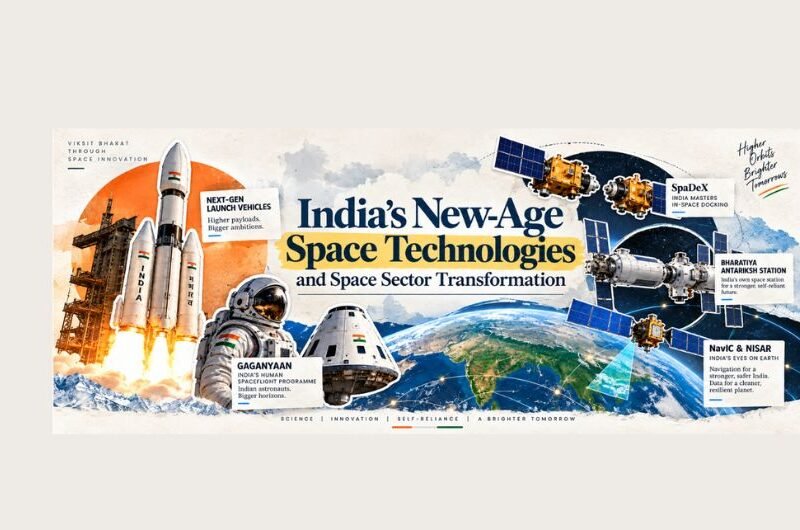
India’s New-Age Space Technologies and Space Sector Transformation
India’s New-Age Space Technologies and Space Sector Development
India’s space programme is moving beyond traditional applications such as telecommunications, weather forecasting, and satellite-based services towards advanced space exploration, reusable launch vehicles, human spaceflight, and commercial space activities. The development of new technologies by the Indian Space Research Organisation (ISRO), along with increasing private sector participation, is strengthening India’s technological capabilities, strategic independence, and position in the global space economy.
1. Major Areas of India’s New-Age Space Technologies
The Indian Space Research Organisation (ISRO) and private space companies are focusing on five major areas of technological development.
A. Next-Generation and Reusable Launch Systems
India’s NGLV is being developed as a heavy-lift launch vehicle with a maximum payload capacity of 30 tonnes to Low Earth Orbit (LEO). A partially reusable variant is being developed with a payload capacity of approximately 14 tonnes to LEO. The vehicle will use liquid methane and liquid oxygen (Methalox) propulsion to improve launch efficiency and support future space missions. Its development was approved in September 2024 with an allocation of ₹8,240 crore.
ISRO is developing reusable launch technologies to reduce the cost of accessing space. Its Pushpak winged test vehicle successfully demonstrated autonomous runway landing capabilities through the RLV Landing Experiment (LEX) programme. These technologies support the future recovery and reuse of launch vehicle components.
B. In-Space Operations and Infrastructure
On 16 January 2025, India became the fourth country after the United States, Russia, and China to demonstrate spacecraft docking in orbit. The mission involved two independent satellites, SDX-01 and SDX-02, and demonstrated technologies for rendezvous, docking, undocking, and power transfer between spacecraft. These capabilities are important for orbital assembly, satellite servicing, and future space station operations.
India is developing its own modular space station to support long-duration human spaceflight and scientific experiments in orbit. The first module is targeted for 2028, with the establishment of the complete station planned by 2035. Space docking technology will enable different modules to be connected and operated together in orbit.
C. Human Spaceflight and Advanced Exploration
The Gaganyaan mission aims to demonstrate India’s independent human spaceflight capability by sending a three-member crew to a 400 km Low Earth Orbit for approximately three days and returning them safely to Earth. The programme involves the development of human-rated launch vehicles, life-support systems, crew escape mechanisms, and astronaut training facilities.
Chandrayaan-4 aims to collect samples from the Moon and return them to Earth for detailed scientific analysis. Unlike earlier lunar missions focused on landing and surface exploration, it requires advanced technologies for lunar ascent, orbital rendezvous, spacecraft docking, and sample transfer.
D. Independent Navigation and Advanced Satellite Systems
Navigation with Indian Constellation (NavIC) is India’s independent regional satellite navigation system. Second-generation satellites, including NVS-03, are designed to improve navigation accuracy, reliability, and continuity of services. The NVS series introduces civilian L1-band signals alongside existing L5 and S-band signals. NavIC covers India and a region extending approximately 1,500 km beyond its boundaries, reducing dependence on foreign navigation systems such as GPS. The launch of NVS-03 is scheduled for 30 October 2026.
E. High-Precision Earth Observation
NISAR is a joint satellite mission developed by NASA and ISRO and launched on 30 July 2025. It is the world’s first spaceborne radar mission to use both L-band and S-band Synthetic Aperture Radar (SAR) systems. The satellite provides high-resolution, all-weather observations of Earth’s surface to monitor tectonic movements, agricultural changes, land deformation, glaciers, ice sheets, and natural disasters.
2. Institutional Framework for India’s Space Sector
India’s space sector has undergone significant institutional reforms to encourage technological innovation, commercial activities, and private investment. The Indian Space Policy 2023 provides the framework for expanding participation in space-related activities.
| Institutional Framework | Main Functions | Significance |
|---|---|---|
| Indian Space Policy 2023 | Allows private companies to undertake end-to-end space activities, including satellite manufacturing, launch services, satellite operations, and space-based data services. | Enables ISRO to concentrate more on advanced research, technology development, and exploration while expanding private sector participation. |
| IN-SPACe (Indian National Space Promotion and Authorisation Centre) | Acts as an autonomous single-window agency for promoting, authorising, and supervising space activities undertaken by private entities. | Supports space startups, facilitates access to space infrastructure, and improves the business environment for private investment. |
| NSIL (NewSpace India Limited) | Operates as the commercial arm of the Department of Space, promoting commercial launch services, satellite-based services, technology transfers, and industry participation. | Supports commercialisation of Indian space technologies and the projected expansion of India’s space economy to approximately USD 44 billion by 2033. |
3. Benefits and Challenges of New-Age Space Technologies
Strategic and Economic Benefits
Reusable launch vehicle technologies can reduce the cost of placing satellites and other payloads into orbit. The development of NGLV and reusable launch systems can strengthen India’s competitiveness in the international commercial launch market.
Indigenous navigation systems such as NavIC and advanced spacecraft docking technologies developed through SpaDeX reduce dependence on foreign technological capabilities. These systems are important for national security, independent space operations, and long-term strategic requirements.
Advanced Earth observation technologies such as NISAR support agricultural monitoring, disaster management, infrastructure planning, and environmental protection. High-resolution satellite data can improve crop assessment, monitor natural hazards, and strengthen climate-related planning.
Major Challenges
Despite significant technological achievements, India accounted for approximately 2% of the global space economy in 2023. Expanding commercial launch services, satellite manufacturing, and space-based businesses is necessary to increase its international market share.
Advanced space technologies require substantial investment in research, manufacturing, testing facilities, and infrastructure. Private Indian space companies face challenges in securing long-term funding for capital-intensive projects, although investment in the sector has increased in recent years.
The Indian Space Policy 2023 has expanded opportunities for private participation, but detailed legal and regulatory arrangements for third-party liability, space debris management, orbital safety, and commercial space operations require continued development.
4. Space Docking Technology and Its Applications
The Space Docking Experiment was developed to demonstrate autonomous rendezvous, docking, and undocking between two spacecraft in Low Earth Orbit. India successfully demonstrated docking on 16 January 2025, becoming the fourth country to achieve this capability.
Space docking technology is essential for assembling the Bharatiya Antariksh Station, conducting lunar sample return missions such as Chandrayaan-4, transferring power between spacecraft, and supporting future in-orbit servicing and assembly operations.
Must Know Terms
1. Next-Generation Launch Vehicle (NGLV)
The Next-Generation Launch Vehicle is a heavy-lift rocket being developed by the Indian Space Research Organisation (ISRO). It uses methane-liquid oxygen propulsion and incorporates reusable launch technology to reduce launch costs. It will support heavy satellite launches, human spaceflight, and future space exploration missions.
2. Space Docking Experiment (SpaDeX)
The Space Docking Experiment is an ISRO mission designed to demonstrate the rendezvous, docking, and undocking of two spacecraft in orbit. On 16 January 2025, India became the fourth country to achieve successful space docking. This technology is important for space station assembly, lunar sample return missions, and future orbital operations.
3. Bharatiya Antariksh Station (BAS)
Bharatiya Antariksh Station is India’s planned modular space station for conducting scientific experiments and supporting long-duration human spaceflight. Its first module is targeted for launch by 2028, while the complete station is planned by 2035. Space docking technology will help connect different modules in orbit.
4. Gaganyaan Programme
Gaganyaan is India’s human spaceflight programme aimed at sending a three-member crew to a Low Earth Orbit of approximately 400 km for a three-day mission. It focuses on developing human-rated launch vehicles, life-support systems, crew safety mechanisms, and safe re-entry technology.
5. Navigation with Indian Constellation (NavIC)
NavIC is India’s independent regional satellite navigation system developed by ISRO. It provides positioning, navigation, and timing services across India and approximately 1,500 km beyond its boundaries. Second-generation satellites introduce L1-band navigation signals to improve compatibility with civilian navigation devices.
6. NASA-ISRO Synthetic Aperture Radar (NISAR)
NISAR is a joint Earth observation satellite developed by the National Aeronautics and Space Administration (NASA) and ISRO. Launched on 30 July 2025, it uses L-band and S-band radar systems to monitor changes in Earth’s surface. It supports agricultural monitoring, disaster management, glacier studies, and the detection of land deformation.
Multiple-Choice Questions
1. Consider the following statements regarding India’s Next-Generation Launch Vehicle (NGLV):
Which of the statements given above are correct?
2. Match List-I with List-II regarding India’s advanced space technologies:
Select the correct answer using the code given below:
| A | B | C | D | |
| (a) | 2 | 4 | 1 | 3 |
| (b) | 4 | 2 | 1 | 3 |
| (c) | 2 | 3 | 4 | 1 |
| (d) | 3 | 4 | 1 | 2 |
3. Consider the following statements regarding India’s human spaceflight and lunar exploration programmes:
Which of the statements given above are correct?
4. Consider the following Assertion (A) and Reason (R):
Assertion (A): The technologies demonstrated through SpaDeX are important for India’s planned lunar sample return missions.
Reason (R): Space docking allows independently launched spacecraft to rendezvous and connect in orbit, enabling operations such as sample transfer.
Select the correct answer:
5. Match List-I with List-II regarding India’s institutional framework for space activities:
Select the correct answer using the code given below:
| A | B | C | D | |
| (a) | 2 | 4 | 1 | 3 |
| (b) | 4 | 2 | 3 | 1 |
| (c) | 2 | 1 | 4 | 3 |
| (d) | 3 | 4 | 1 | 2 |
6. Consider the following statements regarding Navigation with Indian Constellation (NavIC):
Which of the statements given above are correct?
7. A private Indian space company proposes to develop an indigenous launch vehicle and commercially operate its own satellite constellation. It requires authorisation for launch operations and associated space activities.
Which institution is primarily responsible for granting such authorisations under India’s space sector framework?
8. Match List-I with List-II regarding India’s space missions and their objectives:
Select the correct answer using the code given below:
| A | B | C | D | |
| (a) | 3 | 4 | 1 | 2 |
| (b) | 3 | 1 | 4 | 2 |
| (c) | 1 | 3 | 4 | 2 |
| (d) | 3 | 1 | 2 | 4 |
9. Consider the following statements regarding the NASA-ISRO Synthetic Aperture Radar (NISAR) mission:
Which of the statements given above are correct?
10. Consider the following Assertion (A) and Reason (R):
Assertion (A): Reusable launch vehicle technologies can reduce the cost of placing payloads into orbit.
Reason (R): Recovering and reusing launch vehicle components can reduce the need to manufacture entirely new components for every launch.
Select the correct answer:
11. Match List-I with List-II regarding the challenges and development priorities of India’s space sector:
Select the correct answer using the code given below:
| A | B | C | D | |
| (a) | 4 | 2 | 3 | 1 |
| (b) | 2 | 3 | 4 | 1 |
| (c) | 2 | 4 | 1 | 3 |
| (d) | 2 | 4 | 3 | 1 |
12. Consider the following statements regarding the Indian Space Policy 2023:
Which of the statements given above are correct?
13. A government agency requires satellite-based information for the following purposes:
Which of the following Indian space missions is most suitable for these applications?
14. Match List-I with List-II regarding important milestones in India’s space programme:
Select the correct answer using the code given below:
| A | B | C | D | |
| (a) | 3 | 1 | 4 | 2 |
| (b) | 1 | 3 | 2 | 4 |
| (c) | 3 | 4 | 1 | 2 |
| (d) | 4 | 1 | 3 | 2 |
15. ISRO is testing an experimental winged vehicle that can autonomously approach a runway, perform controlled descent and land without direct human piloting. The purpose is to develop technologies that can eventually reduce launch costs through vehicle recovery and reuse.
Which of the following programmes is most directly associated with this demonstration?




0 comment