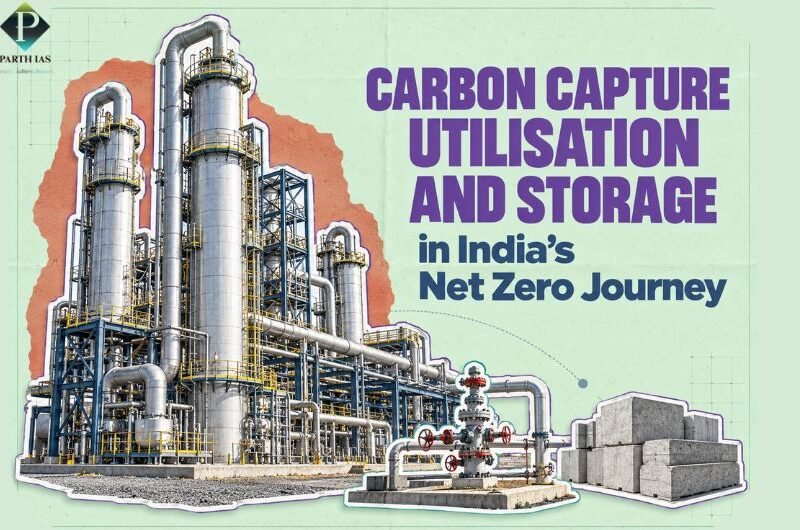
Carbon Capture Utilisation and Storage in India’s Net Zero Journey
Carbon Capture, Utilisation and Storage in India’s Net Zero Journey
Carbon Capture, Utilisation and Storage (CCUS) is an important technology for achieving India’s Panchamrit commitments and its Net Zero emissions target by 2070. It helps reduce carbon dioxide emissions from industrial activities, particularly in sectors where renewable energy and electrification alone cannot eliminate emissions. CCUS supports industrial development while reducing the environmental impact of carbon-intensive economic activities.
1. What is Carbon Capture, Utilisation and Storage (CCUS)?
Carbon Capture, Utilisation and Storage (CCUS) is a technology used to capture carbon dioxide from industrial processes, transport it, and either reuse it in useful products or store it permanently underground. The process involves three main stages:
Carbon dioxide is separated from industrial flue gases or synthesis gas through pre-combustion or post-combustion capture processes. The captured CO₂ is purified and compressed into a dense form, which may reach a supercritical state under suitable temperature and pressure conditions.
The captured CO₂ is transported through pipelines, specialised shipping vessels, or road transport vehicles to utilisation facilities or geological storage sites.
2. Role of CCUS in India’s Net Zero Journey
Heavy industries such as steel, cement, refineries, chemicals, and fertilisers cannot be fully decarbonised through electrification or renewable energy alone because of high-temperature industrial processes and chemical reactions. These sectors, along with thermal power generation, are projected to emit approximately 2,300 million tonnes of CO₂ annually by 2030.
As of August 2026, fossil-fuel-based sources accounted for approximately 45.12% of India’s total installed power capacity. Installing CCUS systems in existing thermal power plants can help reduce emissions while allowing continued use of existing energy infrastructure during the transition towards cleaner energy sources.
CCUS can support the production of Blue Hydrogen from fossil-fuel-based processes, including coal gasification, by capturing a substantial proportion of the resulting carbon emissions. Blue hydrogen can serve as a transitional option alongside the expansion of renewable-energy-based Green Hydrogen production.
CCUS can lower the carbon intensity of industrial products manufactured in India. This can help Indian exporters manage carbon-related costs under international regulations, particularly the European Union’s Carbon Border Adjustment Mechanism (CBAM).
3. Major Government Initiatives and Policy Measures
| Initiative / Policy | Main Objectives and Features |
|---|---|
| Union Budget 2026–27 CCUS Scheme | An outlay of ₹20,000 crore over five years was proposed to promote CCUS technologies across five major sectors: Power, Steel, Cement, Refineries, and Chemicals. |
| DST-CCUS R&D Roadmap | Launched by the Department of Science and Technology (DST) in December 2025 to guide research, funding, technology development, and commercial deployment of carbon capture technologies. |
| National CCUS Centres | Established at IIT Bombay and JNCASR, Bengaluru, to develop indigenous carbon capture technologies, conduct pilot-scale demonstrations, and promote cooperation between research institutions and industries. |
| India’s First Integrated CCUS Field Laboratory | Inaugurated at IIT Bombay in May 2026, with a pilot facility capable of capturing up to 3 tonnes of CO₂ per day from industrial emissions and ambient air. It uses non-potable water to produce carbonate and bicarbonate materials and includes scientific drilling to assess geological storage potential in the Deccan Traps basalt formations. |
| CCUS Hubs and Clusters Model | Promoted by NITI Aayog to connect multiple industrial emission sources with shared CO₂ transportation and storage infrastructure, reducing project costs and infrastructure-related risks. |
| International Collaboration | The Department of Science and Technology (DST) and Department of Biotechnology (DBT) participate in CCUS research under Mission Innovation, collaborating with 13 partner countries to develop technologies for carbon capture, storage, and conversion into useful products. |
4. Challenges Associated with CCUS
Installing carbon capture equipment, developing dedicated CO₂ pipelines, and constructing underground storage facilities require substantial investment. Additional expenditure on energy, maintenance, and geological exploration increases the overall cost of CCUS projects.
Carbon capture and compression processes require considerable amounts of electricity, heat, and water. These additional requirements can increase operating costs and may reduce the overall environmental benefits when the energy is obtained from fossil fuels.
Transporting and storing compressed CO₂ requires specialised infrastructure and continuous safety monitoring. Pipeline corrosion, accidental leakage, pressure-related failures, and unsuitable geological storage conditions can create operational and environmental risks.
Excessive reliance on CCUS may discourage industries from shifting towards renewable energy, energy-efficient technologies, and cleaner production methods. Carbon capture should complement other emission reduction measures rather than replace them.
5. Measures for Effective CCUS Deployment in India
Priority should be given to industries where carbon emissions are difficult to eliminate through electrification or renewable energy, particularly cement, steel, and certain chemical processes. Financial assistance should focus on projects capable of achieving substantial and measurable emission reductions.
Regulations are required for CO₂ transportation, geological storage, monitoring, verification, and long-term responsibility. Standards should cover carbon accounting, ownership of stored CO₂, environmental safeguards, storage-site monitoring, and carbon credit allocation to ensure safe and effective deployment.
Cooperation between government institutions, research organisations, and private industries can support the expansion of CCUS infrastructure. Regional industrial clusters, shared transportation pipelines, and common storage facilities can reduce costs. Potential storage locations, including North-East India’s oilfields and the Deccan basalt formations, should undergo detailed geological assessment before large-scale commercial deployment.
Must Know Terms
1. Hard-to-Abate Sectors
Hard-to-Abate Sectors are industries where carbon emissions are difficult to eliminate through electrification or renewable energy alone. These include steel, cement, refineries, chemicals and fertilisers. CCUS helps reduce emissions from their industrial processes.
2. Geological Carbon Storage
Geological Carbon Storage involves injecting captured carbon dioxide deep underground for long-term isolation from the atmosphere. Suitable formations include depleted oil and gas reservoirs, deep saline aquifers and basaltic rock formations.
3. CCUS Hubs and Clusters
CCUS Hubs and Clusters connect multiple industrial carbon dioxide emitters through shared infrastructure for transportation, utilisation and storage. This model creates economies of scale, reduces infrastructure risks and supports coordinated carbon management across industrial regions.
4. Carbon Mineralisation
Carbon Mineralisation involves converting captured carbon dioxide into stable mineral-based products, such as carbonates and materials used in concrete. It is an important carbon utilisation pathway being explored through India’s CCU testbeds and research facilities.
5. Coal Gasification
Coal Gasification converts solid coal into synthesis gas (syngas) by reacting it with limited oxygen and steam at approximately 800°C–1,600°C. It can be carried out through surface or underground methods. When combined with carbon capture, it can support blue hydrogen production.
6. Enhanced Oil Recovery (EOR)
Enhanced Oil Recovery is an industrial application in which captured carbon dioxide is used to improve oil extraction from underground reservoirs. Under the CCUS framework, it provides a productive use for captured carbon dioxide and can be combined with underground carbon storage.
Multiple-Choice Questions
1. Consider the following statements regarding Carbon Capture, Utilisation and Storage (CCUS):
Which of the statements given above are correct?
2. Match List-I with List-II regarding the stages of CCUS:
Select the correct answer using the code given below:
| A | B | C | D | |
| (a) | 4 | 3 | 2 | 1 |
| (b) | 2 | 4 | 3 | 1 |
| (c) | 4 | 2 | 3 | 1 |
| (d) | 4 | 2 | 1 | 3 |
3. Consider the following statements regarding the role of CCUS in India’s industrial sector:
How many of the statements given above are correct?
4. Consider the following pairs regarding major CCUS initiatives in India:
Which of the pairs given above are correctly matched?
5. A cement manufacturing facility intends to reduce its carbon emissions. Although it has shifted to renewable electricity, substantial emissions continue to arise from its industrial processes.
Which of the following would be the most appropriate approach?
6. Consider the following Assertion (A) and Reason (R):
Assertion (A): Carbon Capture, Utilisation and Storage should complement the transition towards renewable energy rather than replace it.
Reason (R): Excessive dependence on CCUS may discourage industries from adopting cleaner production methods and renewable energy technologies.
Select the correct answer:
7. Match List-I with List-II regarding carbon management technologies:
Select the correct answer using the code given below:
| A | B | C | D | |
| (a) | 2 | 1 | 3 | 4 |
| (b) | 2 | 3 | 1 | 4 |
| (c) | 3 | 2 | 1 | 4 |
| (d) | 2 | 3 | 4 | 1 |
8. Consider the following statements regarding India’s First Integrated CCUS Field Laboratory:
Which of the statements given above are correct?
9. Match the following challenges of CCUS with their associated consequences:
Select the correct answer using the code given below:
| A | B | C | D | |
| (a) | 4 | 3 | 1 | 2 |
| (b) | 1 | 4 | 3 | 2 |
| (c) | 4 | 1 | 3 | 2 |
| (d) | 4 | 1 | 2 | 3 |
10. Consider the following statements regarding CCUS and the Carbon Border Adjustment Mechanism (CBAM):
Which of the statements given above are correct?
11. Consider the following Assertion (A) and Reason (R):
Assertion (A): Installing CCUS systems can increase the overall energy requirements of industrial facilities.
Reason (R): Once carbon dioxide is separated from industrial gases, its purification and compression require no additional energy.
Select the correct answer:
12. Consider the following statements regarding measures for effective CCUS deployment in India:
Which of the statements given above are correct?
13. An industrial facility produces hydrogen through coal gasification and installs a carbon capture system to reduce the associated carbon dioxide emissions.
Which of the following statements correctly describes this arrangement?
14. Match List-I with List-II regarding India’s CCUS initiatives and institutions:
Select the correct answer using the code given below:
| A | B | C | D | |
| (a) | 3 | 1 | 4 | 2 |
| (b) | 1 | 3 | 2 | 4 |
| (c) | 3 | 2 | 1 | 4 |
| (d) | 3 | 1 | 2 | 4 |
15. Match the following measures for CCUS deployment with their primary objectives:
Select the correct answer using the code given below:
| A | B | C | |
| (a) | 2 | 1 | 3 |
| (b) | 2 | 3 | 1 |
| (c) | 3 | 2 | 1 |
| (d) | 1 | 3 | 2 |




0 comment