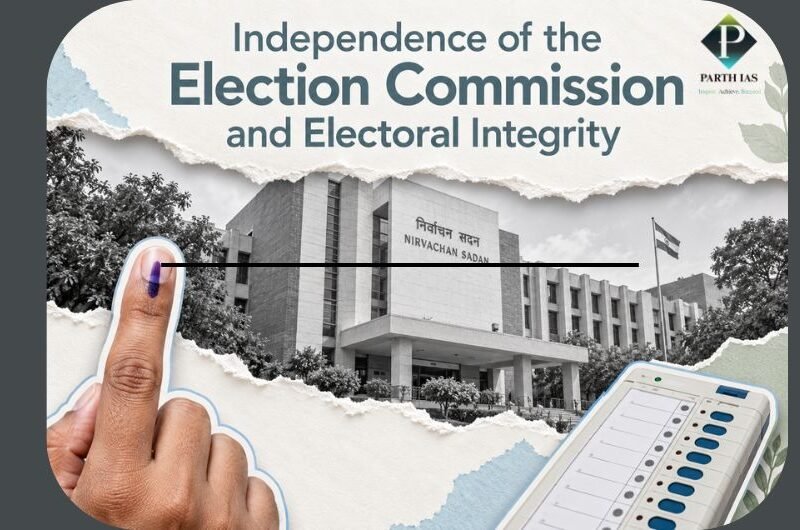
Independence of the Election Commission and Electoral Integrity
Overview of the Election Commission of India (ECI)
The Election Commission of India (ECI) is a permanent, autonomous constitutional body established under
Article 324 of the Constitution of India.
It is entrusted with the superintendence, direction, and control of elections to Parliament, State Legislatures, and the offices of the President and Vice-President of India. Free and fair elections form a part of the
Basic Structure of the Constitution
(Indira Nehru Gandhi v. Raj Narain, 1975), making the independence of the ECI fundamental to upholding the democratic fabric and ensuring electoral integrity.
Constitutional Safeguards vs. Structural Flaws
While the Constitution explicitly seeks to safeguard the autonomy of the ECI, several structural gaps persist, particularly highlighted by legislative transitions like the
Chief Election Commissioner and Other Election Commissioners (Appointment, Conditions of Service and Term of Office) Act, 2023.
| Dimension | Constitutional / Institutional Safeguards | Structural Flaws & Vulnerabilities |
|---|---|---|
| Security of Tenure | The CEC cannot be removed from office except in a manner and on grounds similar to a Supreme Court Judge, requiring a special majority in Parliament. | Absence of Parity: Election Commissioners do not enjoy the same constitutional protection; they can be removed on the recommendation of the CEC. |
| Appointment Mechanism | The President appoints the CEC and ECs. Under recent legislation, appointments are executed through a three-member Selection Committee. | Executive Dominance: The Selection Committee consists of the Prime Minister, a Union Cabinet Minister, and the Leader of the Opposition. Replacing the Chief Justice of India with a Cabinet Minister gives the executive a 2:1 structural majority, raising impartiality concerns. |
| Financial Independence | The ECI operates with functional autonomy to incur expenditures necessary for managing nationwide polling infrastructure. | Budgetary Control: The administrative expenses of the ECI are not explicitly charged upon the Consolidated Fund of India; they are voted expenditures, making the body dependent on the Ministry of Finance for annual allocations. |
| Post-Retirement Eligibility | Commissioners are expected to act impartially without seeking executive favors during their tenure. | No Cooling-Off Period: The Constitution has not debarred retiring Election Commissioners from further administrative or political appointments by the government, creating potential conflicts of interest. |
| Qualifications & Terms | The ECI has functioned as a stable multi-member body since 1993 to prevent concentration of power (T.N. Seshan v. Union of India). | Lack of Constitutionally Defined Criteria: The Constitution does not prescribe specific legal, judicial, or administrative qualifications, nor does it specify a fixed constitutional term for its members. |
Current Challenges to Electoral Integrity
Institutional scrutiny frequently emerges over the Special Intensive Revision (SIR) of electoral rolls. Allegations of large-scale, erroneous deletions of legitimate names from voter lists pose threats of mass disenfranchisement and erode public trust.
The ECI continuously manages vulnerabilities related to technological transparency—such as public scrutiny over Electronic Voting Machines (EVMs) and Voter Verifiable Paper Audit Trail (VVPAT) architectures—alongside checking illegal money power, voter impersonation, and hate speech.
Internal institutional rifts regarding procedural fairness and digital infrastructure highlight challenges in maintaining a unified, transparent command structure within the multi-member Commission.
While the ECI exercises plenary powers where the law is silent (Mohinder Singh Gill v. CEC, 1978), the Model Code of Conduct lacks statutory backing, leaving the ECI reliant on moral suasion and swift administrative enforcement.
Landmark Judicial Precedents
Declared that free and fair elections are an essential feature of the Basic Structure.
Ruled that Article 324 is a plenary provision. The ECI possesses residual powers to act in scenarios where the legislature has left a regulatory vacuum.
Clarified that the ECI’s discretionary powers cannot override existing statutory laws enacted by Parliament.
Upholding the multi-member framework, the Supreme Court ruled that the CEC is “first among equals” and does not possess superior overriding powers over the other two Election Commissioners.
Way Forward & Recommendations
To restore public confidence, the selection panel should balance executive influence, either by re-incorporating the Chief Justice of India or requiring unanimous consensus for appointments rather than a simple majority vote.
Amend Article 324(5) to extend the same removal safeguards enjoyed by the CEC to the other Election Commissioners.
Explicitly amend rules to charge the ECI’s administrative expenses directly to the Consolidated Fund of India, mirroring the financial protections given to the Union Public Service Commission and the Comptroller and Auditor General of India.
Introduce a mandatory cooling-off period post-retirement before Commissioners can accept any government-appointed political or administrative roles.
Modernise the SIR process with transparent, independent verification mechanisms to prevent arbitrary deletions from electoral rolls, ensuring that no genuine voter is disenfranchised.
Must Know Terms
1. Constitutional Autonomy
Article 324 grants the Election Commission of India the authority to supervise, direct and control elections independently.
2. Security of Tenure
The Chief Election Commissioner enjoys constitutional protection against removal, while other Election Commissioners can be removed on the recommendation of the CEC.
3. Executive Dominance
Under the 2023 Act, the three-member Selection Committee includes the Prime Minister, a Union Cabinet Minister and the Leader of the Opposition, raising concerns about executive influence.
4. Special Intensive Revision (SIR)
A process of intensive verification and revision of electoral rolls to identify eligible voters and correct inaccuracies, with concerns regarding wrongful deletions.
5. Plenary Powers
Under Article 324, the ECI can exercise residual powers in electoral matters where legislation is silent, subject to existing laws.
6. Model Code of Conduct (MCC)
A set of electoral guidelines governing political parties and candidates during elections. It lacks independent statutory backing, limiting direct legal enforcement of its provisions.
Multiple-Choice Questions
1. With reference to the Election Commission of India (ECI), consider the following statements:
Which of the statements given above are correct?
2. Consider the following statements regarding the constitutional protection available to the Chief Election Commissioner (CEC) and other Election Commissioners (ECs):
Which of the statements given above are correct?
3. With reference to the Chief Election Commissioner and Other Election Commissioners (Appointment, Conditions of Service and Term of Office) Act, 2023, consider the following statements:
Which of the statements given above are correct?
4. Consider the following pairs:
How many of the above pairs are correctly matched?
5. With reference to the financial independence of the Election Commission of India, consider the following statements:
Which of the statements given above are correct?
6. With reference to the Special Intensive Revision (SIR) of electoral rolls, consider the following statements:
Which of the statements given above are correct?
7. Consider the following statements regarding the Model Code of Conduct (MCC):
Which of the statements given above are correct?
8. Match the following judicial decisions with their principal constitutional significance:
Select the correct answer using the code given below:
| A | B | C | D | |
| (a) | 4 | 2 | 3 | 1 |
| (b) | 2 | 4 | 3 | 1 |
| (c) | 2 | 3 | 4 | 1 |
| (d) | 1 | 4 | 3 | 2 |
9. Consider the following statements regarding Article 324 and the powers of the ECI:
Which of the statements given above are correct?
10. With reference to T.N. Seshan v. Union of India (1995), consider the following statements:
Which of the statements given above are correct?
11. Consider the following statements regarding the constitutional and statutory framework governing Election Commissioners:
Which of the statements given above are correct?
12. With reference to the institutional challenges confronting the ECI, consider the following statements:
Which of the statements given above are correct?
13. Consider the following proposed reforms concerning the Election Commission of India:
Which of the above have been proposed as measures to strengthen the independence of the ECI?
14. Consider the following statements:
Statement I:
The composition of the Selection Committee under the 2023 Act has raised concerns regarding executive influence over appointments to the Election Commission.
Statement II:
The Selection Committee includes the Prime Minister and a Union Cabinet Minister, giving executive representatives two of its three positions.
Which one of the following is correct?
15. Consider the following statements regarding measures for strengthening electoral integrity:
Which of the statements given above are correct?




0 comment