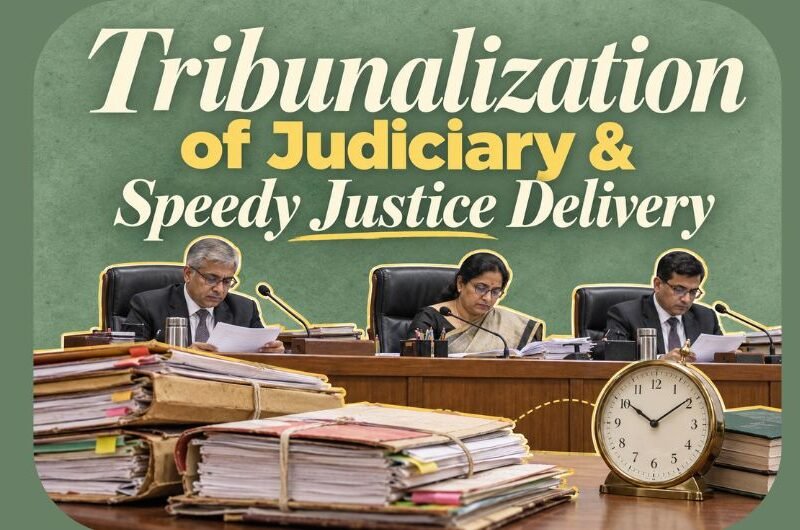
Tribunalization of Judiciary & Speedy Justice Delivery
Tribunalisation of the judiciary refers to the transfer of specialised disputes from traditional courts to
quasi-judicial bodies established under statutory frameworks.
Tribunals were introduced to ensure speedy dispute resolution, provide specialised expertise and reduce the burden on the regular judicial system.
The tribunal system has evolved through constitutional provisions, parliamentary legislation and judicial decisions. However, concerns regarding
judicial independence, executive interference, institutional vacancies and procedural efficiency
have continued to affect its functioning.
1. Constitutional Framework and Evolution
Tribunals were not expressly provided for in the original Constitution.
Part XIV-A, containing Articles
323A and 323B, was introduced through the
42nd Constitutional Amendment Act, 1976,
following the recommendations of the Swaran Singh Committee.
| Constitutional Provision | Scope and Coverage | Key Legislation and Examples |
|---|---|---|
| Article 323A | Administrative Tribunals: Empowers Parliament to establish tribunals for disputes concerning recruitment and conditions of service of public servants at the Union, State and local government levels. | The Administrative Tribunals Act, 1985 established the Central Administrative Tribunal (CAT) and provides for State Administrative Tribunals. |
| Article 323B | Tribunals for Other Matters: Enables Parliament and State Legislatures to provide for tribunals dealing with specified subjects including taxation, foreign exchange, labour disputes, land reforms, urban property ceilings and elections. | Important specialised tribunals include the National Green Tribunal (NGT) and National Company Law Tribunal (NCLT), established under their respective statutory frameworks. |
2. Role of Tribunals in Speedy Justice Delivery
Tribunals are intended to provide specialised and relatively accessible mechanisms for dispute resolution.
Unlike ordinary civil courts, many tribunals are not bound by the strict procedural requirements of the Code of Civil Procedure, 1908, or traditional rules of evidence. They generally follow the principles of natural justice, subject to their governing statutes. This flexibility can facilitate faster case disposal.
Tribunals combine judicial expertise with technical or subject-specific knowledge. Judicial and technical members can examine complex disputes involving environmental protection, corporate restructuring, taxation and administrative services.
Tribunals act as forums of first instance or specialised appellate bodies for matters assigned to them by law. By handling technical and administrative disputes, they can reduce the volume of cases requiring initial examination by High Courts and subordinate courts.
Simplified procedures, specialised benches and flexible adjudicatory mechanisms can reduce litigation expenses and improve access to dispute resolution. Regional benches may also reduce the need for litigants to approach distant courts.
3. Challenges Affecting Tribunal Functioning
Despite their intended advantages, tribunals face institutional and administrative challenges that may delay dispute resolution and affect public confidence.
Delays in appointing judicial and technical members may leave tribunal benches understaffed or temporarily non-functional. Such vacancies can increase case pendency and affect disposal of disputes in institutions such as the Income Tax Appellate Tribunal and other specialised forums.
Many tribunals have historically depended on parent ministries for administrative support, infrastructure, funding and appointments. When executive authorities whose decisions may be challenged also exercise substantial administrative control, concerns arise regarding institutional independence, impartiality and separation of powers.
In L. Chandra Kumar v. Union of India (1997), the Supreme Court held that judicial review by High Courts under Articles 226 and 227 and by the Supreme Court under Article 32 forms part of the Basic Structure of the Constitution.
Tribunal decisions therefore remain subject to constitutional judicial scrutiny.
Differences in qualifications, appointment procedures, retirement ages, service conditions and tenure across tribunals have historically created administrative inconsistencies, affecting recruitment, continuity and institutional efficiency.
4. Tribunals Reforms Act, 2026
The Tribunals Reforms Act, 2026, enacted on
13 August 2026 and brought into force on
25 August 2026, introduced a revised institutional framework for tribunal administration, appointments and service conditions.
The legislation seeks to strengthen judicial independence, standardise administrative procedures and establish a more transparent system of tribunal governance.
| Feature | Provisions under the Tribunals Reforms Act, 2026 |
|---|---|
| National Tribunals Commission (NTC) | Provides for a five-member statutory commission responsible for the selection process for tribunal appointments, performance review, oversight of inquiries into complaints against tribunal members and maintenance of the National Tribunals Data Grid. The framework covers 16 specified tribunals and related bodies. |
| Composition of NTC |
Chairperson: A former Supreme Court Judge or former Chief Justice of a High Court. Judicial Members: Two former High Court Chief Justices or Judges. Technical Members: Two persons with at least 25 years of relevant experience in public administration, finance, law, accountancy, banking, management or technology. |
| Judicial Safeguards | Requires consultation with the Chief Justice of India before appointing the NTC Chairperson and Judicial Members. Tribunal appointments are made on recommendations of Search-cum-Selection Committees. The Central Government must process the recommendations and make appointments within three months of receiving them. |
| Institutional Reorganisation | Repeals the Tribunals Reforms Act, 2021, subject to savings provisions, and introduces a common framework concerning appointments, qualifications, tenure, service conditions, removal procedures and administrative oversight. |
Its establishment is intended to reduce inconsistencies in tribunal administration and strengthen institutional safeguards.
The 2026 framework provides for a digital system to maintain tribunal-related case information, supporting monitoring, transparency and performance assessment.
Must Know Terms
1. Tribunalisation of the Judiciary
The transfer of specialised disputes from regular courts to quasi-judicial bodies established under statutory frameworks. It aims to ensure speedy justice, provide subject-specific expertise, reduce judicial pendency and improve access to dispute resolution.
2. Articles 323A and 323B
Constitutional provisions introduced by the 42nd Constitutional Amendment Act, 1976. Article 323A empowers Parliament to establish Administrative Tribunals for public service disputes, while Article 323B enables Parliament and State Legislatures to provide for tribunals concerning specified matters such as taxation, labour and land reforms.
3. Principles of Natural Justice
Fundamental principles ensuring fairness and impartiality in adjudicatory proceedings. They include the right to a fair hearing
(Audi Alteram Partem) and the rule against bias
(Nemo Judex in Causa Sua). Tribunals follow these principles while exercising procedural flexibility.
4. Judicial Review of Tribunal Decisions
The constitutional power of High Courts and the Supreme Court to examine the legality of tribunal decisions. In L. Chandra Kumar v. Union of India (1997), the Supreme Court held that judicial review under Articles 226/227 and Article 32 forms part of the Basic Structure of the Constitution.
5. National Tribunals Commission (NTC)
A five-member statutory body described under the Tribunals Reforms Act, 2026, intended to strengthen tribunal administration, oversee selection procedures, review institutional performance and promote transparency and judicial independence in tribunal functioning.
6. National Tribunals Data Grid
A digital information framework described in the 2026 tribunal reforms for maintaining tribunal-related case information. It is intended to support case monitoring, assessment of pendency, institutional transparency and evaluation of tribunal performance.
Multiple-Choice Questions
1. With reference to the constitutional framework governing tribunals in India, consider the following statements:
Which of the statements given above are correct?
2. Match List I with List II:
Select the correct answer using the code given below:
3. Consider the following Assertion (A) and Reason (R):
Assertion (A):
Decisions of Administrative Tribunals remain subject to judicial review by High Courts under Articles 226 and 227.
Reason (R):
In L. Chandra Kumar v. Union of India (1997), the Supreme Court held that constitutional judicial review forms part of the Basic Structure of the Constitution.
Select the correct answer:
4. With reference to the procedural functioning of tribunals, consider the following statements:
Which of the statements given above are correct?
5. Consider the following statements regarding the functioning of tribunals:
How many of the above statements are correct?
6. Match List I with List II:
Select the correct answer using the code given below:
7. Consider the following Assertion (A) and Reason (R):
Assertion (A):
Administrative dependence on parent ministries may create concerns regarding the independence and impartiality of tribunals.
Reason (R):
The executive authorities whose administrative decisions are subject to tribunal scrutiny may also exercise significant control over tribunal funding, infrastructure and appointments.
Select the correct answer:
8. With reference to the Tribunals Reforms Act, 2026, consider the following statements:
Which of the statements given above are correct?
9. With reference to the composition of the National Tribunals Commission under the Tribunals Reforms Act, 2026, consider the following statements:
Which of the statements given above are correct?
10. Match List I with List II:
Select the correct answer using the code given below:
11. Consider the following Assertion (A) and Reason (R):
Assertion (A):
The establishment of the National Tribunals Commission under the Tribunals Reforms Act, 2026, completely eliminates the role of the Central Government in tribunal appointments and administration.
Reason (R):
The 2026 framework retains the Central Government’s role in appointments, rule-making and financial support.
Select the correct answer:
12. With reference to Articles 323A and 323B of the Constitution, consider the following statements:
Which of the statements given above are correct?
13. Consider the following statements regarding institutional safeguards under the Tribunals Reforms Act, 2026:
How many of the above statements are correct?
14. Match List I with List II:
Select the correct answer using the code given below:
15. With reference to the objectives and institutional framework of the Tribunals Reforms Act, 2026, consider the following statements:
Which of the statements given above are correct?




0 comment