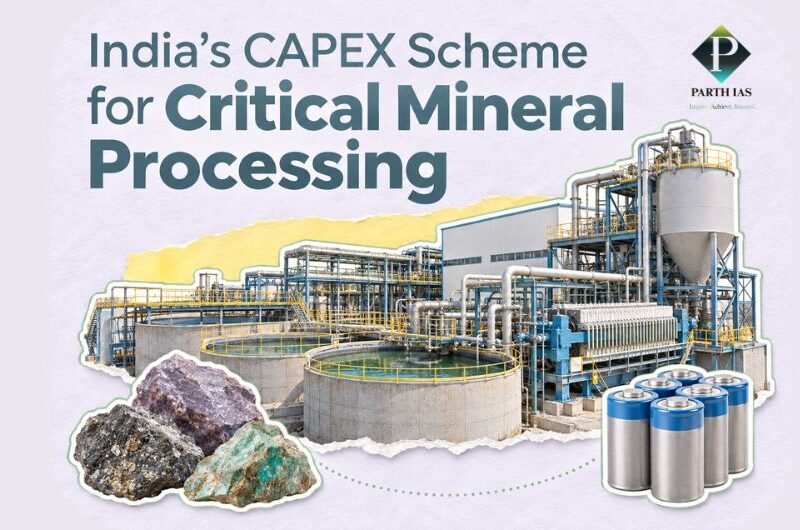
India’s CAPEX Scheme for Critical Mineral Processing
1
India has identified 24 critical minerals, including lithium, nickel, cobalt, graphite and rare earth elements. These minerals are important for electric mobility, battery storage, electronics, telecommunications, defence and clean energy technologies. India’s dependence on imported refined minerals and high-purity materials creates supply-chain risks due to geographically concentrated global processing capacity.
2
The CAPEX Support Scheme to Promote Critical Mineral Processing was approved by the Union Cabinet on 4 November 2026. It has a total financial outlay of ₹2,814 crore and will operate for five years, from FY 2026–27 to FY 2030–31. The scheme is fully funded through budgetary support from the Government of India and aims to strengthen domestic lithium and nickel processing capabilities.
3
The scheme provides a capital expenditure (CAPEX) subsidy of 30% of eligible investment for establishing four critical mineral processing plants. These comprise two lithium processing plants with a minimum capacity of 30 kilotonnes (kt) each and two nickel processing plants with a minimum capacity of 50 kt each.
4
Lithium processing plants supported under the scheme will convert ores and concentrates, excluding brines, into battery-grade lithium products. Nickel processing plants will produce Class-1 nickel or battery-grade nickel sulphate, with cobalt recovery. These facilities aim to strengthen domestic value addition by converting mineral raw materials into high-purity industrial products.
5
CAPEX support is capped at ₹500 crore per lithium beneficiary and ₹900 crore per nickel beneficiary. The maximum subsidy allocation is ₹1,000 crore for two lithium plants and ₹1,800 crore for two nickel plants, totalling ₹2,800 crore. The remaining ₹14 crore, equivalent to approximately 0.5% of the scheme’s total outlay, is allocated for administrative expenses.
6
Beneficiaries will be selected through a competitive two-stage process. Stage 1 involves technical qualification of applications, while Stage 2 involves financial bidding by technically qualified applicants. Selection follows the least-cost criterion, under which preference is given to the lowest CAPEX support sought. Two beneficiaries will be selected for each mineral, making four beneficiaries in total.
7
Financial assistance will be released in three milestone-linked tranches. The first tranche releases 25% of the quoted subsidy after 25% of committed CAPEX is spent and at least 15% of minimum required equity is contributed. The second brings cumulative subsidy disbursement to 50% after 50% CAPEX expenditure and 50% minimum equity contribution. The final tranche brings cumulative disbursement to 100% after plant commissioning and full contribution of the minimum required equity.
8
Selected beneficiaries must commission their processing plants within three years of receiving the Letter of Award (LoA). Commissioning must be completed within an absolute maximum period of five years from the LoA. Delays beyond three years will trigger a tapering mechanism that progressively reduces the remaining undisbursed CAPEX support until the fifth year.
9
The scheme follows a three-tier governance framework comprising a Governing Council (GC), Techno-Financial Committee (TFC) and Project Management Agency (PMA). The Governing Council is chaired by the Secretary, Ministry of Mines, and provides strategic guidance, reviews progress, makes final beneficiary selections and sanctions financial assistance.
10
The Techno-Financial Committee evaluates applications on technical and financial grounds and recommends suitable beneficiaries to the Governing Council. It includes experts from research and development organisations, technical institutions and public sector undertakings. The Project Management Agency provides secretarial, managerial and implementation support. The Governing Council can also approve changes to scheme guidelines, subject to approval by the Union Minister of Mines.
11
The scheme is expected to attract approximately ₹10,000 crore in processing investments and create a combined capacity of 60 kt for lithium and 100 kt for nickel. These capacities are intended to meet projected domestic demand by 2030 while strengthening India’s position in critical mineral processing and reducing dependence on imported high-purity mineral products.
12
Domestic critical mineral processing faces high capital requirements due to advanced machinery, multi-stage conversion systems and strict environmental safeguards. Other constraints include limited access to suitable processing technologies, intermediate compounds, technical expertise and raw materials. The 30% capital subsidy is intended to improve project viability and encourage private investment in domestic processing facilities.
13
The scheme aims to strengthen India’s critical mineral value chain through domestic processing of ores, concentrates and intermediates into high-purity materials. Expected benefits include reduced import dependence, lower foreign exchange outgo, improved supply-chain resilience, increased domestic value addition and employment generation. Refined products will support downstream manufacturing in battery materials, battery cells, electric mobility, electronics, defence and speciality steel.
14
The National Critical Mineral Mission (NCMM), launched in January 2025, aims to secure long-term critical mineral supplies and strengthen exploration, mining, recycling and processing capabilities. Under the Mission, the Union Cabinet approved a ₹1,500 crore critical mineral recycling scheme on 3 September 2025 to recover minerals from secondary resources, including electronic waste, spent lithium-ion batteries and other scrap materials.
15
The Central Government has auctioned 64 critical and strategic mineral blocks and 11 Exploration Licence blocks to strengthen domestic mineral resource development. The CAPEX Support Scheme complements these efforts by addressing the processing stage of the critical mineral value chain, connecting mineral exploration, extraction and recycling with domestic production of refined materials and high-purity intermediates.
Must Know Terms :
1. Capital Expenditure (CAPEX)
Capital Expenditure refers to investment in establishing or developing long-term assets such as industrial plants, machinery and processing infrastructure. Under the CAPEX Support Scheme, the Government provides a 30% capital subsidy for eligible investments in lithium and nickel processing facilities.
2. Class-1 Nickel
Class-1 Nickel is a high-purity form of refined nickel used in industrial applications, including battery manufacturing. Under the CAPEX Support Scheme, supported nickel plants will produce Class-1 nickel or battery-grade nickel sulphate, along with cobalt recovery.
3. Battery-Grade Lithium
Battery-Grade Lithium refers to high-purity lithium products suitable for battery manufacturing. Under the scheme, lithium processing plants will convert ores and concentrates, excluding brines, into battery-grade products. Each supported lithium plant must have a minimum processing capacity of 30 kilotonnes.
4. Least-Cost Selection Criterion
The Least-Cost Selection Criterion is a competitive method of selecting beneficiaries based on the lowest financial support requested. Under the scheme, applicants first undergo technical qualification, after which qualified applicants submit financial bids. Selection is based on the lowest CAPEX subsidy sought.
5. Milestone-Linked Disbursement
Milestone-Linked Disbursement is the release of financial assistance in stages after specified project targets are achieved. Under the CAPEX Support Scheme, subsidies are released in three tranches linked to capital expenditure, equity contribution and plant commissioning. Cumulative subsidy releases are 25%, 50% and 100%.
6. Techno-Financial Committee (TFC)
The Techno-Financial Committee forms the evaluation tier of the scheme’s three-tier governance framework. It assesses applications on technical and financial criteria and recommends eligible beneficiaries to the Governing Council. It includes experts from research institutions, technical organisations and public sector undertakings.
MCQ :
1. With reference to the CAPEX Support Scheme to Promote Critical Mineral Processing, consider the following statements:
1. It was approved by the Union Cabinet on 4 November 2026.
2. It will operate for seven financial years, beginning in FY 2026–27.
3. It is fully funded through budgetary support from the Government of India.
4. Its total financial outlay is ₹2,800 crore, including administrative expenses.
Which of the statements given above are correct?
(a) 1 and 2 only
(b) 1 and 3 only
(c) 2 and 4 only
(d) 1, 3 and 4 only
2. Consider the following pairs regarding processing plants proposed under the CAPEX Support Scheme:
Mineral                 Proposed Capacity

1. Lithium              Two plants of at least 30 kt each
2. Nickel               Two plants of at least 50 kt each
3. Lithium              Two plants of at least 50 kt each
4. Nickel               Four plants of at least 30 kt each
Which of the pairs given above are correctly matched?
(a) 1 only
(b) 2 only
(c) 1 and 3 only
(d) 1 and 2 only
3. With reference to mineral processing under the CAPEX Support Scheme, consider the following statements:
1. Lithium processing plants will convert ores and concentrates, excluding brines, into battery-grade lithium products.
2. Nickel processing plants may produce Class-1 nickel or battery-grade nickel sulphate, along with cobalt recovery.
3. Lithium processing plants are specifically designed to process brines exclusively.
4. Nickel processing plants will produce only unrefined nickel ore for export.
Which of the statements given above are correct?
(a) 1 and 2 only
(b) 1, 2 and 3 only
(c) 2 and 4 only
(d) 1, 3 and 4 only
4. Under the CAPEX Support Scheme, the maximum financial assistance available for two lithium plants and two nickel plants, excluding administrative expenses, is:
(a) ₹1,800 crore
(b) ₹2,814 crore
(c) ₹2,800 crore
(d) ₹3,600 crore
5. With reference to the selection of beneficiaries under the CAPEX Support Scheme, consider the following statements:
1. Only technically qualified applicants can participate in the financial bidding stage.
2. Beneficiaries are selected according to the highest amount of CAPEX support requested.
3. Two beneficiaries will be selected for each mineral.
4. Beneficiaries are selected through direct nomination without competitive bidding.
Which of the statements given above are correct?
(a) 1 and 2 only
(b) 2 and 3 only
(c) 1, 2 and 3 only
(d) 1 and 3 only
6. Consider the following pairs regarding milestone-linked subsidy disbursement:
Milestone                                    Cumulative Subsidy Released

1. 25% CAPEX spent and at least
   15% minimum equity contributed            25%

2. 50% CAPEX spent and at least
   50% minimum equity contributed            50%

3. Plant commissioned with 100%
   minimum equity contributed                75%

4. 10% CAPEX spent without any
   minimum equity contribution               25%
Which of the pairs given above are correctly matched?
(a) 1 and 2 only
(b) 1, 2 and 3 only
(c) 2 and 4 only
(d) 1, 3 and 4 only
7. With reference to the commissioning timeline under the CAPEX Support Scheme, consider the following statements:
1. Beneficiaries are required to commission their plants within three years of receiving the Letter of Award.
2. The maximum permissible commissioning period is five years from the Letter of Award.
3. The tapering mechanism is applicable only after the fifth year.
4. The Letter of Award automatically extends the commissioning deadline to seven years.
Which of the statements given above are correct?
(a) 1 and 3 only
(b) 2 and 4 only
(c) 1 and 2 only
(d) 1, 2 and 3 only
8. Consider the following pairs regarding the governance framework of the CAPEX Support Scheme:
Institution                          Function

1. Governing Council                 Final selection of beneficiaries and sanctioning of CAPEX support

2. Techno-Financial Committee        Technical and financial evaluation of applications

3. Project Management Agency         Final approval of amendments to scheme guidelines

4. Governing Council                 Approval of guideline amendments, subject to the Union Minister of Mines
Which of the pairs given above are correctly matched?
(a) 1, 2 and 3 only
(b) 1, 2 and 4 only
(c) 2, 3 and 4 only
(d) 1 and 3 only
9. With reference to the expected outcomes of the CAPEX Support Scheme, consider the following statements:
1. The scheme is expected to create 60 kt of lithium processing capacity.
2. It aims to establish 60 kt of nickel processing capacity.
3. It is expected to attract approximately ₹10,000 crore in processing investments.
4. It proposes the establishment of 50 processing plants across India.
Which of the statements given above are correct?
(a) 1 and 3 only
(b) 1, 2 and 3 only
(c) 2 and 4 only
(d) 1, 3 and 4 only
10. Arrange the following developments in chronological order:
1. Approval of the CAPEX Support Scheme to Promote Critical Mineral Processing
2. Approval of the ₹1,500 crore critical mineral recycling scheme
3. Launch of the National Critical Mineral Mission
Select the correct answer using the code given below.
(a) 1-2-3
(b) 2-3-1
(c) 3-1-2
(d) 3-2-1
11. With reference to the auction of critical and strategic mineral resources in India, consider the following statements:
1. The Central Government has auctioned 64 critical and strategic mineral blocks.
2. Eleven Exploration Licence blocks have also been auctioned.
3. A total of 64 Exploration Licence blocks have been auctioned.
4. All auctioned mineral blocks are restricted exclusively to lithium extraction.
Which of the statements given above are correct?
(a) 1 and 3 only
(b) 1 and 2 only
(c) 2 and 4 only
(d) 1, 2 and 3 only
12. Consider the following hypothetical financial bids under the CAPEX Support Scheme for a lithium processing plant:
Applicant       Technical Qualification       CAPEX Support Requested

A               Qualified                     ₹450 crore
B               Not Qualified                 ₹380 crore
C               Qualified                     ₹410 crore
D               Qualified                     ₹430 crore
Assuming all other applicable conditions are satisfied, which applicant would be selected under the least-cost criterion?
(a) Applicant A
(b) Applicant B
(c) Applicant C
(d) Applicant D
13. Consider the following statements:
Statement-I:
Developing domestic processing facilities for critical minerals can reduce India’s dependence on imported high-purity mineral products.
Statement-II:
The CAPEX Support Scheme supports the domestic conversion of ores and concentrates into refined materials while helping offset high initial investment costs.
Which one of the following is correct?
(a) Both Statement-I and Statement-II are correct, but Statement-II does not explain Statement-I.
(b) Statement-I is correct, but Statement-II is incorrect.
(c) Statement-I is incorrect, but Statement-II is correct.
(d) Both Statement-I and Statement-II are correct, and Statement-II explains Statement-I.
14. A lithium processing company proposes an eligible capital investment of ₹2,000 crore under the CAPEX Support Scheme.
Considering the 30% capital subsidy and the maximum support ceiling, what is the highest subsidy the company could receive, subject to competitive selection and other scheme conditions?
(a) ₹600 crore
(b) ₹500 crore
(c) ₹900 crore
(d) ₹300 crore
15. With reference to the National Critical Mineral Mission (NCMM), consider the following statements:
1. It was launched in January 2025 to strengthen India’s critical mineral value chain.
2. A ₹1,500 crore critical mineral recycling scheme was approved on 3 September 2025.
3. The recycling scheme covers secondary resources such as electronic waste, spent lithium-ion batteries and other scrap materials.
4. The CAPEX Support Scheme is restricted exclusively to the exploration of new mineral deposits.
Which of the statements given above are correct?
(a) 1, 2 and 3 only
(b) 1, 3 and 4 only
(c) 2 and 4 only
(d) 1, 2, 3 and 4



0 comment