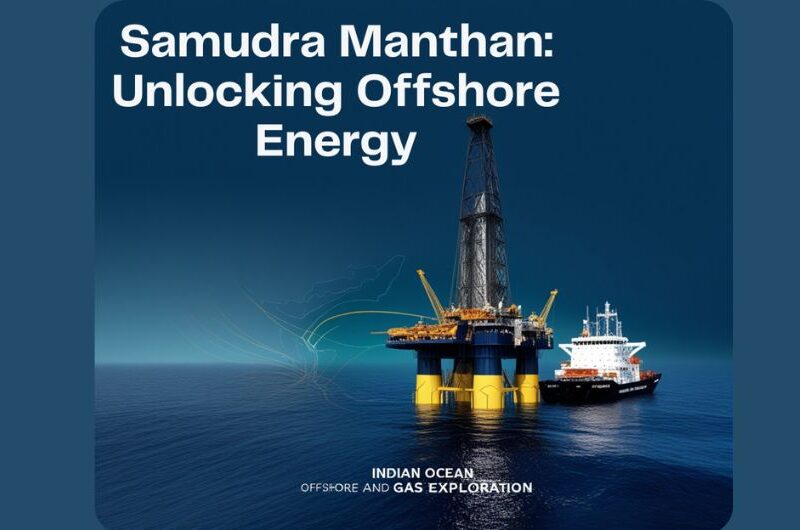
Samudra Manthan: Unlocking Offshore Energy
1. Samudra Manthan – National Offshore Exploration Scheme was approved on 31 July 2026 with a Phase-I outlay of ₹84,084 crore for the period up to FY 2030–31.
2. The scheme aims to unlock India’s offshore hydrocarbon potential by promoting exploration, modern technology, shared infrastructure, and domestic manufacturing.
3. India is the world’s third-largest consumer of crude oil, with an annual crude oil import bill of nearly USD 144 billion, or around ₹13 lakh crore.
4. India’s eastern and western offshore basins extend to water depths of up to 3,000 metres and are estimated to contain over 5,600 MMTOE of hydrocarbon resources.
5. A typical deepwater exploratory well costs about USD 125–150 million, while commercial production generally takes 5–10 years from the award of an exploration block.
6. Existing oil and gas fields experience a natural production decline of about 6–7% annually, making continuous exploration essential.
7. Samudra Manthan allocates ₹28,534 crore for large-scale 2D and 3D seismic surveys, AI-based interpretation, and reprocessing of data stored in the National Data Repository (NDR).
8. The scheme provides ₹43,200 crore to drill 60 deepwater and ultra-deepwater exploration wells, with financial support of up to 50% of drilling costs or ₹675 crore per well, whichever is lower.
9. An amount of ₹10,000 crore has been earmarked to develop common offshore production and evacuation infrastructure, particularly in the Mahanadi and Kutch basins.
10. The scheme allocates ₹2,000 crore to establish an integrated Oil and Gas Manufacturing and Services Zone to strengthen domestic manufacturing under the Make in India initiative.
11. Samudra Manthan targets the addition of over 600 MMTOE of hydrocarbon reserves, increasing India’s resource base from 1.6 billion TOE to 2.2 billion TOE.
12. The scheme aims to increase annual domestic hydrocarbon production from about 62 MMTOE to 80 MMTOE, with incremental production of 10–15 MMTOE and a peak potential of 20 MMTOE.
13. The Hydrocarbon Exploration and Licensing Policy (HELP), launched in 2016, introduced the Open Acreage Licensing Programme (OALP), replacing the earlier nomination-based licensing system.
14. Under OALP, 172 exploration blocks covering nearly 3.8 lakh sq km have been awarded, attracting committed investments exceeding USD 4.3 billion.
15. On 25 July 2026, drilling of the first appraisal well, MN-DWN18-1-HD, commenced in the Mahanadi Offshore Basin, marking the beginning of India’s major deepwater appraisal campaign.
Must Know Terms :
1. Samudra Manthan
Samudra Manthan is the National Offshore Exploration Scheme approved on 31 July 2026 to boost offshore hydrocarbon exploration and strengthen India’s energy security. Phase-I has an outlay of ₹84,084 crore up to FY 2030–31. The scheme focuses on exploration, drilling, shared infrastructure, and domestic manufacturing.
2. Hydrocarbon Exploration and Production (E&P)
Exploration and Production (E&P) refers to the process of locating, drilling, extracting, and producing crude oil and natural gas. Under Samudra Manthan, ₹43,200 crore has been allocated to drill 60 deepwater and ultra-deepwater exploration wells to increase India’s domestic hydrocarbon reserves.
3. Hydrocarbon Exploration and Licensing Policy (HELP)
Launched in 2016, HELP replaced the earlier licensing regime with a transparent and investor-friendly framework. It introduced revenue-sharing contracts, uniform licensing, lower levies, and the Open Acreage Licensing Programme (OALP) to encourage exploration.
4. Open Acreage Licensing Programme (OALP)
OALP allows companies to choose exploration blocks of their interest instead of waiting for government bidding rounds. So far, 172 exploration blocks covering nearly 3.8 lakh sq km have been awarded, with committed investments exceeding USD 4.3 billion.
5. National Data Repository (NDR)
The National Data Repository is India’s central digital database of geological and geophysical data related to hydrocarbon exploration. Under Samudra Manthan, older seismic data will be reprocessed using Artificial Intelligence (AI) and advanced technologies to improve exploration success.
6. Million Metric Tonnes of Oil Equivalent (MMTOE)
MMTOE is a standard unit used to measure the combined energy content of crude oil, natural gas, and other hydrocarbons. Samudra Manthan aims to add over 600 MMTOE of hydrocarbon reserves and increase India’s annual production from about 62 MMTOE to 80 MMTOE.
MCQ :
1. With reference to Samudra Manthan – National Offshore Exploration Scheme, consider the following statements:
1. It was approved on 31 July 2026.
2. Phase-I has an outlay of ₹84,084 crore up to FY 2030–31.
3. It is implemented exclusively for onshore hydrocarbon exploration.
Which of the statements given above is/are correct?
A. 1 and 2 only
B. 2 and 3 only
C. 1 only
D. 1, 2 and 3
2. Which one of the following is the primary objective of the Samudra Manthan Scheme?
A. Expanding renewable energy generation
B. Unlocking India’s offshore hydrocarbon potential
C. Promoting nuclear energy production
D. Developing inland waterways
3. India’s eastern and western offshore basins are estimated to contain more than:
A. 2,200 MMTOE of hydrocarbons
B. 3,800 MMTOE of hydrocarbons
C. 5,600 MMTOE of hydrocarbons
D. 8,400 MMTOE of hydrocarbons
4. Consider the following statements regarding offshore hydrocarbon exploration:
1. A typical deepwater exploratory well costs around USD 125–150 million.
2. Commercial production usually begins within one year of block allocation.
3. Existing oil and gas fields naturally decline by about 6–7% annually.
Which of the statements given above is/are correct?
A. 1 only
B. 1 and 3 only
C. 2 and 3 only
D. 1, 2 and 3
5. Under Samudra Manthan, ₹28,534 crore has been allocated primarily for:
A. Construction of refineries
B. Seismic surveys and National Data Repository data reprocessing
C. LNG import terminals
D. Offshore wind energy projects
6. With reference to accelerated offshore exploration under Samudra Manthan, consider the following statements:
1. ₹43,200 crore has been allocated for drilling.
2. Sixty deepwater and ultra-deepwater wells are proposed.
3. Financial support is available up to 50% of drilling cost or ₹675 crore per well.
Which of the statements given above is/are correct?
A. 1 and 2 only
B. 2 and 3 only
C. 1, 2 and 3
D. 1 only
7. Which one of the following basins has been specifically identified for common offshore production and evacuation infrastructure under Samudra Manthan?
A. Krishna Basin only
B. Cambay Basin only
C. Assam Shelf only
D. Mahanadi and Kutch Basins
8. The Oil and Gas Manufacturing and Services Zone under Samudra Manthan has been established mainly to:
A. Increase crude oil imports
B. Promote offshore tourism
C. Strengthen domestic manufacturing under Make in India
D. Expand strategic petroleum reserves
9. Samudra Manthan aims to increase India’s annual domestic hydrocarbon production from approximately:
A. 50 MMTOE to 65 MMTOE
B. 55 MMTOE to 70 MMTOE
C. 62 MMTOE to 80 MMTOE
D. 70 MMTOE to 90 MMTOE
10. The Hydrocarbon Exploration and Licensing Policy (HELP), launched in 2016, introduced:
A. Production Sharing Contracts only
B. Nomination-based licensing
C. Open Acreage Licensing Programme (OALP)
D. National Exploration Licensing Policy
11. Consider the following statements regarding the Open Acreage Licensing Programme (OALP):
1. Companies can identify exploration blocks of their choice.
2. It replaced the earlier nomination-based licensing approach.
3. Nearly 172 exploration blocks covering about 3.8 lakh sq km have been awarded.
Which of the statements given above is/are correct?
A. 1 and 2 only
B. 2 and 3 only
C. 1 and 3 only
D. 1, 2 and 3
12. The National Data Repository (NDR) is best described as:
A. India’s strategic crude oil storage facility
B. A repository of offshore port infrastructure
C. A digital database of geological and geophysical exploration data
D. A platform for petroleum product pricing
13. The Samudra Manthan Scheme aims to expand India’s hydrocarbon resource base from:
A. 1.2 billion TOE to 1.8 billion TOE
B. 1.4 billion TOE to 2.0 billion TOE
C. 1.6 billion TOE to 2.2 billion TOE
D. 2.0 billion TOE to 2.8 billion TOE
14. The first appraisal well (MN-DWN18-1-HD), whose drilling commenced on 25 July 2026, is located in the:
A. Krishna-Godavari Offshore Basin
B. Andaman Offshore Basin
C. Mumbai Offshore Basin
D. Mahanadi Offshore Basin
15. Million Metric Tonnes of Oil Equivalent (MMTOE) is used to measure:
A. Offshore drilling depth
B. Refinery processing capacity
C. Combined energy content of hydrocarbons
D. Crude oil import expenditure




0 comment