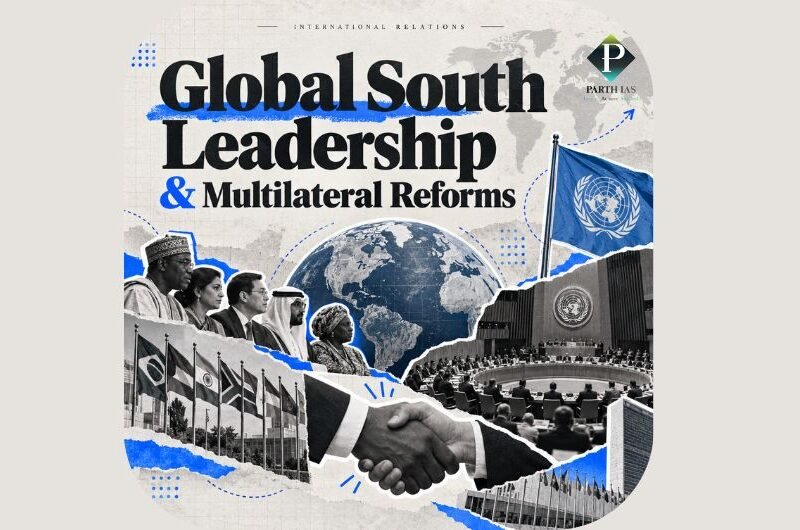
Global South Leadership & Multilateral Reforms
1. India supports the agenda of “Reformed Multilateralism” to make global institutions more representative of present geopolitical and economic realities.
2. India supports reform and expansion of the United Nations Security Council (UNSC).
3. India is a member of the G4 grouping along with Brazil, Germany and Japan.
4. The G4 supports permanent membership of its members in an expanded UNSC.
5. India also works with the L.69 Group, which represents developing countries seeking reform of the UN Security Council.
6. India supports reform of quota and voting arrangements in institutions such as the International Monetary Fund (IMF) and the World Bank.
7. India supports greater representation of emerging and developing economies in global financial institutions.
8. India supports restoration and reform of the World Trade Organization (WTO) dispute-settlement system, including the Appellate Body.
9. India supports continuation of Special and Differential Treatment (S&DT) provisions for developing countries in the WTO framework.
10. India has hosted the Voice of Global South Summit to bring together the concerns and priorities of developing countries.
11. The African Union became a permanent member of the G20 during India’s G20 Presidency in 2023.
12. India promotes Digital Public Infrastructure (DPI), including platforms and systems such as UPI, Aadhaar and DigiLocker.
13. India is a founding member of the International Solar Alliance (ISA), which promotes solar-energy cooperation among member countries.
14. The India-UN Development Partnership Fund supports development projects in developing countries, particularly in the Global South.
15. India follows issue-based and multi-aligned diplomacy through platforms such as the G20, BRICS, Quad and other multilateral or minilateral groupings.
Must Know Terms :
1.Reformed Multilateralism
Reformed Multilateralism means restructuring global institutions so that they better reflect present-day geopolitical and economic realities, especially the growing role of developing countries.
2. Global South
The Global South broadly refers to developing and emerging countries in Asia, Africa, Latin America and other regions that share common concerns related to development, representation and global inequality.
3. G4
The G4 consists of India, Brazil, Germany and Japan. The group supports expansion of the United Nations Security Council and permanent membership for its members.
4. L.69 Group
The L.69 Group is a coalition of developing countries that supports comprehensive reform of the United Nations Security Council, including greater representation for developing nations.
5. Special and Differential Treatment
Special and Differential Treatment (S&DT) refers to provisions in the World Trade Organization framework that provide developing countries greater flexibility, longer implementation periods and certain special rights.
6. Digital Public Infrastructure
Digital Public Infrastructure (DPI) refers to large-scale digital systems that support public services and economic activity. India promotes models such as UPI, Aadhaar and DigiLocker as examples of scalable digital governance.
MCQ :
1. With reference to India’s approach to “Reformed Multilateralism”, consider the following statements:
1) It seeks to make global institutions more representative of present geopolitical and economic realities.
2) India supports reform and expansion of the United Nations Security Council.
3) It seeks to preserve the existing representation structure of global institutions without major changes.
Which of the statements given above are correct?
(a) 1 and 2 only
(b) 2 and 3 only
(c) 1 and 3 only
(d) 1, 2 and 3
2. Consider the following countries:
1) India
2) Brazil
3) Germany
4) Japan
How many of the above are members of the G4 grouping?
(a) Only one
(b) All four
(c) Only three
(d) Only two
3. With reference to the G4, consider the following statements:
1) It supports expansion of the United Nations Security Council.
2) Its members support permanent membership for themselves in an expanded UNSC.
3) It consists exclusively of developing countries.
Which of the statements given above are correct?
(a) 1 and 3 only
(b) 2 and 3 only
(c) 1 and 2 only
(d) 1, 2 and 3
4. The L.69 Group is best described as:
(a) A grouping of advanced economies coordinating IMF quota reforms
(b) A coalition dealing exclusively with WTO dispute settlement
(c) A financial grouping established under the G20
(d) A coalition of developing countries supporting comprehensive reform of the UN Security Council
5. With reference to India’s position on global financial governance, consider the following statements:
1) India supports reform of quota arrangements in institutions such as the IMF.
2) India supports reform of voting arrangements in global financial institutions.
3) India seeks greater representation of emerging and developing economies in such institutions.
Which of the statements given above are correct?
(a) 1, 2 and 3
(b) 1 and 2 only
(c) 2 and 3 only
(d) 1 and 3 only
6. Consider the following statements regarding India and the World Trade Organization (WTO):
1) India supports restoration and reform of the WTO dispute-settlement system.
2) India supports continuation of Special and Differential Treatment provisions for developing countries.
3) India favours complete removal of special flexibilities available to developing economies.
Which of the statements given above are correct?
(a) 1 and 3 only
(b) 1 and 2 only
(c) 2 and 3 only
(d) 1, 2 and 3
7. Special and Differential Treatment (S&DT) under the WTO framework is associated with:
(a) Permanent veto rights for developing countries
(b) Mandatory uniform trade obligations for all WTO members
(c) Greater flexibility, longer implementation periods and certain special rights for developing countries
(d) Exemption of developing countries from all WTO rules
8. With reference to the Voice of Global South Summit, consider the following statements:
1) India has hosted the summit.
2) It provides a platform for concerns and priorities of developing countries.
3) It is a formal organ of the United Nations.
4) It is associated with India’s engagement with the Global South.
Which of the statements given above are correct?
(a) 1 and 3 only
(b) 2 and 4 only
(c) 1, 2 and 3 only
(d) 1, 2 and 4 only
9. Which one of the following developments occurred during India’s G20 Presidency in 2023?
(a) The African Union became a permanent member of the G20.
(b) The G4 was converted into a formal UN institution.
(c) The WTO Appellate Body was permanently abolished.
(d) BRICS was incorporated into the United Nations.
10. Consider the following pairs:
1) UPI — Digital Public Infrastructure
2) Aadhaar — Digital Public Infrastructure
3) DigiLocker — Digital Public Infrastructure
4) International Solar Alliance — Digital identity platform
How many of the pairs given above are correctly matched?
(a) Only one
(b) Only three
(c) Only two
(d) All four
11. With reference to the International Solar Alliance (ISA), consider the following statements:
1) India is a founding member of the initiative.
2) It promotes cooperation in the field of solar energy.
3) It is primarily a military-security grouping of developing countries.
Which of the statements given above are correct?
(a) 2 and 3 only
(b) 1 and 3 only
(c) 1 and 2 only
(d) 1, 2 and 3
12. The India-UN Development Partnership Fund is primarily associated with:
(a) Financing the expansion of the UN Security Council
(b) Providing defence assistance to G4 members
(c) Financing the WTO dispute-settlement mechanism
(d) Supporting development projects in developing countries, particularly in the Global South
13. Consider the following pairs:
1) G4 — UNSC reform
2) L.69 Group — Greater representation of developing countries in the UNSC
3) S&DT — Special provisions for developing countries under the WTO
4) DPI — Large-scale digital systems supporting public services and economic activity
Which of the pairs given above are correctly matched?
(a) 1, 2, 3 and 4
(b) 1 and 2 only
(c) 2, 3 and 4 only
(d) 1, 3 and 4 only
14. Consider the following statements:
Statement-I:
India engages simultaneously with platforms such as the G20, BRICS and Quad.
Statement-II:
India follows an issue-based and multi-aligned approach in its diplomacy.
Which one of the following is correct in respect of the above statements?
(a) Both Statement-I and Statement-II are correct, but Statement-II does not explain Statement-I.
(b) Both Statement-I and Statement-II are correct, and Statement-II explains Statement-I.
(c) Statement-I is correct, but Statement-II is incorrect.
(d) Statement-I is incorrect, but Statement-II is correct.
15. With reference to India and the Global South, consider the following statements:
1) India supports greater representation of developing countries in major global institutions.
2) India promotes Digital Public Infrastructure as a model of scalable digital governance.
3) India supports solar-energy cooperation through the International Solar Alliance.
4) India’s approach is limited exclusively to reform of the United Nations Security Council.
Which of the statements given above are correct?
(a) 1 and 4 only
(b) 2 and 3 only
(c) 1, 2 and 3 only
(d) 1, 2, 3 and 4

0 comment