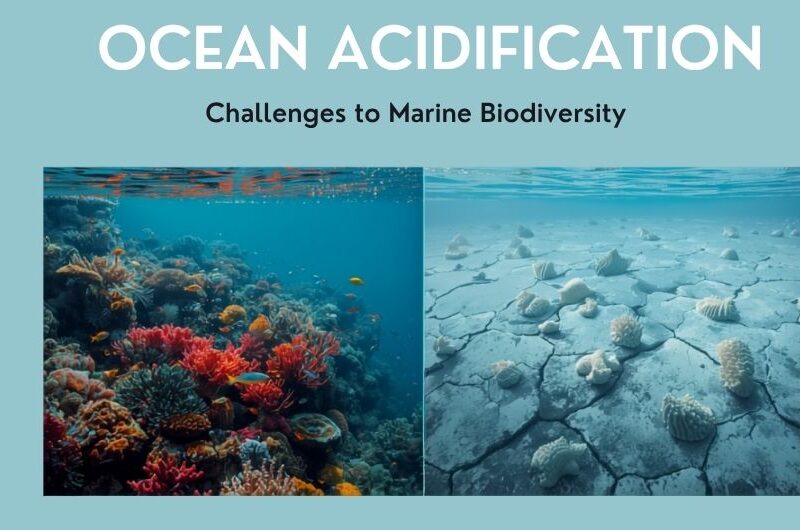
Ocean Acidification: Challenges to Marine Biodiversity
1. Ocean acidification is the long-term decrease in the pH of seawater caused primarily by the absorption of anthropogenic carbon dioxide (CO₂) from the atmosphere.
2. The world’s oceans absorb nearly 30% of human-generated carbon dioxide emissions, making them one of the Earth’s largest carbon sinks.
3. When carbon dioxide dissolves in seawater, it reacts with water to form carbonic acid (H₂CO₃), initiating the process of ocean acidification.
4. Carbonic acid dissociates into hydrogen ions (H⁺) and bicarbonate ions (HCO₃⁻), increasing the concentration of hydrogen ions in seawater.
5. Although ocean pH has declined from about 8.15 to 8.05, seawater remains slightly alkaline despite becoming more acidic.
6. Excess hydrogen ions combine with carbonate ions (CO₃²⁻), reducing the availability of carbonate needed by marine organisms to build calcium carbonate shells and skeletons.
7. Calcifying organisms such as corals, oysters, clams, sea urchins, and pteropods are among the most vulnerable to ocean acidification.
8. Ocean acidification reduces the growth and survival of calcareous phytoplankton, weakening marine food webs and affecting fish, seabirds, and marine mammals.
9. Elevated carbon dioxide levels can alter the behaviour and nervous systems of fish, reducing their ability to detect predators and suitable habitats.
10. Non-calcifying marine plants such as seagrasses and certain algae may benefit from higher carbon dioxide concentrations through enhanced photosynthesis.
11. Ocean acidification is one of the nine Planetary Boundaries identified for maintaining Earth’s environmental stability and has now exceeded its safe operating limit.
12. The saturation horizon is the ocean depth below which calcium carbonate dissolves, and ocean acidification is causing this boundary to move closer to the surface.
13. Aragonite, the calcium carbonate form used by corals and pteropods, is more soluble and vulnerable to acidification than calcite.
14. Reduced production of Dimethyl Sulfide (DMS) by marine phytoplankton due to ocean acidification may weaken natural cloud formation and influence regional climate.
15. Global initiatives addressing ocean acidification include the Paris Agreement, SDG Target 14.3 (Life Below Water), and the Global Ocean Acidification Observing Network (GOA-ON), which monitors changes in ocean chemistry worldwide.
Must Know Terms :
1.Ocean Acidification: Ocean acidification is the long-term decline in the pH of seawater caused by the absorption of atmospheric carbon dioxide (CO₂). As CO₂ dissolves in seawater, it forms carbonic acid, increasing hydrogen ion concentration and reducing carbonate ions essential for marine organisms.
2. Carbonate Ions (CO₃²⁻): Carbonate ions are essential for marine organisms such as corals, oysters, clams, and pteropods to build calcium carbonate (CaCO₃) shells and skeletons. Ocean acidification reduces carbonate ion availability, making shell formation increasingly difficult.
3. Planetary Boundaries: Planetary Boundaries is a scientific framework defining the safe operating limits for Earth’s critical environmental systems. Ocean acidification is one of the nine planetary boundaries and has now crossed its safe threshold due to rising atmospheric CO₂ levels.
4. Aragonite Saturation Horizon: The aragonite saturation horizon is the ocean depth below which aragonite, a highly soluble form of calcium carbonate, begins to dissolve. Ocean acidification causes this horizon to move upward, exposing shallow marine ecosystems to corrosive conditions.
5. Global Ocean Acidification Observing Network (GOA-ON): GOA-ON is an international scientific network established to monitor ocean acidification, collect standardized ocean chemistry data, and improve understanding of its impacts on marine ecosystems through global collaboration.
6. Sustainable Development Goal (SDG) 14.3: SDG Target 14.3 under “Life Below Water” calls for minimizing and addressing the impacts of ocean acidification through enhanced scientific cooperation, monitoring, research, and capacity building to protect marine ecosystems.
MCQ :
1. With reference to Ocean Acidification, consider the following statements:
1. It is primarily caused by the absorption of atmospheric carbon dioxide by oceans.
2. It results in a long-term decrease in the pH of seawater.
3. It is mainly caused by depletion of dissolved oxygen in seawater.
Which of the statements given above is/are correct?
(a) 1 and 2 only
(b) 2 and 3 only
(c) 1 only
(d) 1, 2 and 3
2. Which one of the following best explains the formation of carbonic acid in oceans?
(a) Carbon dioxide reacts with dissolved oxygen.
(b) Carbon dioxide reacts with seawater to form carbonic acid.
(c) Carbonate ions react with chloride ions.
(d) Calcium carbonate reacts with seawater.
3. Ocean acidification reduces the availability of which of the following ions essential for shell-building marine organisms?
(a) Chloride ions
(b) Sodium ions
(c) Carbonate ions
(d) Sulphate ions
4. Which of the following marine organisms are most vulnerable to ocean acidification?
1. Corals
2. Oysters
3. Pteropods
4. Sea Urchins
Select the correct answer using the code below.
(a) 1 and 2 only
(b) 2 and 3 only
(c) 1, 3 and 4 only
(d) 1, 2, 3 and 4
5. Which of the following statements regarding ocean pH is correct?
(a) Ocean water has become acidic with a pH below 7.
(b) Ocean pH has increased from 8.05 to 8.15.
(c) Ocean pH has declined from about 8.15 to 8.05 but remains slightly alkaline.
(d) Ocean acidification has no effect on seawater pH.
6. Assertion (A): Ocean acidification threatens marine food webs.
Reason (R): It reduces the growth and survival of calcareous phytoplankton that form the base of many marine ecosystems.
(a) Both A and R are true, and R is the correct explanation of A.
(b) Both A and R are true, but R is not the correct explanation of A.
(c) A is true, but R is false.
(d) A is false, but R is true.
7. Which one of the following marine plants is likely to benefit from increased carbon dioxide concentrations?
(a) Coral polyps
(b) Seagrasses
(c) Oysters
(d) Pteropods
8. Ocean acidification is recognised as one of the:
(a) Sustainable Development Goals
(b) Aichi Biodiversity Targets
(c) Planetary Boundaries
(d) Ramsar Principles
9. The “Saturation Horizon” in the context of ocean acidification refers to:
(a) The upper limit of coral reef growth
(b) The depth below which calcium carbonate begins to dissolve
(c) The maximum sunlight penetration in oceans
(d) The boundary between freshwater and seawater
10. Which of the following statements regarding Aragonite is correct?
(a) It is less soluble than Calcite.
(b) It is the primary mineral used by corals and is more vulnerable to ocean acidification.
(c) It is produced only by marine algae.
(d) It is unaffected by changes in seawater chemistry.
11. Reduced production of Dimethyl Sulfide (DMS) by marine phytoplankton may affect:
(a) Ocean salinity
(b) Cloud formation and regional climate
(c) Tidal movements
(d) Marine oil deposits
12. Which of the following international initiatives directly address ocean acidification?
1. Paris Agreement
2. SDG Target 14.3
3. Global Ocean Acidification Observing Network (GOA-ON)
Select the correct answer using the code below.
(a) 1 and 2 only
(b) 2 and 3 only
(c) 1 and 3 only
(d) 1, 2 and 3
13. The Global Ocean Acidification Observing Network (GOA-ON) primarily aims to:
(a) Promote marine tourism
(b) Monitor changes in ocean chemistry and acidification
(c) Regulate international fisheries
(d) Prevent marine oil spills
14. Which of the following statements regarding Carbonate Ions (CO₃²⁻) are correct?
1. They are essential for the formation of calcium carbonate shells.
2. Their concentration decreases during ocean acidification.
3. They combine with excess hydrogen ions to form bicarbonate.
Select the correct answer using the code below.
(a) 1 and 2 only
(b) 2 and 3 only
(c) 1 and 3 only
(d) 1, 2 and 3
15. Which of the following chemical processes is directly responsible for ocean acidification?
(a) Increase in dissolved oxygen concentration
(b) Formation of carbonic acid and release of hydrogen ions
(c) Increase in sodium chloride concentration
(d) Breakdown of calcium carbonate into oxygen




0 comment