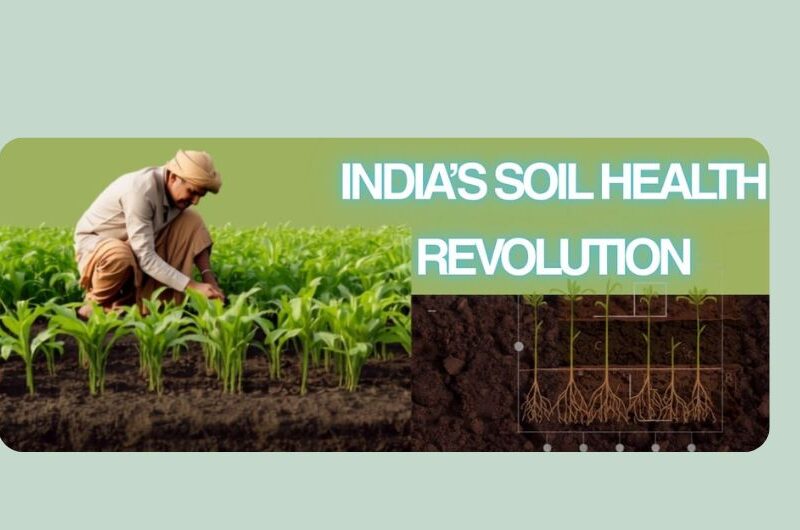
India’s Soil Health Revolution
1. Soil is a strategic national resource that supports agricultural productivity, food security, ecosystem health, and the livelihoods of more than 46% of India’s workforce engaged in agriculture and allied activities.
2. According to Land Use Statistics 2022–23, India’s total reported geographical area is 306.65 million hectares, of which nearly 59% is under agriculture.
3. Healthy soils contribute to the achievement of Sustainable Development Goals (SDGs), particularly SDG 2 (Zero Hunger) and SDG 13 (Climate Action).
4. The Soil Health Card Scheme provides scientific soil testing and crop-specific nutrient recommendations, and more than 25.89 crore Soil Health Cards had been generated as of 13 March 2026.
5. The National Mission for Sustainable Agriculture (NMSA), launched in 2014–15 under the National Action Plan on Climate Change (NAPCC), promotes climate-resilient farming, efficient water use, and improved soil health.
6. The National Mission on Natural Farming (NMNF), launched in 2024, has expanded to 18,786 clusters covering 8.80 lakh hectares, with over 18.19 lakh farmers enrolled by March 2026.
7. The National Mission for a Green India (GIM), one of the eight missions under NAPCC, aims to create an additional carbon sink of 2.5–3.0 billion tonnes of CO₂ equivalent by 2030.
8. According to the India State of Forest Report (ISFR) 2023, India created an additional carbon sink of 2.29 billion tonnes of CO₂ equivalent between 2005 and 2021.
9. The Carbon Credit Trading Scheme, adopted in 2023, enables farmers and organisations to earn tradable carbon credits through verified greenhouse gas mitigation activities.
10. Each carbon credit under the Carbon Credit Trading Scheme represents one metric tonne of carbon dioxide equivalent (CO₂e) reduced, avoided, or removed from the atmosphere.
11. India’s National Adaptation Fund for Climate Change (NAFCC), established in 2015 and implemented through NABARD, finances state-level climate adaptation projects.
12. Under the Nutrient Based Subsidy (NBS) Scheme, the Government provides subsidies on 28 grades of Phosphatic and Potassic (P&K) fertilisers, including Diammonium Phosphate (DAP), to promote balanced nutrient application.
13. The Government of India has mandated 100% neem coating of all domestically produced urea to improve nitrogen-use efficiency and prevent diversion for non-agricultural purposes.
14. The Nationwide Soil Resource Mapping Project, implemented by the Soil and Land Use Survey of India (SLUSI), had mapped nearly 29 million hectares by September 2024, with a target of mapping 142 million hectares of agricultural land.
15. Under the Digital Agriculture Mission, platforms such as AgriStack and the Krishi Decision Support System (KDSS) integrate soil, land, weather, and crop data to provide AI-enabled, location-specific advisories for precision farming and sustainable soil management.
Must Know Terms :
1.Soil Health Card Scheme: Launched in 2015, the Soil Health Card Scheme provides farmers with information on soil nutrient status and crop-specific recommendations for balanced fertiliser use. More than 25.89 crore Soil Health Cards had been generated by 13 March 2026.
2. National Mission for Sustainable Agriculture (NMSA): NMSA was launched in 2014–15 under the National Action Plan on Climate Change. It promotes soil health improvement, efficient water use, integrated farming systems and climate-resilient agricultural practices.
3. National Mission on Natural Farming (NMNF): Launched in 2024, NMNF promotes chemical-free and nature-based farming practices. By March 2026, it covered 18,786 clusters, 8.80 lakh hectares and more than 18.19 lakh farmers.
4. Nutrient Based Subsidy (NBS): The NBS Scheme provides fertiliser subsidies according to nutrient content rather than product price. It covers 28 grades of phosphatic and potassic fertilisers, including Diammonium Phosphate, to encourage balanced nutrient application.
5. Soil Organic Carbon: Soil organic carbon is carbon stored in soil through plant roots, crop residues and microorganisms. Higher levels improve soil fertility, water retention, structure and resilience while also supporting climate change mitigation.
6. Digital Soil Mapping: Digital soil mapping combines satellite imagery, geospatial technology and field observations to prepare detailed soil inventories. The SLUSI project had mapped around 29 million hectares by September 2024 against a target of 142 million hectares.
MCQ :
1. With reference to soil in India, consider the following statements:
1. Soil supports agricultural productivity and food security.
2. More than 46% of India’s workforce is engaged in agriculture and allied activities.
3. Soil health has no impact on rural livelihoods.
Which of the statements given above are correct?
A. 1 and 2 only
B. 2 and 3 only
C. 1 only
D. 1, 2 and 3
2. According to Land Use Statistics 2022–23, nearly what percentage of India’s reported geographical area is under agriculture?
A. 45%
B. 52%
C. 59%
D. 68%
3. Healthy soils directly contribute to achieving which of the following Sustainable Development Goals (SDGs)?
1. SDG 2 – Zero Hunger
2. SDG 13 – Climate Action
3. SDG 14 – Life Below Water
Select the correct answer using the code below.
A. 1 only
B. 1 and 2 only
C. 2 and 3 only
D. 1, 2 and 3
4. With reference to the Soil Health Card Scheme, consider the following statements:
1. It was launched in 2015.
2. It provides crop-specific nutrient recommendations.
3. More than 25.89 crore Soil Health Cards had been generated by March 2026.
Which of the statements given above are correct?
A. 1 and 2 only
B. 2 and 3 only
C. 1 and 3 only
D. 1, 2 and 3
5. The National Mission for Sustainable Agriculture (NMSA) is implemented under:
A. National Biodiversity Action Plan
B. National Action Plan on Climate Change
C. National Water Mission
D. National Agroforestry Policy
6. Assertion (A): The National Mission on Natural Farming promotes sustainable and climate-resilient agriculture.
Reason (R): The mission encourages nature-based farming while reducing dependence on chemical inputs.
A. Both A and R are true, and R is the correct explanation of A.
B. Both A and R are true, but R is not the correct explanation of A.
C. A is true, but R is false.
D. A is false, but R is true.
7. The National Mission for a Green India (GIM) aims to:
A. Increase fertilizer production
B. Create an additional carbon sink of 2.5–3.0 billion tonnes of CO₂ equivalent by 2030
C. Replace all chemical fertilizers with biofertilizers
D. Eliminate greenhouse gas emissions by 2030
8. According to the India State of Forest Report (ISFR) 2023, India created an additional carbon sink of approximately:
A. 1.25 billion tonnes CO₂ equivalent
B. 2.29 billion tonnes CO₂ equivalent
C. 3.50 billion tonnes CO₂ equivalent
D. 4.00 billion tonnes CO₂ equivalent
9. With reference to the Carbon Credit Trading Scheme, consider the following statements:
1. It was adopted in 2023.
2. It allows verified emission reduction activities to earn tradable carbon credits.
3. One carbon credit equals one metric tonne of CO₂ equivalent.
Which of the statements given above are correct?
A. 1 and 2 only
B. 2 and 3 only
C. 1 and 3 only
D. 1, 2 and 3
10. India’s National Adaptation Fund for Climate Change (NAFCC) is implemented through:
A. ICAR
B. NABARD
C. FCI
D. NITI Aayog
11. The Nutrient Based Subsidy (NBS) Scheme provides subsidies on:
A. Nitrogenous fertilizers only
B. Organic fertilizers only
C. Phosphatic and Potassic fertilizers
D. Biofertilizers only
12. The mandatory 100% neem coating of domestically produced urea primarily aims to:
1. Improve nitrogen-use efficiency.
2. Reduce diversion of urea for non-agricultural purposes.
3. Increase urea imports.
Select the correct answer using the code below.
A. 1 only
B. 2 only
C. 1 and 2 only
D. 1, 2 and 3
13. The Nationwide Soil Resource Mapping Project is implemented by:
A. Geological Survey of India
B. Soil and Land Use Survey of India
C. National Remote Sensing Centre
D. Indian Space Research Organisation
14. Under the Digital Agriculture Mission, which of the following platforms support AI-enabled precision agriculture?
1. AgriStack
2. Krishi Decision Support System (KDSS)
3. eNAM
Select the correct answer using the code below.
A. 1 only
B. 2 only
C. 1 and 2 only
D. 1, 2 and 3
15. Which of the following initiatives are directly related to scientific soil management in India?
1. Soil Health Card Scheme
2. National Mission on Natural Farming
3. National Mission for Sustainable Agriculture
4. Digital Agriculture Mission
Select the correct answer using the code below.
A. 1, 2 and 3 only
B. 2, 3 and 4 only
C. 1, 3 and 4 only
D. 1, 2, 3 and 4




0 comment