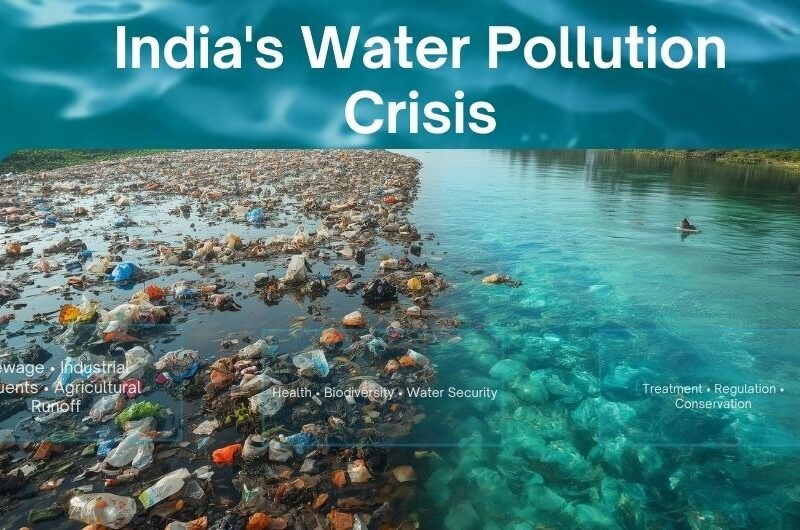
India’s Water Pollution Crisis: Causes, Impacts and Solutions
1. Nearly 70 percent of India’s surface water is contaminated, and the country ranks 120th out of 122 nations on the global Water Quality Index, highlighting the severity of its water pollution crisis.
2. According to the Central Pollution Control Board (CPCB), India has 296 polluted river stretches spread across 271 rivers.
3. More than 60 percent of urban sewage generated in India is discharged into rivers without adequate treatment, making untreated domestic sewage the largest source of water pollution.
4. Maharashtra has the highest number of polluted river stretches in India, with 54 polluted stretches as per the CPCB 2025 assessment.
5. River stretches with Biochemical Oxygen Demand (BOD) above 3 mg/L are classified as polluted, while Priority-I polluted stretches have BOD levels exceeding 30 mg/L.
6. Unsafe and polluted water is responsible for nearly two lakh deaths every year in India, according to NITI Aayog.
7. Industrial effluents from sectors such as textiles, tanneries, paper, and chemical industries release toxic pollutants like lead, mercury, and chromium into water bodies.
8. Excessive use of chemical fertilizers and pesticides leads to agricultural runoff, causing nitrate contamination and eutrophication in rivers and lakes.
9. Eutrophication occurs due to excessive nutrient loading of nitrates and phosphates, resulting in algal blooms, oxygen depletion, and large-scale fish mortality.
10. India is the world’s largest consumer of groundwater, making groundwater contamination by arsenic, fluoride, uranium, and nitrate a major public health concern.
11. Arsenic contamination is widespread across the Gangetic plains, while excessive fluoride in groundwater causes skeletal and dental fluorosis in several states.
12. Polluted water ecosystems threaten biodiversity by endangering species such as the Ganges River Dolphin and the Ganges River Shark.
13. Article 48A, Article 51A(g), and Article 21 of the Constitution collectively provide the constitutional foundation for environmental protection and the right to clean water.
14. The Water (Prevention and Control of Pollution) Act, 1974 established the Central Pollution Control Board (CPCB) and State Pollution Control Boards (SPCBs) to regulate water pollution.
15. Major government initiatives such as the Namami Gange Programme and Jal Jeevan Mission focus on improving river conservation, sewage treatment, and access to safe drinking water across India.
Must Know Terms :
1.Biochemical Oxygen Demand (BOD): BOD measures the amount of dissolved oxygen required by microorganisms to decompose organic matter in water. A BOD level above 3 mg/L indicates polluted water, while Priority-I polluted river stretches have BOD levels exceeding 30 mg/L.
2. Eutrophication: Eutrophication is the excessive enrichment of water bodies with nutrients such as nitrates and phosphates, leading to algal blooms, depletion of dissolved oxygen, fish mortality, and degradation of aquatic ecosystems.
3. Central Pollution Control Board (CPCB): CPCB is the apex statutory body established under the Water (Prevention and Control of Pollution) Act, 1974. It monitors water quality, identifies polluted river stretches, and coordinates pollution control measures across India.
4. Namami Gange Programme: Launched in 2014, the Namami Gange Programme is an integrated river conservation initiative aimed at reducing pollution in the Ganga through sewage treatment infrastructure, industrial pollution control, river rejuvenation, and biodiversity conservation.
5. Zero Liquid Discharge (ZLD): Zero Liquid Discharge is an industrial wastewater management system in which all wastewater is treated, recycled, and reused within the facility, eliminating the discharge of untreated effluents into natural water bodies.
6. Water (Prevention and Control of Pollution) Act, 1974: This landmark environmental legislation provides the legal framework for preventing and controlling water pollution in India. It established the Central Pollution Control Board (CPCB) and State Pollution Control Boards (SPCBs) to regulate water quality and industrial discharges.
MCQ :
1. With reference to water pollution in India, consider the following statements:
1. Nearly 70 percent of India’s surface water is contaminated.
2. India ranks 120th out of 122 countries on the global Water Quality Index.
3. India ranks first globally in water quality.
Which of the statements given above is/are correct?
(a) 1 and 2 only
(b) 2 and 3 only
(c) 1 only
(d) 1, 2 and 3
2. According to the Central Pollution Control Board (CPCB), India has:
(a) 196 polluted river stretches across 171 rivers
(b) 296 polluted river stretches across 271 rivers
(c) 271 polluted river stretches across 296 rivers
(d) 320 polluted river stretches across 290 rivers
3. Assertion (A): Untreated domestic sewage is the largest source of water pollution in India.
Reason (R): More than 60 percent of urban sewage is discharged into rivers without adequate treatment.
(a) Both A and R are true, and R is the correct explanation of A.
(b) Both A and R are true, but R is not the correct explanation of A.
(c) A is true, but R is false.
(d) A is false, but R is true.
4. Which one of the following states has the highest number of polluted river stretches according to the CPCB (2025)?
(a) Uttar Pradesh
(b) Gujarat
(c) Maharashtra
(d) West Bengal
5. With reference to Biochemical Oxygen Demand (BOD), consider the following statements:
1. BOD measures the oxygen required by microorganisms to decompose organic matter.
2. River stretches with BOD above 3 mg/L are classified as polluted.
3. Priority-I polluted stretches have BOD levels above 30 mg/L.
Which of the statements given above are correct?
(a) 1 and 2 only
(b) 2 and 3 only
(c) 1 and 3 only
(d) 1, 2 and 3
6. Which of the following are major sources of water pollution in India?
1. Untreated domestic sewage
2. Industrial effluents
3. Agricultural runoff
Select the correct answer using the code below.
(a) 1 and 2 only
(b) 2 and 3 only
(c) 1 only
(d) 1, 2 and 3
7. Eutrophication is primarily caused by the excessive presence of:
(a) Heavy metals
(b) Nitrates and phosphates
(c) Carbon dioxide
(d) Sulphur dioxide
8. Which of the following groundwater contaminants are major public health concerns in India?
1. Arsenic
2. Fluoride
3. Uranium
4. Nitrate
Select the correct answer using the code below.
(a) 1 and 2 only
(b) 2 and 3 only
(c) 1, 2 and 4 only
(d) 1, 2, 3 and 4
9. Assertion (A): India is the world’s largest consumer of groundwater.
Reason (R): Groundwater contamination by arsenic, fluoride, uranium, and nitrate has become a major public health concern.
(a) Both A and R are true, and R is the correct explanation of A.
(b) Both A and R are true, but R is not the correct explanation of A.
(c) A is true, but R is false.
(d) A is false, but R is true.
10. Which of the following species are threatened due to polluted freshwater ecosystems?
1. Ganges River Dolphin
2. Ganges River Shark
3. Olive Ridley Turtle
Select the correct answer using the code below.
(a) 1 and 2 only
(b) 2 and 3 only
(c) 1 only
(d) 1, 2 and 3
11. Which of the following Constitutional provisions are associated with environmental protection and clean water?
1. Article 21
2. Article 48A
3. Article 51A(g)
Select the correct answer using the code below.
(a) 1 and 2 only
(b) 2 and 3 only
(c) 1 and 3 only
(d) 1, 2 and 3
12. The Water (Prevention and Control of Pollution) Act, 1974 established:
(a) National Green Tribunal
(b) Central Pollution Control Board and State Pollution Control Boards
(c) National Biodiversity Authority
(d) National Water Development Agency
13. Which one of the following best describes the Namami Gange Programme?
(a) A programme for interlinking rivers
(b) An integrated programme for Ganga conservation and pollution abatement
(c) A groundwater recharge scheme
(d) A drinking water supply scheme for urban areas
14. Zero Liquid Discharge (ZLD) refers to:
(a) Complete prohibition on industrial water use
(b) Recycling and reuse of all industrial wastewater without external discharge
(c) Construction of dams to prevent pollution
(d) Diversion of polluted river water into reservoirs
15. Which of the following initiatives specifically aim to improve water quality and safe drinking water access?
1. Namami Gange Programme
2. Jal Jeevan Mission
3. Water (Prevention and Control of Pollution) Act, 1974
Select the correct answer using the code below.
(a) 1 and 2 only
(b) 2 and 3 only
(c) 1 and 3 only
(d) 1, 2 and 3



0 comment