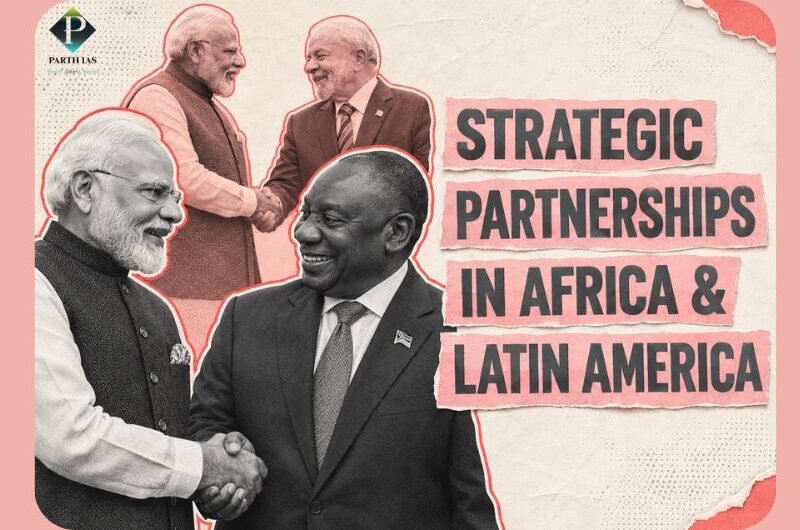
Strategic Partnerships in Africa & Latin America
India’s Strategic Partnerships in Africa and Latin America
India’s strategic partnerships with Africa and Latin America reflect a shift from historical Non-Aligned solidarity towards active South-South Cooperation. These partnerships focus on securing critical minerals, diversifying energy supplies, expanding Digital Public Infrastructure (DPI), strengthening economic relations and promoting reforms in global governance. They also support India’s strategic autonomy and its growing role in representing the interests of the Global South.
1. India–Africa Strategic Partnership
India’s Africa policy is guided by the Kampala Principles, a set of 10 guiding principles announced in Uganda in 2018. These emphasize development based on African priorities, local capacity-building, economic cooperation and mutual benefit. The India–Africa Forum Summit (IAFS) provides an institutional framework for political, economic and development cooperation.
Key Bilateral Strategic Partners: India maintains important strategic relations with South Africa, Nigeria, Egypt, Kenya, Mauritius and Ethiopia. The India–South Africa Strategic Partnership was established through the Red Fort Declaration (1997). India has also strengthened its relations with Ethiopia, including the elevation of bilateral ties to a Strategic Partnership in December 2025.
Economic and Resource Security: India–Africa trade reached approximately USD (United States dollar) 81.99 billion in 2024–25, making India Africa’s fourth-largest trading partner. India is expanding cooperation in critical minerals, particularly cobalt and lithium, to support its clean energy transition. The Democratic Republic of the Congo (DRC) holds approximately 55% of global cobalt reserves. The African Continental Free Trade Area (AfCFTA) provides opportunities for expanding trade and investment.
Ministry of External Affairs+1
Development and Digital Cooperation: India has extended concessional Lines of Credit (LoCs) worth approximately USD 12 billion to 42 African countries for infrastructure and development projects. Major initiatives include e-VidyaBharti and e-ArogyaBharti (e-VBAB) for tele-education and telemedicine, the Indian Technical and Economic Cooperation (ITEC) Programme for training and capacity-building, and cooperation in India Stack and Unified Payments Interface (UPI) technologies.
Maritime and Defense Security: Under Security and Growth for All in the Region (SAGAR), India strengthens maritime security cooperation through joint military exercises such as the Africa–India Field Training Exercise (AFINDEX) and anti-piracy operations in the Western Indian Ocean. India is also a major contributor to United Nations (UN) peacekeeping missions, including operations in Africa.
Geopolitical Convergence: India played a major role in securing permanent membership for the African Union (AU) in the Group of Twenty (G20) in 2023. India and Japan have also promoted the Asia–Africa Growth Corridor (AAGC) as a framework for sustainable connectivity and development cooperation. It represents an alternative approach to infrastructure development alongside China’s Belt and Road Initiative (BRI).
2. India–Latin America & Caribbean (LAC) Partnership
India’s relations with Latin America and the Caribbean (LAC) have historically been limited by geographical distance, language barriers and weak transport connectivity. Economic and diplomatic engagement has expanded through the Focus Latin America and Caribbean (FOCUS LAC) programme, strategic partnerships and cooperation with regional organizations.
Key Bilateral Strategic Partners: Brazil is India’s principal strategic partner in Latin America. Both countries cooperate through BRICS (Brazil, Russia, India, China and South Africa — the original five members), IBSA (India, Brazil, South Africa Dialogue Forum) and the G4 (Group of Four: Brazil, Germany, India and Japan) for UN Security Council reform. India also maintains important economic and strategic relations with Argentina, Chile, Mexico and Guyana.
Critical Minerals and Energy Transition: KABIL (Khanij Bidesh India Limited), an Indian state-backed joint venture, secured exploration and development rights over five lithium blocks in Argentina’s Catamarca province in January 2024. India is also pursuing opportunities in lithium and copper resources in Chile. Crude oil imports from Venezuela, Brazil and Guyana contribute to the diversification of India’s energy supplies.
Trade Blocs and Institutional Ties: India maintains a Preferential Trade Agreement (PTA) with MERCOSUR (Southern Common Market). The agreement was concluded with Argentina, Brazil, Paraguay and Uruguay. Bolivia became a full MERCOSUR member in 2024 but was not among the original parties to India’s PTA. India also engages with CELAC (Community of Latin American and Caribbean States), comprising 33 countries, and CARICOM (Caribbean Community) to strengthen regional diplomacy and economic cooperation.
Agriculture, Pharma, and Green Tech: Indian generic pharmaceuticals contribute to affordable healthcare in Latin American countries. Cooperation also covers agriculture, food processing, renewable energy and clean technologies. Brazil and several other LAC countries participate in the International Solar Alliance (ISA), while Brazil is also an important partner in the Global Biofuels Alliance.
Comparative Overview
| Dimension | Africa | Latin America & Caribbean (LAC) |
|---|---|---|
| Core Policy Framework | Kampala Principles, SAGAR, IAFS | FOCUS LAC, Strategic Autonomy |
| Primary Strategic Partners | South Africa, Nigeria, Egypt, Ethiopia, Mauritius | Brazil, Argentina, Chile, Mexico, Guyana |
| Key Regional Blocs | African Union (AU), AfCFTA, ECOWAS (Economic Community of West African States), SACU (Southern African Customs Union) | MERCOSUR, CELAC, CARICOM, Pacific Alliance |
| Key Strategic Resources | Cobalt, Manganese, Crude Oil, Gold, Pulses | Lithium (Lithium Triangle), Copper, Crude Oil, Edible Oils |
| Major Challenges | Chinese BRI influence and debt concerns, Sahel coups, project delays | Limited direct flights and shipping connectivity, tariff barriers, political volatility |
Way Forward
Institutionalize Summits: Resume regular India–Africa Forum Summits, as the last summit was held in 2015. Establish a structured India–CELAC summit mechanism to strengthen regular political dialogue, economic cooperation and institutional engagement.
Adopt a Mineral-to-Market Strategy: Expand cooperation beyond the extraction and export of raw minerals. Investment in local mineral processing, refining, manufacturing and value addition can strengthen supply chains while supporting industrial development and employment in partner countries.
Enhance Connectivity: Improve direct air connections and maritime shipping routes between India and LAC countries to reduce transport costs and strengthen trade. Expand existing Preferential Trade Agreements, including the India–MERCOSUR agreement, towards broader Free Trade Agreements (FTAs) to improve market access and economic integration.
Must Know Terms :
1. South-South Cooperation
Cooperation among developing countries in trade, technology, education, infrastructure and development. It promotes mutual benefits, knowledge-sharing, economic independence and stronger representation of developing nations in global affairs.
2. Kampala Principles
Ten guiding principles announced by India in Uganda in 2018 to strengthen India–Africa relations. They emphasize African development priorities, local capacity-building, trade, investment, infrastructure, security and mutually beneficial partnerships.
3. African Continental Free Trade Area (AfCFTA)
A major African economic integration initiative aimed at creating a single continental market for goods and services. It seeks to reduce trade barriers, increase intra-African trade, attract investment and strengthen regional industrial development.
4. Mineral-to-Market Strategy
An approach that connects mineral exploration and extraction with local processing, refining, manufacturing and final markets. It promotes value addition, employment, industrial development and secure supply chains for critical minerals.
5. Lithium Triangle
A mineral-rich region covering Argentina, Bolivia and Chile, known for its extensive lithium resources. Lithium is essential for rechargeable batteries, electric vehicles and energy storage systems, making the region strategically important.
6. Strategic Autonomy
The ability of a country to make independent foreign policy, economic and security decisions according to its national interests. It allows India to cooperate with different countries and international groupings without depending exclusively on any single power.
MCQ :
1. Consider the following statements regarding the Kampala Principles and India–Africa cooperation:

1. The Kampala Principles consist of ten guiding principles announced by India in Uganda in 2018.

2. The Kampala Principles prioritize externally determined development projects over the development priorities of African countries.

3. The India–Africa Forum Summit (IAFS) provides an institutional framework for political, economic and development cooperation.

4. The Kampala Principles were formulated exclusively for military cooperation and exclude trade, investment and local capacity-building.

How many of the above statements are correct?

(a) Only one

(b) Only three

(c) Only two

(d) Only four
2. Consider the following pairs regarding India’s strategic relations with African countries:
| Country | Development |
|---|---|
| 1. South Africa | – Strategic Partnership established through the Kampala Principles in 2018. |
| 2. South Africa | – Strategic Partnership established through the Red Fort Declaration in 1997. |
| 3. Ethiopia | – Bilateral relations elevated to a Strategic Partnership in 2015. |
| 4. Kenya | – Founding member of the IBSA Dialogue Forum alongside India and Brazil. |
How many of the above pairs are correctly matched?

(a) Only one

(b) Only four

(c) Only two

(d) Only three
3. Consider the following statements regarding India's economic and resource cooperation with Africa:

1. India–Africa bilateral trade reached approximately USD 81.99 billion during 2024–25.

2. India emerged as Africa's largest trading partner during 2024–25, surpassing every other major trading economy.

3. The Democratic Republic of the Congo holds approximately 15% of global cobalt reserves.

4. The African Continental Free Trade Area (AfCFTA) provides opportunities for strengthening continental trade and investment.

How many of the above statements are correct?

(a) Only one

(b) Only three

(c) Only four

(d) Only two
4. With reference to India's development and digital cooperation with African countries, consider the following statements:

1. India has extended concessional Lines of Credit worth approximately USD 12 billion to 42 African countries for development projects.

2. The e-VidyaBharti and e-ArogyaBharti initiatives were established exclusively for digital payments and cross-border currency settlements.

3. The Indian Technical and Economic Cooperation (ITEC) Programme supports training and capacity-building.

4. India's digital cooperation with Africa excludes India Stack and Unified Payments Interface technologies.

Which of the statements given above are correct?

(a) 1 and 2 only

(b) 1 and 3 only

(c) 2 and 4 only

(d) 3 and 4 only
5. Consider the following pairs regarding India’s maritime and geopolitical cooperation with Africa:
| Initiative / Institution | Description |
|---|---|
| 1. AFINDEX | – Africa–India Field Training Exercise. |
| 2. SAGAR | – Framework restricted exclusively to preferential trade agreements. |
| 3. African Union | – Became a permanent member of the G20 in 2015. |
| 4. Indian Peacekeeping Contribution | – Participation in United Nations peacekeeping operations in Africa. |
How many of the above pairs are correctly matched?

(a) Only two

(b) Only three

(c) Only one

(d) Only four
6. With reference to the Asia–Africa Growth Corridor (AAGC), consider the following statements:

1. India and Japan have promoted the AAGC as a framework for sustainable connectivity and development cooperation.

2. The AAGC was established jointly by China and India as an administrative component of the Belt and Road Initiative.

3. The principal objective of the AAGC is to establish a single African currency administered by the Reserve Bank of India.

4. The AAGC replaced the African Continental Free Trade Area as the primary legal framework for trade among African countries.

How many of the above statements are correct?

(a) Only three

(b) Only two

(c) Only one

(d) Only four
7. Consider the following statements regarding India's strategic engagement with Latin America and the Caribbean:

1. Geographical distance, language barriers and limited transport connectivity have historically constrained India's engagement with Latin America.

2. The FOCUS LAC programme was established exclusively to replace India's economic and development cooperation with African countries.

3. Brazil cooperates with India through BRICS, IBSA and the G4 grouping for United Nations Security Council reform.

4. The G4 grouping consists of India, Brazil, Argentina and Japan and excludes Germany.

How many of the above statements are correct?

(a) Only three

(b) Only two

(c) Only four

(d) Only one
8. With reference to India's critical mineral and energy cooperation with Latin America, consider the following statements:

1. Khanij Bidesh India Limited (KABIL) secured exploration and development rights over five lithium blocks in Argentina's Catamarca province in January 2024.

2. India has completed the acquisition of all major copper-processing facilities in Chile through KABIL, eliminating the need for further mineral cooperation.

3. The Lithium Triangle consists of Brazil, Chile and Guyana, which together form the principal lithium-producing region of South America.

4. Crude oil imports from Venezuela, Brazil and Guyana contribute to the diversification of India's energy supplies.

Which of the statements given above are correct?

(a) 1 and 2 only

(b) 2 and 3 only

(c) 3 and 4 only

(d) 1 and 4 only
9. Consider the following pairs regarding India’s trade relations with Latin American regional organizations:
| Institution / Agreement | Description |
|---|---|
| 1. India–MERCOSUR PTA | – Originally concluded with Bolivia as one of its four participating MERCOSUR countries. |
| 2. India–MERCOSUR PTA | – Concluded with Argentina, Brazil, Paraguay and Uruguay. |
| 3. Bolivia | – Became a full member of MERCOSUR in 2024. |
| 4. CELAC | – Four-country customs union established to replace MERCOSUR. |
How many of the above pairs are correctly matched?

(a) Only four

(b) Only one

(c) Only two

(d) Only three
10. Consider the following statements regarding regional organizations in Latin America and the Caribbean:

1. The Community of Latin American and Caribbean States (CELAC) comprises 33 countries and provides a framework for regional diplomatic engagement.

2. The Pacific Alliance is an African regional economic organization established to coordinate trade among West African countries.

3. The Caribbean Community (CARICOM) is an important regional organization through which India strengthens diplomatic and economic cooperation with Caribbean countries.

4. The Economic Community of West African States (ECOWAS) is the principal regional trade organization governing the economies of Argentina, Brazil and Chile.

How many of the above statements are correct?

(a) Only two

(b) Only four

(c) Only one

(d) Only three
11. With reference to cooperation between India and Latin America in pharmaceuticals and green technologies, consider the following statements:

1. Indian pharmaceutical cooperation with Latin America is restricted to expensive patented medicines and excludes the supply of affordable generic drugs.

2. Brazil is an important partner in the Global Biofuels Alliance, supporting international cooperation in sustainable biofuels.

3. The International Solar Alliance excludes Latin American countries because its membership is restricted exclusively to African economies.

4. India's economic cooperation with Latin America excludes agriculture and food processing and is confined entirely to petroleum imports.

How many of the above statements are correct?

(a) Only two

(b) Only one

(c) Only four

(d) Only three
12. Consider the following pairs regarding India’s strategic partnerships with Africa and Latin America:
| Dimension | Region / Characteristic |
|---|---|
| 1. Strategic Resources | – Africa: Cobalt, manganese, crude oil and gold. |
| 2. Regional Organizations | – Latin America: MERCOSUR, CELAC, CARICOM and Pacific Alliance. |
| 3. Major Connectivity Challenge | – Africa: Absence of direct flights and shipping routes with Latin America. |
| 4. Political Instability | – Latin America: Sahel military coups and associated regional security challenges. |
How many of the above pairs are correctly matched?

(a) Only three

(b) Only one

(c) Only two

(d) Only four
13. Consider the following statements regarding the institutional strengthening of India's partnerships with Africa and Latin America:

1. India–Africa Forum Summits have been conducted annually without interruption since 2015.

2. India and CELAC established a permanent annual summit mechanism in 2015 that eliminated the need for further institutional cooperation.

3. The last India–Africa Forum Summit was held in 2015, making the resumption of regular summit-level engagement an important diplomatic priority.

4. Strengthening India–Latin America connectivity requires discontinuing maritime shipping links and relying exclusively on indirect air transportation.

How many of the above statements are correct?

(a) Only four

(b) Only two

(c) Only three

(d) Only one
14. With reference to the Mineral-to-Market Strategy and the Lithium Triangle, consider the following statements:

1. The Mineral-to-Market Strategy emphasizes the export of unprocessed mineral resources while discouraging investment in local refining and manufacturing.

2. The Mineral-to-Market Strategy connects mineral extraction with local processing, refining, manufacturing and value addition.

3. The Lithium Triangle comprises Argentina, Peru and Chile and excludes Bolivia from its geographical extent.

4. Argentina, Bolivia and Chile constitute the Lithium Triangle, a region strategically important for rechargeable batteries and energy storage systems.

Which of the statements given above are correct?

(a) 2 and 4 only

(b) 1 and 2 only

(c) 1 and 3 only

(d) 3 and 4 only
15. Consider the following statements regarding strategic autonomy and the future of India's partnerships with Africa and Latin America:

1. Strategic autonomy enables India to pursue independent foreign policy, economic and security decisions according to its national interests.

2. Strategic autonomy requires India to establish exclusive dependence on a single major power and discontinue cooperation with other international groupings.

3. Expanding preferential trade arrangements into broader Free Trade Agreements can improve market access and strengthen economic integration with partner countries.

4. Improving direct maritime and aviation connectivity with Latin America is incompatible with India's strategy of diversifying economic partnerships.

Which of the statements given above are correct?

(a) 2 and 4 only

(b) 1 and 3 only

(c) 1 and 4 only

(d) 2 and 3 only



0 comment