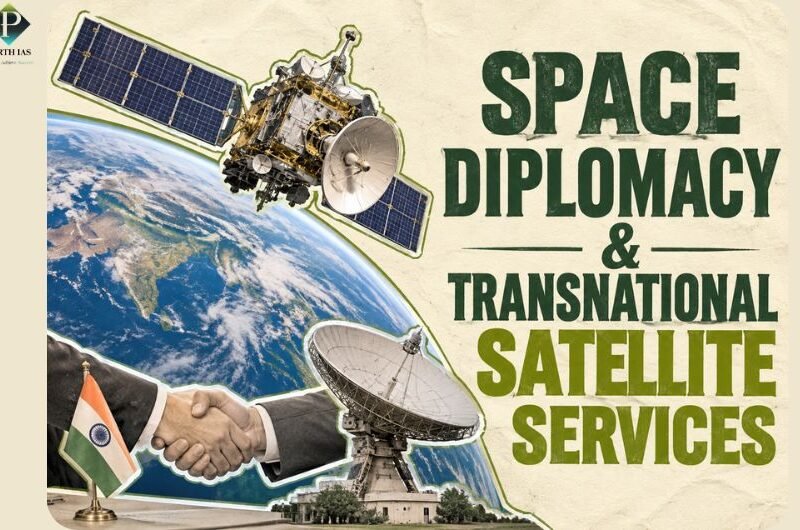
Space Diplomacy & Transnational Satellite Services
Space Diplomacy and Transnational Satellite Services
Space diplomacy refers to the use of space technology, scientific cooperation and satellite infrastructure to advance national interests and strengthen international relations. Transnational satellite services involve providing communication, navigation and Earth-observation services across national borders to support development, improve regional connectivity and strengthen cooperation among countries.
India uses its cost-effective space technology and satellite capabilities to strengthen diplomatic relations, support developing countries and expand its presence in the global space sector, particularly in the Global South.
1. Core Pillars of India’s Space Diplomacy and Satellite Services
Regional Transnational Services:
- India launched the South Asia Satellite (GSAT-9) in 2017 as a regional cooperation initiative for SAARC countries, excluding Pakistan.
- It provides satellite-based services such as:
- Telecommunication.
- Telemedicine.
- Tele-education.
- Disaster forecasting and management.
- It improves regional connectivity and supports access to essential services in neighbouring countries.
Countering Geopolitical Rivalry:
- India uses space cooperation to strengthen its strategic position in the neighbourhood and balance China’s growing space presence under the Belt and Road Space Information Corridor.
- India established a satellite ground station in Bhutan (Thimphu) to strengthen space cooperation.
- The joint INS-2B (BhutanSat) mission further strengthens India-Bhutan technological relations.
Global South Capacity Building:
- India supports developing countries through satellite technology training and technical cooperation.
- UNNATI (Unispace Nanosatellite Assembly & Training) provides training in nanosatellite development and related technologies.
- CSSTEAP (Centre for Space Science and Technology Education in Asia and the Pacific) provides education and training in space science and technology.
- India established a satellite tracking and data reception station in Vietnam to support cooperation with ASEAN countries.
Commercial Launch Diplomacy:
- Through NewSpace India Limited (NSIL), India provides commercial satellite launch services to international customers.
- The Polar Satellite Launch Vehicle (PSLV) offers reliable and cost-effective satellite launch services.
- India has launched hundreds of foreign satellites from more than 30 countries.
- Commercial launches generate revenue, strengthen bilateral relations and expand India’s presence in the international space market.
High-Tech Strategic Alliances:
- India cooperates with major space powers for scientific research, advanced satellite missions and space security.
- Important collaborations include:
- NISAR: A joint radar imaging satellite mission of the National Aeronautics and Space Administration (NASA) and Indian Space Research Organisation (ISRO).
- Megha-Tropiques: A joint climate research satellite mission between India and France through the French National Centre for Space Studies (CNES).
- Artemis Accords: India signed the US-led Artemis Accords in 2023 to promote international cooperation in peaceful space exploration.
2. Strategic Significance for India
| Dimension | Strategic Impact |
|---|---|
| Soft Power and Leadership | Strengthens India’s position as a reliable partner of the Global South through affordable space technology and development-oriented cooperation. |
| Disaster and Climate Resilience | Satellite data from EOS-06 and INSAT-3DS helps neighbouring coastal and island countries monitor cyclones, weather conditions and agricultural risks. |
| Space Security and SSA | Space Situational Awareness (SSA) agreements with the US and domestic tracking through Project NETRA help monitor space debris and potential threats to satellites. |
| Economic Growth | Liberalised Foreign Direct Investment (FDI) rules and the Indian Space Policy 2023 encourage private investment, support space startups and expand India’s role in the global space economy. |
Soft Power and Global Leadership:
- Strengthens India’s position as a partner of developing countries.
- Promotes India’s image as a provider of affordable and accessible space technology.
- Expands India’s diplomatic influence through scientific and technological cooperation.
- Supports the development of space capabilities in the Global South.
Disaster and Climate Resilience:
- Satellite-based weather monitoring helps neighbouring countries prepare for natural disasters.
- Earth-observation data supports cyclone tracking, flood monitoring and agricultural planning.
- Satellite communication provides connectivity during emergencies.
- Regional data-sharing improves disaster preparedness and response.
Space Security and Space Situational Awareness:
- Space Situational Awareness (SSA) involves monitoring objects, activities and potential threats in outer space.
- India cooperates with the United States on space security and satellite tracking.
- Project NETRA (Network for Space Objects Tracking and Analysis) strengthens India’s ability to monitor space objects and debris.
- These capabilities help protect satellites and other space assets from collision risks and potential anti-satellite (ASAT) threats.
Economic Growth:
- The Indian Space Policy 2023 encourages greater private-sector participation in space activities.
- Liberalised Foreign Direct Investment (FDI) rules attract domestic and international investment.
- Space startups contribute to satellite manufacturing, launch services and space-based applications.
- India aims to increase its share of the global space economy from around 2%, with a sector growth target of over $40 billion by 2033.
3. Key Challenges and Way Forward
Geopolitical Competition:
- China is expanding its space cooperation with developing countries through satellite systems, ground stations and BeiDou navigation services.
- Competition is increasing in Asia and Africa, particularly in satellite infrastructure and space-based services.
- India faces the challenge of maintaining its technological and strategic position.
Commercial and Budget Constraints:
- India faces strong competition from international private companies such as SpaceX.
- Reusable launch vehicles and low-cost satellite launch services are becoming increasingly important.
- Limited financial resources compared with major global space powers can restrict large-scale development.
- Greater private investment and commercial participation are important for sectoral growth.
Global Governance Gaps:
- Existing international space laws do not adequately address several emerging challenges.
- Major concerns include:
- Space debris and orbital congestion.
- Mega-constellations of satellites.
- Space resource exploration and mining.
- Anti-satellite weapons and space security.
- The 1967 Outer Space Treaty provides the basic international legal framework for space activities, but newer developments require stronger international rules and cooperation.
Way Forward:
- Comprehensive Space Legislation: A dedicated Space Activities Act can establish clear rules for private companies, licensing, liability and regulation of space activities.
- Reusable Launch Vehicle Development: Greater research and development (R&D) in reusable launch technology can reduce launch costs and improve competitiveness.
- International Cooperation: Stronger partnerships with developing and developed countries can expand satellite services, scientific research and technology sharing.
- Private-Sector Participation: Greater investment in space startups, satellite manufacturing and commercial launch services can strengthen India’s space industry.
- Global Space Governance: India can play a greater role in developing inclusive international rules for space debris management, resource utilisation and peaceful space activities.
- Regional Cooperation: Expanding satellite-based communication, navigation, weather forecasting and disaster management services can strengthen India’s relations with neighbouring countries.
Must Know Terms :
1. Space Diplomacy
- Use of space technology, satellite infrastructure and scientific cooperation to strengthen international relations and advance national interests.
2. South Asia Satellite (GSAT-9)
- A communication satellite launched by India in 2017 to provide telecommunication, telemedicine, tele-education and disaster management services to neighbouring countries, excluding Pakistan.
3. UNNATI (Unispace Nanosatellite Assembly & Training)
- An ISRO initiative that provides training to participants from different countries in nanosatellite assembly, development and related technologies.
4. NISAR (NASA-ISRO Synthetic Aperture Radar)
- A joint satellite mission of NASA and ISRO designed to observe Earth’s land and ice surfaces, monitor changes and study natural processes using advanced radar technology.
5. Space Situational Awareness (SSA)
- Monitoring and tracking objects in outer space to identify potential threats, satellite collisions and space debris.
6. Project NETRA (Network for Space Objects Tracking and Analysis)
- An ISRO initiative to develop India’s space surveillance capabilities by tracking satellites, space debris and other objects in Earth’s orbit.
MCQ :
SPACE DIPLOMACY AND TRANSNATIONAL SATELLITE SERVICES
15 MCQs
1. With reference to Space Diplomacy, consider the following statements:

1. It involves the use of space technology to advance national interests.
2. It promotes international relations through scientific cooperation.
3. It uses satellite infrastructure to strengthen cooperation among countries.

Which of the statements given above are correct?

(a) 1 and 2 only
(b) 2 and 3 only
(c) 1 and 3 only
(d) 1, 2 and 3
2. With reference to the South Asia Satellite (GSAT-9), consider the following statements:

1. It was launched by India in 2017.
2. It provides telecommunication, telemedicine and tele-education services.
3. Pakistan is a participating country in this initiative.

Which of the statements given above are correct?

(a) 2 only
(b) 2 and 3 only
(c) 1 and 2 only
(d) 1, 2 and 3
3. Consider the following statements regarding India-Bhutan space cooperation:

1. India established a satellite ground station in Thimphu, Bhutan.
2. INS-2B (BhutanSat) is a joint satellite initiative between India and Bhutan.
3. These initiatives strengthen technological cooperation between the two countries.

Which of the statements given above are correct?

(a) 1 only
(b) 1 and 2 only
(c) 2 and 3 only
(d) 1, 2 and 3
4. Consider the following statements regarding India's space capacity-building initiatives:

1. UNNATI provides training in nanosatellite assembly and development.
2. CSSTEAP provides education and training in space science and technology.
3. India established a satellite tracking and data reception station in Vietnam.

Which of the statements given above are correct?

(a) 1 only
(b) 1 and 3 only
(c) 2 and 3 only
(d) 1, 2 and 3
5. Which of the following organizations promotes India's commercial satellite launch services for international customers?

(a) NewSpace India Limited (NSIL)
(b) Centre for Space Science and Technology Education in Asia and the Pacific (CSSTEAP)
(c) National Aeronautics and Space Administration (NASA)
(d) National Centre for Medium Range Weather Forecasting (NCMRWF)
6. With reference to India's commercial space launch capabilities, consider the following statements:

1. Polar Satellite Launch Vehicle (PSLV) provides reliable and cost-effective satellite launch services.
2. India has launched hundreds of foreign satellites from more than 30 countries.
3. Commercial satellite launches help generate revenue and strengthen international relations.

Which of the statements given above are correct?

(a) 1 and 2 only
(b) 2 only
(c) 1, 2 and 3
(d) 1 and 3 only
7. Consider the following pairs:

        Mission / Initiative       Associated Cooperation

1. NISAR                       NASA and ISRO
2. Megha-Tropiques              India and France
3. Artemis Accords              US-led international initiative

How many of the above pairs are correctly matched?

(a) Only one
(b) All three
(c) Only two
(d) None
8. India signed the US-led Artemis Accords in which of the following years?

(a) 2019
(b) 2021
(c) 2022
(d) 2023
9. Which of the following best explains the role of India's space diplomacy in strengthening its soft power?

(a) Sharing affordable space technology and supporting developing countries.
(b) Restricting access to satellite technology for neighbouring countries.
(c) Replacing all international space organizations with Indian institutions.
(d) Limiting space cooperation to commercial satellite launches.
10. Consider the following statements regarding the role of satellite services in disaster and climate resilience:

1. Satellite-based weather monitoring helps neighbouring countries prepare for natural disasters.
2. Earth-observation data supports cyclone tracking, flood monitoring and agricultural planning.
3. Satellite communication can provide connectivity during emergencies.
4. Regional data-sharing improves disaster preparedness and response.

Which of the statements given above are correct?

(a) 1 and 2 only
(b) 2 and 3 only
(c) 1, 2, 3 and 4
(d) 1, 3 and 4 only
11. With reference to Space Situational Awareness (SSA), consider the following statements:

1. It involves monitoring and tracking objects in outer space.
2. It helps identify potential satellite collisions and space debris.
3. It contributes to the protection of space assets.

Which of the statements given above are correct?

(a) 1 and 2 only
(b) 1, 2 and 3
(c) 2 and 3 only
(d) 1 only
12. Project NETRA, developed by ISRO, is primarily associated with:

(a) Development of reusable launch vehicles.
(b) Providing satellite-based internet services.
(c) Training foreign participants in nanosatellite assembly.
(d) Tracking space objects and monitoring orbital debris.
13. Consider the following statements regarding the economic growth of India's space sector:

1. Indian Space Policy 2023 encourages private-sector participation.
2. Liberalised Foreign Direct Investment (FDI) rules aim to attract investment.
3. Space startups contribute to satellite manufacturing, launch services and space-based applications.

Which of the statements given above are correct?

(a) 1, 2 and 3
(b) 1 and 2 only
(c) 2 and 3 only
(d) 1 only
14. With reference to international space governance, consider the following statements:

1. The Outer Space Treaty was adopted in 1967.
2. Existing international space laws adequately address all emerging challenges related to space activities.
3. Space debris, mega-constellations and space resource mining are important global governance concerns.

Which of the statements given above are correct?

(a) 1 only
(b) 2 and 3 only
(c) 1 and 3 only
(d) 1, 2 and 3
15. Consider the following statements regarding the challenges faced by India's space diplomacy:

1. China is expanding its space cooperation through satellite systems, ground stations and BeiDou navigation services.
2. International private companies such as SpaceX create competition in the commercial space sector.
3. Limited financial resources compared with major global space powers can restrict large-scale development.
4. Reusable launch vehicles are becoming less important in global space competition.

Which of the statements given above are correct?

(a) 1 and 2 only
(b) 2, 3 and 4 only
(c) 1, 3 and 4 only
(d) 1, 2 and 3




0 comment