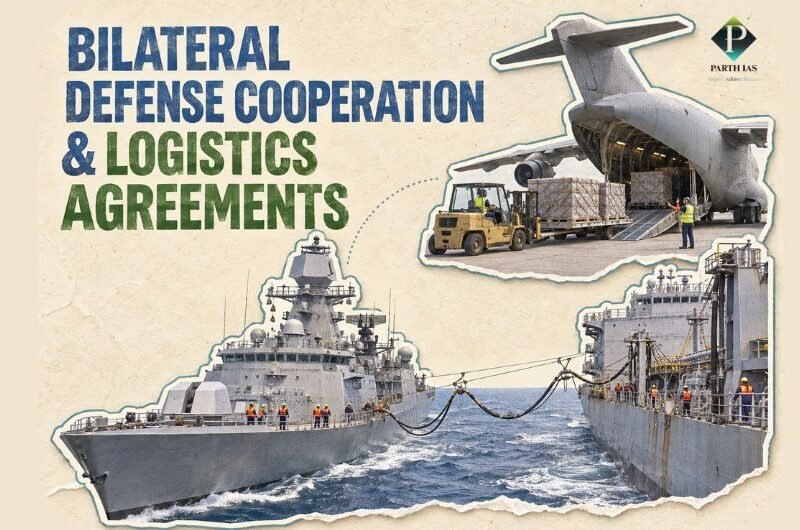
Bilateral Defense Cooperation & Logistics Agreements
Bilateral Defense Cooperation and Logistics Support Agreements (LSAs)
Bilateral Defense Cooperation and Logistics Support Agreements (LSAs) establish administrative arrangements through which partner countries provide reciprocal logistical assistance to their armed forces. These agreements facilitate access to designated military facilities, ports, and airfields for refueling, maintenance, replenishment, and operational support.
Such arrangements strengthen India’s strategic autonomy, maritime operational reach, military interoperability, and defense cooperation with multiple international partners without requiring membership in a formal military alliance.
1. Core Concept & Scope of Logistics Agreements
Logistics agreements establish standardized procedures for providing military supplies and services between partner nations. They reduce operational delays, improve coordination, and support overseas military deployments without automatically creating mutual defense obligations.
Services Covered: Refueling, food, drinking water, petroleum, oil, lubricants (POL), spare parts, medical assistance, equipment repairs, storage, transportation, and routine maintenance.
Operational Contexts: Logistics support is primarily provided during authorized port visits, joint military exercises, training programmes, naval deployments, and Humanitarian Assistance and Disaster Relief (HADR) operations.
Financial Mechanism: Supplies and services are exchanged through reimbursement, reciprocal support, or mutually agreed accounting arrangements. These mechanisms simplify payments and reduce administrative delays during military operations.
Non-Basing Provisions: Reciprocal logistics access does not automatically authorize permanent foreign military bases or unrestricted stationing of troops. Access remains governed by the specific agreement, national laws, and the consent of the participating countries.
2. Key Bilateral Logistics Agreements of India
India has established logistics cooperation arrangements with several strategic partners to strengthen military mobility, sustain overseas deployments, and improve operational coordination across the Indian Ocean and Indo-Pacific regions.
| Partner Nation | Agreement Name | Year Signed / Operationalized | Strategic Geographic Access |
|---|---|---|---|
| United States | Logistics Exchange Memorandum of Agreement (LEMOA) | Signed in 2016 | Reciprocal logistical support through authorized US military facilities, including locations in Djibouti, Diego Garcia, Guam, and the wider Indo-Pacific. |
| France | Reciprocal Logistics Support Agreement | Signed in 2018 | Access to authorized French military facilities, including those associated with Réunion, Djibouti, and Abu Dhabi. |
| Singapore | Naval Cooperation Agreement and Implementing Arrangements for Logistics Support | Naval agreement in 2017; logistics arrangement in 2018 | Access to Singapore’s naval facilities, including support near the strategically important Strait of Malacca. |
| South Korea | Mutual Logistics Support Agreement | Signed in 2019 | Reciprocal naval logistics support through designated South Korean ports and military facilities in the Western Pacific. |
| Australia | Mutual Logistics Support Arrangement (MLSA) | Signed in 2020 | Australian military facilities in the eastern Indian Ocean, with potential operational support involving strategically located territories such as the Cocos (Keeling) Islands, subject to authorization. |
| Japan | Acquisition and Cross-Servicing Agreement (ACSA) | Signed in 2020; entered into force in 2021 | Reciprocal logistical support through Japanese Self-Defense Force facilities in the Western Pacific and overseas locations, including Djibouti. |
| Russia | Reciprocal Exchange of Logistics Agreement (RELOS) | Signed in February 2025; operational framework in effect by 2026 | Reciprocal access to authorized Russian ports, airfields, and military facilities, strengthening India’s logistical reach toward the Arctic region. |
| Other Partners | Bilateral Logistics and Maritime Cooperation Arrangements | Various years | Defense and maritime cooperation with countries including the United Kingdom, Vietnam, and Oman, particularly access arrangements associated with Duqm Port in Oman. |
3. Foundational Defense Agreements (India–US Context)
India and the United States have developed four major foundational defense agreements covering military information security, logistics support, secure communications, and geospatial intelligence. These arrangements strengthen interoperability while maintaining separate national command structures and strategic decision-making.
GSOMIA (2002): The General Security of Military Information Agreement establishes procedures for protecting classified military information exchanged between India and the United States. The Industrial Security Annex (ISA), signed in 2019, extended security arrangements to classified information involving defense industries.
LEMOA (2016): The Logistics Exchange Memorandum of Agreement facilitates reciprocal access to logistical supplies and services during authorized military activities. It is adapted to the India–US defense relationship and does not establish permanent military bases.
COMCASA (2018): The Communications Compatibility and Security Agreement enables secure and encrypted military communications between compatible Indian and American defense platforms, improving operational coordination and information exchange.
BECA (2020): The Basic Exchange and Cooperation Agreement facilitates the sharing of geospatial intelligence, satellite imagery, nautical charts, and other geographic information relevant to military navigation, surveillance, and targeting accuracy.
Recent Additions: India and the United States signed the Security of Supply Arrangement (SOSA) in 2024 to strengthen defense industrial supply-chain cooperation. A new 10-year Defense Framework Agreement was signed in October 2025, covering military interoperability, defense technology cooperation, industrial collaboration, and regional security.
4. India–Russia RELOS Agreement
The Reciprocal Exchange of Logistics Agreement (RELOS) strengthens military logistics cooperation between India and Russia. Signed on 18 February 2025, the agreement came into force on 29 December 2025 following ratification by both countries. Its initial validity period is five years, with provisions for automatic renewal.
Operational Scope: RELOS establishes procedures for reciprocal port visits by warships, use of military airfields, temporary deployment of military formations, and logistical support. The agreement provides for the presence of up to 3,000 personnel, five warships, and ten military aircraft, subject to its conditions and applicable permissions.
Arctic Access: Reciprocal access to Russian logistical facilities can extend India’s maritime and aviation reach toward the Arctic region. The region is gaining strategic importance because of changing sea-ice conditions, emerging shipping routes, energy resources, and geopolitical competition.
Inventory Maintenance: A substantial part of India’s military equipment inventory is of Russian origin. RELOS facilitates logistical coordination, spare-parts availability, repair services, and maintenance support for compatible defense platforms during authorized activities.
5. Strategic Significance & Challenges
Significance
Balancing China’s Maritime Presence: Logistics cooperation with countries across the Indian Ocean and Western Pacific expands India’s naval access and operational flexibility amid China’s growing maritime presence and overseas infrastructure network, often described as the String of Pearls.
Blue Water Navy Capabilities: Overseas logistics access enables the Indian Navy to sustain extended deployments beyond India’s immediate coastline. Refueling, replenishment, and maintenance facilities support operations across the western Indian Ocean, eastern Africa, the Strait of Malacca, and the South China Sea.
Multi-Alignment Diplomacy: India’s logistics arrangements with the United States, Japan, Australia, France, and Russia demonstrate its policy of maintaining diverse defense partnerships without entering a binding military alliance. These relationships strengthen strategic autonomy and diplomatic flexibility.
Jointness and Theaterization: Standardized logistics procedures improve coordination between the Army, Navy, and Air Force. They also support the development of joint operational capabilities and the proposed Integrated Theatre Commands through improved interoperability and logistical readiness.
Challenges
Geopolitical Balancing: Maintaining logistics cooperation with both the United States and Russia requires careful diplomatic management, particularly amid Western sanctions against Russia. Restrictions under laws such as the Countering America’s Adversaries Through Sanctions Act (CAATSA) can create complications for defense transactions.
Sino-Russian Alignment: Expanding strategic cooperation between Russia and China creates challenges for India’s defense diplomacy. India’s dependence on Russian-origin equipment, combined with its security concerns regarding China, makes technology protection, sensitive information security, and supply-chain reliability important considerations.
Export Control Hurdles: Defense technology transfers, military equipment supplies, and dual-use technologies remain subject to export-control laws, licensing requirements, and national security restrictions. These regulations can limit access to sensitive technologies, complicate joint manufacturing, and delay the procurement of critical defense components.
Must Know Terms :
1. Logistics Support Agreements (LSAs): Bilateral arrangements that enable partner countries to provide reciprocal military logistics, including refueling, food, spare parts, medical assistance, and maintenance during authorized military operations, exercises, and port visits.
2. Reciprocal Exchange of Logistics Agreement (RELOS): India–Russia military logistics agreement signed on 18 February 2025. It facilitates reciprocal use of authorized military ports, airfields, and logistical facilities, supporting naval deployments and operational cooperation.
3. Logistics Exchange Memorandum of Agreement (LEMOA): Signed between India and the United States in 2016. It enables reciprocal logistical support during authorized military activities without establishing permanent military bases or creating mutual defense obligations.
4. Military Interoperability: The ability of armed forces from different countries to operate together effectively through compatible communication systems, coordinated procedures, joint exercises, and shared logistical arrangements.
5. Strategic Autonomy & Multi-Alignment: India’s approach of maintaining independent foreign policy and defense decisions while developing strategic partnerships with multiple powers, including the United States, Russia, France, Japan, and Australia.
6. Indo-Pacific Maritime Security: Cooperation among regional countries to protect important sea routes, maintain freedom of navigation, counter piracy, strengthen maritime surveillance, and secure strategic chokepoints such as the Strait of Malacca.
MCQ :
1. With reference to Logistics Support Agreements (LSAs), consider the following statements:

1. They automatically create mutual defense obligations between participating countries.
2. They facilitate refueling, maintenance, and medical assistance during authorized military activities.
3. They permit the establishment of permanent foreign military bases without separate authorization.
4. They may involve reimbursement or mutually agreed accounting arrangements.

Which of the statements given above are correct?

(a) 1 and 2 only
(b) 2 and 4 only
(c) 1 and 3 only
(d) 2, 3 and 4 only
2. Match the following countries with their respective logistics agreements:
| List I (Country) | List II (Agreement) |
|---|---|
| A. United States | 1. Reciprocal Logistics Support Agreement |
| B. Japan | 2. Acquisition and Cross-Servicing Agreement |
| C. Australia | 3. Logistics Exchange Memorandum of Agreement |
| D. France | 4. Mutual Logistics Support Arrangement |
Select the correct answer using the code below:

(a) A-3, B-4, C-2, D-1
(b) A-1, B-2, C-4, D-3
(c) A-3, B-2, C-1, D-4
(d) A-3, B-2, C-4, D-1
3. An Indian naval vessel receives permission to refuel and obtain maintenance support at a French military facility during an authorized overseas deployment.

Which of the following conclusions is most appropriate?

(a) Reciprocal logistics arrangements permit authorized operational support without automatically creating permanent basing rights.
(b) India and France must become members of a formal mutual defense alliance before such support can be provided.
(c) The arrangement permanently transfers control of the facility to the Indian Navy.
(d) Every Indian military deployment to French facilities becomes exempt from the host country's laws.
4. Consider the following statements regarding the geographical scope of India's defense logistics agreements:

1. LEMOA provides India with unconditional rights to establish permanent military installations in Guam.
2. India's logistics cooperation with France may facilitate access to authorized French facilities associated with Réunion.
3. India's agreement with Japan may support logistics cooperation involving Japanese facilities in Djibouti.
4. Australia's MLSA automatically guarantees unrestricted Indian military access to the Cocos (Keeling) Islands.

Which of the statements given above are correct?

(a) 1 and 2 only
(b) 1 and 3 only
(c) 2 and 3 only
(d) 2, 3 and 4 only
5. Match the following countries with the years in which their bilateral logistics agreements with India were signed:
| List I (Country) | List II (Year) |
|---|---|
| A. United States | 1. 2020 |
| B. France | 2. 2019 |
| C. South Korea | 3. 2018 |
| D. Australia | 4. 2016 |
Select the correct answer using the code below:

(a) A-4, B-2, C-3, D-1
(b) A-4, B-3, C-2, D-1
(c) A-3, B-4, C-1, D-2
(d) A-2, B-3, C-4, D-1
6. With reference to the foundational defense agreements between India and the United States, consider the following statements:

1. GSOMIA, signed in 2002, establishes procedures for protecting classified military information.
2. COMCASA, signed in 2018, facilitates secure and encrypted military communications.
3. BECA, signed in 2020, primarily governs financial reimbursement for military fuel and spare parts.
4. The Industrial Security Annex, signed in 2019, extends classified information protection arrangements to defense industries.

Which of the statements given above are correct?

(a) 1, 2 and 4 only
(b) 1, 2 and 3 only
(c) 2, 3 and 4 only
(d) 1, 2, 3 and 4
7. Match the following India–US defense agreements with their primary functions:
| List I (Agreement) | List II (Primary Function) |
|---|---|
| A. GSOMIA | 1. Geospatial intelligence sharing |
| B. LEMOA | 2. Protection of classified military information |
| C. COMCASA | 3. Reciprocal logistics support |
| D. BECA | 4. Secure and encrypted military communication |
Select the correct answer using the code below:

(a) A-1, B-3, C-4, D-2
(b) A-2, B-1, C-3, D-4
(c) A-3, B-2, C-1, D-4
(d) A-2, B-3, C-4, D-1
8. During a joint military exercise, Japanese Self-Defense Forces and Indian armed forces require reciprocal logistical supplies, transportation support, and maintenance services.

Which bilateral agreement provides the relevant administrative framework?

(a) Mutual Logistics Support Arrangement (MLSA)
(b) Communications Compatibility and Security Agreement (COMCASA)
(c) Acquisition and Cross-Servicing Agreement (ACSA)
(d) Basic Exchange and Cooperation Agreement (BECA)
9. Match the following strategic locations with the countries associated with India’s logistics cooperation:
| List I (Location) | List II (Country) |
|---|---|
| A. Changi Naval Base | 1. Oman |
| B. Réunion | 2. Australia |
| C. Duqm Port | 3. Singapore |
| D. Cocos (Keeling) Islands | 4. France |
Select the correct answer using the code below:

(a) A-3, B-1, C-4, D-2
(b) A-3, B-4, C-1, D-2
(c) A-4, B-3, C-2, D-1
(d) A-2, B-4, C-1, D-3
10. Consider the following Assertion (A) and Reason (R):

Assertion (A): The India–Russia RELOS Agreement can strengthen India's capacity to sustain long-distance military deployments, including operations extending toward the Arctic region.

Reason (R): RELOS establishes procedures for reciprocal logistical assistance involving authorized military ports, airfields, and support facilities.

Select the correct answer:

(a) Both A and R are correct, and R is the correct explanation of A.
(b) Both A and R are correct, but R is not the correct explanation of A.
(c) A is correct, but R is incorrect.
(d) A is incorrect, but R is correct.
11. Match the following operational provisions associated with the India–Russia RELOS Agreement:
| List I (Provision) | List II (Specified Limit) |
|---|---|
| A. Personnel | 1. Five years |
| B. Warships | 2. Ten |
| C. Military aircraft | 3. Three thousand |
| D. Initial validity period | 4. Five |
Select the correct answer using the code below:

(a) A-3, B-2, C-4, D-1
(b) A-4, B-3, C-2, D-1
(c) A-2, B-4, C-1, D-3
(d) A-3, B-4, C-2, D-1
12. With reference to recent developments in India–US defense cooperation, consider the following statements:

1. The Security of Supply Arrangement (SOSA), signed in 2024, focuses on strengthening defense industrial supply chains.
2. A new 10-year Defense Framework Agreement was signed in October 2025.
3. The Industrial Security Annex of 2019 supplemented GSOMIA by extending classified information protection arrangements to defense industries.
4. LEMOA established a framework for the compulsory sharing of nuclear weapons between India and the United States.

Which of the statements given above are correct?

(a) 1 and 4 only
(b) 2, 3 and 4 only
(c) 1, 2 and 3 only
(d) 1, 2, 3 and 4
13. Consider the following Assertion (A) and Reason (R):

Assertion (A): India's logistics agreements with countries such as the United States, Russia, France, Japan, and Australia are consistent with its policy of strategic autonomy and multi-alignment.

Reason (R): These arrangements facilitate defense cooperation without automatically creating binding military alliances or obligations to participate in partner countries' wars.

Select the correct answer:

(a) Both A and R are correct, and R is the correct explanation of A.
(b) Both A and R are correct, but R is not the correct explanation of A.
(c) A is correct, but R is incorrect.
(d) A is incorrect, but R is correct.
14. Match the following strategic concepts and challenges with their descriptions:
| List I (Concept / Challenge) | List II (Description) |
|---|---|
| A. CAATSA-related exposure | 1. Compatible communication systems and coordinated military procedures |
| B. Sino-Russian Alignment | 2. Licensing restrictions on sensitive and dual-use defense technologies |
| C. Export Control Hurdles | 3. Potential complications arising from Western sanctions on Russian defense transactions |
| D. Military Interoperability | 4. Concerns involving sensitive information security and defense supply-chain reliability |
Select the correct answer using the code below:

(a) A-2, B-4, C-3, D-1
(b) A-3, B-2, C-4, D-1
(c) A-3, B-4, C-2, D-1
(d) A-4, B-3, C-1, D-2
15. The Indian Navy seeks to sustain prolonged deployments from the eastern African coastline to the South China Sea while reducing dependence on frequent returns to Indian ports.

Which of the following best explains the strategic importance of India's bilateral logistics agreements in this situation?

(a) They permanently transfer command over partner countries' naval facilities to India.
(b) They extend blue-water operational endurance through authorized overseas refueling, replenishment, and maintenance support.
(c) They eliminate the requirement for diplomatic permission before entering foreign military facilities.
(d) They compel partner countries to deploy combat forces alongside the Indian Navy during every overseas operation.




0 comment