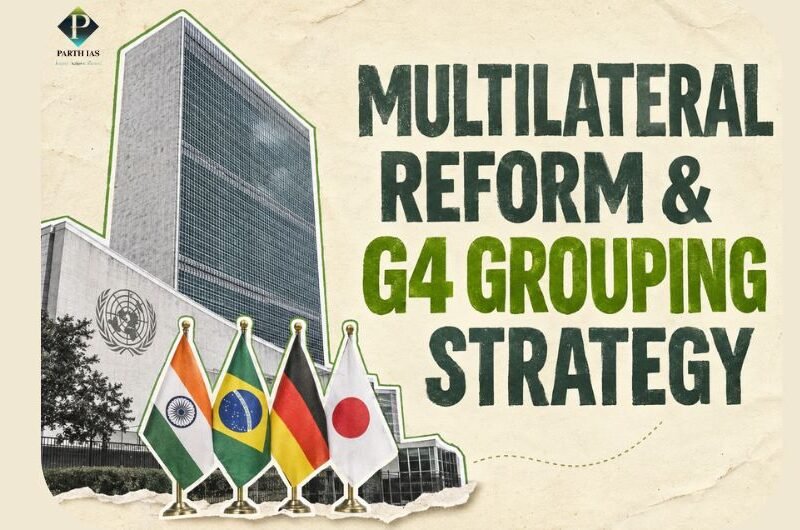
Multilateral Reform & G4 Grouping Strategy
G4 Grouping and Reformed Multilateralism
The G4 grouping—comprising Brazil, Germany, India, and Japan—is a coalition formed in 2005 to advocate for comprehensive reform of the United Nations Security Council (UNSC). Within the broader framework of reformed multilateralism, the bloc pushes to update post-World War II global governance structures so they reflect contemporary geopolitical and economic realities.
Core Strategy and Reform Model
The G4 strategy centers on mutual support for each member’s bid for a permanent seat in an expanded UNSC, alongside broader structural changes to make the body representative. The G4 model proposes expanding the Council from 15 to 25 or 26 members across both categories:
Permanent Seats. The model adds six new permanent seats distributed equitably across regions. These include two for Africa, two for the Asia-Pacific, one for Latin America and the Caribbean, and one for Western Europe and Other States.
Non-Permanent Seats. The proposal adds four or five rotating two-year seats to increase participation for developing nations and Small Island Developing States.
Veto Flexibility. To break diplomatic deadlocks, the G4 has expressed willingness for new permanent members to temporarily waive the exercise of veto power until a formal review takes place 15 years after the reforms take effect.
Text-Based Negotiations. The grouping continuously demands shifting the stalled Intergovernmental Negotiations (IGN) process toward formal text-based negotiations with clear timelines. The bloc also seeks to engage the wider UN General Assembly and align with other reform-oriented groups like the L.69 and the African Group.
Need for Reformed Multilateralism
India’s G4 diplomacy forms part of the wider doctrine of reformed multilateralism, which seeks to reform existing global institutions rather than abandon them.
Rectifying Historical Inequities. The current UNSC structure reflects 1945 power dynamics and leaves entire continents, such as Africa and South America, without permanent representation.
Overcoming Institutional Paralysis. Frequent veto deadlocks among the five permanent members (P5) hinder effective collective action on modern transnational crises, including regional conflicts, climate change, and pandemics.
Broader Institutional Scope. Alongside UNSC expansion, India’s multilateral strategy targets quota and governance reforms in International Financial Institutions (IMF and World Bank) and preserving a rules-based trading system at the World Trade Organization (WTO).
Key Diplomatic Challenges
Despite strong economic and demographic credentials, the G4 faces significant geopolitical roadblocks in realizing its reform agenda.
| Challenge Area | Core Hurdle | Key Actors Involved |
|---|---|---|
| Rival Coalitions | Opposes creating new permanent seats, advocating instead for expanding only non-permanent seats with longer terms. | Uniting for Consensus (Coffee Club), led by Italy and including Pakistan, Mexico, and South Korea. |
| P5 Reluctance | Existing permanent members are hesitant to dilute their exclusive veto power and geopolitical leverage. | China openly opposes Japan and India, while the US opposes extending the veto. |
| The Veto Dilemma | Divergence over whether new permanent members should hold immediate veto rights creates friction with potential allies. | The African Union (Ezulwini Consensus) demands full veto powers for new permanent seats, clashing with G4 flexibility. |
| Procedural Stagnation | The IGN operates without a single negotiating text or formal record-keeping, allowing opponents to indefinitely delay consensus. | Procedural blocks within the UN General Assembly. |
Way Forward for India
India combines its G4 advocacy with broader coalitions and alternative forums to maintain diplomatic momentum.
Building Global South Consensus. Leveraging leadership platforms like the Voice of the Global South Summit and BRICS expansion helps build wider support for institutional reform among developing nations.
Minilateralism as a Bridge. While pushing for long-term UN Charter amendments under Article 108, India actively uses agile minilateral groupings like the Quad and I2U2 to deliver immediate global public goods.
Must Know Terms :
1. G4 (Group of Four)
- Formed in 2005 by Brazil, Germany, India and Japan.
- All four countries support each other’s candidature for permanent membership of the United Nations Security Council (UNSC).
- Advocates expansion of both permanent and non-permanent seats.
2. Reformed Multilateralism
- Refers to restructuring international institutions to ensure fair representation, transparency and effective decision-making.
- India advocates reforms in the United Nations (UN), International Monetary Fund (IMF), World Bank and World Trade Organization (WTO).
- Seeks greater participation of developing countries in global governance.
3. UNSC Expansion
- The UNSC currently consists of 15 members: 5 permanent and 10 non-permanent.
- The G4 proposes expanding membership to 25 or 26 seats.
- Its model includes six additional permanent seats and four or five additional non-permanent seats.
4. Intergovernmental Negotiations (IGN)
- Established in 2008 under the United Nations General Assembly framework.
- Provides a platform for discussions on UNSC reform.
- The G4 demands formal text-based negotiations and a fixed timeline for reforms.
5. Uniting for Consensus (Coffee Club)
- A coalition opposing the creation of additional permanent UNSC seats.
- Prominent members include Italy, Pakistan, Mexico and South Korea.
- Supports greater representation through elected seats rather than new permanent memberships.
6. Ezulwini Consensus
- Adopted by the African Union in 2005 as Africa’s common position on UNSC reform.
- Demands at least two permanent seats and five non-permanent seats for Africa.
- Calls for full veto rights for new African permanent members if the veto system continues.
MCQ :
MULTILATERAL REFORM & G4 GROUPING STRATEGY
1. Consider the following statements regarding the G4 grouping:
1. It was formed in 2005 to advocate comprehensive reform of the United Nations Security Council.
2. Brazil, Germany, India and Japan are its four members.
3. It advocates expanding permanent membership while keeping the number of non-permanent seats unchanged.
Which of the statements given above are correct?
(a) 1 only
(b) 2 and 3 only
(c) 1 and 2 only
(d) 1, 2 and 3
2. Consider the following pairs regarding the G4 proposal for additional permanent seats:
| Region | Proposed Seats |
|---|---|
| 1. Africa | Two |
| 2. Asia-Pacific | One |
| 3. Latin America and the Caribbean | One |
| 4. Western Europe and Other States | Two |
Which of the pairs given above are correctly matched?
(a) 1 and 2 only
(b) 1 and 3 only
(c) 2 and 4 only
(d) 3 and 4 only
3. With reference to the G4 model of UNSC expansion, consider the following statements:
1. It proposes increasing the Council’s membership from 15 to 25 or 26.
2. It provides for four or five additional non-permanent seats.
3. It proposes extending the tenure of all non-permanent members to five years.
Which of the statements given above are correct?
(a) 1 and 2 only
(b) 1 and 3 only
(c) 2 and 3 only
(d) 1, 2 and 3
4. Consider the following statements regarding different approaches to UNSC reform:
1. The G4 supports expansion of both permanent and non-permanent membership.
2. Uniting for Consensus advocates creating additional permanent seats.
3. The Ezulwini Consensus demands veto rights for new African permanent members if the veto system continues.
4. Intergovernmental Negotiations provide a platform for discussions on UNSC reform.
Which of the statements given above are correct?
(a) 1 and 2 only
(b) 2 and 3 only
(c) 1 and 4 only
(d) 1, 3 and 4 only
5. Consider the following Assertion (A) and Reason (R):
Assertion (A): The G4 advocates formal text-based negotiations to advance UNSC reform.
Reason (R): The G4 comprises Brazil, Germany, India and Japan.
Select the correct answer using the code given below:
(a) Both A and R are correct, and R is the correct explanation of A.
(b) Both A and R are correct, but R is not the correct explanation of A.
(c) A is correct, but R is incorrect.
(d) A is incorrect, but R is correct.
6. Consider the following pairs:
| Initiative/Provision | Year/Feature |
|---|---|
| 1. G4 Grouping | Formed in 2005 |
| 2. Intergovernmental Negotiations | Established in 2008 |
| 3. Ezulwini Consensus | Adopted in 2008 |
| 4. Article 108 | UN Charter amendment procedure |
Which of the pairs given above are correctly matched?
(a) 1 and 3 only
(b) 2 and 3 only
(c) 1, 2 and 3 only
(d) 1, 2 and 4 only
7. With reference to India’s approach towards reformed multilateralism, consider the following statements:
1. It seeks to address historical inequalities in international institutions established under earlier global power structures.
2. It advocates abandoning existing multilateral institutions and replacing them entirely with new organizations.
3. It supports quota and governance reforms in the International Monetary Fund and World Bank.
4. It emphasizes preserving a rules-based trading system within the World Trade Organization.
Which of the statements given above are correct?
(a) 1 and 2 only
(b) 1, 3 and 4 only
(c) 2 and 3 only
(d) 1, 2, 3 and 4
8. Which of the following constitute major obstacles to UNSC reform?
1. Reluctance among existing permanent members to dilute their geopolitical influence.
2. Procedural stagnation within the Intergovernmental Negotiations process.
3. The G4’s demand for formal text-based negotiations.
4. Opposition from coalitions that reject the creation of additional permanent seats.
Select the correct answer using the code given below:
(a) 1 and 3 only
(b) 2, 3 and 4 only
(c) 1, 2 and 4 only
(d) 1, 2, 3 and 4
9. Consider the following pairs regarding countries or groupings and their positions on UNSC reform:
| Country/Grouping | Position |
|---|---|
| 1. Italy | Prominent member of Uniting for Consensus |
| 2. China | Supports the permanent membership bids of both India and Japan |
| 3. African Union | Demands full veto rights for new African permanent members if veto rights continue |
| 4. G4 | Supports expansion exclusively through elected seats |
Which of the pairs given above are correctly matched?
(a) 1 and 3 only
(b) 2 and 3 only
(c) 1 and 4 only
(d) 3 and 4 only
10. Suppose a proposal seeks to make the UNSC more representative by increasing membership in both categories while maintaining the existing distinction between permanent and elected members.
Which of the following arrangements would most closely reflect the G4 reform model?
(a) Increasing permanent membership by one seat while reducing the number of elected members.
(b) Adding six permanent seats and four or five non-permanent seats.
(c) Adding only two permanent seats reserved for African countries.
(d) Replacing the UNSC with a decision-making body consisting exclusively of developing countries.
11. Consider the following statements regarding India’s diplomatic strategy for multilateral reform:
1. The Voice of the Global South Summit and BRICS expansion can help mobilize support for institutional reforms.
2. The Quad and I2U2 represent minilateral arrangements that can complement broader multilateral engagement.
3. India considers amendments under Article 108 of the UN Charter unnecessary for achieving structural UNSC reform.
Which of the statements given above are correct?
(a) 1 only
(b) 2 only
(c) 2 and 3 only
(d) 1 and 2 only
12. Consider the following Assertion (A) and Reason (R):
Assertion (A): The G4 demands a transition towards formal text-based negotiations with clear timelines for UNSC reform.
Reason (R): The Intergovernmental Negotiations process already operates through a single agreed negotiating text with comprehensive formal record-keeping.
Select the correct answer using the code given below:
(a) Both A and R are correct, and R is the correct explanation of A.
(b) Both A and R are correct, but R is not the correct explanation of A.
(c) A is correct, but R is incorrect.
(d) A is incorrect, but R is correct.
13. Consider the following pairs regarding international institutions and proposed reforms:
| Institution | Reform Objective |
|---|---|
| 1. IMF | Quota and governance reforms |
| 2. WTO | Expansion of permanent membership |
| 3. UNSC | More representative membership and structural reform |
| 4. World Bank | Introduction of permanent veto-holding seats |
Which of the pairs given above are correctly matched?
(a) 1 and 3 only
(b) 2 and 3 only
(c) 1, 2 and 4 only
(d) 3 and 4 only
14. Consider the following pairs:
| Mechanism/Platform | Significance |
|---|---|
| 1. Intergovernmental Negotiations | UN General Assembly framework for UNSC reform discussions |
| 2. Article 108 | Procedure for amending the UN Charter |
| 3. Quad and I2U2 | Examples of minilateral cooperation |
| 4. Voice of the Global South Summit | Institution granting permanent UNSC membership |
Which of the pairs given above are correctly matched?
(a) 1, 2 and 3 only
(b) 1 and 4 only
(c) 2, 3 and 4 only
(d) 1, 2, 3 and 4
15. With reference to the G4 proposal and the African Union’s Ezulwini Consensus, consider the following statements:
1. The Ezulwini Consensus demands at least two permanent and five non-permanent seats for Africa.
2. The G4 proposal includes two additional permanent seats for Africa.
3. The African Union accepts the permanent exclusion of new permanent members from veto powers under the existing veto system.
4. The G4 has expressed flexibility regarding the exercise of veto powers by new permanent members until a review after 15 years.
Which of the statements given above are correct?
(a) 1 and 3 only
(b) 2 and 3 only
(c) 1, 2 and 4 only
(d) 1, 2, 3 and 4


0 comment