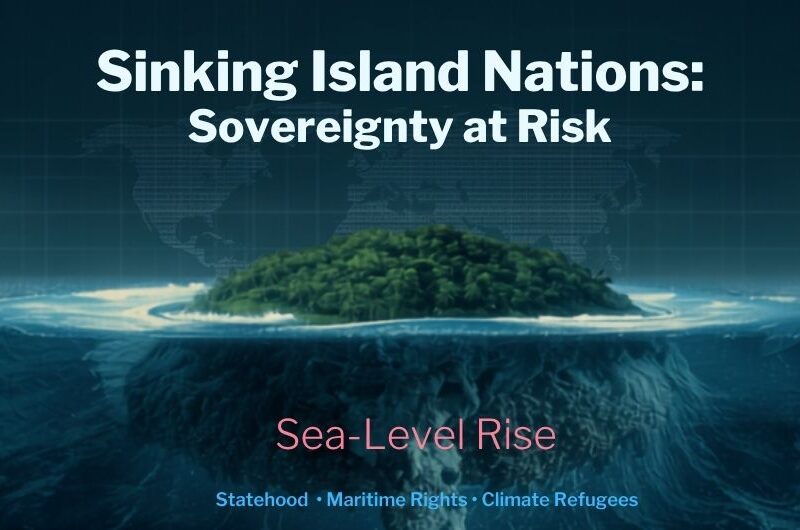
Sinking Island Nations: Sovereignty at Risk
1. Rising sea levels caused by climate change threaten the physical existence of several small island nations, creating unprecedented challenges to their sovereignty and statehood.
2. Under the Montevideo Convention, a sovereign state requires a permanent population, defined territory, government, and the capacity to enter into relations with other states.
3. The complete submergence of island nations could challenge their recognition as sovereign states under existing principles of international law.
4. Tuvalu is developing digital sovereignty by creating virtual versions of its territory, government services, and national records to preserve its identity.
5. The Falepili Union Treaty between Australia and Tuvalu guarantees residency rights for Tuvaluans while recognising the continuity of Tuvalu’s sovereignty despite climate change.
6. Under the United Nations Convention on the Law of the Sea (UNCLOS), coastal states enjoy sovereign rights over a 200-nautical-mile Exclusive Economic Zone (EEZ).
7. Exclusive Economic Zones (EEZs) provide access to valuable marine resources, including fisheries, offshore energy resources, and seabed minerals.
8. Existing UNCLOS provisions link maritime boundaries to permanently dry land, creating legal uncertainty if island territories become submerged.
9. Small Island Developing States (SIDS) and the Alliance of Small Island States (AOSIS) are advocating for fixed maritime boundaries even after physical land loss.
10. Climate change-induced displacement of entire populations has created the emerging issue of climate refugees, which lacks a dedicated legal framework under international law.
11. Current international refugee law does not formally recognise people displaced solely because of climate change as refugees.
12. Countries such as Kiribati and the Maldives are exploring relocation strategies, including purchasing land abroad and developing artificial islands and floating cities.
13. Small Island Developing States (SIDS) occupy strategically important locations in the Indo-Pacific, making them significant in regional geopolitical competition.
14. Major powers, including the Quad countries and China, are increasing engagement with island nations because of their importance in securing Sea Lines of Communication (SLOCs).
15. Many sinking island nations are leveraging their strategic location and voting influence in international organisations to seek climate finance, infrastructure assistance, and security partnerships.
Must know Terms :
1. Montevideo Convention: The Montevideo Convention (1933) lays down four essential criteria for statehood—a permanent population, defined territory, government, and the capacity to enter into relations with other states. Rising sea levels challenge these criteria for sinking island nations.
2. Exclusive Economic Zone (EEZ): An Exclusive Economic Zone (EEZ) extends up to 200 nautical miles from a coastal state’s baseline under UNCLOS, granting sovereign rights over fisheries, offshore energy resources, and seabed minerals.
3. United Nations Convention on the Law of the Sea (UNCLOS): UNCLOS is the international legal framework governing maritime rights and boundaries. It currently links maritime zones to permanently dry land, creating legal uncertainty for sinking island states.
4. Alliance of Small Island States (AOSIS): AOSIS is a coalition of Small Island Developing States that advocates for stronger global climate action, climate finance, and legal protection of maritime boundaries threatened by sea-level rise.
5. Climate Refugees: Climate refugees are people displaced due to the impacts of climate change such as sea-level rise, coastal erosion, or extreme weather events. At present, international refugee law does not formally recognise this category.
6. Falepili Union Treaty: The Falepili Union is a bilateral treaty between Australia and Tuvalu that provides residency pathways for Tuvaluans while recognising the continuity of Tuvalu’s sovereignty and statehood despite climate change-related territorial loss.
MCQ :
1. With reference to the Montevideo Convention, consider the following statements:
1. It lays down the criteria for recognition of a sovereign state.
2. A defined territory is one of the essential conditions for statehood.
3. It specifically recognises climate-induced statelessness.
Which of the statements given above is/are correct?
A. 1 and 2 only
B. 2 and 3 only
C. 1 only
D. 1, 2 and 3
2. Assertion (A): Rising sea levels pose a legal challenge to the sovereignty of some island nations.
Reason (R): International law traditionally links statehood to the existence of a defined territory.
A. Both A and R are true, and R is the correct explanation of A.
B. Both A and R are true, but R is not the correct explanation of A.
C. A is true, but R is false.
D. A is false, but R is true.
3. Digital sovereignty, recently in the news, refers to:
A. Digitisation of maritime navigation systems
B. Creating virtual versions of a country’s territory, governance, and records to preserve state identity
C. Digital voting rights for climate refugees
D. Online registration of international treaties
4. With reference to the Falepili Union Treaty, consider the following statements:
1. It is a bilateral agreement between Australia and Tuvalu.
2. It guarantees residency pathways for Tuvaluans.
3. It seeks to preserve Tuvalu’s sovereignty despite climate-related threats.
Which of the statements given above are correct?
A. 1 and 2 only
B. 2 and 3 only
C. 1 and 3 only
D. 1, 2 and 3
5. Under the United Nations Convention on the Law of the Sea (UNCLOS), an Exclusive Economic Zone (EEZ) extends up to:
A. 12 nautical miles
B. 24 nautical miles
C. 100 nautical miles
D. 200 nautical miles
6. Which of the following resources are generally available within a country’s Exclusive Economic Zone (EEZ)?
1. Fisheries
2. Offshore energy resources
3. Seabed minerals
Select the correct answer using the code below.
A. 1 and 2 only
B. 2 and 3 only
C. 1 only
D. 1, 2 and 3
7. The present legal uncertainty regarding sinking island nations under UNCLOS primarily arises because:
A. Maritime boundaries are based on permanently dry land.
B. UNCLOS prohibits artificial islands.
C. EEZs are valid only for continental states.
D. Island states cannot claim maritime boundaries.
8. The Alliance of Small Island States (AOSIS) is best known for:
A. Conducting naval exercises in the Indo-Pacific
B. Promoting stronger climate action and protection of maritime rights
C. Regulating global shipping routes
D. Managing international refugee camps
9. Which of the following statements regarding climate refugees is/are correct?
1. They are formally recognised under the 1951 Refugee Convention.
2. There is no dedicated international legal framework specifically protecting them.
3. They may be displaced due to sea-level rise and extreme weather events.
A. 2 and 3 only
B. 1 and 2 only
C. 1 only
D. 1, 2 and 3
10. Countries such as Kiribati and the Maldives have explored which of the following adaptation measures?
1. Purchasing land abroad
2. Artificial islands
3. Floating cities
A. 1 and 2 only
B. 2 and 3 only
C. 1 only
D. 1, 2 and 3
11. Small Island Developing States (SIDS) have gained geopolitical importance mainly because they:
A. Possess large nuclear arsenals.
B. Control important Sea Lines of Communication (SLOCs).
C. Are members of the G20.
D. Produce the world’s largest oil reserves.
12. Which of the following countries are commonly associated with strategic competition for influence among Small Island Developing States in the Indo-Pacific?
1. India
2. United States
3. China
4. Japan
Select the correct answer using the code below.
A. 1 and 2 only
B. 2 and 3 only
C. 1, 2 and 4 only
D. 1, 2, 3 and 4
13. Assertion (A): Sinking island nations are demanding that maritime boundaries remain valid even after the physical disappearance of their territory.
Reason (R): Existing maritime rights under UNCLOS are linked to physical land territory.
A. Both A and R are true, and R is the correct explanation of A.
B. Both A and R are true, but R is not the correct explanation of A.
C. A is true, but R is false.
D. A is false, but R is true.
14. Which one of the following is correctly matched?
A. Tuvalu — Digital sovereignty initiatives
B. Kiribati — Arctic Council member
C. Maldives — Member of NATO
D. AOSIS — International Court of Justice
15. With reference to sinking island nations, consider the following statements:
1. They are using international diplomacy to seek climate finance and security partnerships.
2. Their voting influence in international organisations enhances their strategic importance.
3. Climate change has no impact on their maritime claims under existing legal debates.
Which of the statements given above is/are correct?
A. 1 and 2 only
B. 2 and 3 only
C. 1 only
D. 1, 2 and 3




0 comment