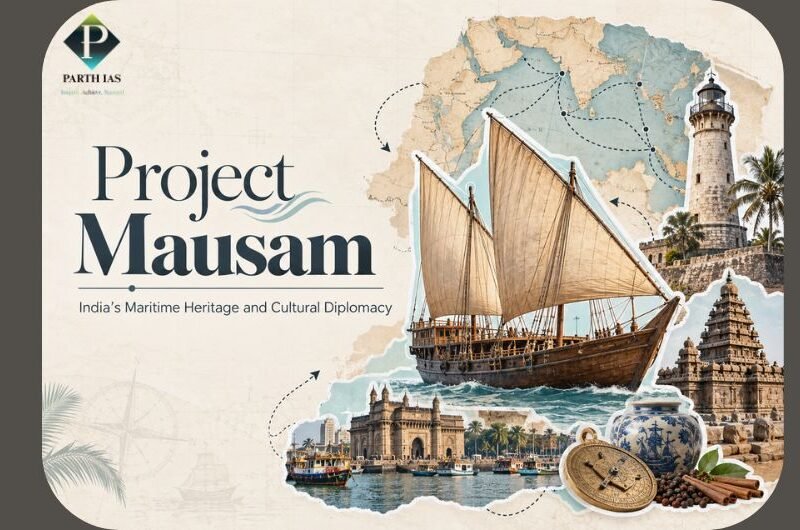
Project Mausam: India’s Maritime Heritage and Cultural Diplomacy
Overview of Project Mausam
Project Mausam is a flagship cultural diplomacy and maritime heritage initiative launched by the
Ministry of Culture in June 2014 during the
38th session of the UNESCO World Heritage Committee.
The project seeks to reconnect and re-establish India’s ancient maritime, cultural and historical links with
39 littoral states across the Indian Ocean Region (IOR).
It focuses particularly on the natural phenomenon of monsoon winds — or
“mausam” — which historically guided mariners and shaped trade,
migration and cultural exchanges across the Indian Ocean.
1. Key Institutional Framework
Ministry of Culture.
Archaeological Survey of India (ASI).
Indira Gandhi National Centre for the Arts (IGNCA) and the National Museum.
Collating historical, literary and archaeological research to document the commercial, cultural and religious interactions that developed across the Indian Ocean.
2. Core Objectives
UNESCO Inscriptions
Heritage
Soft Power Policy
1. Transnational UNESCO Inscriptions
The primary objective is to identify shared archaeological landscapes and promote their nomination to the
UNESCO World Heritage List through transnational nominations.
Ancient maritime trading routes, including historical Chola connections with Southeast Asia.
Transnational routes associated with the spread of Buddhism and Hinduism across South and Southeast Asia.
2. Reclaiming Civilizational Legacy
The project documents and maps ancient port cities, diverse stitched-boat traditions such as the traditional
Odia Tankai method, and epigraphical evidence highlighting India’s historical centrality in the Indian Ocean Region.
3. Strategic Counter-Narrative — Soft Power
Project Mausam acts as an organic and non-coercive diplomatic counter-balance to China’s Maritime Silk Road under
the Belt and Road Initiative. Instead of relying on infrastructure-heavy models, India emphasises
shared cultural memory, historical goodwill and civilizational links.
3. Geopolitical & Soft Power Dimensions
| Dimension | Core Strategy & Strategic Value |
|---|---|
| Cultural Diplomacy |
Uses ancient religious and trade linkages to strengthen bilateral ties with Indian Ocean Rim Association (IORA) nations across East Africa, the Arabian Peninsula and Southeast Asia. |
| Complementary Foreign Policy |
Complements India’s broader geopolitical frameworks, including the Act East Policy, Neighbourhood First Policy and SAGAR doctrine — Security and Growth for All in the Region. |
| Monsoon-Driven Connectivity |
Uses monsoon wind patterns as a shared ecological framework and presents the Indian Ocean as a collaborative, interconnected space rather than an arena defined primarily by security blockades. |
Must Know Terms
1. Maritime Heritage
Project Mausam focuses on India’s ancient maritime connections across the Indian Ocean Region, including historic ports,
sea routes, navigation traditions and maritime trade networks.
2. Cultural Diplomacy
India uses shared cultural, religious and historical connections with Indian Ocean countries to strengthen diplomatic relations
and build long-term goodwill.
3. Monsoon Winds
The project highlights the historical role of monsoon wind patterns in facilitating navigation, trade, migration and cultural exchanges across the Indian Ocean.
4. UNESCO Transnational Nominations
A major objective is to identify shared archaeological and cultural landscapes across different countries and promote their nomination to the UNESCO World Heritage List.
5. Civilizational Connectivity
Project Mausam documents historical links created through trade, Buddhism, Hinduism, migration, port cities, inscriptions and traditional maritime practices across South and Southeast Asia.
6. Indian Ocean Region (IOR)
The Indian Ocean Region is the geographical focus of Project Mausam, connecting India with littoral states across East Africa,
the Arabian Peninsula, South Asia and Southeast Asia.
Multiple-Choice Questions
1. With reference to Project Mausam, consider the following statements:
Which of the statements given above are correct?
2. Project Mausam primarily seeks to reconnect India with:
3. Consider the following pairs:
How many of the pairs given above are correctly matched?
4. The term “Mausam” in Project Mausam is most closely associated with:
5. Consider the following statements regarding the core objectives of Project Mausam:
Which of the statements given above are correct?
6. Which of the following are specifically associated with the “Reclaiming Civilizational Legacy” objective of Project Mausam?
Select the correct answer using the code given below:
7. Project Mausam’s soft power approach is based primarily on:
8. With reference to Project Mausam and the Indian Ocean Region, consider the following statements:
Which of the statements given above are correct?
9. Which of the following best explains the concept of “Civilizational Connectivity” under Project Mausam?
10. Consider the following statements:
Which of the statements given above are correct?
11. Which one of the following is NOT a stated geopolitical or soft power dimension of Project Mausam?
12. Project Mausam is linked with which of the following broader Indian foreign policy frameworks?
Select the correct answer using the code given below:
13. Consider the following statements regarding UNESCO-related aspects of Project Mausam:
Which of the statements given above are correct?
14. Which of the following combinations best represents the historical processes highlighted by Project Mausam?
15. Consider the following statements:
Which of the statements given above are correct?

0 comment