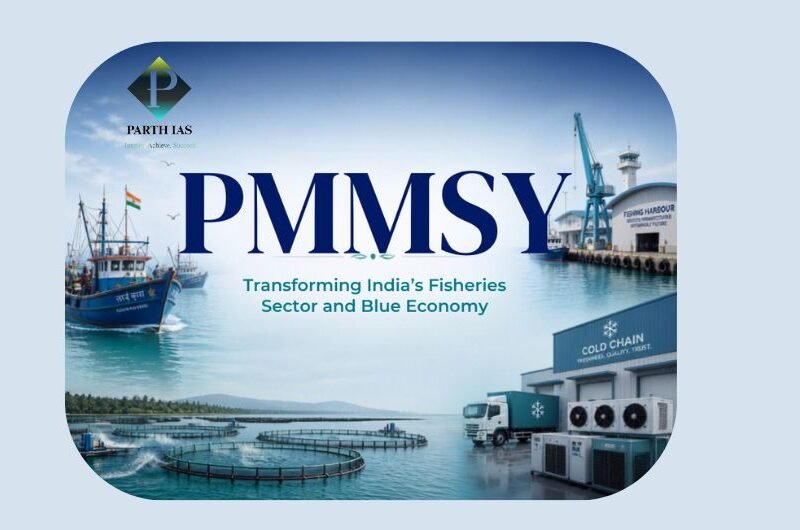
PMMSY Transforming India’s Fisheries Sector and Blue Economy
1. Pradhan Mantri Matsya Sampada Yojana (PMMSY) was launched in 2020 to transform India’s fisheries sector.
2. PMMSY is built on the objectives of the Blue Revolution and focuses on production, infrastructure, livelihoods and sustainability.
3. The scheme has a total outlay of ₹20,750 crore.
4. PMMSY completed six years on 10 September 2026.
5. The Government allocated a record ₹2,500 crore under PMMSY in the Budget Estimates (BE) 2026–27.
6. Fish production increased from 141.64 lakh tonnes in 2019–20 to 197.75 lakh tonnes in 2024–25.
7. Fisheries exports increased from ₹46,663 crore in 2019–20 to ₹73,890 crore in 2025–26.
8. PMMSY created direct and indirect employment opportunities for 58 lakh persons.
9. Fisheries and aquaculture projects worth ₹21,394.88 crore were approved between 2020–21 and 2025–26, including a Central share of ₹9,510.89 crore.
10. The scheme approved ₹2,797 crore for cold-chain and marketing infrastructure.
11. PMMSY supported 2,195 Fish Farmers Producer Organisations (FFPOs) through projects worth ₹544.86 crore.
12. Twelve Integrated Aquaparks were approved under PMMSY at a total cost of ₹713.80 crore.
13. The scheme supported 12,081 Recirculatory Aquaculture Systems (RAS), 4,205 Biofloc units and 52,058 reservoir cages.
14. The Pradhan Mantri Matsya Kisan Samridhi Sah-Yojana (PM-MKSSY) is a Central Sector sub-scheme under PMMSY with an estimated outlay of ₹6,000 crore for 2023–24 to 2026–27.
15. The National Fisheries Digital Platform (NFDP), launched under PM-MKSSY in September 2024, had over 37 lakh individual registrations by September 2026 and supports credit, insurance, traceability and digital formalisation.
Must Know Terms :
1.PMMSY
Pradhan Mantri Matsya Sampada Yojana (PMMSY) was launched in 2020 to modernise India’s fisheries sector. It supports fish production, infrastructure, technology, livelihoods and sustainable fisheries management.
2. Blue Economy
The Blue Economy refers to the sustainable use of oceans, seas and aquatic resources for economic growth, improved livelihoods and environmental protection. Fisheries and aquaculture are important components of India’s Blue Economy.
3. Fisheries Sector
India’s fisheries sector supports nearly three crore livelihoods, especially in coastal and rural communities. It contributes to food security, employment, exports and rural income.
4. Fish Production
India’s fish production increased from 141.64 lakh tonnes in 2019–20 to 197.75 lakh tonnes in 2024–25. PMMSY promotes inland fisheries, marine fisheries, mariculture, seaweed cultivation and aquaculture.
5. Fisheries Exports
India’s fisheries exports increased from ₹46,663 crore in 2019–20 to ₹73,890 crore in 2025–26. Better cold-chain facilities, processing units, transportation and market access support export growth.
6.Sustainable Aquaculture
Sustainable aquaculture uses technology to increase fish production while saving land and water. Recirculatory Aquaculture Systems (RAS), Biofloc technology and cage culture improve resource efficiency and reduce environmental pressure.
MCQ :
1. With reference to the Pradhan Mantri Matsya Sampada Yojana (PMMSY), consider the following statements:
1. It was launched in 2020.
2. It is based on the objectives of the Blue Revolution.
3. It focuses only on marine fisheries and excludes inland aquaculture.
Which of the statements given above is/are correct?
(a) 1 and 2 only
(b) 2 and 3 only
(c) 1 and 3 only
(d) 1, 2 and 3
2. The total outlay of the Pradhan Mantri Matsya Sampada Yojana is:
(a) ₹6,000 crore
(b) ₹20,750 crore
(c) ₹21,394.88 crore
(d) ₹2,500 crore
3. PMMSY completed six years on:
(a) 15 August 2026
(b) 5 September 2026
(c) 10 September 2026
(d) 2 October 2026
4. With reference to PMMSY, consider the following statements:
1. A record ₹2,500 crore was allocated under PMMSY in BE 2026–27.
2. The allocation was made for strengthening fisheries infrastructure and livelihoods.
3. The allocation was made under the Ministry of Agriculture only.
Which of the statements given above is/are correct?
(a) 1 only
(b) 1 and 2 only
(c) 2 and 3 only
(d) 1, 2 and 3
5. India’s fish production increased from 141.64 lakh tonnes in 2019–20 to:
(a) 173.50 lakh tonnes in 2023–24
(b) 185.75 lakh tonnes in 2024–25
(c) 197.75 lakh tonnes in 2024–25
(d) 207.75 lakh tonnes in 2025–26
6. Consider the following statements regarding fisheries exports:
1. Fisheries exports stood at ₹46,663 crore in 2019–20.
2. Fisheries exports increased to ₹73,890 crore in 2025–26.
3. The increase reflects the strengthening of India’s fisheries value chain.
Which of the statements given above are correct?
(a) 1 and 2 only
(b) 2 and 3 only
(c) 1 and 3 only
(d) 1, 2 and 3
7. PMMSY created direct and indirect employment opportunities for approximately:
(a) 30 lakh persons
(b) 45 lakh persons
(c) 58 lakh persons
(d) 75 lakh persons
8. With reference to fisheries and aquaculture projects approved under PMMSY, consider the following statements:
1. Projects worth ₹21,394.88 crore were approved between 2020–21 and 2025–26.
2. The approved projects included a Central share of ₹9,510.89 crore.
3. The projects were approved only for coastal States.
Which of the statements given above is/are correct?
(a) 1 and 2 only
(b) 2 and 3 only
(c) 1 and 3 only
(d) 1, 2 and 3
9. The amount approved under PMMSY for cold-chain and marketing infrastructure is:
(a) ₹544.86 crore
(b) ₹713.80 crore
(c) ₹2,500 crore
(d) ₹2,797 crore
10. Consider the following pairs:
Organisation/Facility Number or Amount
1. Fish Farmers Producer Organisations — 2,195
2. Integrated Aquaparks — 12
3. FFPO projects — ₹544.86 crore
4. Integrated Aquapark projects — ₹713.80 crore
How many of the pairs given above are correctly matched?
(a) One
(b) Two
(c) Three
(d) All four
11. Which of the following technologies or facilities were supported under PMMSY?
1. Recirculatory Aquaculture Systems
2. Biofloc units
3. Reservoir cages
4. Integrated Aquaparks
Select the correct answer using the code given below.
(a) 1 and 2 only
(b) 1, 2 and 3 only
(c) 2, 3 and 4 only
(d) 1, 2, 3 and 4
12. With reference to the Pradhan Mantri Matsya Kisan Samridhi Sah-Yojana (PM-MKSSY), consider the following statements:
1. It is a Central Sector sub-scheme under PMMSY.
2. It has an estimated outlay of ₹6,000 crore.
3. It operates from 2023–24 to 2026–27.
Which of the statements given above are correct?
(a) 1 and 2 only
(b) 2 and 3 only
(c) 1 and 3 only
(d) 1, 2 and 3
13. The National Fisheries Digital Platform (NFDP) was launched under PM-MKSSY in:
(a) 2020
(b) September 2024
(c) April 2025
(d) September 2026
14. Which of the following is/are associated with the National Fisheries Digital Platform?
1. Digital formalisation of the fisheries sector
2. Access to institutional credit
3. Aquaculture insurance
4. Traceability mechanisms
Select the correct answer using the code given below.
(a) 1 and 2 only
(b) 2 and 3 only
(c) 1, 3 and 4 only
(d) 1, 2, 3 and 4
15. Consider the following statements:
1. The Blue Economy promotes the sustainable use of aquatic resources.
2. Fisheries and aquaculture are important components of the Blue Economy.
3. Sustainable aquaculture technologies can improve resource efficiency and reduce environmental pressure.
Which of the statements given above are correct?
(a) 1 and 2 only
(b) 1 and 3 only
(c) 2 and 3 only
(d) 1, 2 and 3



0 comment