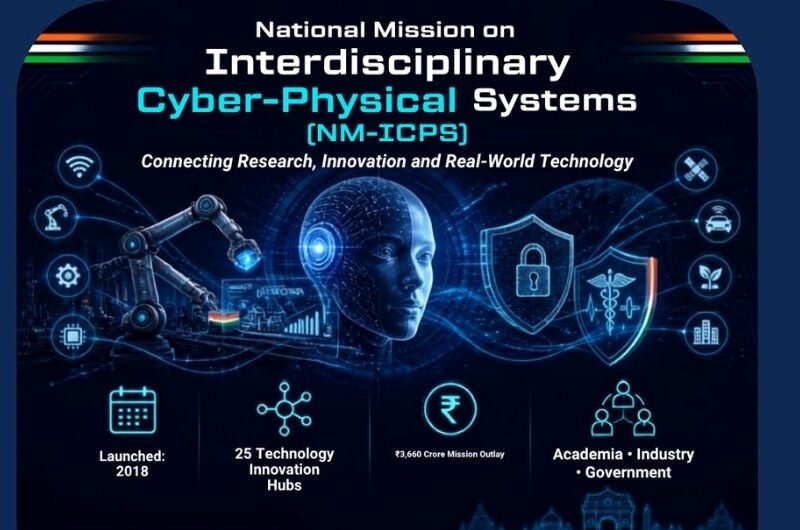
National Mission on Interdisciplinary Cyber-Physical Systems (NM-ICPS)
1. Cyber-Physical Systems (CPS) integrate computation, communication networks and physical processes through sensors, software and real-time data exchange.
2. CPS enables machines to sense their surroundings, analyse information and respond automatically to changing physical conditions.
3. CPS applications include driverless vehicles, smart factories, medical-monitoring devices, smart buildings, cleaning robots and fitness trackers.
4. The Department of Science and Technology implements the National Mission on Interdisciplinary Cyber-Physical Systems (NM-ICPS).
5. The Union Cabinet approved NM-ICPS in 2018 with an outlay of ₹3,660 crore for nine years.
6. NM-ICPS connects academia, industry, government and international organisations across the innovation chain—from research and development to product development, commercialisation and start-up incubation.
7. The Mission has established 25 Technology Innovation Hubs (TIHs) as Section 8 companies at premier academic institutions.
8. TIHs work in four broad areas: technology development; human resource and skill development; innovation, entrepreneurship and start-ups; and international collaboration.
9. In 2025, four high-performing TIHs were selected as Technology Translation Research Parks (TTRPs) to accelerate technology deployment and commercialisation.
10. The four TTRPs are located at IIT Kanpur for cybersecurity, IISc Bengaluru for robotics and artificial intelligence, IIT (ISM) Dhanbad for mining technologies, and IIT Indore for digital healthcare.
11. As of August 2026, NM-ICPS had enabled 1,146 technologies and contributed to 1,329 technology products across sectors such as agriculture, healthcare, mining, cybersecurity and advanced communication.
12. The CHANAKYA Fellowship Programme supports undergraduate, postgraduate, PhD and postdoctoral research on real-world CPS challenges; 5,824 fellowships had been awarded by August 2026.
13. NM-ICPS has trained over 2.46 lakh professionals, incubated 1,136 start-ups and spin-offs, created more than 24,000 jobs, and established 200 international collaborations.
14. BharatGen, led by IIT Bombay, develops sovereign artificial intelligence for Indian languages and contexts. Its Param-2 foundation model has 17 billion parameters and supports all 22 Scheduled Indian languages.
15. NM-ICPS applications include CharakDT digital twin for health simulation, Agri-IoT farm management, mining-monitoring drones, indigenous 5G-Advanced ORAN Massive MIMO technology, IT-OT security operations centres and autonomous-navigation testing facilities.
Must Know Terms :
1.Cyber-Physical Systems (CPS)
CPS integrates computing, communication networks and physical systems through sensors, software and real-time data. It enables machines to sense conditions, analyse information and respond automatically.
2. National Mission on Interdisciplinary Cyber-Physical Systems (NM-ICPS)
Implemented by the Department of Science and Technology, it was approved in 2018 with an outlay of ₹3,660 crore for nine years. It supports CPS research, technology development, skills, start-ups and deployment.
3. Technology Innovation Hubs (TIHs)
TIHs are Section 8 companies hosted by premier academic institutions under NM-ICPS. India has established 25 TIHs for technology development, skill building, innovation, start-ups and international collaboration.
4. Technology Translation Research Parks (TTRPs)
TTRPs convert promising technologies into deployable products and commercial applications. Four TTRPs were selected in 2025 at IIT Kanpur, IISc Bengaluru, IIT (ISM) Dhanbad and IIT Indore.
5. Digital Twin
A digital twin is a live virtual replica of a physical object, process or system. It uses real-time sensor data to monitor, simulate and analyse the performance of its real-world counterpart.
6. BharatGen
BharatGen is an indigenous artificial intelligence initiative led by IIT Bombay under NM-ICPS. Its Param-2 foundation model has 17 billion parameters and supports all 22 Scheduled Indian languages.
MCQ :
1. With reference to Cyber-Physical Systems (CPS), consider the following statements:
1) CPS integrates computing, communication networks and physical processes.
2) CPS uses sensors, software and real-time data exchange.
3) CPS can enable automatic responses to changing physical conditions.
Which of the statements given above are correct?
(a) 1 and 2 only
(b) 2 and 3 only
(c) 1 and 3 only
(d) 1, 2 and 3
2. Which one of the following is not a typical application of Cyber-Physical Systems?
(a) Smart factories
(b) Driverless vehicles
(c) Medical-monitoring devices
(d) Manual typewriters
3. The National Mission on Interdisciplinary Cyber-Physical Systems (NM-ICPS) is implemented by the:
(a) Ministry of Electronics and Information Technology
(b) Department of Science and Technology
(c) NITI Aayog
(d) Department of Telecommunications
4. NM-ICPS was approved by the Union Cabinet in:
(a) 2016
(b) 2017
(c) 2018
(d) 2020
5. The approved outlay for NM-ICPS was:
(a) ₹3,660 crore for nine years
(b) ₹2,660 crore for five years
(c) ₹5,000 crore for ten years
(d) ₹10,000 crore for nine years
6. NM-ICPS connects which of the following across the innovation chain?
1) Academia
2) Industry
3) Government
4) International organisations
Select the correct answer using the code given below.
(a) 1 and 2 only
(b) 1, 2 and 3 only
(c) 2, 3 and 4 only
(d) 1, 2, 3 and 4
7. Technology Innovation Hubs (TIHs) established under NM-ICPS are registered as:
(a) Cooperative societies
(b) Section 8 companies
(c) Statutory regulatory bodies
(d) Public sector banks
8. How many Technology Innovation Hubs have been established under NM-ICPS?
(a) 15
(b) 20
(c) 25
(d) 30
9. Which one of the following is not among the four broad areas of work of Technology Innovation Hubs?
(a) Technology development
(b) Human resource and skill development
(c) Innovation, entrepreneurship and start-up development
(d) Regulation of foreign direct investment
10. Technology Translation Research Parks (TTRPs) are primarily intended to:
(a) Translate promising technologies into deployable and commercial applications
(b) Regulate research funding in universities
(c) Monitor cybercrime investigations
(d) Conduct only basic theoretical research
11. Consider the following pairs:
TTRP — Focus Area
1. IIT Kanpur — Cybersecurity
2. IISc Bengaluru — Robotics and Artificial Intelligence
3. IIT (ISM) Dhanbad — Mining Technologies
4. IIT Indore — Digital Healthcare
Which of the pairs given above are correctly matched?
(a) 1 and 2 only
(b) 1, 2 and 3 only
(c) 2, 3 and 4 only
(d) 1, 2, 3 and 4
12. The CHANAKYA Fellowship Programme supports:
(a) Only school-level robotics education
(b) Undergraduate, postgraduate, PhD and postdoctoral research
(c) Only private-sector employees
(d) Only international students
13. A digital twin is best described as:
(a) A virtual replica of a real-world object, process or system using real-time data
(b) A duplicate physical machine kept as an emergency backup
(c) A computer virus that copies industrial data
(d) A remote-control device used only in factories
14. BharatGen is led by:
(a) IIT Delhi
(b) IISc Bengaluru
(c) IIT Bombay
(d) IIT Kanpur
15. With reference to BharatGen’s Param-2 foundation model, consider the following statements:
1) It has 17 billion parameters.
2) It supports all 22 Scheduled Indian languages.
3) It is developed for Indian-language and Indian-context applications.
Which of the statements given above are correct?
(a) 1 and 2 only
(b) 2 and 3 only
(c) 1 and 3 only
(d) 1, 2 and 3




0 comment