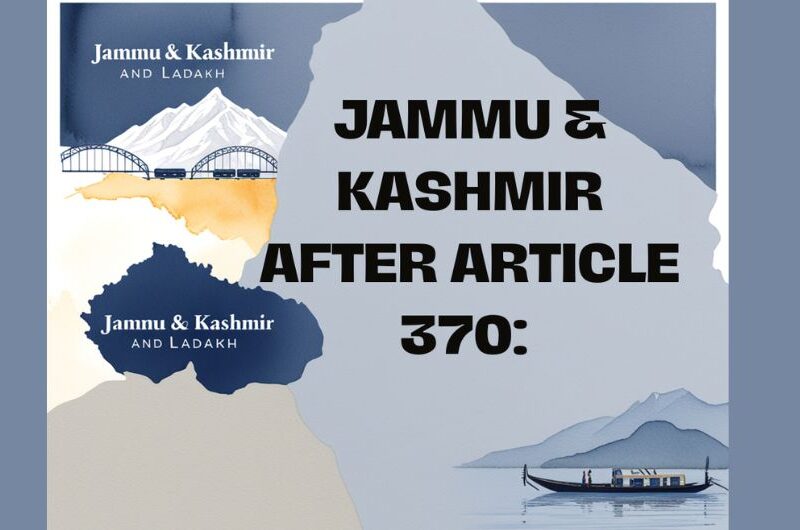
Jammu & Kashmir After Article 370:
Seven Years of Security, Development and Integration
1. Article 370 and Article 35A Changes
On 5 August 2019, Article 370 was effectively rendered inoperative and Article 35A ceased to operate. The earlier special constitutional arrangement of Jammu & Kashmir was replaced by a new legal and administrative framework.
2. Reorganisation into Two Union Territories
The erstwhile State of Jammu & Kashmir was reorganised into two Union Territories — Jammu & Kashmir with a legislature and Ladakh without a legislature.
3. Supreme Court Verdict and Assembly Elections
In December 2023, the Supreme Court upheld the constitutional changes related to Article 370. It directed that Assembly elections be held by September 2024, and the elections were subsequently conducted in 2024.
4. Constitutional Integration and Democratic Consolidation
The post-2019 framework strengthened Jammu & Kashmir’s constitutional integration with India. However, democratic consolidation also depends on representative institutions, public participation and effective governance.
5. Decline in Terrorist Incidents
The security situation has improved substantially. Terrorist-initiated incidents declined from 228 in 2018 to 44 in 2023, while civilian deaths fell from 55 to 13 during the same period.
6. Continuing Security Challenges
Terrorism has not disappeared. Jammu & Kashmir continues to face infiltration attempts, targeted attacks and smaller asymmetric terrorist operations, even though large-scale organised violence has declined.
7. Expansion of Infrastructure
Roads, tunnels, bridges, railways, electricity projects, healthcare facilities and tourism infrastructure have expanded significantly. These projects improve access, mobility, emergency response and economic activity.
8. Chenab Rail Bridge and Strategic Connectivity
The Chenab Rail Bridge is an important symbol of improved rail connectivity between the Kashmir Valley and the wider Indian railway network. Infrastructure also strengthens strategic mobility in a sensitive border region.
9. Tourism Growth
Domestic tourist visits rose from about 2.52 million in 2020 to 23.52 million in 2024. Tourism supports hotels, transport, restaurants, handicrafts, local guides, homestays, retail and adventure activities.
10. Tourism Diversification
Jammu & Kashmir is expanding beyond conventional tourism into adventure, pilgrimage, rural, wellness, agro and heritage tourism. This can help spread economic benefits to lesser-known areas.
11. Investment and Employment Challenge
Infrastructure and policy incentives can attract investment, but the real economic test is actual capital investment, operational enterprises, local value addition and sustainable jobs for youth.
12. Greater Legal and Institutional Integration
Central laws and the broader Indian constitutional framework now apply to Jammu & Kashmir. Changes have affected reservations, domicile rules, property-related regulations, local governance and legal rights of different communities.
13. Return of Electoral Politics
The 2024 Assembly elections restored an elected legislative government after a prolonged gap. Representation, accountability, political competition and local participation remain important for democratic integration.
14. Unresolved Political and Economic Issues
Statehood remains a major political demand. Economic transformation is still incomplete, political trust needs strengthening, and Pakistan-backed cross-border terrorism continues to affect the security environment.
15. Strategic Importance and Future Direction
Jammu & Kashmir is strategically important due to the Line of Control, Line of Actual Control, Ladakh connectivity, Himalayan geography, water resources and India’s relations with Pakistan and China. Its long-term stability depends on security, strong institutions, employment generation, political participation and inclusive development.
Must Know Terms :
1. Delimitation Commission
The Delimitation Commission redraws Assembly and Parliamentary constituency boundaries. In Jammu & Kashmir, the 2022 delimitation exercise increased Assembly seats from 83 to 90 and provided 43 seats for Jammu and 47 for Kashmir.
2. District Development Council (DDC)
District Development Councils are elected bodies created to strengthen district-level local governance in Jammu & Kashmir. Each district has a 14-member DDC.
3. Jammu & Kashmir Domicile Rules, 2020
These rules define who is eligible to be considered a domicile of Jammu & Kashmir for certain government jobs and other benefits. They replaced the earlier permanent resident framework.
4. Union Territory with Legislature
Jammu & Kashmir is a Union Territory with an elected Legislative Assembly. However, subjects such as public order and police remain under the Union Government’s control.
5. Line of Control (LoC)
The LoC is the military control line between India and Pakistan in Jammu & Kashmir. It emerged after the 1949 Karachi Agreement and is different from an internationally recognised border.
6. Counter-Insurgency Grid
The counter-insurgency grid is the coordinated security network of the Army, Central Armed Police Forces, Jammu & Kashmir Police and intelligence agencies. Its role is to prevent infiltration, identify terrorist networks and respond to attacks.
MCQ :
1. With reference to the constitutional changes in Jammu & Kashmir in 2019, consider the following statements:
1. Article 370 was effectively rendered inoperative.
2. Article 35A ceased to operate.
3. The former State was reorganised into Jammu & Kashmir and Ladakh, both with legislatures.
Which of the statements given above are correct?
(a) 1 and 2 only
(b) 2 and 3 only
(c) 1 and 3 only
(d) 1, 2 and 3
2. Jammu & Kashmir differs from Ladakh after the 2019 reorganisation because:
(a) Jammu & Kashmir has no elected Assembly while Ladakh has one
(b) Jammu & Kashmir is a Union Territory with a legislature, while Ladakh is a Union Territory without a legislature
(c) Jammu & Kashmir is a State while Ladakh is a Union Territory
(d) Both are Union Territories with identical legislative powers
3. With reference to the Supreme Court verdict on Article 370, consider the following statements:
1. The verdict was delivered in December 2023.
2. It upheld the constitutional changes related to Article 370.
3. It directed that J&K Assembly elections be conducted by September 2024.
Which of the statements given above are correct?
(a) 1 only
(b) 1 and 2 only
(c) 1, 2 and 3
(d) 2 and 3 only
4. Which one of the following best explains the difference between constitutional integration and democratic consolidation in Jammu & Kashmir?
(a) Constitutional integration relates only to tourism, while democratic consolidation relates only to infrastructure.
(b) Constitutional integration means restoring statehood, while democratic consolidation means abolishing local bodies.
(c) Constitutional integration applies only to Ladakh, while democratic consolidation applies only to Jammu & Kashmir.
(d) Constitutional integration involves legal and administrative changes, while democratic consolidation requires representative institutions and public participation.
5. Consider the following statements regarding the security situation in Jammu & Kashmir:
1. Terrorist-initiated incidents declined from 228 in 2018 to 44 in 2023.
2. Civilian deaths declined from 55 to 13 during the same comparison.
3. The decline in incidents means that terrorism has completely disappeared from the region.
Which of the statements given above are correct?
(a) 1 and 2 only
(b) 2 and 3 only
(c) 1 and 3 only
(d) 1, 2 and 3
6. The changing nature of the security challenge in Jammu & Kashmir is best described as:
(a) A complete end to infiltration and terrorist activity
(b) A shift from large-scale organised violence towards smaller, targeted and asymmetric attacks
(c) A shift from terrorism to only conventional war
(d) A shift from border security to only cyber security
7. Which of the following can be considered developmental as well as strategic benefits of infrastructure expansion in Jammu & Kashmir?
1. Improved access to markets
2. Better emergency and disaster response
3. Enhanced strategic mobility
4. Reduction in the importance of border infrastructure
Select the correct answer using the code below.
(a) 1 and 4 only
(b) 2 and 3 only
(c) 1, 2 and 3 only
(d) 1, 2, 3 and 4
8. With reference to the Chenab Rail Bridge, consider the following statements:
1. It is located in the Reasi district of Jammu & Kashmir.
2. It is part of the railway project linking the Kashmir Valley with the wider Indian railway network.
3. It is the world’s highest railway arch bridge.
Which of the statements given above are correct?
(a) 1 and 2 only
(b) 2 and 3 only
(c) 1 and 3 only
(d) 1, 2 and 3
9. Domestic tourist visits to Jammu & Kashmir increased from about 2.52 million in 2020 to about:
(a) 23.52 million in 2024
(b) 12.52 million in 2022
(c) 25.20 million in 2023
(d) 32.52 million in 2024
10. Which one of the following is not included in the diversification strategy of tourism in Jammu & Kashmir?
(a) Adventure tourism
(b) Wellness tourism
(c) Agro tourism
(d) Deep-sea tourism
11. Which of the following are appropriate indicators for assessing the success of investment policies in Jammu & Kashmir?
1. Actual capital invested
2. Number of operational enterprises
3. Sustainable jobs created
4. Local value addition
Select the correct answer using the code below.
(a) 1 and 2 only
(b) 1, 2, 3 and 4
(c) 2, 3 and 4 only
(d) 1, 3 and 4 only
12. With reference to the Jammu & Kashmir Domicile Rules, 2020, consider the following statements:
1. They define eligibility to be considered a domicile of Jammu & Kashmir.
2. They are relevant for certain government jobs and benefits.
3. They replaced the earlier permanent resident framework.
Which of the statements given above are correct?
(a) 1 and 2 only
(b) 2 and 3 only
(c) 1, 2 and 3
(d) 1 and 3 only
13. Consider the following statements regarding the Delimitation Commission in Jammu & Kashmir:
1. It redraws Assembly and Parliamentary constituency boundaries.
2. The 2022 delimitation exercise increased Assembly seats from 83 to 90.
3. It provided 43 Assembly seats for Jammu and 47 for Kashmir.
Which of the statements given above are correct?
(a) 1 and 2 only
(b) 1, 2 and 3
(c) 2 and 3 only
(d) 1 and 3 only
14. With reference to the Union Territory of Jammu & Kashmir, which of the following subjects remain under the control of the Union Government?
(a) Public order and police
(b) Agriculture and tourism
(c) Local governance and handicrafts
(d) Health and education
15. Consider the following statements:
1. District Development Councils are elected bodies for district-level local governance in Jammu & Kashmir.
2. Each District Development Council has 14 members.
3. The Line of Control is an internationally recognised border between India and Pakistan.
Which of the statements given above are correct?
(a) 1 only
(b) 1 and 3 only
(c) 2 and 3 only
(d) 1 and 2 only


0 comment