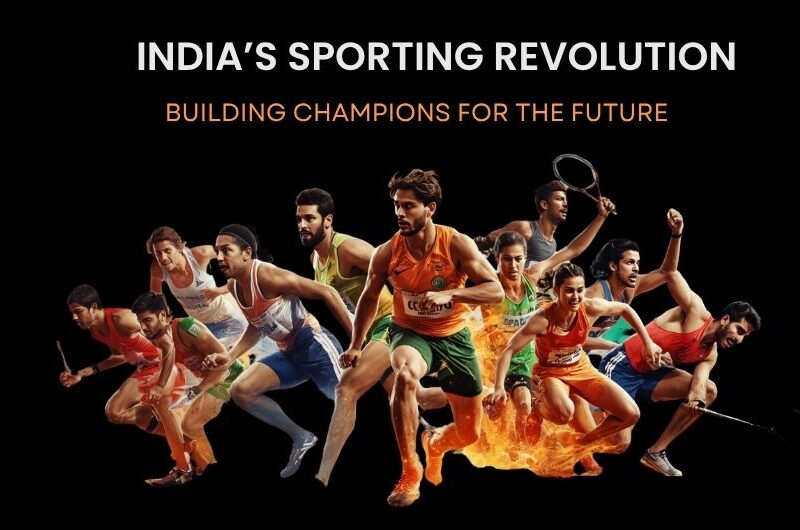
India’s Sporting Revolution: Building Champions for the Future
1. India is participating in its 19th Commonwealth Games in Glasgow 2026, continuing a journey that began with its debut at the 1934 Commonwealth Games.
2. The Commonwealth Games 2026 are being held in Glasgow, Scotland, from 23 July to 2 August 2026.
3. Mirabai Chanu won India’s first gold medal at the Commonwealth Games 2026, becoming the first Indian to secure three consecutive Commonwealth Games titles.
4. The Union Budget 2026–27 allocated a record ₹4,479.88 crore to the Ministry of Youth Affairs and Sports, compared to ₹1,219 crore in 2013–14.
5. Launched in 2017, the Khelo India Scheme integrated the Rajiv Gandhi Khel Abhiyan, Urban Sports Infrastructure Scheme, and National Sports Talent Search Scheme into a single programme.
6. As of July 2026, the Khelo India Scheme has approved 349 sports infrastructure projects with an investment of ₹3,176 crore.
7. The Khelo India ecosystem includes 1,067 Khelo India Centres, 267 academies, and supports 2,745 Khelo India Athletes through coaching, equipment, medical care, and financial assistance.
8. Since 2018, more than 63,000 athletes have participated in various Khelo India Games, including Youth, University, Winter, Para, Beach, Water Sports, and Tribal Games.
9. The Target Olympic Podium Scheme (TOPS), launched in September 2014 and revamped in 2018, provides foreign training, specialised coaching, equipment, and monthly stipends to elite athletes.
10. As of April 2026, TOPS supports 51 Core Athletes, 52 Para Core Athletes, and 130 Development Athletes.
11. The Khelo India Rising Talent Identification (KIRTI) initiative identifies sporting talent among children aged 9–18 years using Artificial Intelligence, data analytics, and scientific assessment methods.
12. As of 2026, KIRTI operates 174 Talent Assessment Centres and has completed 1,87,921 talent assessments.
13. The Union Budget 2026–27 announced a dedicated ₹500 crore initiative to promote sports goods manufacturing and strengthen India’s position as a global sports equipment hub.
14. India’s best-ever Asian Games performance came at Hangzhou 2023, where it won a record 107 medals, including 28 gold medals.
15. At the Commonwealth Games 2026, India is represented by a 124-member contingent comprising 78 male and 46 female athletes, and had won four medals (1 Gold, 2 Silver, 1 Bronze) as of 27 July 2026.
Must Know Terms :
1. Khelo India Scheme: Launched in 2017, the Khelo India Scheme is the Government of India’s flagship programme for sports development. It integrates talent identification, sports infrastructure, athlete training, coaching, sports science, and competitions to strengthen the country’s sporting ecosystem.
2. Target Olympic Podium Scheme (TOPS): Introduced in September 2014, TOPS provides financial assistance, foreign training, international exposure, specialized coaching, equipment, and monthly stipends to elite Olympic and Paralympic athletes. As of April 2026, it supports 51 Core Athletes, 52 Para Core Athletes, and 130 Development Athletes.
3. Khelo India Rising Talent Identification (KIRTI): KIRTI identifies sporting talent among children aged 9–18 years using Artificial Intelligence, data analytics, and standardized fitness assessments. By 2026, it operates 174 Talent Assessment Centres and has completed over 1.87 lakh assessments.
4. Khelo India Centres (KICs): Khelo India Centres are grassroots training facilities established across the country to provide coaching, equipment, and sports infrastructure at the district level. As of July 2026, 1,067 centres have been established to nurture young athletes.
5. Commonwealth Games (CWG): The Commonwealth Games are a multi-sport event held every four years among Commonwealth nations. India first participated in 1934 and made its 19th appearance at the Glasgow 2026 Commonwealth Games, where Mirabai Chanu won her third consecutive CWG gold medal.
6. Sports Authority of India (SAI): Established in 1984 under the Ministry of Youth Affairs and Sports, the Sports Authority of India is the apex body responsible for implementing sports development programmes, managing national training centres, supporting elite athletes, and executing flagship schemes such as Khelo India and TOPS.
MCQ :
1. With reference to the Commonwealth Games 2026, consider the following statements:
1. They are being held in Glasgow, Scotland.
2. India is making its 19th appearance at the Commonwealth Games.
3. India first participated in the Commonwealth Games in 1934.
Which of the statements given above are correct?
(a) 1 and 2 only
(b) 2 and 3 only
(c) 1 and 3 only
(d) 1, 2 and 3
2. Mirabai Chanu created history at the Commonwealth Games 2026 by:
(a) Becoming India’s first Olympic gold medallist
(b) Winning India’s first gold medal at Glasgow and her third consecutive Commonwealth Games title
(c) Winning India’s first Paralympic medal
(d) Becoming the youngest Commonwealth champion
3. The Khelo India Scheme was launched in:
(a) 2014
(b) 2015
(c) 2017
(d) 2019
4. Which of the following schemes were merged to create the Khelo India Scheme?
1. Rajiv Gandhi Khel Abhiyan
2. Urban Sports Infrastructure Scheme
3. National Sports Talent Search Scheme
Select the correct answer using the code below.
(a) 1 and 2 only
(b) 2 and 3 only
(c) 1 and 3 only
(d) 1, 2 and 3
5. As of July 2026, the Khelo India Scheme has approved:
(a) 267 sports infrastructure projects
(b) 349 sports infrastructure projects
(c) 1,067 sports infrastructure projects
(d) 2,745 sports infrastructure projects
6. Which of the following statements regarding Khelo India are correct?
1. More than 1,000 Khelo India Centres have been established.
2. The scheme supports Khelo India Athletes through coaching and medical care.
3. More than 63,000 athletes have participated in Khelo India Games since 2018.
(a) 1 and 2 only
(b) 2 and 3 only
(c) 1 and 3 only
(d) 1, 2 and 3
7. The Target Olympic Podium Scheme (TOPS) was launched in:
(a) 2012
(b) 2014
(c) 2016
(d) 2018
8. Assertion (A): TOPS aims to improve India’s Olympic and Paralympic performances.
Reason (R): It provides elite athletes with foreign training, specialised coaching, equipment, and financial assistance.
(a) Both A and R are true, and R is the correct explanation of A.
(b) Both A and R are true, but R is not the correct explanation of A.
(c) A is true, but R is false.
(d) A is false, but R is true.
9. The Khelo India Rising Talent Identification (KIRTI) initiative identifies sporting talent among children belonging to which age group?
(a) 5–10 years
(b) 9–18 years
(c) 12–21 years
(d) 15–25 years
10. KIRTI uses which of the following technologies?
1. Artificial Intelligence
2. Data Analytics
3. Standardised Talent Assessment Protocols
Select the correct answer using the code below.
(a) 1 and 2 only
(b) 2 and 3 only
(c) 1 and 3 only
(d) 1, 2 and 3
11. The Union Budget 2026–27 announced a dedicated allocation of ₹500 crore for:
(a) Olympic Village Development
(b) Sports Goods Manufacturing
(c) National Sports University
(d) Rural Sports Infrastructure
12. India’s best-ever performance at the Asian Games was recorded at:
(a) Incheon 2014
(b) Jakarta 2018
(c) Hangzhou 2023
(d) Paris 2024
13. Which of the following statements regarding the Commonwealth Games 2026 are correct?
1. India is represented by a 124-member contingent.
2. The contingent includes 78 male and 46 female athletes.
3. As of 27 July 2026, India had won one gold, two silver, and one bronze medal.
(a) 1 and 2 only
(b) 2 and 3 only
(c) 1 and 3 only
(d) 1, 2 and 3
14. The Sports Authority of India (SAI) was established in:
(a) 1982
(b) 1984
(c) 1986
(d) 1988
15. Which of the following initiatives are directly aimed at strengthening India’s sporting ecosystem?
1. Khelo India Scheme
2. Target Olympic Podium Scheme (TOPS)
3. Khelo India Rising Talent Identification (KIRTI)
4. Khelo India Centres (KICs)
Select the correct answer using the code below.
(a) 1, 2 and 3 only
(b) 2, 3 and 4 only
(c) 1, 3 and 4 only
(d) 1, 2, 3 and 4

0 comment