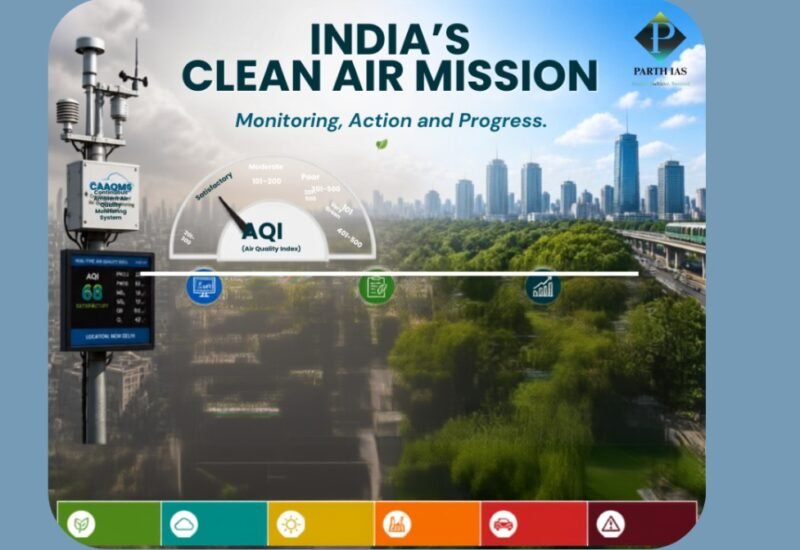
India’s Clean Air Mission: Monitoring, Action and Progress
1. The International Day of Clean Air for Blue Skies is observed on 7 September. The United Nations General Assembly designated the day in 2019.
2. India observes the occasion as Swachh Vayu Diwas, linking global clean-air action with national efforts.
3. Particulate Matter (PM) includes tiny solid or liquid particles suspended in air. PM10 has a diameter of 10 micrometres or less, while PM2.5 has a diameter of 2.5 micrometres or less.
4. PM2.5 particles can penetrate deep into the respiratory system and may enter the bloodstream, increasing health risks.
5. The National Ambient Air Quality Monitoring Programme (NAMP) monitors ambient air pollution, tracks air-quality trends and identifies violations of prescribed standards.
6. As of March 2026, India had 1,646 ambient air-quality monitoring stations across 603 cities in 28 States and 7 Union Territories.
7. Continuous Ambient Air Quality Monitoring Systems (CAAQMS) provide real-time data, while manual monitoring stations collect air samples periodically for laboratory analysis.
8. The SAMEER mobile application and web portal provide near real-time Air Quality Index (AQI) information for more than 292 cities.
9. India’s AQI is based on eight pollutants: PM10, PM2.5, nitrogen dioxide, sulphur dioxide, carbon monoxide, ozone, ammonia and lead.
10. AQI has six categories: Good (0–50), Satisfactory (51–100), Moderate (101–200), Poor (201–300), Very Poor (301–400) and Severe (401–500).
11. The National Clean Air Programme (NCAP) was launched in 2019 in 130 cities to reduce urban air pollution through source-specific clean-air action plans.
12. Under NCAP, ₹16,423.55 crore was provided to 130 cities between FY 2019–20 and FY 2025–26 through air-quality performance-linked grants.
13. In FY 2025–26, 108 NCAP cities recorded lower annual PM10 levels than in 2017–18; 72 cities achieved reductions above 20%, while 26 achieved reductions above 40%.
14. PRANA, or Portal for Regulation of Air-Pollution in Non-Attainment Cities, tracks the physical and financial progress of NCAP city action plans.
15. Swachh Vayu Survekshan is an annual assessment of NCAP cities launched in 2022–23. In 2025, Indore topped the category of cities with a population of 10 lakh or more, Amravati led the 3–10 lakh category, and Dewas led the below-3 lakh category.
Must Know Terms :
1.National Clean Air Programme (NCAP)
A national programme launched in 2019 to improve air quality in 130 cities. It uses city-specific action plans to control pollution from transport, industries, dust, waste burning and other major sources.
2. Particulate Matter (PM)
Tiny solid particles and liquid droplets suspended in the air. PM10 has a diameter of 10 micrometres or less, while PM2.5 has a diameter of 2.5 micrometres or less and can enter deep into the lungs.
3. Air Quality Index (AQI)
A scale that communicates daily air-quality conditions and their likely health effects. It uses eight pollutants and classifies air quality from Good to Severe on a scale of 0 to 500.
4. Continuous Ambient Air Quality Monitoring System (CAAQMS)
An automated system that provides continuous, real-time data on pollutants such as PM2.5, PM10, sulphur dioxide, nitrogen oxides, carbon monoxide, ozone and ammonia.
5. PRANA Portal
Portal for Regulation of Air-Pollution in Non-Attainment Cities. It monitors the physical and financial progress of city clean-air action plans under the National Clean Air Programme.
6. Graded Response Action Plan (GRAP)
An emrgency framework for the National Capital Region that introduces progressively stricter measures as air quality worsens. It covers actions such as dust control, restrictions on construction and industrial activities, and vehicle-related measures.
MCQ :
1. The International Day of Clean Air for Blue Skies is observed on:
(a) 7 September
(b) 5 June
(c) 22 April
(d) 16 September
2. India observes the International Day of Clean Air for Blue Skies as:
(a) Vayu Raksha Diwas
(b) Swachh Vayu Diwas
(c) Paryavaran Diwas
(d) Prithvi Diwas
3. With reference to Particulate Matter, consider the following statements:
1) PM10 consists of particles with a diameter of 10 micrometres or less.
2) PM2.5 consists of particles with a diameter of 2.5 micrometres or less.
3) PM2.5 particles cannot enter the respiratory system.
Which of the statements given above are correct?
(a) 1 and 2 only
(b) 2 and 3 only
(c) 1 and 3 only
(d) 1, 2 and 3
4. Which one of the following is the main function of the National Ambient Air Quality Monitoring Programme (NAMP)?
(a) Managing municipal solid waste
(b) Issuing Pollution Under Control certificates
(c) Monitoring ambient air pollution and air-quality trends
(d) Regulating import of petroleum products
5. As of March 2026, India had how many ambient air-quality monitoring stations?
(a) 1,646
(b) 603
(c) 130
(d) 292
6. Which one of the following correctly describes Continuous Ambient Air Quality Monitoring Systems (CAAQMS)?
(a) They collect samples only once a year.
(b) They provide automated, real-time ambient air-quality data.
(c) They monitor only industrial wastewater.
(d) They are used only for weather forecasting.
7. The SAMEER mobile application and web portal provide near real-time Air Quality Index information for:
(a) More than 130 cities
(b) More than 603 cities
(c) More than 292 cities
(d) More than 1,646 cities
8. India’s Air Quality Index is based on how many pollutants?
(a) Six
(b) Eight
(c) Ten
(d) Twelve
9. Which one of the following AQI ranges is correctly matched with its category?
(a) Good — 51–100
(b) Poor — 101–200
(c) Very Poor — 201–300
(d) Severe — 401–500
10. With reference to the National Clean Air Programme (NCAP), consider the following statements:
1) It was launched in 2019.
2) It covers 130 cities.
3) It promotes source-specific clean-air action plans.
Which of the statements given above are correct?
(a) 1 and 2 only
(b) 1 and 3 only
(c) 1, 2 and 3
(d) 2 and 3 only
11. In FY 2025–26, how many NCAP cities recorded lower annual PM10 concentrations than in 2017–18?
(a) 72
(b) 108
(c) 26
(d) 130
12. PRANA portal is associated with:
(a) Tracking the implementation of NCAP city action plans
(b) Registration of electric vehicles
(c) Monitoring forest fires
(d) Issuing industrial licences
13. Swachh Vayu Survekshan was launched in:
(a) 2019–20
(b) 2020–21
(c) 2022–23
(d) 2025–26
14. Which city topped the Swachh Vayu Survekshan 2025 category for cities with a population of 10 lakh or more?
(a) Dewas
(b) Amravati
(c) Lucknow
(d) Indore
15. The Graded Response Action Plan (GRAP) is an emergency response framework mainly applicable to:
(a) National Capital Region
(b) Himalayan Region
(c) Coastal Regulation Zone
(d) North Eastern Region



0 comment