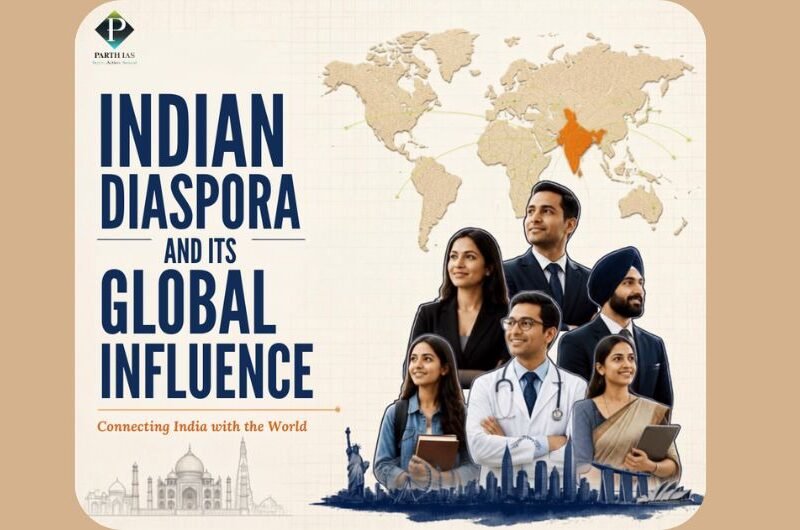
Indian Diaspora and Its Global Influence
1. The Indian diaspora includes Indian citizens and people of Indian origin living outside India, either temporarily or permanently.
2. India has the world’s largest overseas population, with approximately 35 million people of Indian origin living across more than 200 countries.
3. Non-Resident Indians (NRIs) are Indian citizens who ordinarily reside outside India for employment, education, business or other purposes.
4. Overseas Citizens of India (OCIs) are foreign citizens of Indian origin who receive certain immigration and economic benefits in India.
5. OCI status is not dual citizenship. OCI cardholders cannot vote, contest elections, hold constitutional offices or purchase agricultural land in India.
6. The Person of Indian Origin (PIO) and OCI card schemes were merged in 2015, creating a single OCI framework.
7. During the colonial period, Indian indentured labourers, commonly known as Girmitiyas, were taken to places such as Mauritius, Fiji, Guyana, Suriname, Trinidad and other Caribbean territories.
8. Between the 1950s and 1980s, many Indian doctors, engineers, scientists and other professionals migrated to the United States, United Kingdom and Western Europe.
9. From the 1970s, the oil boom encouraged large-scale migration of Indian workers to the Gulf Cooperation Council (GCC) countries.
10. Modern Indian migration also includes information-technology professionals, entrepreneurs and students moving to countries such as the United States, Canada and Australia.
11. India is the world’s largest recipient of remittances, receiving approximately US$138 billion in recent estimates.
12. The Indian diaspora supports investment, entrepreneurship, technology transfer, knowledge exchange and the growth of Indian start-ups.
13. Overseas Indians strengthen India’s cultural influence by promoting yoga, Ayurveda, Indian cuisine, cinema and festivals across the world.
14. Pravasi Bharatiya Divas is observed on 9 January, marking Mahatma Gandhi’s return from South Africa to India in 1915.
15. The MADAD portal supports consular grievance redressal, while the e-Migrate system protects overseas workers and regulates recruitment for foreign employment.
Must Know Terms :
1.Indian Diaspora
Indian citizens and people of Indian origin who live outside India temporarily or permanently. They maintain cultural, social, economic or emotional links with India.
2. Non-Resident Indian (NRI)
An Indian citizen who ordinarily resides outside India for employment, education, business or other purposes. An NRI continues to hold Indian citizenship and an Indian passport.
3. Overseas Citizen of India (OCI)
A foreign citizen of Indian origin who receives lifelong multiple-entry access to India and certain economic and educational benefits. OCI status is not dual citizenship and does not provide voting rights.
4. Girmitiyas
Indian indentured labourers taken during the colonial period to plantations in Mauritius, Fiji, Guyana, Suriname, Trinidad and other territories. The term originated from the word “agreement.”
5. Remittances
Money transferred by overseas Indians to their families or other recipients in India. Remittances support household income, consumption and India’s balance of payments.
6. Pravasi Bharatiya Divas (PBD)
An event observed on 9 January to strengthen engagement between India and its overseas community. The date marks Mahatma Gandhi’s return from South Africa to India in 1915.
MCQ :
- Which one of the following best describes the Indian diaspora?
(a) Only Indian citizens employed in foreign countries
(b) Indian citizens and people of Indian origin living outside India
(c) Only foreign citizens studying in India
(d) Only OCI cardholders residing in India
- With reference to the Indian diaspora, consider the following statements:
- It is the largest overseas population in the world.
- It comprises approximately 35 million people.
- It is spread across more than 200 countries.
Which of the statements given above are correct?
(a) 1 and 2 only
(b) 2 and 3 only
(c) 1, 2 and 3
(d) 1 and 3 only
- A Non-Resident Indian (NRI) is:
(a) A foreign citizen of Indian origin
(b) An Indian citizen ordinarily residing outside India
(c) A foreign citizen permanently residing in India
(d) An OCI cardholder who has acquired Indian citizenship
- With reference to Overseas Citizen of India (OCI) status, consider the following statements:
- It amounts to dual citizenship.
- It provides voting rights in India.
- It permits an OCI cardholder to contest elections in India.
Which of the statements given above is/are correct?
(a) 1 only
(b) 2 and 3 only
(c) 1 and 3 only
(d) None of the above
- Which one of the following rights is not available to an OCI cardholder?
(a) Voting in Indian elections
(b) Lifelong multiple-entry access to India
(c) Certain economic benefits in India
(d) Certain educational benefits in India
- The Person of Indian Origin (PIO) and Overseas Citizen of India (OCI) card schemes were merged in:
(a) 2010
(b) 2015
(c) 2017
(d) 2020
- The term “Girmitiyas” is associated with:
(a) Indian soldiers serving in colonial armies
(b) Indian traders settled in Southeast Asia
(c) Indian indentured labourers transported during the colonial period
(d) Indian professionals who migrated after Independence
- Which of the following were major destinations of Indian indentured labourers?
- Mauritius
- Fiji
- Guyana
- Suriname
Select the correct answer using the code given below:
(a) 1 and 2 only
(b) 2 and 3 only
(c) 1, 3 and 4 only
(d) 1, 2, 3 and 4
- Which phase of Indian migration was characterised by the movement of doctors, engineers and scientists to Western countries?
(a) The post-Independence period between the 1950s and 1980s
(b) The colonial indentured-labour period
(c) The pre-colonial maritime-trade period
(d) The Gulf oil-boom period alone
- Large-scale migration of Indian workers to Gulf countries from the 1970s was primarily encouraged by:
(a) The Green Revolution
(b) The Gulf oil boom
(c) The decline of maritime trade
(d) The abolition of indentured labour
- Which of the following groups are prominent in modern Indian migration?
- Information-technology professionals
- Entrepreneurs
- Students
Select the correct answer using the code given below:
(a) 1 only
(b) 1 and 2 only
(c) 1, 2 and 3
(d) 2 and 3 only
- Remittances are best described as:
(a) Loans provided by international organisations to India
(b) Foreign investment made exclusively in government securities
(c) Taxes paid by overseas Indians to foreign governments
(d) Money transferred by overseas Indians to recipients in India
- The Indian diaspora contributes to India through:
- Investment and entrepreneurship
- Technology transfer
- Knowledge exchange
- Promotion of Indian culture
Select the correct answer using the code given below:
(a) 1, 2, 3 and 4
(b) 1 and 2 only
(c) 2, 3 and 4 only
(d) 1 and 4 only
- Pravasi Bharatiya Divas is observed on 9 January to commemorate:
(a) The launch of the OCI scheme
(b) Mahatma Gandhi’s return from South Africa to India
(c) The abolition of indentured labour
(d) The merger of the PIO and OCI schemes
- Which one of the following pairs is correctly matched?
(a) MADAD Portal — Regulation of foreign investment
(b) e-Migrate System — Granting voting rights to OCI cardholders
(c) MADAD Portal — Consular grievance redressal
(d) Pravasi Bharatiya Divas — Observed on 2 October



0 comment