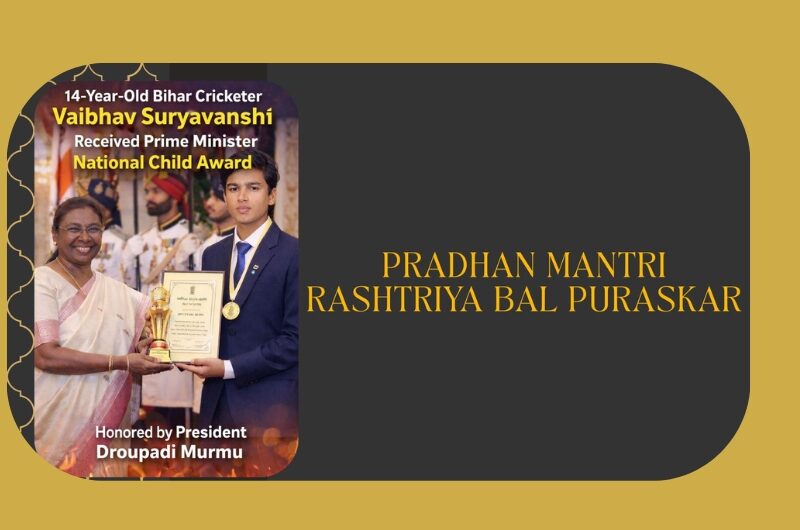
Honouring India’s Young Achievers
1. The Pradhan Mantri Rashtriya Bal Puraskar (PMRBP) is India’s premier national award recognising exceptional achievements of children aged 5 to 18 years.
2. The award is presented annually by the President of India on Veer Bal Diwas, observed on 26 December.
3. PMRBP has been conferred since 2019, and a total of 203 children have received the award.
4. The award consists of a medal, a certificate, and a citation.
5. The award recognises excellence in six categories: Bravery, Social Service, Environment, Sports, Art and Culture, and Science and Technology.
6. Veer Bal Diwas commemorates the martyrdom of Sahibzada Zorawar Singh and Sahibzada Fateh Singh, the sons of Guru Gobind Singh.
7. Sahibzada Zorawar Singh and Sahibzada Fateh Singh were 9 and 7 years old respectively when they were martyred on 26 December 1704 for refusing to renounce their faith.
8. Around 25 PMRBP awards are conferred each year across the six notified categories.
9. For PMRBP 2026, nominees must be Indian citizens and residents of India and must be between 5 and 18 years of age as on 31 July 2026.
10. The achievement or act for which the nomination is made must have occurred within two years preceding the nomination deadline of 31 July 2026.
11. Previous recipients of the Pradhan Mantri Rashtriya Bal Puraskar are not eligible to receive the award again in any category.
12. Any individual, institution, or the child through self-nomination can submit nominations for the award.
13. Nominations can also be recommended by authorities such as Central Ministers, Chief Ministers, Governors, Members of Parliament, District Magistrates, and recognised educational institutions.
14. The awards committee is constituted by the Union Minister for Women and Child Development and is chaired by the Secretary of the Ministry of Women and Child Development.
15. The Ministry of Women and Child Development bears the cost of round-trip economy travel, local transport, boarding, and lodging for awardees and up to two parents or guardians attending the ceremony in New Delhi.
Must Know Terms :
1. Pradhan Mantri Rashtriya Bal Puraskar (PMRBP): Instituted in 2019, PMRBP is India’s premier national award for children aged 5–18 years who demonstrate exceptional achievements in fields such as Bravery, Social Service, Environment, Sports, Art and Culture, and Science and Technology. The award is presented annually by the President of India.
2. Veer Bal Diwas: Observed every year on 26 December, Veer Bal Diwas commemorates the martyrdom of Sahibzada Zorawar Singh and Sahibzada Fateh Singh, the young sons of Guru Gobind Singh, who sacrificed their lives in 1704 for refusing to abandon their faith.
3. Sahibzada Zorawar Singh and Sahibzada Fateh Singh: Aged 9 and 7 years respectively at the time of their martyrdom, they are remembered for their extraordinary courage, moral conviction, and steadfast commitment to their beliefs despite immense adversity.
4. Award Categories: The Pradhan Mantri Rashtriya Bal Puraskar recognises excellence in six fields—Bravery, Social Service, Environment, Sports, Art and Culture, and Science and Technology. Around 25 awards are conferred each year across these categories.
5. Eligibility Criteria: Children nominated for the award must be Indian citizens and residents, between 5 and 18 years of age as on 31 July 2026. The recognised achievement must have occurred within two years before the nomination deadline, and previous awardees are generally not eligible for another award.
6. Ministry of Women and Child Development (MWCD): The Ministry administers the Pradhan Mantri Rashtriya Bal Puraskar, constitutes the awards committee, oversees the selection process, and bears the travel, boarding, and lodging expenses of awardees and up to two accompanying parents or guardians.
Key Takeaways
The Pradhan Mantri Rashtriya Bal Puraskar is India’s premier national honour dedicated to celebrating the exceptional resilience, courage, creativity, and indomitable spirit of young citizens aged 5 to 18. Conferred annually by the Hon’ble President of India at a special ceremony in New Delhi, the award recognizes outstanding achievements across six distinct categories: Bravery, Social Service, Environment, Sports, Art and Culture, and Science and Technology. By scheduling this prestigious presentation on Veer Bal Diwas (26th December)—a day dedicated to honouring the historical sacrifice and moral fortitude of the young sons of Guru Gobind Singh—the Government of India bridges contemporary youth excellence with a timeless legacy of conviction.
MCQ :
1. With reference to the Pradhan Mantri Rashtriya Bal Puraskar (PMRBP), consider the following statements:
1. It recognises exceptional achievements of children aged 5 to 18 years.
2. It is presented annually by the President of India.
3. It is conferred on Republic Day every year.
Which of the statements given above is/are correct?
A. 1 and 2 only
B. 2 and 3 only
C. 1 and 3 only
D. 1, 2 and 3
2. PMRBP has been conferred since:
A. 2014
B. 2017
C. 2019
D. 2021
3. Which one of the following correctly lists all the categories under the Pradhan Mantri Rashtriya Bal Puraskar?
A. Bravery, Sports, Literature, Science, Environment and Defence
B. Bravery, Social Service, Environment, Sports, Art and Culture, and Science and Technology
C. Bravery, Innovation, Governance, Sports, Music and Education
D. Bravery, Agriculture, Environment, Sports, Art and Public Administration
4. Veer Bal Diwas is observed every year on:
A. 14 November
B. 24 December
C. 25 December
D. 26 December
5. With reference to Sahibzada Zorawar Singh and Sahibzada Fateh Singh, consider the following statements:
1. They were the sons of Guru Gobind Singh.
2. They were martyred on 26 December 1704.
3. They were aged 9 and 7 years respectively.
How many of the above statements are correct?
A. Only one
B. Only two
C. All three
D. None
6. Around how many Pradhan Mantri Rashtriya Bal Puraskar awards are conferred annually?
A. 10
B. 15
C. 25
D. 50
7. For PMRBP 2026, the age of nominees should be between:
A. 3 and 16 years
B. 5 and 18 years
C. 6 and 18 years
D. 8 and 21 years
8. With reference to PMRBP nominations, consider the following statements:
1. The recognised achievement must have occurred within two years before the nomination deadline.
2. Previous recipients are generally not eligible to receive the award again in any category.
Which of the statements given above is/are correct?
A. 1 only
B. 2 only
C. Both 1 and 2
D. Neither 1 nor 2
9. Who among the following can nominate a child for the Pradhan Mantri Rashtriya Bal Puraskar?
1. Any individual
2. Any institution
3. The child through self-nomination
Select the correct answer using the code below.
A. 1 and 2 only
B. 2 and 3 only
C. 1 and 3 only
D. 1, 2 and 3
10. Which of the following authorities may recommend nominations for PMRBP?
1. Central Ministers
2. Chief Ministers
3. Members of Parliament
4. District Magistrates
Select the correct answer using the code below.
A. 1 and 2 only
B. 3 and 4 only
C. 1, 2 and 3 only
D. 1, 2, 3 and 4
11. The awards committee for the Pradhan Mantri Rashtriya Bal Puraskar is constituted by the:
A. President of India
B. Prime Minister of India
C. Union Minister for Women and Child Development
D. Cabinet Secretary
12. The awards committee for PMRBP is chaired by the:
A. Secretary of the Ministry of Women and Child Development
B. Chairperson of NITI Aayog
C. Chief Justice of India
D. Secretary of the Ministry of Education
13. Which one of the following is NOT a component of the Pradhan Mantri Rashtriya Bal Puraskar?
A. Medal
B. Certificate
C. Citation
D. Cash grant guaranteed by statute
14. The Ministry of Women and Child Development bears the expenses for:
1. Round-trip economy travel
2. Local transport
3. Boarding and lodging
4. Up to two parents or guardians accompanying the awardee
Select the correct answer using the code below.
A. 1 and 2 only
B. 3 and 4 only
C. 1, 2 and 3 only
D. 1, 2, 3 and 4
15. Which one of the following best describes the objective of the Pradhan Mantri Rashtriya Bal Puraskar?
A. To recognise only academic excellence among school students
B. To honour exceptional achievements of children in diverse fields and inspire young talent
C. To provide scholarships exclusively for higher education abroad
D. To recognise only national-level sports champions

0 comment