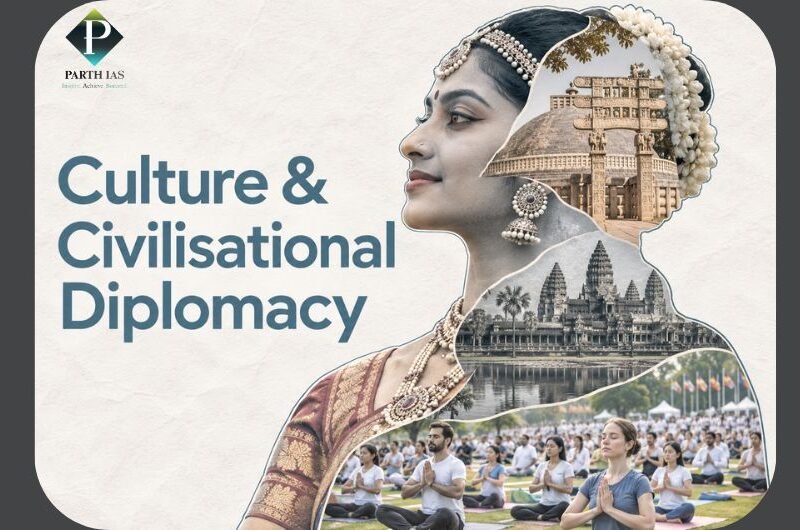
Culture & Civilisational Diplomacy
Culture and Civilisational Diplomacy in India’s Foreign Policy
Culture and civilisational diplomacy form an important part of India’s foreign policy. They involve the use of India’s ancient heritage, shared historical connections, spiritual traditions and cultural influence to build international trust and strengthen strategic partnerships. India’s cultural diversity, philosophical traditions and historical links with other civilisations contribute to its diplomatic influence and global engagement.
Core Concepts
Cultural Diplomacy: Cultural diplomacy uses art, music, cinema, cuisine, literature and language to promote mutual understanding and friendly relations between countries. It operates through Soft Power, which refers to the ability to influence others through attraction, cultural appeal and persuasion rather than military force or economic pressure.
Civilisational Diplomacy: Civilisational diplomacy focuses on historical, philosophical, religious and cultural connections shared by different societies over centuries. India’s approach reflects the philosophy of Vasudhaiva Kutumbakam (The World Is One Family), emphasizing peaceful coexistence, mutual respect and cooperation among nations.
Key Pillars and Instruments
India promotes its cultural and civilisational connections through spiritual traditions, heritage conservation, cultural institutions, government initiatives and engagement with the Indian diaspora.
Spiritual and Wellness Heritage: India promotes Yoga and Ayurveda internationally as traditional systems supporting physical, mental and holistic well-being. The International Day of Yoga, recognized by the United Nations (UN), is observed annually on 21 June, with participation across more than 190 countries.
Buddhist Diplomacy: India, as the birthplace of Buddhism, maintains strong historical and religious connections with East and Southeast Asian countries. Buddhist diplomacy includes the development of the Buddhist Tourism Circuit, international Buddhist conferences, cultural exchanges and the preservation of important Buddhist heritage sites.
Heritage Restoration Abroad: The Archaeological Survey of India (ASI) works with the Ministry of External Affairs to conserve and restore historic monuments in other countries. Important heritage conservation projects include Angkor Wat in Cambodia, Wat Phu in Laos and the Prambanan Temple complex in Indonesia. These projects strengthen India’s historical and cultural connections with Asian civilisations.
Institutional Outreach: The Indian Council for Cultural Relations (ICCR) promotes Indian culture through cultural centres abroad, international festivals, artistic performances, academic exchanges and educational scholarships. Programmes such as the General Cultural Scholarship Scheme (GCSS) support foreign students pursuing higher education in India.
Government Schemes: The Ministry of Culture promotes international cultural engagement through initiatives such as the Global Engagement Scheme (GES). Important cultural initiatives also include Project Mausam, which highlights historical maritime trade and cultural connections across the Indian Ocean, and Brihattar Bharat, which emphasizes India’s historical civilisational and cultural links with other regions.
Gift Diplomacy and GI Products: Indian leaders present traditional handicrafts, handlooms, paintings and regional artworks to foreign dignitaries as diplomatic gifts. Products carrying a Geographical Indication (GI) tag, such as Kalamkari paintings and Muga silk, represent India’s regional artistic traditions, craftsmanship and cultural heritage.
Diaspora Engagement: The Indian diaspora plays an important role in promoting Indian culture and strengthening people-to-people relations. Programmes such as Pravasi Bharatiya Divas (PBD) and the Know India Programme (KIP) encourage overseas Indians to maintain connections with their cultural roots and participate in India’s international cultural engagement.
Strategic Significance for India
Countering Geopolitical Rivalry: India’s historical and civilisational connections with South and Southeast Asian countries strengthen diplomatic goodwill and regional cooperation. Shared Buddhist heritage, cultural exchanges and historical relationships also provide India with a means of balancing China’s growing economic and political influence in the region.
Economic and Tourism Boost: Cultural diplomacy promotes international tourism, traditional handicrafts, regional art forms and Indian wellness practices. The development of Buddhist tourism circuits, heritage destinations and traditional medicine centres supports local employment, increases tourism revenue and creates export opportunities for artisans and cultural industries.
Multilateral Leadership: India uses international platforms such as the Group of Twenty (G20) to showcase its democratic traditions, cultural diversity and civilisational heritage. The concept of India as the “Mother of Democracy” highlights its historical traditions of public participation and collective decision-making. Cultural diplomacy also strengthens India’s position as an important representative of the Global South.
Challenges and Way Forward
Resource Constraints: India’s financial resources for international cultural outreach, cultural centres and ICCR programmes remain limited compared with the extensive cultural networks maintained by countries such as China through its Confucius Institutes. Limited funding affects the expansion of cultural programmes, international exhibitions and institutional partnerships.
Translating Soft Power into Hard Gains: Cultural influence helps generate goodwill, improve international perceptions and strengthen diplomatic relationships. However, these benefits do not always produce immediate economic advantages, trade concessions or strategic agreements. Converting cultural influence into measurable diplomatic and economic outcomes remains an important challenge.
Infrastructure Gaps: Several cultural and religious tourism destinations in India, particularly those along the Buddhist Circuit, require improvements in transport connectivity, accommodation, sanitation, visitor facilities and heritage management. Inadequate infrastructure limits the potential of these destinations to attract international tourists and religious visitors.
Way Forward: India’s cultural diplomacy can be strengthened through greater investment in cultural institutions, wider use of digital diplomacy and improved international cultural exchanges. Linking cultural engagement with trade, tourism, education and technology partnerships can increase its economic and diplomatic value. Stronger coordination among government institutions, cultural organizations and the Indian diaspora can further expand India’s global cultural influence.
Must Know Terms :
1. Soft Power
The ability of a country to influence other nations through cultural attraction, shared values, education and diplomacy rather than military force or economic pressure. India’s Yoga, Ayurveda, cinema and spiritual heritage are important sources of soft power.
2. Cultural Diplomacy
The use of art, music, literature, language, cuisine and cultural exchanges to build mutual understanding and strengthen international relations. It promotes national identity, diplomatic goodwill and people-to-people connections.
3. Civilisational Diplomacy
The use of shared historical, religious, philosophical and cultural traditions to strengthen relations between countries. India’s Buddhist heritage and the philosophy of Vasudhaiva Kutumbakam support its civilisational engagement with other nations.
4. Buddhist Diplomacy
The use of India’s Buddhist heritage to strengthen cultural and diplomatic relations, particularly with East and Southeast Asian countries. It includes Buddhist tourism circuits, international conferences, cultural exchanges and heritage conservation.
5. Diaspora Diplomacy
Engagement with citizens and communities of Indian origin living abroad to strengthen cultural, economic and diplomatic relations. Initiatives such as Pravasi Bharatiya Divas (PBD) and the Know India Programme (KIP) encourage cultural connections with India.
6. Gift Diplomacy
The practice of presenting culturally significant gifts to foreign dignitaries to express goodwill and strengthen diplomatic relationships. India frequently uses traditional handicrafts, artworks and Geographical Indication (GI)-tagged products to showcase its cultural heritage.
MCQ :
1. Consider the following statements regarding the concept of Cultural Diplomacy and Soft Power:

1. Cultural diplomacy promotes international understanding through cultural attraction, communication and persuasion rather than coercion.

2. Cultural diplomacy necessarily requires the establishment of formal military alliances before cultural exchanges can take place.

3. Art, music, cinema, literature, language and cuisine can serve as instruments of cultural diplomacy.

4. Soft Power primarily refers to the ability of a country to compel other states through military force and economic sanctions.

How many of the above statements are correct?

(a) Only three

(b) Only one

(c) Only two

(d) Only four
2. With reference to India's approach to Civilisational Diplomacy, consider the following statements:

1. Civilisational diplomacy focuses exclusively on contemporary popular culture and excludes historical or philosophical connections.

2. Shared religious, historical and philosophical traditions provide an important foundation for civilisational diplomacy.

3. The philosophy of Vasudhaiva Kutumbakam requires India to establish exclusive strategic alliances with countries sharing identical religious traditions.

4. The concept of Vasudhaiva Kutumbakam emphasizes peaceful coexistence, mutual respect and cooperation among nations.

Which of the statements given above are correct?

(a) 1 and 3 only

(b) 2 and 4 only

(c) 1 and 4 only

(d) 2 and 3 only
3. Consider the following statements regarding India's Spiritual and Wellness Diplomacy:

1. The International Day of Yoga is observed annually on 21 June and has been recognized by the United Nations.

2. India's international promotion of Ayurveda is restricted exclusively to the export of pharmaceutical products and excludes holistic wellness practices.

3. Yoga and Ayurveda serve as instruments of India's cultural influence by promoting physical, mental and holistic well-being.

4. The International Day of Yoga was established by the Indian Council for Cultural Relations without any involvement of the United Nations.

How many of the above statements are correct?

(a) Only two

(b) Only four

(c) Only one

(d) Only three
4. Consider the following statements regarding India's Buddhist Diplomacy:

1. The Buddhist Tourism Circuit and international Buddhist conferences contribute to India's cultural engagement with East and Southeast Asian countries.

2. India's Buddhist diplomacy is restricted exclusively to domestic religious institutions and excludes international cultural exchanges.

3. Buddhist diplomacy originated as an economic programme designed to replace historical religious connections with compulsory trade agreements.

4. India's Buddhist diplomacy operates primarily through military alliances rather than shared religious heritage and cultural exchanges.

How many of the above statements are correct?

(a) Only three

(b) Only four

(c) Only two

(d) Only one
5. Consider the following pairs regarding India’s heritage conservation activities abroad:
| Heritage Site / Institution | Location / Responsibility |
|---|---|
| 1. Angkor Wat | – Cambodia |
| 2. Wat Phu | – Indonesia |
| 3. Prambanan Temple Complex | – Indonesia |
| 4. Archaeological Survey of India | – Institution restricted exclusively to conservation projects within India’s territorial boundaries. |
How many of the above pairs are correctly matched?

(a) Only one

(b) Only two

(c) Only three

(d) Only four
6. With reference to the Indian Council for Cultural Relations (ICCR), consider the following statements:

1. The General Cultural Scholarship Scheme is administered exclusively by the United Nations rather than Indian cultural institutions.

2. ICCR promotes cultural exchanges through international festivals, artistic performances and educational scholarships.

3. The Archaeological Survey of India is the principal institution responsible for administering ICCR scholarships for foreign students.

4. ICCR operates cultural centres abroad and supports educational opportunities for foreign students studying in India.

Which of the statements given above are correct?

(a) 1 and 2 only

(b) 1 and 3 only

(c) 2 and 4 only

(d) 3 and 4 only
7. Consider the following pairs regarding India’s cultural engagement initiatives:
| Initiative | Primary Objective |
|---|---|
| 1. Project Mausam | – Highlighting historical maritime trade and cultural connections across the Indian Ocean. |
| 2. Global Engagement Scheme | – Establishing military bases abroad under the Ministry of Defence. |
| 3. Brihattar Bharat | – Emphasizing India’s historical civilisational and cultural connections with other regions. |
| 4. Project Mausam | – Introducing compulsory customs duties on international maritime trade. |
How many of the above pairs are correctly matched?

(a) Only two

(b) Only three

(c) Only four

(d) Only one
8. Consider the following statements regarding Gift Diplomacy and Geographical Indication (GI) products:

1. GI-tagged products can represent the distinctive regional craftsmanship and cultural traditions of India.

2. India's gift diplomacy relies exclusively on imported industrial products and excludes traditional handicrafts and artworks.

3. Kalamkari paintings and Muga silk are examples of culturally significant products associated with India's regional heritage.

4. Gift diplomacy is a compulsory judicial procedure through which states settle territorial disputes by exchanging valuable objects.

Which of the statements given above are correct?

(a) 1 and 2 only

(b) 2 and 3 only

(c) 3 and 4 only

(d) 1 and 3 only
9. Consider the following statements regarding India's Diaspora Diplomacy:

1. Pravasi Bharatiya Divas and the Know India Programme strengthen cultural connections between India and overseas Indian communities.

2. Diaspora diplomacy is confined exclusively to domestic cultural events and excludes the participation of overseas Indians.

3. The Know India Programme was established to replace international cultural centres and prohibit artistic exchanges between India and foreign countries.

4. Indian diaspora communities are excluded from cultural diplomacy because they have no role in strengthening people-to-people relations.

How many of the above statements are correct?

(a) Only two

(b) Only three

(c) Only one

(d) Only four
10. Consider the following statements regarding the strategic and economic significance of India's Cultural Diplomacy:

1. Shared Buddhist heritage and historical relationships contribute to diplomatic goodwill between India and countries of South and Southeast Asia.

2. The promotion of Indian handicrafts and traditional art forms necessarily reduces export opportunities and employment for local artisans.

3. Cultural tourism, heritage destinations and traditional wellness practices can contribute to employment generation and foreign tourism revenue.

4. Cultural diplomacy has no connection with economic relations because cultural exchanges cannot influence tourism or commercial opportunities.

How many of the above statements are correct?

(a) Only four

(b) Only one

(c) Only three

(d) Only two
11. With reference to India's cultural engagement through multilateral institutions, consider the following statements:

1. India uses platforms such as the G20 to highlight its cultural diversity, democratic traditions and civilisational heritage.

2. The concept of India as the Mother of Democracy was introduced to reject historical traditions of public participation and collective decision-making.

3. The designation Mother of Democracy is a legally binding status granted exclusively through a formal treaty of the G20.

4. Cultural diplomacy weakens India's engagement with the Global South because it prevents cooperation based on shared historical and cultural connections.

How many of the above statements are correct?

(a) Only two

(b) Only one

(c) Only four

(d) Only three
12. Consider the following statements regarding the challenges of India's Cultural Diplomacy:

1. India's cultural outreach institutions possess unlimited financial resources, eliminating the need for additional institutional investment.

2. Limited financial resources can restrict the international expansion of cultural centres, exhibitions and exchange programmes.

3. Diplomatic goodwill created through cultural influence does not necessarily result in immediate trade concessions or strategic agreements.

4. The successful promotion of cultural traditions automatically guarantees economic agreements and eliminates the need for conventional diplomacy.

Which of the statements given above are correct?

(a) 2 and 3 only

(b) 1 and 4 only

(c) 1 and 3 only

(d) 2 and 4 only
13. Consider the following pairs regarding institutional mechanisms of India’s Cultural Diplomacy:
| Institution / Programme | Function |
|---|---|
| 1. General Cultural Scholarship Scheme | – Supporting educational opportunities for foreign students in India. |
| 2. Pravasi Bharatiya Divas | – International judicial mechanism for resolving maritime disputes. |
| 3. Global Engagement Scheme | – Promoting India’s international cultural engagement. |
| 4. Know India Programme | – Conducting compulsory military training exercises with foreign armed forces. |
How many of the above pairs are correctly matched?

(a) Only two

(b) Only one

(c) Only four

(d) Only three
14. With reference to strengthening India's cultural and civilisational diplomacy, consider the following statements:

1. Digital diplomacy is incompatible with cultural exchanges and must replace traditional cultural institutions entirely.

2. Linking cultural exchanges with trade, tourism and educational partnerships can increase their diplomatic and economic impact.

3. Indian diaspora communities have no role in expanding cultural influence because international cultural engagement is restricted to government institutions.

4. Improving connectivity, hospitality services and heritage management can strengthen the international appeal of India's Buddhist tourism destinations.

Which of the statements given above are correct?

(a) 1 and 3 only

(b) 2 and 4 only

(c) 1 and 4 only

(d) 2 and 3 only
15. Consider the following pairs regarding India’s cultural and civilisational diplomacy:
| Instrument | Characteristic |
|---|---|
| 1. International Day of Yoga | – Observed annually on 21 June as a UN-recognized international observance. |
| 2. Indian Council for Cultural Relations | – Institution responsible primarily for establishing military bases and defence installations abroad. |
| 3. Cultural Diplomacy through Multilateral Platforms | – Showcasing India’s cultural diversity and democratic traditions through forums such as the G20. |
| 4. Heritage Conservation Abroad | – Restricted exclusively to monuments located within India’s national boundaries. |
How many of the above pairs are correctly matched?

(a) Only three

(b) Only one

(c) Only two

(d) Only four

0 comment