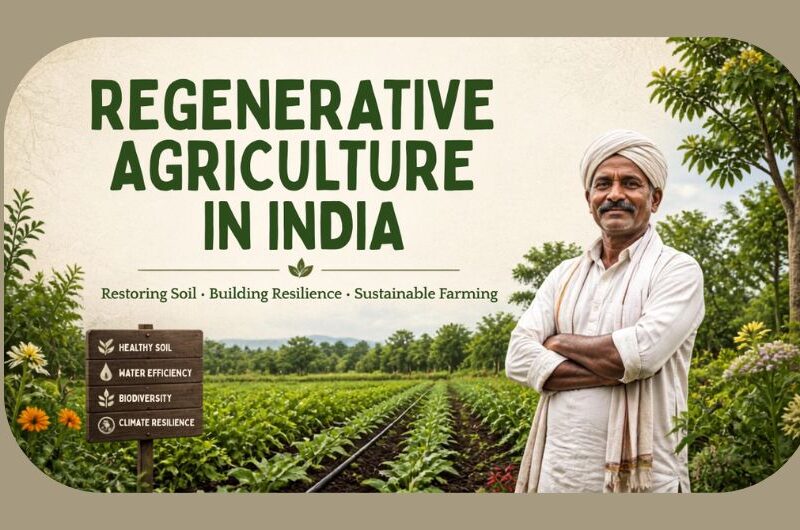
Regenerative Agriculture in India
1. India’s agriculture and allied sectors recorded a decadal growth rate of 4.45 percent during Financial Year 2015–16 to Financial Year 2024–25, the highest among recent decades.
2. Regenerative agriculture is a holistic farming approach that seeks to actively restore soil health, enhance biodiversity, improve carbon storage and strengthen resilience against droughts, heatwaves, floods and other climate stresses.
3. Its main principles include minimum soil disturbance, maintenance of soil cover, protection of living roots, integration of livestock, limited chemical inputs and greater biodiversity.
4. Important regenerative practices include natural farming, micro-irrigation, farm mechanisation, nitrogen fertiliser management, green manuring, cover cropping, mulching, integrated farming systems and agroforestry.
5. Natural farming is a chemical-free approach based on on-farm biological inputs such as Beejamrut, Jeevamrut, GhanJeevamrut, Neemastra and Dashparni. It promotes traditional seeds, multi-cropping, mulching, cover crops, livestock integration and minimum soil disturbance.
6. Green manuring adds organic matter and nutrients by incorporating crops into soil; cover cropping protects soil from erosion and supports nutrient cycling; mulching conserves moisture, regulates temperature and suppresses weeds.
7. Integrated Farming Systems (IFS) combine crops, livestock, fisheries, horticulture, agroforestry and apiculture. They promote crop rotation, intercropping, multi-cropping and mixed farming to diversify income and reduce climate-related risks.
8. Agroforestry combines trees with crops and plantations. It improves soil moisture, regulates local temperature, stores carbon, restores degraded rainfed land and provides farmers with additional income.
9. The National Mission on Natural Farming (NMNF) was launched in 2024. It provides an incentive of Rs. 4,000 per acre per year for two years, up to one acre per farmer, and supports 10,000 need-based Bio-input Resource Centres.
10. As of 5 March 2026, NMNF had formed 18,786 natural farming clusters covering 8.80 lakh hectares and enrolling 18.19 lakh farmers. It had also trained 33,676 Community Resource Persons through Krishi Vigyan Kendras, Agricultural Universities and local natural farming institutions.
11. Paramparagat Krishi Vikas Yojana (PKVY) was launched in 2015 to promote organic farming. It provides Rs. 31,500 per hectare over three years, and had covered 16.90 lakh hectares as of 31 October 2025.
12. Per Drop More Crop (PDMC), implemented since 2015–16, promotes drip and sprinkler irrigation. It provides 55 percent financial assistance to small and marginal farmers and 45 percent to other farmers; about 109 lakh hectares had been covered by May 2026 with central assistance of Rs. 26,325 crore.
13. The Rainfed Area Development Programme (RAD), implemented since 2014–15, promotes IFS through clusters of about 20 hectares. It provides Rs. 30,000 per family for IFS and Rs. 10,000 per cluster for training; it had covered 9.53 lakh hectares and benefited 15.73 lakh farmers by December 2025.
14. The Agroforestry Component under Pradhan Mantri Rashtriya Krishi Vikas Yojana supports nurseries, sapling production, tissue culture, research and carbon-market projects. In 2025–26, Rs. 78.31 crore was sanctioned to 27 States and Union Territories, leading to 135 new nurseries and around 176.59 lakh saplings.
15. The Soil Health Card Scheme, launched in 2015, gives plot-wise soil test reports on 12 parameters and crop-specific nutrient recommendations every two years. As of 13 March 2026, 25.89 crore cards had been generated, 7.17 lakh demonstrations conducted and 70,002 Krishi Sakhis trained.
Must Know Terms :
1.Regenerative Agriculture
Regenerative agriculture restores soil health, improves biodiversity and strengthens resilience against climate stresses. It goes beyond maintaining farms by improving their ecological condition.
2. Natural Farming
Natural farming is a chemical-free farming system based on on-farm biological inputs such as Jeevamrut and Beejamrut. It promotes local seeds, mulching, multi-cropping and livestock integration.
3. Micro-Irrigation
Micro-irrigation supplies water directly to crops through drip and sprinkler systems. It reduces water wastage and improves farm-level water-use efficiency.
4. Integrated Farming System
An Integrated Farming System combines crops with livestock, fisheries, horticulture, agroforestry and apiculture. It diversifies farm income and reduces the risk of crop failure.
5. Agroforestry
Agroforestry integrates trees with crops or livestock on the same land. It improves soil moisture, stores carbon and provides additional income to farmers.
6. Soil Health Card
A Soil Health Card provides plot-wise soil test results on 12 soil parameters. It gives crop-specific advice on the use of fertilisers, bio-fertilisers, organic inputs and soil treatments.
MCQ :
1. With reference to regenerative agriculture, consider the following statements:
1. It seeks to restore soil health and enhance biodiversity.
2. It aims to improve carbon storage and resilience against climate stresses.
3. It only seeks to maintain existing soil conditions without improving them.
Which of the statements given above are correct?
(a) 1 and 2 only
(b) 2 and 3 only
(c) 1 and 3 only
(d) 1, 2 and 3
2. Which of the following are principles of regenerative agriculture?
1. Minimum soil disturbance
2. Maintenance of soil cover
3. Integration of livestock
4. Greater biodiversity
Select the correct answer using the code given below:
(a) 1 and 2 only
(b) 2 and 3 only
(c) 1, 2, 3 and 4
(d) 1, 3 and 4 only
3. Natural farming is best described as:
(a) farming based entirely on imported chemical inputs
(b) cultivation limited only to plantation crops
(c) farming without livestock integration
(d) a chemical-free approach based on on-farm biological inputs
4. Which one of the following is not an on-farm biological input used in natural farming?
(a) Beejamrut
(b) Urea
(c) Jeevamrut
(d) Neemastra
5. With reference to soil health management practices, consider the following statements:
1. Green manuring adds organic matter and nutrients to the soil.
2. Cover cropping protects soil from erosion and supports nutrient cycling.
3. Mulching helps conserve moisture and suppress weeds.
Which of the statements given above are correct?
(a) 1 and 2 only
(b) 2 and 3 only
(c) 1 and 3 only
(d) 1, 2 and 3
6. Integrated Farming Systems combine:
(a) crops, livestock, fisheries, horticulture, agroforestry and apiculture
(b) only crops and chemical fertilisers
(c) only livestock and fisheries
(d) only plantation crops and forestry
7. Agroforestry can help in:
1. Improving soil moisture
2. Regulating local temperature
3. Storing carbon
4. Restoring degraded rainfed land
Select the correct answer using the code given below:
(a) 1 and 2 only
(b) 2 and 3 only
(c) 1, 2, 3 and 4
(d) 1, 3 and 4 only
8. The National Mission on Natural Farming was launched in:
(a) 2021
(b) 2024
(c) 2015
(d) 2018
9. Under the National Mission on Natural Farming, the incentive provided is:
(a) Rs. 4,000 per hectare for one year
(b) Rs. 10,000 per acre for two years
(c) Rs. 31,500 per hectare for three years
(d) Rs. 4,000 per acre per year for two years, up to one acre per farmer
10. As of 5 March 2026, natural farming clusters under the National Mission on Natural Farming covered:
(a) 8.80 lakh hectares
(b) 16.90 lakh hectares
(c) 9.53 lakh hectares
(d) 109 lakh hectares
11. Paramparagat Krishi Vikas Yojana provides financial assistance of:
(a) Rs. 4,000 per acre per year for two years
(b) Rs. 30,000 per family
(c) Rs. 31,500 per hectare over three years
(d) Rs. 55,000 per hectare over five years
12. Per Drop More Crop provides financial assistance for micro-irrigation at the rate of:
(a) 100 percent for all farmers
(b) 55 percent for small and marginal farmers and 45 percent for other farmers
(c) 45 percent for small and marginal farmers and 55 percent for other farmers
(d) 50 percent for all farmers
13. With reference to the Rainfed Area Development Programme, consider the following statements:
1. It has been implemented since 2014–15.
2. It promotes Integrated Farming Systems through an area-based cluster approach.
3. Clusters of about 20 hectares are developed under the programme.
4. It provides Rs. 30,000 per family for adopting Integrated Farming Systems.
Which of the statements given above are correct?
(a) 1 and 2 only
(b) 2 and 3 only
(c) 1, 3 and 4 only
(d) 1, 2, 3 and 4
14. The Agroforestry Component is implemented under:
(a) Pradhan Mantri Rashtriya Krishi Vikas Yojana
(b) Paramparagat Krishi Vikas Yojana
(c) Per Drop More Crop
(d) Soil Health Card Scheme
15. With reference to the Soil Health Card Scheme, consider the following statements:
1. It was launched in 2015.
2. It provides plot-wise soil test reports on 12 parameters.
3. Soil Health Cards are issued every two years.
4. As of 13 March 2026, 25.89 crore cards had been generated.
Which of the statements given above are correct?
(a) 1 and 2 only
(b) 2 and 3 only
(c) 1, 2, 3 and 4
(d) 1, 3 and 4 only




0 comment