Best UPSC and MPPSC IAS Coaching Classes in Gwalior

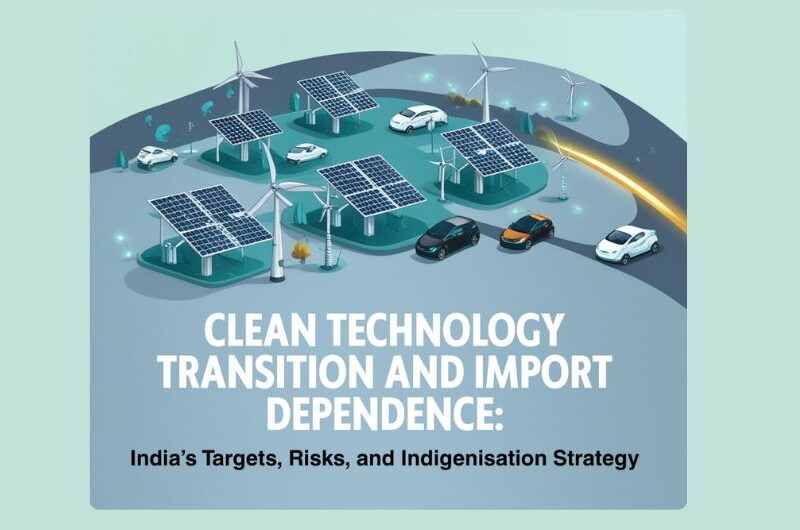
Clean Technology Transition and Import Dependence: India’s Targets, Risks, and Indigenisation Strategy

Clean Technology Transition and Import Dependence: India’s Targets, Risks, and Indigenisation Strategy   1. India has declared a net zero emissions target for 2070 and targets 50% of energy from non-fossil sources by 2030, requiring accelerated deployment and reliable grid integration. 2. India targets 30% of new vehicle sales as electric by 2030, implying large-scale charging rollout, battery ecosystem expansion, and industrial capacity for motors, controllers, and cells. 3. The power system scale is stated as 442 GW installed capacity, with renewables at 33% and hydropower at 11%, indicating a growing but not yet dominant clean capacity mix. 4. Rapid renewable installation growth is presented as supporting confidence in meeting 2030 clean energy objectives ahead of schedule, driven by targeted policy incentives and reduced investor uncertainty. 5. Renewable energy capacity is stated to have grown eightfold between 2010 and 2023, with falling solar and wind costs cited as key enablers alongside procurement mechanisms. 6. Clean transition scale-up is described as expanding venture capital participation through policy stability and financial innovations across clean technology segments and investment pipelines. 7. Scale-up is framed as creating startup and MSME opportunities across manufacturing and services value chains, linking domestic entrepreneurship to deployment, O&M, and component supply. 8. Cleantech expenditure is stated as $68 billion in 2023, about 40% higher than average spending during 2016–2020, signalling a step-change in annual investment intensity. 9. Capturing transition benefits is linked to indigenising supply chains and building domestic manufacturing for critical components while addressing high capital costs that reduce project viability. 10. Supply chain bottlenecks and local technology expertise gaps are identified as constraints slowing indigenisation, limiting competitiveness, and sustaining reliance on imported upstream inputs. 11. Import dependence is framed as a strategic risk in a fragmented economy with export controls; clean technology dependence is compared to oil dependence in vulnerability terms. 12. Import dependence is stated to range from 20% to 90% across cleantech segments, showing uneven exposure and differing readiness of domestic ecosystems by technology. 13. Segment dependence is stated as: solar 80%, wind 60%, BESS 75–90%, e-mobility components 60–70%, green hydrogen 90%, and bioenergy 20–30% import dependent. 14. Without policy action, cleantech imports are projected at $85–110 billion by 2030 and $140–300 billion by 2040, approaching the magnitude of the oil import bill. 15. Strategy stresses Made in India capacity plus partnerships: PLI, duties, linked auctions, technology transfer, finance alliances, market access, and rapid execution amid infrastructure, logistics, R&D, and machinery constraints. Must Know Terms :   1.Net Zero 2070 Net Zero 2070: India announced the net-zero target year as 2070 at COP26 (Glasgow) on 2 November 2021. The same announcement listed “Panchamrit” targets for 2030: (i) 500 GW non-fossil electricity capacity, (ii) 50% of energy requirements from renewables, (iii) 45% reduction in emissions intensity of GDP, (iv) 1 billion tonnes reduction in projected cumulative emissions, and (v) net-zero by 2070. 2.Import Dependence Range Import Dependence Range: India’s dependence differs by fuel and is often expressed as import dependency (%). Crude oil import dependency is around the high-80% range in recent years; natural gas import dependency is roughly around half; coal imports remain large in absolute terms (hundreds of million tonnes annually) even with rising domestic production, indicating continued exposure to global supply and price shocks across multiple fuels. 3.Cleantech Spend 2023 Cleantech Spend 2023: Global energy investment in 2023 was about US$2.8 trillion, with more than US$1.7 trillion directed to clean energy (renewables, grids, storage, nuclear, low-emission fuels, efficiency, electrification). The remaining slightly over US$1 trillion went to unabated fossil fuel supply and power. A commonly cited ratio for 2023 is: for every US$1 spent on fossil fuels, about US$1.7 was spent on clean energy. 4.Techno-Nationalism and Export Controls Techno-Nationalism and Export Controls: Export controls are state tools to restrict access to strategic technologies (chips, advanced tools, software, know-how) for security and industrial policy goals. The U.S. imposed major advanced computing and semiconductor-related export controls on 7 Oct 2022, expanded/updated them on 17 Oct 2023, updated again on 2 Dec 2024, and further strengthened restrictions on 15 Jan 2025—tightening access to high-end chips and key chipmaking capabilities. 5.PLI and Manufacturing-Linked Auctions PLI and Manufacturing-Linked Auctions: India’s PLI scheme for High-Efficiency Solar PV Modules has an outlay of ₹24,000 crore. Official parliamentary reporting notes large realised investments and job creation under this scheme by late 2024. Separately, “manufacturing-linked” solar procurement has been used in competitive bidding—capacity awards for solar generation were linked with domestic manufacturing commitments, including documented examples of 12,000 MW solar linked with 3,000 MW manufacturing, and an additional “Green Shoe Option” linking extra capacity with manufacturing, with tariffs around ₹2.92/kWh in earlier award records. 6.Indigenisation Constraints Indigenisation Constraints: Local manufacturing faces constraints from concentrated global chokepoints—frontier lithography tools, specialty chemicals/materials, ultra-pure gases, precision components, and IP. Advanced nodes rely on extremely complex equipment ecosystems; access limitations (including export controls) can slow timelines, increase costs, and force dependence on older-generation tools. This creates a practical gap between policy intent (localisation) and achievable near-term capability, especially in semiconductors and high-end cleantech supply chains. MCQ 1. India’s declared net zero emissions target year is: (a) 2030 (b) 2050 (c) 2070 (d) 2100 2. India’s 2030 target for energy from non-fossil sources is: (a) 25% (b) 40% (c) 50% (d) 70% 3. India’s target for electric share of new vehicle sales by 2030 is: (a) 15% (b) 30% (c) 45% (d) 60% 4. India’s total installed energy capacity is stated as: (a) 242 GW (b) 342 GW (c) 442 GW (d) 542 GW 5. Renewables are stated as what percent of installed capacity? (a) 11% (b) 22% (c) 33% (d) 50% 6. Hydropower is stated as what percent of installed capacity? (a) 5% (b) 11% (c) 18% (d) 33% 7. Renewable energy capacity is stated to have grown how much between 2010 and 2023? (a) Twofold (b) Fourfold (c) Eightfold (d) Tenfold 8. Cleantech expenditure in 2023 is stated as: (a) $28 billion (b) $48 billion (c) $68 billion (d) $88 billion 9. The 2023

More Details
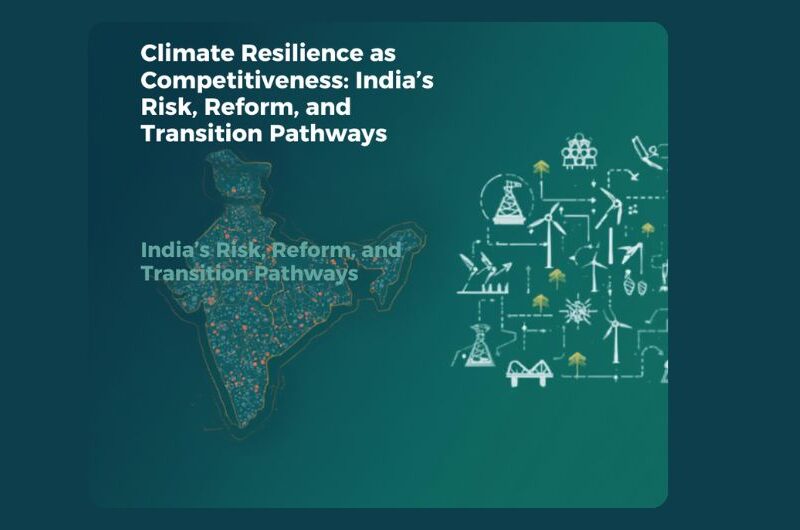
Climate Resilience as Competitiveness: India’s Risk, Reform, and Transition Pathways

Climate Resilience as Competitiveness: India’s Risk, Reform, and Transition Pathways     1. National competitiveness is increasingly tied to resilience: the capacity to manage cascading climate risks, protect livelihoods, and sustain growth during simultaneous heatwaves, floods, cyclones, and droughts nationwide. 2. India’s recent experience with pandemic, global economic shocks, and converging climate threats shows crises can occur together or in quick succession, changing planning assumptions for policy and firms. 3. Competitiveness is no longer judged only by GDP or exports, because repeated climate disruption can erase gains, weaken long-term prosperity, and undermine national stability and services. 4. Resilience functions as a metric for inclusive prosperity by safeguarding livelihoods, maintaining essential services, and keeping growth stable during repeated climate shocks and recovery cycles. 5. Late twentieth century debates linked competitiveness with innovation, investment attraction, and export performance; India’s 1991 reforms emphasised liberalisation, efficiency, market dynamism, and services exports. 6. Standards of progress evolve; AI, digital platforms, and supply-chain shifts reshape competitiveness, while global markets increasingly value policy coherence, predictability, productive ecosystems, and institutional capacity. 7. Historical development brought gains with major costs: Panama Canal (1880–1914), Industrial Revolution pollution, and colonial extraction caused human suffering, deforestation, soil exhaustion, displacement, and cultural loss. 8. Man-made disasters illustrate catastrophic risk: Bhopal (1984) and Chernobyl (1986) produced long-lasting health and environmental impacts, underscoring the need for safeguards and oversight. 9. Mega infrastructure shows tradeoffs: Three Gorges displaced over one million and altered ecosystems; Aswan High Dam reduced silt deposition, affected fertility and fisheries, and relocated Nubian communities. 10. Policy frames development, security, and environmental preservation as interlinked priorities; Great Nicobar debate highlights ecological risks, disaster exposure, and tribal impacts alongside strategic and economic goals. 11. Heat stress already cuts average labour productivity by 5.7% in lower-middle-income countries; by 2030, India could lose 34 million job equivalents or about $450 billion output annually. 12. Highly exposed workers include construction, agriculture, and informal sectors, converting climate stress into macroeconomic competitiveness losses, especially where cooling, safety, and work redesign are limited. 13. Agriculture supports livelihoods for over 40% of India’s workforce; climate variability could reduce unirrigated farm incomes by up to 25%, widening rural vulnerability and regional disparities. 14. Recurrent shocks show persistence: Assam floods, Bundelkhand droughts, 2019 Chennai water crisis, and Cyclone Amphan 2020 causing $13 billion damages strain infrastructure and budgets. 15. 2010–2020 climate disasters cost India about $87 billion annually, near 3% of GDP; transition strategies link decarbonisation, circular economy, renewables scaling, and job creation to competitiveness.   Must Know Terms: 1.Resilience Metric Resilience Metric: A hard, trackable score used to compare “risk-to-loss reduction” across countries/projects. Under the Sendai Framework, progress is monitored using 7 global targets (A–G) and 38 indicators (mortality, affected people, direct economic loss, damage to critical infrastructure/basic services, DRR strategies, international cooperation, early warning/risk information). The World Bank’s Resilience Rating System (RRS) rates projects from C to A+ on two dimensions and was piloted on 21 projects in FY21–FY22.   2.Heat Stress Productivity Loss Heat Stress Productivity Loss: Measurable output loss when heat/humidity reduces safe working time or forces slower work, especially in agriculture and construction. ILO projects that by 2030, 2.2% of total global working hours will be lost due to heat stress—equivalent to about 80 million full-time jobs and about US$2.4 trillion in annual economic losses. For India, McKinsey estimates lost labor hours from heat/humidity could put ~2.5–4.5% of GDP at risk by 2030 (≈ US$150–250 billion).   3.Climate Disaster Fiscal Drain Climate Disaster Fiscal Drain: Quantified pressure on public finances after disasters—relief + reconstruction outlays, revenue shortfalls, and higher debt/interest. IMF research finds public debt rises by about 2.5% of GDP in disaster years on average (lower growth + lower tax revenue + higher spending). India-specific IMF staff analysis reports fiscal costs from disasters ranging roughly 0.5% to 5.2% of state-level GDP, illustrating how repeated shocks can crowd out capex and social spending. 4.Great Nicobar Strategic Infrastructure Great Nicobar Strategic Infrastructure: Official project scope for “Integrated Development” includes (i) International Container Transshipment Terminal (ICTT) at Galathea Bay with planned capacity 14.2 million TEU, (ii) Township & Area Development, and (iii) 450 MVA gas-and-solar power plant, over a stated project area of 16,610 hectares in Great Nicobar. The Environment Ministry clearance letter cites File No. 10/17/2021-IA.III and is dated 11.11.2022 (EC & CRZ clearance). 5.Carbon-Linked Trade Regimes Carbon-Linked Trade Regimes: Trade systems where market access/cost is tied to embedded carbon emissions. EU CBAM is the flagship case: it entered “transitional application” on 1 Oct 2023 and runs to 31 Dec 2025; during this phase, importers mainly report embedded emissions, and the first reporting period ended 31 Jan 2024. Covered sectors include cement, iron & steel, aluminium, fertilisers, electricity, and hydrogen. The “definitive period” starts 1 Jan 2026, when financial compliance (CBAM certificates) applies. 6.Circular Economy Transition Circular Economy Transition: Data-driven shift from “take–make–waste” to keeping materials in use (reuse/repair/refurbish/remanufacture/recycle) and reducing virgin extraction. The key global metric is circularity rate (share of secondary materials in total material use). Circularity Gap Report 2024 documents a decline from 9.1% (2018) to 7.2% (2023)—a 21% drop in five years, meaning the world is becoming less circular despite expanding circular-economy policy and investment.   MCQ 1. In these notes, “resilience” most directly means the capacity to: (a) Maximise exports regardless of shocks (b) Manage climate risks, protect livelihoods, and sustain growth during multiple hazards (c) Replace all public services with private provision (d) Reduce trade by isolating the economy 2. The notes argue competitiveness is no longer judged only by GDP because: (a) GDP is now banned in policy analysis (b) Climate disruption can erase gains and weaken long-term prosperity (c) Exports have no role in growth (d) Innovation no longer matters 3. India’s 1991 reforms are linked in the notes with: (a) Import substitution and high tariffs (b) Global integration, liberalisation, efficiency, and services export growth (c) Abolition of private investment (d) Elimination of market dynamism 4. Which factor is explicitly listed as reshaping competitiveness today? (a) AI, digital platforms, and

More Details

Integrated Development, Environmental Ethics, and Disaster Governance

Integrated Development, Environmental Ethics, and Disaster Governance 1. Panama Canal (1880–1914) and the Industrial Revolution (18th–19th centuries) shortened routes and raised output, yet caused worker deaths, smog, polluted rivers, deforestation, and severe public health crises locally. 2. Colonial rubber, cotton, and mineral extraction across Africa, Asia, and Latin America expanded, driving deforestation, soil exhaustion, displacement, and cultural loss, while assessments and rehabilitation costs were deferred. 3. Ecosystems have carrying-capacity limits; resource use beyond regeneration turns dependence into degradation, reducing long-term productivity of land, water, and forests; nonrenewables bring income, but depletion burdens future generations. 4. Timber demand and plantation clearing reduce biodiversity, destabilise slopes, increase flood peaks, and diminish groundwater recharge, raising downstream disaster vulnerability and weakening ecosystem services that often buffer communities. 5. Dense urban housing near factories increased exposure to soot, sewage, and workplace hazards; where sanitation lagged, infectious outbreaks and occupational illnesses became common, revealing public-health costs of growth. 6. Engineering achievements can boost trade and security, but without safeguards they fragment habitats, alter hydrology, and impose health costs; integrated planning aligns economic targets with thresholds and safeguards. 7. Bhopal (1984) toxic gas release killed thousands and left lasting health and environmental impacts; Chernobyl (1986) reactor accident spread radiation across borders, forcing evacuations, exclusion zones, chronic risks. 8. High-hazard industries need strict maintenance, transparent continuous monitoring, and emergency readiness; low-probability failures can generate irreversible human and ecological harm, often exposing weak community protection and oversight systems. 9. Poor toxic-waste storage, transport accidents, and illegal dumping spread pollutants into soil and water, creating disease burdens and remediation; marine oil spills smother coasts, poison fisheries, disrupt livelihoods. 10. Large dams inundate villages, farmland, and forests, requiring resettlement, fair compensation, livelihood rebuilding, and long-term support; China’s Three Gorges displaced over one million and altered ecology, sediments, fisheries. 11. Aswan High Dam (1960s) reduced Nile silt deposition, changed fertility, affected fisheries, and relocated Nubian communities, transforming heritage landscapes; disasters reshape regulations, yet enforcement gaps persist under pressure. 12. Environmental ethics assesses duties when infrastructure reshapes ecosystems; technology amplifies impacts; climate research links fossil fuels and forest clearing to greenhouse gases, seriously demanding consideration beyond local debates. 13. Frameworks differ: anthropocentrism values nature instrumentally; stewardship assigns custodial responsibility; ecofeminism links exploitation with patriarchy; biocentrism values all organisms; ecocentrism prioritises ecosystem integrity and cycles in public governance. 14. Environmental justice stresses equal protection and meaningful participation; procedural and geographic inequities exclude communities and export waste burdens; marginalised groups face disproportionate toxic exposure, requiring transparency, uniform enforcement. 15. India’s Great Nicobar plan spans ~166 km² over 30 years: Bay port, airport, and cities within biosphere reserve and hazard zone; Narmada protests since 1985; Sterlite closure 2018. Must Know Terms : 1.Carrying Capacity Carrying Capacity: The average population size or density of a species that an environment can sustain over time; below this level numbers tend to rise, above it they tend to fall due to resource shortages. It is species-specific and depends on limiting factors like food, water, shelter, and space. In applied environmental planning, it is used to set quantified caps for tourism load, grazing pressure, water withdrawal, and waste-assimilation limits.   2.Bhopal Tragedy (1984) Bhopal Tragedy (1984): The disaster occurred on the night of 2/3 December 1984 when toxic methyl isocyanate (MIC) leaked from Union Carbide India Limited’s pesticide plant in Bhopal. Government sources note the Bhopal Gas Leak Disaster (Processing of Claims) Act, 1985 came into force on 20.02.1985. Reported exposure exceeded 500,000 people; reported injuries are at least 558,125, and reported deaths include at least 3,787 (with higher estimates in some accounts).   3.Chernobyl Accident (1986) Chernobyl Accident (1986): On 26 April 1986, Reactor 4 at the Chernobyl Nuclear Power Plant (near Pripyat) was destroyed, releasing substantial radioactive material. UNSCEAR reports 30 worker deaths within a few weeks and radiation injuries to over 100 others. Pripyat was evacuated on 27 April 1986; about 116,000 people living within a 30-km radius were evacuated and later relocated by mid-May 1986.   4.Environmental Justice Environmental Justice: Defined by the U.S. EPA as fair treatment and meaningful involvement of all people regardless of race, color, national origin, or income in the development, implementation, and enforcement of environmental laws and policies. Fair treatment implies no group should bear a disproportionate share of negative environmental consequences, while meaningful involvement implies timely access to information, participation opportunities, and consideration of community input in decisions.   5.Great Nicobar Project Great Nicobar Project: The officially cleared proposal includes an International Container Transshipment Terminal (ICTT) with stated capacity of 14.2 million TEU, township and area development, and a 450 MVA gas-and-solar power plant, over a stated project area of 16,610 hectares. The Environment Ministry clearance document is dated 11.11.2022 and carries File No. 10/17/2021-IA.III (EC and CRZ clearance).   6.Integrated Planning Integrated Planning: A holistic approach that combines multiple sectors so decisions reinforce each other—land use, transport, housing, environment, and infrastructure investment—rather than working in silos. In practice, it aligns master plans, mobility plans, water and waste systems, climate risk reduction, and phased public investment under one coordinated framework. MCQ 1. The concept of carrying capacity primarily refers to: (a) Maximum annual GDP growth sustainable for a country (b) Finite ecological limits beyond which resource use degrades long-term productivity (c) Legal limits on industrial output imposed by regulators (d) Maximum population that can be supported by imports indefinitely 2. Exceeding an ecosystem’s regeneration capacity most directly results in: (a) Automatic technological substitution without losses (b) Conversion of dependence into degradation and reduced long-term productivity (c) Permanent increase in groundwater recharge rates (d) Reduced disaster vulnerability through rapid growth 3. In the provided notes, fossil fuels and minerals are treated as problematic mainly because: (a) They cannot generate concentrated energy (b) Their depletion and emissions create intergenerational burdens not reversible by short-term compensation (c) Their use always reduces trade and security (d) Their extraction never produces local employment 4. The Bhopal tragedy (1984) is used chiefly to highlight: (a) Benefits of industrial clustering for urban jobs (b) Industrial safety failures

More Details

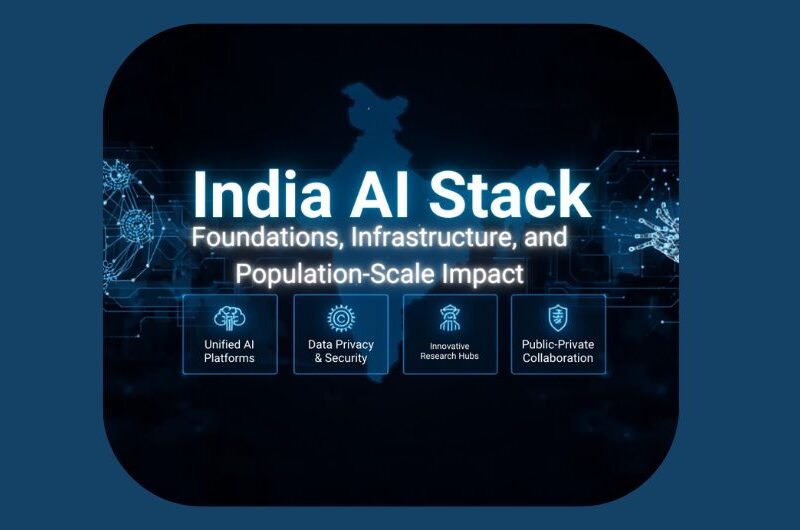
India’s AI Stack: Foundations, Infrastructure, and Population-Scale Impact

India’s AI Stack: Foundations, Infrastructure, and Population-Scale Impact     1. India’s AI vision emphasises democratisation: AI should benefit every citizen, support public welfare, and remain people centric, enabling “AI for Humanity” rather than limited elite control alone anywhere. 2. India’s AI Stack integrates tools and infrastructure to build, deploy, and operate AI reliably at population scale through five layers: applications, models, compute, data centres, networks, and energy. 3. The application layer delivers user-facing AI services such as health diagnostics, farming advisories, chatbots, and translation, embedding AI into healthcare, education, agriculture, finance, governance, transport, and climate action. 4. AI advisory deployments in agriculture, including implementations in Andhra Pradesh and Maharashtra, improve sowing decisions, raise yields, and boost input efficiency, with reported productivity gains reaching 30–50 percent. 5. In education, NEP 2020 integrates AI learning via CBSE curricula, DIKSHA, and YUVAi, building practical skills; in justice, e-Courts Phase III uses AI for translation and scheduling. 6. IMD applies AI for advanced forecasting of rainfall, cyclones, fog, lightning, and fires, and supports farmers through tools like Mausam GPT, strengthening disaster response and early warning systems nationwide. 7. Under the IndiaAI Mission, 12 indigenous AI models are being developed for India-specific use cases, while startups receive subsidised compute with up to 25 percent of costs supported directly. 8. BharatGen is building India-centric foundation and multimodal models, scaling from billions to trillions of parameters, to serve research, startups, and public-sector applications across domains securely. 9. IndiaAIKosh functions as a national repository for datasets, models, and tools; by December 2025, it hosted 5,722 datasets and 251 models from 54 entities across 20 sectors online. 10. Bhashini, under the National Language Translation Mission, hosts over 350 AI models for speech recognition, machine translation, text-to-speech, OCR, and language detection, expanding multilingual digital access. 11. The IndiaAI Compute Portal offers compute as a service, providing shared cloud access to 38,000 GPUs and 1,050 TPUs at subsidised rates under ₹100 per hour for startups nationwide. 12. A secure national GPU cluster of 3,000 next-generation GPUs is being established for sovereign strategic applications, alongside 10 approved semiconductor projects under the ₹76,000 crore mission. 13. The National Supercomputing Mission has deployed over 40 petaflops across IITs, IISERs, and research institutions; PARAM Siddhi-AI and AIRAWAT support workloads like NLP, weather prediction, and drug discovery. 14. India has about 3 percent of global data centre capacity, roughly 960 MW installed, projected to reach 9.2 GW by 2030; Mumbai–Navi Mumbai leads with over 25 percent share. 15. India met peak power demand of 242.49 GW in FY 2025–26 with shortages limited to 0.03 percent; installed capacity reached 509.7 GW, with over 51 percent from non-fossil sources.     Must Know Terms : 1. AI Stack AI Stack refers to the complete layered ecosystem enabling artificial intelligence to function at scale. It integrates applications, AI models, compute infrastructure, data centres, networks, and energy systems. This structure ensures reliable deployment, seamless integration, scalability, and real-world usability of AI across sectors such as governance, healthcare, agriculture, education, industry, and public services nationwide.   2.Application Layer The application layer represents the user-facing dimension of artificial intelligence, where advanced algorithms translate into practical services. It includes tools like health diagnostics, agricultural advisories, language translation, education platforms, and governance systems. This layer determines AI’s societal impact by embedding intelligence into everyday decision-making, service delivery, productivity enhancement, and citizen-centric digital solutions.   3.AI Model Layer The AI model layer functions as the cognitive core of artificial intelligence systems. It involves training algorithms on vast datasets to recognize patterns, generate predictions, and enable intelligent responses. Indigenous model development ensures relevance to local languages, contexts, and public needs, strengthening technological sovereignty, reducing external dependence, and aligning AI outcomes with national developmental priorities.   4.Compute Infrastructure Compute infrastructure provides the processing power required to train and operate AI models efficiently. It includes GPUs, TPUs, NPUs, supercomputers, and cloud-based resources. Affordable and shared access to compute lowers entry barriers for startups and research institutions, accelerates innovation, supports large-scale experimentation, and enables population-scale AI deployment across diverse sectors.   5.Data Centres and Networks Data centres and digital networks form the backbone enabling AI systems to store, process, and transmit data reliably. High-speed broadband, optical fibre, and 5G connectivity ensure low-latency performance, real-time analytics, and nationwide reach. Expanding domestic data centre capacity strengthens digital resilience, supports cloud services, and anchors AI infrastructure within national jurisdiction.   6.Energy Layer The energy layer sustains continuous AI operations by supplying reliable and affordable electricity to data centres and computing systems. AI workloads are energy-intensive, making power availability critical for scalability. Increasing reliance on non-fossil energy sources, storage systems, and nuclear options aligns AI expansion with sustainability, grid stability, and long-term environmental commitments.   MCQ:   1. The concept of an AI Stack primarily refers to: A) A single AI application used by governments B) A layered ecosystem enabling AI deployment at scale C) A hardware-only framework for AI computation D) A regulatory mechanism for AI governance 2. The core objective behind building a population-scale AI Stack is to: A) Promote private monopolies in technology B) Restrict AI access to research institutions C) Ensure inclusive and scalable AI deployment D) Replace conventional digital infrastructure 3. Which layer of the AI Stack directly interacts with end users? A) Compute layer B) AI model layer C) Application layer D) Energy layer 4. AI-powered health diagnostics, agricultural advisories, and chatbots belong to the: A) Model training layer B) Data infrastructure layer C) Application layer D) Energy layer 5. The AI model layer is best described as the: A) Storage unit for raw data B) Brain of AI systems C) Power supply unit of AI D) User interface of AI platforms 6. Development of indigenous AI models mainly supports: A) Higher hardware imports B) Increased data localisation costs C) Technological sovereignty and relevance D) Reduced public-sector usage 7. Compute infrastructure in AI primarily determines: A) User interface quality B) Data ownership C) Scale, speed, and efficiency of AI models D) Legal accountability of AI

More Details

Kavach and AI-Driven Safety Transformation in Indian Railways

Kavach and AI-Driven Safety Transformation in Indian Railways         1. Kavach is India’s indigenously developed Automatic Train Protection system providing collision prevention, overspeed control, and Signal Passing at Danger protection through continuous monitoring and automatic braking interventions nationwide. 2. Kavach has been implemented on more than 2,200 route kilometres, reflecting large scale deployment of indigenous ATP technology across critical corridors of the Indian Railways network nationwide infrastructure. 3. Kavach Version 4.0 operates over 1,306.3 route kilometres across five railway zones, strengthening safety on high speed, high density corridors such as Delhi–Mumbai and Delhi–Howrah trunk routes, nationally. 4. Vande Bharat 4.0 trains are envisaged to incorporate Kavach 5.0, enabling reduced headway, higher suburban frequency, and advanced automatic safety enforcement for future operations across major rail sections. 5. Kavach provides in cab signalling to loco pilots, displaying movement authority, target speed, target distance, and signal aspects for safer operations beyond 120 kilometres per hour thresholds nationally. 6. Developed by RDSO, Kavach mitigates risks arising from human error, equipment failure, and operational limitations through real time situational awareness and automated intervention mechanisms across diverse railway conditions. 7. Kavach uses secure UHF radio communication and RFID tags to determine precise train location while wayside units integrate interlocking, occupancy, and route data continuously for safe authority computation. 8. The system automatically applies brakes if a train overspeeds, approaches a danger signal, or enters a conflicting route, preventing collisions and Signal Passing at Danger incidents nationwide deployment. 9. Kavach supports Stop on Sight commands, ensuring automatic stoppage when two trains move toward each other in block sections, preventing head on and rear end collisions during operations. 10. Kavach is certified to Safety Integrity Level four, representing the highest global railway signalling safety standard and ensuring fail safe train protection under all conditions across Indian Railways. 11. Consequential train accidents declined significantly from 135 in 2014–15 to 31 in 2024–25 and further to 11 during 2025–26, reflecting technology driven safety gains across national rail corridors. 12. Indian Railways increased safety expenditure steadily from ₹39,200 crore in 2013–14 to ₹1,17,693 crore in 2025–26, underscoring long term institutional commitment towards infrastructure modernisation, accident prevention, resilience, nationally. 13. Kavach was adopted as the national Automatic Train Protection system in July 2020, enabling standardized deployment of interoperable safety architecture across Indian Railways networks, corridors, operations, zones, nationwide. 14. Kavach Version 4.0 commissioning prioritises High Density and Highly Used Network routes, including corridors cleared for 160 kilometres per hour operations with ABS and CTC signalling, control, systems. 15. AI enabled intrusion detection, predictive maintenance, video analytics, and digital communication systems complement Kavach, creating an integrated, preventive, and technology driven railway safety ecosystem across passengers, assets, operations. Must Know Terms :   1.Kavach Kavach is India’s indigenously developed Automatic Train Protection system adopted as the national ATP by Indian Railways in 2020. It prevents train accidents by monitoring speed, signal compliance, and train movement in real time. Kavach automatically applies brakes during unsafe conditions, significantly reducing human error–induced accidents and enhancing operational safety across high-density rail corridors. 2.Automatic Train Protection (ATP) Automatic Train Protection refers to systems that continuously supervise train movement, speed, and signal adherence, intervening automatically when unsafe conditions arise. ATP systems prevent Signal Passing at Danger, overspeeding, and collisions. With increasing traffic density and higher speeds, ATP has become essential to maintain safety, reliability, and capacity on modern railway networks like Indian Railways. 3.Safety Integrity Level–4 (SIL-4) SIL-4 is the highest internationally recognised safety certification for railway signalling systems. Kavach’s SIL-4 certification indicates extremely high reliability, fail-safe design, and minimal probability of dangerous failure. This level ensures that even under component failure or adverse conditions, the system defaults to safe states, making it suitable for high-speed and high-density railway operations. 4.Signal Passing at Danger (SPAD) Signal Passing at Danger occurs when a train crosses a stop signal without authorisation, often leading to collisions. SPAD has historically been a major cause of serious rail accidents. Kavach directly addresses this risk by automatically stopping trains before danger signals, reducing dependence on human vigilance and significantly improving safety, especially under fog, curves, or poor visibility conditions. 5.Stop-on-Sight (SoS) Stop-on-Sight is an automated safety command within Kavach that activates when two trains are detected moving toward each other in block sections. The system immediately applies brakes on both trains, preventing head-on or rear-end collisions. SoS is critical in non-interlocked or high-risk sections, providing a last-line defence against catastrophic accidents in real time. 6.AI-enabled Intrusion Detection System (IDS) The AI-enabled Intrusion Detection System uses Distributed Acoustic Sensing technology to detect animal movement, particularly elephants, on railway tracks. It generates real-time alerts for loco pilots and control rooms, enabling preventive action. Deployed in vulnerable corridors, IDS reduces wildlife casualties, train derailment risks, and service disruptions, integrating ecological protection with railway safety objectives.   Advantages of Kavach User-friendly cab signaling for loco pilots. Multi-vendor interoperability – avoids dependence on a single supplier. Suitable for specific Indian Railways requirements and conditions. Enhances safety in foggy weather. Effective at high speeds. Enables centralized real-time monitoring of train movements. Key Takeaways KAVACH is an indigenously developed Automatic Train Protection (ATP) system that provides Train Protection as well as Collision Prevention capabilities for trains. Kavach has now been implemented on more than 2,200 route kilometres. Kavach 4.0 now covers over 1,300 Route Kilometres across five Indian Railways Zones. Vande Bharat 4.0 is envisaged to incorporate Kavach 5.0 as part of its advanced safety and technology framework. MCQ     1. Kavach is best described as which of the following systems? A) Passenger Information System B) Automatic Train Protection system C) Train Scheduling Software D) Track Maintenance Mechanism 2. Kavach has been developed indigenously by Indian Railways through which organisation? A) DMRC B) IIT Kanpur C) RDSO D) ISRO 3. Kavach primarily helps in preventing which of the following railway incidents? A) Track corrosion B) Signal Passing at Danger C) Coach overcrowding D) Power supply failure 4. Kavach provides in-cab display information to the loco pilot related to: A) Passenger occupancy B) Ticketing status C) Movement authority and speed D) Weather forecasting 5. Kavach Version 4.0 is currently

More Details

Silicon Sovereignty: India’s Semiconductor Mission 2.0 and the Road to Chip Self-Reliance

Silicon Sovereignty: India’s Semiconductor Mission 2.0 and the Road to Chip Self-Reliance     1. ISM 2.0 in Budget 2026–27 prioritises domestic semiconductor equipment and materials, full-stack Indian semiconductor IP, and stronger supply chains, backed by ₹1,000 crore for FY 2026–27 allocation nationwide. 2. India’s semiconductor market is estimated at $38 billion in 2023, $45–$50 billion in 2024–25, and projected to reach $100–$110 billion by 2030, driven by demand across value chains. 3. ISM 1.0, approved in December 2021, created an incentive framework of ₹76,000 crore, offering fiscal support up to 50% for silicon fabs, compound semiconductors, ATMP/OSAT, and design nationwide. 4. By December 2025, ten semiconductor projects totaling ₹1.60 lakh crore were approved across six states, spanning silicon fabs, silicon carbide fabs, advanced packaging, memory packaging, and testing infrastructure. 5. By 2029, India targets capability to design and manufacture chips covering 70–75% of domestic applications, serving consumer appliances, industrial electronics, automobiles, telecommunications, aerospace, and power electronics sectors needs. 6. The advanced manufacturing roadmap defines progression toward 3-nanometre and 2-nanometre nodes, aiming for India to rank among top semiconductor nations by 2035 through sustained capability building and resilience. 7. For 2026–27, the modified semiconductor and display manufacturing ecosystem programme carries a total outlay of ₹8,000 crore, recalibrating support for manufacturing, display fabs, and the design ecosystem nationwide. 8. In 2026–27, the modified scheme for semiconductor fabs supports one fab, targeting ₹4,000 crore investment during the year and generating about 1,500 jobs in operations and engineering directly. 9. The compound semiconductors, photonics, sensors, discrete fabs and ATMP/OSAT scheme supports nine units in 2026–27, targeting ₹11,000 crore investment and about 3,000 jobs across facilities for capacity scaling. 10. The design-linked incentive scheme supports 30 design companies in 2026–27, targeting development of 10 semiconductor IP cores and employment of around 200 specialised semiconductor design professionals this year. 11. By January 2026, design incentives support 24 startups, which attracted nearly ₹430 crore venture funding, while the national EDA platform recorded about 2.25 crore high-end tool hours nationally. 12. Around 67,000 students and over 1,000 startup engineers use national design tools; academia completed 122 tape-outs and fabricated 56 chips at 180 nm in the Mohali facility annually. 13. Startups completed 16 tape-outs, producing six chips at advanced foundry nodes including 12 nm; academic institutions filed 75 patents and startups filed 10 patents, expanding indigenous IP rapidly. 14. DHRUV64 is an indigenous 64-bit microprocessor built by C-DAC under MDP, intended for 5G, automotive electronics, industrial automation, consumer devices, and IoT, reducing import dependence and security assurance. 15. Talent pipeline measures include Chips to Startup across 397 universities and startups, AICTE semiconductor programmes, SMART Lab training over 62,000 engineers toward 100,000, and Lam partnership training 60,000. Must Know Terms :   1.India Semiconductor Mission 2.0 (ISM 2.0): ISM 2.0 is the Budget 2026–27 push to move from ecosystem creation to consolidation. It prioritises domestic semiconductor equipment and materials, full-stack Indian IP, and stronger supply chains. The government earmarked ₹1,000 crore for FY 2026–27 to support industry-led R&D and training centres, aiming to deepen technology capability and workforce readiness across the entire chip value chain.   2.Modified Semiconductor & Display Programme (2026–27): This is the recalibrated support package responding to global incentive competition. For 2026–27, it carries a total financial outlay of ₹8,000 crore to accelerate capital investment across semiconductor fabs, compound semiconductors, ATMP/OSAT, and display manufacturing. It focuses on expanding fabrication, packaging, and design capacity, generating high-quality jobs, and reducing dependence on concentrated global suppliers and shocks.   3.Design Linked Incentive (DLI) Scheme: DLI strengthens India’s fabless and IP creation pipeline by supporting startups and early-stage design firms. As of January 2026, it supports 24 design startups, which attracted nearly ₹430 crore venture funding. It aims to translate academic research into deployable products, increase patents and tape-outs, and scale toward enabling at least 50 fabless companies in the next phase.   4.Advanced EDA National Chip Design Platform: Advanced Electronic Design Automation access is the backbone for domestic chip design at scale. The platform has recorded around 2.25 crore tool hours, with about 67,000 students and over 1,000 startup engineers using high-end tools. It lowers entry barriers, improves design productivity, and supports more tape-outs and prototypes by providing shared infrastructure that individual institutions may not afford independently.   5.Tape-out and Fabrication Pipeline (Mohali SCL + Advanced Nodes): Tape-out is the stage where a design is finalised for fabrication, making it a measurable output of design capability. Academia has completed 122 tape-outs, with 56 chips fabricated at 180 nm at the Semiconductor Laboratory, Mohali. Startups completed 16 tape-outs, producing six chips at advanced foundry nodes including 12 nm, signalling progress beyond legacy processes.   6.DHRUV64 and Indigenous Microprocessor Stack: DHRUV64 is an indigenous 64-bit microprocessor developed by C-DAC under the Microprocessor Development Programme. It is positioned for deployment in 5G infrastructure, automotive electronics, industrial automation, consumer devices, and IoT. It builds on SHAKTI, AJIT, VIKRAM, and THEJAS under the DIR-V programme using RISC-V architecture, improving sovereignty and security in critical computing.     Key Takeaways   Union Budget 2026–27 allocates ₹1,000 crore for India Semiconductor Mission (ISM) 2.0.   As of December 2025, 10 ISM projects worth ₹1.60 lakh crore approved across six states.   India’s semiconductor market projected to reach $100–110 billion by 2030.           MCQ :   1. India Semiconductor Mission 2.0 announced in Budget 2026–27 primarily emphasises which strategic shift? A) Import substitution through tariff protection B) Consolidation of domestic capabilities across equipment, materials, IP, and supply chains C) Exclusive focus on consumer electronics manufacturing D) Privatisation of semiconductor regulation 2. The financial provision made specifically for ISM 2.0 in FY 2026–27 is: A) ₹500 crore B) ₹750 crore C) ₹1,000 crore D) ₹1,500 crore 3. India’s semiconductor market size is projected to reach approximately what value by 2030? A) $60–70 billion B) $80–90 billion C) $100–110 billion D) $130–140 billion 4. The incentive framework approved under India Semiconductor Mission 1.0 amounted to: A) ₹45,000 crore B) ₹60,000 crore C) ₹76,000

More Details

Regulatory and Digital Reforms Driving India’s Business Environment Transformation

Regulatory and Digital Reforms Driving India’s Business Environment Transformation       1. Union Budget 2026–27 reiterates Ease of Doing Business as a growth pillar, prioritising digitisation, tax certainty, investor access and litigation reduction to strengthen confidence across sectors nationwide. 2. An interconnected single digital window for cargo approvals is proposed, enabling streamlined customs clearances, reduced interface duplication, faster releases, and lower compliance friction for trade participants and paperwork. 3. Customs Integrated System will be rolled out within two years as an integrated, scalable platform covering end-to-end customs processes, improving interoperability, traceability, and predictability for trade. 4. Non-intrusive scanning using imaging and AI-enabled risk assessment will expand in phases, targeting scanning of every container across major ports to tighten security and reduce delays. 5. Trusted importers will be recognised in risk systems, cutting physical verification, enabling electronically sealed factory-to-ship export clearance, and facilitating immediate release on arrival for compliant filings. 6. For goods without compliance requirements, customs clearance will occur immediately after online registration by the importer, subject to duty payment, shortening dwell time and improving logistics efficiency overall. 7. Portfolio Investment Scheme access is widened for individuals resident outside India to invest in listed equity instruments, enhancing market liquidity and broadening foreign investor participation pathways significantly overall. 8. Individual PROI investment limit under PIS is proposed to rise from 5% to 10%, while the overall ceiling for individual PROIs rises to 24% from 10% in aggregate. 9. Minimum Alternate Tax is proposed as levy at 14% instead of 15%, aiming to reduce disputes, improve certainty, and simplify settlement of MAT liabilities for firms in India. 10. Non-residents paying presumptive tax are proposed to be exempt from MAT, supporting predictable taxation and lowering friction for global businesses operating under presumptive income frameworks in India. 11. MAT credit set-off in the new regime is proposed up to one-fourth of tax liability, easing costs and improving cash-flow planning for firms shifting regimes. 12. Integrated assessment and penalty proceedings through a common order are proposed, with no interest on penalty during appeal and reduced pre-payment requirement from 20% to 10% thereby. 13. Return updating is proposed even after reassessment initiation, with an additional 10% tax above the applicable rate, enabling voluntary self-correction for taxpayers and reducing prolonged disputes materially. 14. Immunity from penalty and prosecution framework is extended from underreporting to misreporting, requiring payment of 100% additional income tax over tax and interest due in specified eligible cases. 15. Duty deferral period for Tier-2 and Tier-3 Authorised Economic Operators is extended from 15 to 30 days, supporting ‘Clear first, pay later’ for time-sensitive production.   Trust-based systems   Enhanced the duty deferral period for Tier 2 and Tier 3 Authorised Economic Operators (AEO), from 15 days to 30 days. What does it mean?   Deferred duty payment is a mechanism for delinking duty payment and Customs clearance. It is based on the principle ‘Clear first-Pay later’. The aim is to have a seamless wharf to warehouse transit in order to facilitate just-in-time manufacturing.   The enhancement in the duty deferral period means extending the time allowed to pay customs or import duties after goods are imported, instead of paying them immediately.   Other Single Window Digital Platforms     PARIVESH (Pro-Active and Responsive facilitation by Interactive, Virtuous, and Environmental Single Window Hub) 3.0 For environmental clearances and post-approval compliance monitoring.   It integrates baseline data, afforestation land banks, inter-ministerial dashboards, and AI-enabled support to enhance transparency, predictability, and efficiency.         e-Gram SWARAJ portal Provides a single window with the complete Profile of the GP, including details of Sarpanch/Secretary, demography, finances, assets along with activities taken up through the Gram Panchayat Development Plan (GPDP).   Serving as a unified reporting and tracking platform, it strengthens decentralised planning and improves the effectiveness of development fund utilisation. Achievements of States under BRAP     Kerala Streamlined business registration Digitised land and tax processes, Simplified environmental clearances, and advanced renewable energy adoption, carbon-neutral gram panchayats, and waterbody rejuvenation.     Tamil Nadu Introduced single-window Digitised approvals alongside land reforms, while promoting solar parks, decarbonisation plans, Effective monitoring of industrial effluent treatment systems.     Andhra Pradesh Implemented single-window industrial clearances, Online land registration, E-environmental approvals, Expanded its Online Consent Management & Monitoring System allowing firms to apply for consents and track approvals digitally — Must Know Terms :    1.Ease of Doing Business (EoDB) Ease of Doing Business refers to a reform-driven framework aimed at simplifying regulatory procedures, reducing compliance costs, and improving predictability for enterprises. In India, EoDB focuses on digitisation, decriminalisation of minor offences, tax certainty, and trust-based governance to enhance investor confidence, promote entrepreneurship, improve competitiveness, and integrate domestic firms with global value chains effectively. 2.Customs Integrated System (CIS) The Customs Integrated System is a proposed unified digital platform designed to integrate all customs-related processes into a single, scalable architecture. CIS aims to replace fragmented systems, enabling seamless data sharing, end-to-end cargo tracking, faster clearances, improved risk assessment, and enhanced transparency. It supports reduced transaction costs, predictability in trade logistics, and improved ease for importers and exporters. 3.Minimum Alternate Tax (MAT) Minimum Alternate Tax is a tax mechanism introduced to ensure companies with substantial book profits pay a minimum level of tax despite exemptions. Under recent reforms, MAT is proposed as a final tax at a reduced rate of 14 percent, improving tax certainty, lowering litigation, enabling better financial planning, and reducing prolonged disputes between taxpayers and tax authorities. 4.Portfolio Investment Scheme (PIS) The Portfolio Investment Scheme regulates equity investments by persons resident outside India in listed Indian companies. Recent enhancements permit wider access and higher investment limits for individual foreign investors. These reforms aim to deepen capital markets, improve liquidity, diversify investor participation, and align India’s financial markets with global investment practices and standards. 5.Authorised Economic Operator (AEO) Programme The Authorised Economic Operator programme accredits compliant and trusted trade entities, granting them facilitative benefits in customs procedures. Enhanced duty deferral periods and preferential treatment under risk management systems reduce inspections and delays. The programme strengthens supply chain

More Details

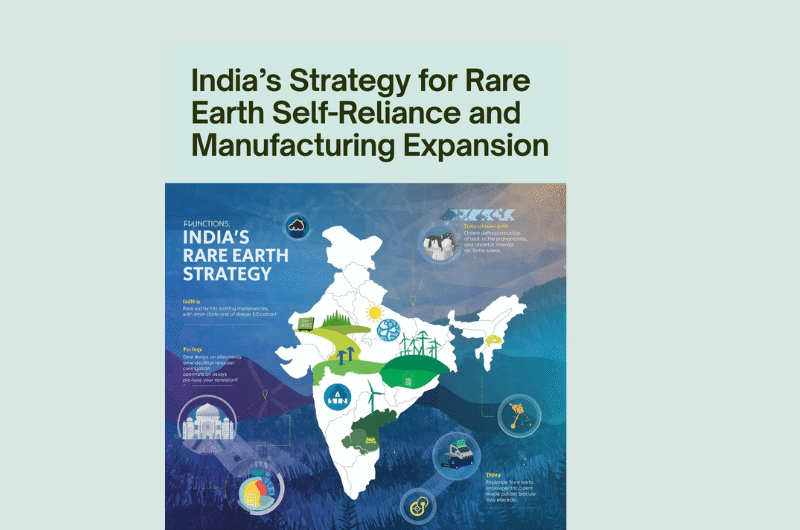
India’s Strategy for Rare Earth Self-Reliance and Manufacturing Expansion

India’s Strategy for Rare Earth Self-Reliance and Manufacturing Expansion         1. Union Budget 2026–27 announced Dedicated Rare Earth Corridors in Odisha, Kerala, Andhra Pradesh and Tamil Nadu, integrating mining, processing, research and REPM manufacturing to expand domestic capacity national. 2. In November 2025, the government approved a ₹7,280 crore REPM Manufacturing Scheme to create an end-to-end domestic ecosystem from rare-earth oxides to finished magnets ensuring national supply security. 3. The scheme targets creation of 6,000 MTPA integrated sintered REPM capacity, allocated among up to five beneficiaries through global competitive bidding to ensure supply security for strategic industries. 4. Over five years, ₹6,450 crore sales-linked incentives and ₹750 crore capital subsidy will support advanced facilities after a two-year gestation period for production linked to verified output milestones. 5. Rare Earth Permanent Magnets are high-strength, stable magnets essential for electric vehicle motors, wind turbine generators, electronics, aerospace systems, defence equipment and precision sensors used across strategic sectors. 6. India possesses 13.15 million tonnes of monazite containing about 7.23 million tonnes of rare-earth oxides, forming a strong domestic raw-material base for downstream permanent magnet manufacturing industries nationwide. 7. Rare-earth deposits occur across Odisha, Kerala, Andhra Pradesh, Tamil Nadu, West Bengal, Gujarat, Maharashtra and Jharkhand, mainly in coastal beach sands, teri sands and inland alluvium geological formations. 8. Additional in-situ rare-earth oxide resources of about 1.29 million tonnes have been identified in hard-rock areas of Gujarat and Rajasthan, expanding exploration potential beyond coastal mineral sands regions. 9. Geological Survey of India identified 482.6 million tonnes of rare-earth ore resources across 34 exploration projects, significantly strengthening the national raw-material inventory for future industrial scale manufacturing capacity. 10. Between 2022 and 2025, India sourced nearly 60–80 percent by value and 85–90 percent by quantity of permanent magnets from China, highlighting strategic import dependence risks nationally significant. 11. Rapid growth in electric mobility, renewable energy, electronics and defence is expected to double India’s REPM consumption by 2030, necessitating urgent domestic manufacturing expansion to meet projected demand. 12. Dedicated Rare Earth Corridors aim to strengthen mining, processing, research and manufacturing linkages, boosting local economies, R&D capacity and India’s integration into global advanced-materials value chains networks worldwide. 13. IREL India Limited, under the Department of Atomic Energy since 1963, operates processing facilities producing ilmenite, rutile, zircon, sillimanite and garnet minerals supporting strategic mineral supply chains nationally. 14. IREL operates a Rare Earth Extraction Plant in Odisha and a Rare Earth Refining Unit at Aluva, Kerala, supporting corridor-based expansion of domestic rare-earth capacity and downstream manufacturing. 15. Policy reforms under the amended MMDR Act 2023 and the National Critical Minerals Mission 2025 promote exploration, private participation and secure supply chains for critical minerals nationwide development. Must Know Terms:     1) Rare Earth Permanent Magnets (REPMs): REPMs are high-performance magnets with very high magnetic strength and stability in compact form. They are essential for EV motors, wind turbine generators, electronics, aerospace systems, defence equipment and precision sensors. Their availability directly affects clean-energy scale-up and strategic manufacturing, so domestic REPM capacity reduces import risk and strengthens supply security.   2) Dedicated Rare Earth Corridors: These are corridor-based industrial ecosystems announced in Union Budget 2026–27 for Odisha, Kerala, Andhra Pradesh and Tamil Nadu. They aim to integrate mining, processing, research and manufacturing in mineral-rich regions. Corridors are important because they cluster infrastructure, skills and R&D, improve logistics efficiency, strengthen local economies and connect India into advanced-materials value chains.   3) REPM Manufacturing Scheme (₹7,280 crore): Approved in November 2025, this scheme supports creation of 6,000 MTPA integrated sintered REPM capacity and covers the value chain from rare-earth oxides to finished magnets. It includes five-year sales-linked incentives and capital subsidy for advanced facilities after a two-year setup period. The scheme matters for supply security in mobility, renewables, electronics and defence.   4) Monazite Deposits and Rare-Earth Oxides (REO): Monazite is a rare-earth bearing mineral that provides rare-earth oxides used in downstream products like permanent magnets. India holds 13.15 million tonnes of monazite containing an estimated 7.23 million tonnes of REO. Deposits occur in several states, mainly in coastal beach sands and also inland settings, creating a strong raw-material base for domestic manufacturing.   5) GSI Rare-Earth Ore Resource Identification: Geological Survey of India identified 482.6 million tonnes of rare-earth ore resources across 34 exploration projects. This expands the documented resource base beyond known deposits and supports planning for mining, processing and manufacturing investments. Large identified resources matter because they improve long-term supply confidence, attract industry participation and support scaling integrated rare earth value chains.   6) Import Dependence on China (2022–25): During 2022–25, permanent magnet imports were mainly sourced from China, about 60–80% by value and 85–90% by quantity. This level of dependence creates strategic vulnerability to supply disruptions and price shocks. Reducing it is important for EVs, wind energy and defence systems where magnets are critical components for performance and reliability.     Key Takeaways Union Budget 2026–27 announces Dedicated Rare Earth Corridors in Odisha, Kerala, Andhra Pradesh, and Tamil Nadu for mining, processing, research, and manufacturing of Rare Earth Permanent Magnets (REPMs). ₹7,280 crore REPM Manufacturing Scheme approved in November 2025. 6,000 MTPA integrated REPM capacity to be created. ₹6,450 crore sales-linked incentives over five years. ₹750 crore capital subsidy for advanced facilities. Geological Survey of India (GSI) has identified 482.6 million tonnes of rare-earth ore resources.       MCQ 1. The Union Budget 2026–27 announced Dedicated Rare Earth Corridors in which of the following states? A. Odisha, Kerala, Andhra Pradesh, Tamil Nadu B. Gujarat, Rajasthan, Maharashtra, Jharkhand C. West Bengal, Bihar, Odisha, Assam D. Chhattisgarh, Telangana, Karnataka, Kerala 2. The REPM Manufacturing Scheme approved in November 2025 has a total financial outlay of: A. ₹6,450 crore B. ₹7,280 crore C. ₹8,000 crore D. ₹7,750 crore 3. The targeted integrated manufacturing capacity of Rare Earth Permanent Magnets under the approved scheme is: A. 3,000 MTPA B. 4,500 MTPA C. 6,000 MTPA D. 7,500 MTPA 4. Sales-linked incentives under the REPM Manufacturing Scheme are provided for a period of: A. Three years B. Four years C. Five

More Details

Shaping Global AI for Inclusive Development: India–AI Impact Summit 2026

Shaping Global AI for Inclusive Development: India–AI Impact Summit 2026   1. India AI Impact Summit 2026 is scheduled from 16–20 February 2026 at Bharat Mandapam, New Delhi, as a five-day programme spanning policy, research, industry, and public engagement. 2. The Summit is described as the first global AI summit to be hosted in the Global South, bringing leaders, policymakers, companies, innovators, and experts together. 3. The Summit is anchored on three foundational pillars called Sutras: People, Planet, and Progress, intended as guiding principles for impact-oriented cooperation. 4. The India AI Impact Expo 2026 is expected to feature over 300 exhibitors from 30 countries across more than 10 thematic pavilions; figures are tentative. 5. The Summit aligns with Viksit Bharat by 2047 and connects with the IndiaAI Mission and Digital India Initiative for development-focused AI outcomes. 6. The Summit outlines AI benefits for People, including telemedicine, diagnostics, adaptive education, and fraud detection, aiming to expand access and strengthen systems. 7. For the Planet, it highlights AI in agriculture through crop prediction, precision farming, drone monitoring, and advisory support using weather, pest, and irrigation data. 8. For Progress, it notes AI-assisted translation of court judgments, smart city optimisation, improved service delivery, and everyday efficiency in mobility services. 9. Pre-Summit Events are organised in India and abroad to facilitate consultations and thematic discussions involving governments, academia, industry, startups, and civil society.   10. Eight Regional AI Conferences were held between October 2025 and January 2026 across Meghalaya, Gujarat, Odisha, Madhya Pradesh, Uttar Pradesh, Rajasthan, Kerala, and Telangana. 11. The Main Summit sessions are structured around seven Chakras, and the programme reports receiving over 700 proposals, indicating strong global participation. 12. The AI Compendium will be released on 17 February 2026, presenting thematic casebooks on real-world AI applications across priority sectors. 13. The AI for ALL Global Impact Challenge is partnered with Startup India and the Digital India Bhashini Division, offering awards up to INR 2.50 crore. 14. The AI by HER Global Impact Challenge partners the NITI Aayog Women Entrepreneurship Platform, showcasing women-led AI solutions, with awards up to INR 2.50 crore. 15. The YUVAi Global Youth Challenge targets ages 13–21, partnered with MyBharat and NIELIT, offering prizes worth up to INR 85 lakh. India–AI Impact Summit 2026: Event Schedule and Key Programmes Date Event Venue 16–20 February 2026 AI Impact Expo Bharat Mandapam, New Delhi 16 February 2026 Keynotes, Panel Discussions, Roundtables Bharat Mandapam/ Sushma Swaraj Bhawan/ Ambedkar Bhawan, New Delhi 17 February 2026 Release of Knowledge Compendiums on AI in Health, Energy, Education, Agriculture, Gender Empowerment, Accessibility Bharat Mandapam, New Delhi Seminar on Applied AI AI by HER: Global Impact Challenge Sushma Swaraj Bhawan, New Delhi Keynotes, Panel Discussions, Roundtables Bharat Mandapam/ Sushma Swaraj Bhawan/ Ambedkar Bhawan, New Delhi 18 February 2026 Research Symposium Bharat Mandapam, New Delhi Industry Session AI by HER: Global Impact Challenge Sushma Swaraj Bhawan, New Delhi Keynotes, Panel Discussions, Roundtables Bharat Mandapam/ Sushma Swaraj Bhawan/ Ambedkar Bhawan, New Delhi Summit Dinner Convention Centre, New Delhi 19 February 2026 Opening Ceremony Bharat Mandapam, New Delhi   Leaders’ Plenary CEO Roundtable Keynotes / Panel Discussion/ Roundtables Bharat Mandapam / Sushma Swaraj Bhawan / Ambedkar Bhawan, New Delhi 20 February 2026 GPAI Council Meeting Bharat Mandapam, New Delhi Keynotes/ Panel Discussion/ Roundtables Bharat Mandapam / Sushma Swaraj Bhawan / Ambedkar Bhawan, New Delhi   MUST-KNOW TERMS 1. India–AI Impact Summit 2026: India–AI Impact Summit 2026 is a global artificial intelligence summit scheduled from 16–20 February 2026 at Bharat Mandapam, New Delhi. It is the first global AI summit hosted in the Global South and focuses on translating AI discussions into development outcomes aligned with national priorities, governance needs, and inclusive growth objectives under the IndiaAI Mission and Digital India. 2. IndiaAI Mission: IndiaAI Mission is a flagship national initiative aimed at building a robust, inclusive, and responsible artificial intelligence ecosystem in India. It focuses on AI compute infrastructure, indigenous AI models, datasets, skilling, startup support, and ethical deployment, ensuring AI adoption strengthens governance, economic growth, and public service delivery across sectors. 3. Three Sutras: The Three Sutras—People, Planet, and Progress—are the foundational pillars of the India–AI Impact Summit 2026. They guide AI deployment toward inclusive social outcomes, environmental sustainability, and governance efficiency. These principles emphasize people-centric AI, sustainable resource use, and technology-enabled institutional progress through multilateral cooperation. 4. Seven Chakras: Seven Chakras represent key areas of multilateral cooperation at the Summit, including Human Capital, Inclusion for Social Empowerment, Safe and Trusted AI, Resilience and Innovation, Science, Democratizing AI Resources, and AI for Economic Growth and Social Good. These Chakras structure discussions to align AI strategies with inclusive and sustainable development outcomes. 5. AI Impact Expo 2026: The India AI Impact Expo 2026 is a large-scale exhibition organised by MeitY with STPI as custodian. Spread over 70,000 square metres, it showcases AI transition from research to deployment, featuring innovators, startups, investors, and thematic pavilions demonstrating sector-specific AI solutions. 6. AI Compendium: The AI Compendium is a knowledge output of the Summit to be released on 17 February 2026. It contains thematic casebooks documenting real-world AI applications across priority sectors such as health, education, agriculture, energy, and governance, serving as a reference for practitioners and policymakers.     Key Takeaways The India–AI Impact Summit 2026will be the first global AI summit to be hosted in the Global South. It will be held from 16 to 20 February 2026 at Bharat Mandapam, New Delhi, as a five-day programme covering policy, research, industry, and public engagement. It will be anchored on 3 foundational pillars, or ‘Sutras’: People, Planet and Progress. The India AI Impact Expo is expected to feature over 300 exhibitors, from 30 Countries, across more than 10 thematic pavilions.                                                                                                                        MCQ     1. The India–AI Impact Summit 2026 will be held at which location? A. Vigyan Bhawan, New Delhi B. Bharat Mandapam, New Delhi C. Hyderabad International Convention Centre D. India Habitat Centre 2. The India–AI Impact Summit 2026 is described as: A. First AI summit hosted by

More Details

MISSION ZERO DUMPSITES: DRAP AND LEGACY WASTE REMEDIATION

MISSION ZERO DUMPSITES: DRAP AND LEGACY WASTE REMEDIATION 1. DRAP launched in November 2025 to achieve Lakshya: Zero Dumpsites by October 2026, accelerating scientific remediation of long-standing municipal legacy waste across cities nationwide. 2. India has identified about 2,479 legacy dumpsites with 1,000+ tonnes waste, containing roughly 25 crore metric tonnes spread across nearly 15,000 acres nationwide today. 3. Remediation is underway at 1,428 sites, and over 62% of identified legacy waste has already been processed through biomining, segregation, and recovery pathways successfully. 4. DRAP prioritises 214 high-impact dumpsites holding nearly 80% of remaining legacy waste, spanning 30 States/UTs and covering about 200 urban local bodies nationwide collectively. 5. These 214 sites account for roughly 8.6 crore metric tonnes; projects worth about ₹6,700 crore target accelerated clearance, processing capacity, and land reclamation quickly. 6. Legacy dumpsites harm air quality, contaminate soil and groundwater, emit methane, create fire risks, and attract disease vectors, causing chronic health burdens nearby communities. 7. Strategy is double-pronged: remove existing dumpsites through remediation while preventing new ones by expanding processing facilities and scientific handling of fresh waste streams daily. 8. In 2025, 459 dumpsites across 438 cities achieved complete remediation, processing 183 lakh metric tonnes, contributing to 1,138 fully remediated sites overall nationwide cumulatively. 9. Reclaimed land after remediation is prioritised for solid waste management infrastructure or developing green cover, ensuring productive reuse rather than renewed open dumping anywhere. 10. SBM-Urban 2.0 launched in 2021 deepened progress through segregation at source, expanded processing capacity, and stronger scientific waste management systems in cities nationwide significantly. 11. DRAP uses a 5P framework: Political Leadership, Public Finance, Partnerships, People’s Participation, and Project Management, ensuring accountable planning, financing, execution, and monitoring always transparently. 12. Financial support includes CFA at ₹550 per tonne, with 25%, 33%, or 50% project-cost disbursement tiers depending on city category and scale parameters defined. 13. Partnerships route inert waste to roads via PWDs/NHAI, send RDF to cement or WtE plants, and integrate corporates, experts, NGOs for scale efficiently nationally. 14. Biomining excavates, aerates, bio-stabilises, screens, and segregates waste into fines, inert, recyclables, and combustibles, then routes fractions to appropriate reuse outlets safely, responsibly onsite. 15. Only non-reusable rejects go to scientific landfills, enabling circular economy outcomes and supporting SDGs 11, 12, and 13 with reduced methane emissions substantially nationwide.  MUST-KNOW TERMS   1. DRAP (Dumpsite Remediation Accelerator Programme): DRAP is a national accelerator launched in November 2025 to fast-track scientific cleanup of legacy municipal dumpsites and prevent new ones. It targets Lakshya: Zero Dumpsites by October 2026, prioritising 214 high-impact sites holding most remaining waste. It integrates funding, leadership adoption, partnerships, and tech-enabled monitoring so cities execute remediation quickly, transparently, and measurably, with clear nationwide milestones. 2. Legacy waste / legacy dumpsite: Legacy waste refers to decades-old mixed municipal garbage accumulated through unscientific open dumping by urban local bodies. It contaminates groundwater and soil, degrades air quality, emits methane, and creates fire and disease risks. Remediation involves scientific excavation and processing, recovery of usable fractions, disposal of only rejects in engineered landfills, and reclamation of land for infrastructure or green cover. 3. Biomining: Biomining is the scientific excavation and stabilisation of old dumpsite waste to recover resources and reduce landfill pressure. Excavated waste is aerated in windrows, where bio-cultures accelerate decomposition until stability is achieved. The material is then screened into soil-like fines, inert debris, recyclables, and combustibles, each routed for reuse, recycling, co-processing, or energy generation safely on site. 4. Refuse-Derived Fuel (RDF): RDF is the combustible, non-recyclable fraction recovered from mixed waste and biomined legacy dumpsites. It includes soiled paper, contaminated plastics, multilayer packaging, rubber, leather, wood, tyres, and thermocol. Instead of dumping, RDF is supplied to cement kilns and waste-to-energy plants as an alternative to coal, reducing fossil fuel consumption and landfill fires at scale nationwide. 5. Material Recovery Facility (MRF): An MRF is a dedicated facility for sorting and processing recyclable materials from dry waste streams. It enhances segregation efficiency, reduces landfill load, and boosts recycling rates by separating plastics, paper, metals, glass, and cardboard into marketable fractions. Under SBM–Urban 2.0, cities are encouraged to establish at least one MRF, with mechanisation promoted for larger facilities. 6. Central Financial Assistance (CFA): CFA is per-tonne central funding support for legacy waste remediation and related waste-processing infrastructure. Under DRAP, assistance is calculated at ₹550 per tonne of legacy waste, with project-cost disbursement levels of 25%, 33%, or 50% depending on city category. It aims to ease financial constraints, accelerate remediation, and prevent formation of new dumpsites.     Key Takeaways   India is targeting “Zero Dumpsites” through the Dumpsite Remediation Accelerator Programme. Over 61% of legacy waste has already been processed. The programme prioritises 214 high-impact sites containing nearly 80% of the remaining waste. Remediated waste is repurposed into resources such as road-building material, filling of low-lying areas, recyclables, and Refuse-Derived Fuel. Once dumpsites are remediated, cities benefit from cleaner air, safer groundwater, reduced fires, and reclaimed land for infrastructure or developing green cover.       MCQ   1. DRAP was launched primarily to achieve which target? A) 100% door-to-door collection in all cities B) Lakshya: Zero Dumpsites by October 2026 C) Ban all plastics nationwide by 2026 D) Build one landfill in every district 2. DRAP was launched in which month and year? A) November 2025 B) January 2024 C) October 2026 D) March 2025 3. Approximately how many legacy dumpsites were identified across the country (1,000 tonnes or more)? A) 1,428 B) 214 C) 2,479 D) 459 4. The estimated quantity of accumulated legacy waste in identified dumpsites is closest to: A) 2.5 crore metric tonnes B) 25 crore metric tonnes C) 250 crore metric tonnes D) 25 lakh metric tonnes 5. DRAP prioritises how many high-impact dumpsites for accelerated remediation? A) 200 B) 214 C) 240 D) 247 6. The high-impact dumpsites contain approximately what share of remaining legacy waste? A) 50% B) 61% C) 80% D) 95% 7. Remediation is currently underway at how many dumpsites (as described)?

More Details

Free IAS Guidance
Start Your Journey Today 🇮🇳

Fill out the form below, and we will be in touch shortly.