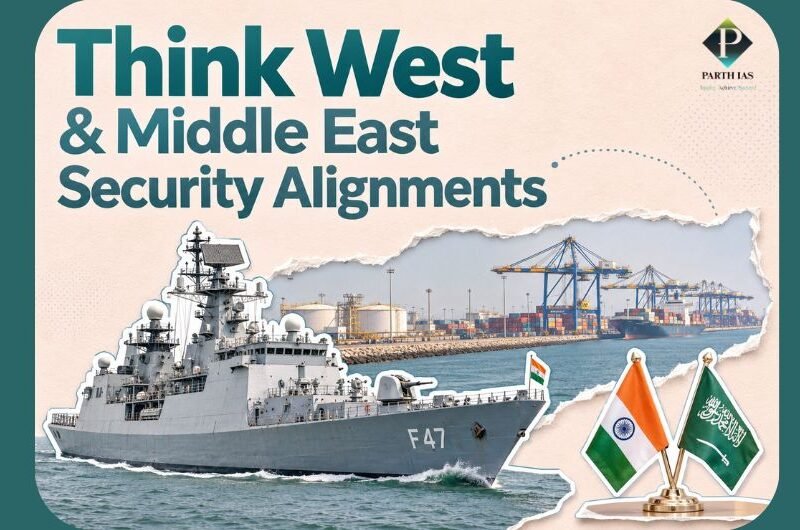
“Think West” & Middle East Security Alignments
India’s “Think West” Policy: Strategic Opportunities and Challenges in West Asia
India’s “Think West” policy, launched in 2014, represents a shift from an approach focused mainly on energy and trade to a broader strategy of multi-alignment across West Asia. The policy seeks to strengthen India’s partnerships in security, technology, infrastructure, trade and diplomacy. However, deepening regional divisions and changes in the security environment pose significant challenges.
This approach highlights how India seeks to maintain strategic autonomy while managing relationships with competing regional powers and security groupings.
1. Conceptual Framework: Evolution of “Think West”
Historically, India followed a policy of de-hyphenation, maintaining separate bilateral relationships with countries such as Israel and Palestine rather than allowing relations with one to determine its engagement with the other. Under “Think West,” this approach has developed into more active and structured multi-alignment.
2. The Middle East Security Grid
The contemporary Middle East is increasingly divided among three competing security groupings, alongside changes in the involvement of external powers.
| MIDDLE EAST SECURITY GRID | ||
|---|---|---|
| Vector 1: Israel Bloc | Vector 2: Iran’s Resistance Axis | Vector 3: Arab Hedging Bloc |
| Focuses on deterrence and the elimination of hostile armed groups. | Includes Hezbollah, the Houthis and Hamas, which oppose Western and Israeli influence. | Includes Gulf Cooperation Council (GCC) members such as Saudi Arabia and the UAE, which seek to reduce tensions while protecting economic and security interests. |
3. Core Strategic Dilemmas for India
The development of stronger regional security groupings creates new challenges for India’s policy of maintaining balanced relationships across West Asia.
| Security Driver | Strategic Vulnerability under “Think West” |
|---|---|
| The Pakistan-Gulf Convergence | The Mecca Joint Defence Agreement could strengthen Pakistan’s military role in the Gulf, creating challenges for India’s close security relationships with GCC countries. |
| The “Israel Habit” vs. Global South | India’s growing dependence on Israeli defence technology must be balanced with its ambition to act as a Vishwa Bandhu (friend to the world), particularly among Global South countries that have traditionally supported the Palestinian cause. |
| Maritime Vulnerabilities | Confrontations involving the Houthi movement in the Red Sea threaten important Indian trade routes. These developments have increased the need for the Indian Navy to conduct anti-piracy operations and protect maritime shipping routes. |
| The Iran-West Collision | Sanctions and military confrontations involving Iran create difficulties for India’s access to Chabahar Port, which is an important gateway for connectivity with Central Asia. |
4. Way Forward
To protect its geo-economic, geo-strategic and maritime interests, India needs to strengthen its economic partnerships while taking a more active role in regional security and diplomacy.
Must Know Terms
1. Think West Policy
India’s strategy to strengthen economic, diplomatic, technological and security partnerships with West Asian countries.
2. Multi-Alignment
Maintaining strong relationships with competing regional powers while protecting India’s independent foreign policy interests.
3. Strategic Autonomy
India’s ability to make independent foreign policy and security decisions without excessive dependence on any single country or alliance.
4. De-Hyphenation
Maintaining separate relationships with Israel, Palestine, Iran and Arab countries without allowing one partnership to determine another.
5. India-Middle East-Europe Economic Corridor (IMEC)
A proposed trade and connectivity corridor linking India with the Middle East and Europe through transport and infrastructure networks.
6. Maritime Security
Protecting important shipping routes, especially in the Red Sea and Persian Gulf, through naval cooperation, intelligence sharing and anti-piracy operations.
Multiple-Choice Questions
Q2. Match List I with List II:
Select the correct answer using the code given below:
Q5. Match the following foreign policy concepts with their characteristics:
Select the correct answer:
Q8. Consider the following pairs:
How many of the above pairs are correctly matched?
Q12. Match the following challenges with the corresponding policy responses:
Select the correct answer:
Q14. Match the following terms with their appropriate meanings:
Select the correct answer:




0 comment