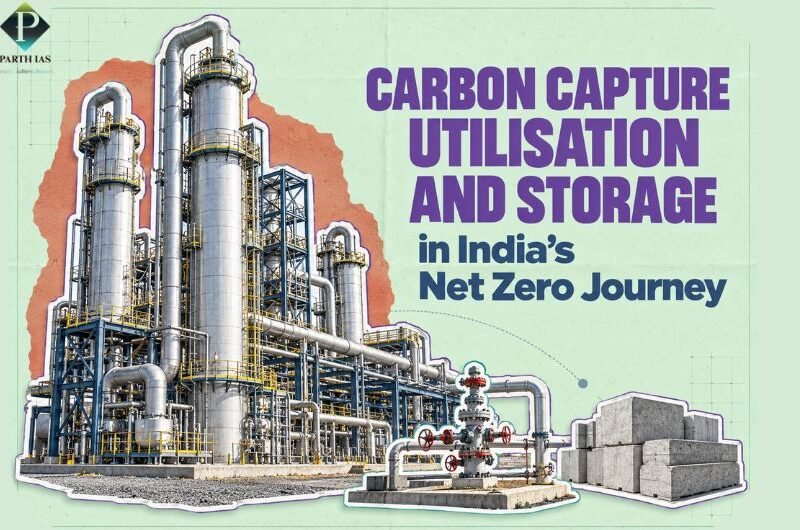
Carbon Capture Utilisation and Storage in India’s Net Zero Journey
1
Carbon Capture, Utilisation and Storage (CCUS) is a technology-based approach for capturing carbon dioxide from industrial sources before its release into the atmosphere, utilising it in productive applications or storing it permanently underground. It supports India’s Net Zero by 2070 target and complements renewable energy in decarbonising hard-to-abate sectors, including steel, cement, oil and gas, petrochemicals, chemicals, fertilisers and thermal power generation.
2
NITI Aayog identifies CCUS as an important technology for deep decarbonisation of hard-to-abate industries where emissions cannot be easily eliminated through electrification alone. Emissions from these sectors and thermal power generation are expected to reach approximately 2,300 million tonnes per annum by 2030. As of August 2026, fossil-fuel-based sources accounted for 45.12% of India’s total installed power capacity, making emission reduction from existing energy infrastructure significant.
3
The CCUS process begins with separating carbon dioxide from gases generated during fuel combustion or industrial processes. The captured carbon dioxide is subsequently purified, dried and compressed into a dense form. It can then be transported to facilities for productive utilisation or permanent geological storage. Existing industrial facilities, including steel plants, cement factories and thermal power stations, can potentially be retrofitted with carbon capture systems.
4
Captured carbon dioxide is commonly transported through pipelines, while ships and other transport modes may be used depending on distance, volume, available infrastructure and destination. Permanent geological storage involves injecting carbon dioxide into deep underground formations such as depleted oil and gas reservoirs, deep saline aquifers and basaltic rock formations. These geological formations provide potential sites for long-term isolation of captured carbon dioxide.
5
Carbon utilisation involves converting captured carbon dioxide into useful products or employing it in industrial processes. Major applications include enhanced oil recovery, urea production, green methanol, concrete, aggregates, synthetic fuels, chemicals, polymers and algae-based products such as biofuels. CCUS can therefore support industrial resource efficiency by treating captured carbon dioxide as a potential feedstock for materials, fuels, chemicals and biological products.
6
India’s CCUS framework promotes a hub-and-cluster model connecting multiple industrial carbon dioxide emitters through shared transport, utilisation and storage infrastructure. NITI Aayog identifies this model as suitable for achieving economies of scale and reducing infrastructure risks. The Department of Science and Technology’s CCUS Roadmap 2025 identifies potential clusters along the Gujarat coast for refineries and chemicals, the Odisha–Jharkhand belt for steel and cement, and Northeast India for oil and gas activities.
7
CCUS can support blue hydrogen production through coal gasification combined with carbon capture. Green hydrogen is produced through water electrolysis using renewable electricity, whereas blue hydrogen uses natural gas or coal as its primary feedstock. Coal gasification converts coal into synthesis gas (syngas) through reactions with limited oxygen and steam at approximately 800°C–1,600°C. Its two established methods are surface coal gasification using above-ground gasifiers and underground coal gasification within coal seams.
8
India’s first integrated CCUS Field Laboratory was inaugurated at the Indian Institute of Technology (IIT) Bombay in May 2026. The indigenous pilot-scale facility integrates carbon capture, utilisation and permanent geological storage. It can capture up to 3 tonnes of carbon dioxide per day from industrial emissions and ambient air, using non-potable water, and convert it into carbonate and bicarbonate products. Scientific drilling in the Deccan Traps basalt formations will assess their potential for safe and permanent carbon dioxide storage.
9
The Union Budget 2026–27 announced a ₹20,000 crore CCUS scheme in February 2026, with funding spread over five years. The initiative targets carbon capture, utilisation and storage technologies in five major industrial sectors: Power, Steel, Cement, Refineries and Chemicals. It forms part of India’s broader strategy for industrial decarbonisation and development of domestic carbon management capabilities.
10
NITI Aayog released its CCUS Policy Framework and Mechanism report in November 2022, outlining sector-specific policy interventions for deep decarbonisation. The Department of Science and Technology (DST) launched its CCUS Research and Development Roadmap in December 2025, focusing on funding, technology development, commercial readiness and deployment. Two National CCUS Centres were established in 2022 at IIT Bombay and the Jawaharlal Nehru Centre for Advanced Scientific Research (JNCASR), Bengaluru, to support research, technology development, pilot demonstrations and industry collaboration.
11
India launched its first cluster of five Carbon Capture and Utilisation (CCU) testbeds for the cement industry on 11 May 2025. Led by the Department of Science and Technology, the initiative operates through a Public-Private Partnership model involving cement manufacturers and research institutions. The testbeds focus on carbon dioxide capture, mineralisation and conversion into concrete products, supporting the development and deployment of industrial CCU technologies.
12
The Department of Science and Technology has supported two CCU Technology Deployment Testbeds for pilot-scale demonstrations at coal gasification facilities. The industry-research partnerships involve IIT Delhi with Thermax Limited and CSIR–Indian Institute of Chemical Technology (IICT), Hyderabad, with Bharat Heavy Electricals Limited (BHEL). These testbeds focus on carbon utilisation for methanol and DME production and involve technology developers and industrial partners working on applications for hard-to-abate sectors.
13
India’s CCUS research programme is jointly advanced by the Department of Science and Technology (DST) and the Department of Biotechnology (DBT). Under Mission Innovation, an international clean-energy collaboration platform, India has worked with 13 partner countries on technologies for capturing, separating, securely storing and converting carbon dioxide into value-added products. The initiatives support indigenous technology development, research collaboration and industrial deployment of carbon management solutions.
14
As of April 2026, India had three operational Carbon Capture and Utilisation projects, with one each in Madhya Pradesh, Tamil Nadu and Maharashtra. Six additional projects were under construction or execution, comprising three in Andhra Pradesh, two in Telangana and one in Maharashtra. These projects involve public sector enterprises, private industries and research institutions and focus on emission reduction, carbon utilisation and circular-economy applications.
15
As of April 2026, sixteen CCU projects were at the proposed stage across India. Assam and Odisha had the highest number, with four proposed projects each, followed by Gujarat and Rajasthan with two each. Andhra Pradesh, Madhya Pradesh, Haryana and Tamil Nadu had one proposed project each. Alongside this expanding project pipeline, the second Emerging Science, Technology and Innovation Conclave (ESTIC-2026), organised by the Council of Scientific & Industrial Research (CSIR), is being held from 27–29 October 2026 at Bharat Mandapam, New Delhi, covering 12 thematic areas including emerging energy technologies such as CCUS.
Must Know Terms
1. Hard-to-Abate Sectors
Hard-to-Abate Sectors are industries where carbon emissions are difficult to eliminate through electrification or renewable energy alone. These include steel, cement, refineries, chemicals and fertilisers. CCUS helps reduce emissions from their industrial processes.
2. Geological Carbon Storage
Geological Carbon Storage involves injecting captured carbon dioxide deep underground for long-term isolation from the atmosphere. Suitable formations include depleted oil and gas reservoirs, deep saline aquifers and basaltic rock formations.
3. CCUS Hubs and Clusters
CCUS Hubs and Clusters connect multiple industrial carbon dioxide emitters through shared infrastructure for transportation, utilisation and storage. This model creates economies of scale, reduces infrastructure risks and supports coordinated carbon management across industrial regions.
4. Carbon Mineralisation
Carbon Mineralisation involves converting captured carbon dioxide into stable mineral-based products, such as carbonates and materials used in concrete. It is an important carbon utilisation pathway being explored through India’s CCU testbeds and research facilities.
5. Coal Gasification
Coal Gasification converts solid coal into synthesis gas (syngas) by reacting it with limited oxygen and steam at approximately 800°C–1,600°C. It can be carried out through surface or underground methods. When combined with carbon capture, it can support blue hydrogen production.
6. Enhanced Oil Recovery (EOR)
Enhanced Oil Recovery is an industrial application in which captured carbon dioxide is used to improve oil extraction from underground reservoirs. Under the CCUS framework, it provides a productive use for captured carbon dioxide and can be combined with underground carbon storage.
Multiple-Choice Questions
1. With reference to Carbon Capture, Utilisation and Storage (CCUS), consider the following statements:
1. It involves capturing carbon dioxide from industrial sources before its release into the atmosphere.
2. Captured carbon dioxide can either be utilised in productive applications or stored permanently underground.
3. CCUS is restricted exclusively to capturing carbon dioxide directly from ambient air.
4. CCUS is intended to completely replace renewable energy technologies in industrial decarbonisation.
Which of the statements given above are correct?
(a) 1 and 2 only
(b) 1, 2 and 3 only
(c) 2 and 4 only
(d) 1, 3 and 4 only
2. With reference to CCUS and India’s industrial decarbonisation, consider the following statements:
1. Hard-to-abate sectors include steel, cement, petrochemicals, chemicals and fertilisers, where emissions cannot be easily eliminated through electrification alone.
2. Emissions from hard-to-abate sectors and thermal power generation are expected to reach approximately 2,300 million tonnes per annum by 2030.
3. As of August 2026, fossil-fuel-based sources accounted for 45.12% of India’s total installed power capacity.
4. The figure of 45.12% represents the share of fossil fuels in India’s total electricity generation rather than installed capacity.
Which of the statements given above are correct?
(a) 1, 2 and 4 only
(b) 1, 2 and 3 only
(c) 2 and 3 only
(d) 1, 3 and 4 only
3. Consider the following statements regarding the capture and transportation of carbon dioxide under CCUS:
1. Captured carbon dioxide is purified, dried and compressed before transportation or utilisation.
2. Permanent geological storage requires carbon dioxide to be injected into shallow formations from which it can freely escape into the atmosphere.
3. Pipelines are commonly used for carbon dioxide transportation, while ships may provide an alternative for longer distances.
4. The choice of transportation mode is independent of the volume of carbon dioxide and the availability of infrastructure.
Which of the statements given above are correct?
(a) 1, 2 and 3 only
(b) 2 and 4 only
(c) 1 and 3 only
(d) 1, 3 and 4 only
4. Consider the following pairs regarding carbon dioxide management:
1. Depleted oil and gas reservoirs — Geological storage
2. Deep saline aquifers — Geological storage
3. Basaltic rock formations — Geological storage
4. Food and beverage applications — Permanent geological storage
Which of the pairs given above are correctly matched?
(a) 1 and 2 only
(b) 2, 3 and 4 only
(c) 1, 3 and 4 only
(d) 1, 2 and 3 only
5. With reference to carbon dioxide utilisation under CCUS, consider the following applications:
1. Production of green methanol and synthetic fuels
2. Enhanced Oil Recovery
3. Production of concrete, aggregates and algae-based biofuels
4. Injection into deep saline aquifers solely for permanent isolation
Which of the above are examples of productive carbon dioxide utilisation?
(a) 1, 2 and 3 only
(b) 1, 2 and 4 only
(c) 2, 3 and 4 only
(d) 1, 2, 3 and 4
6. Consider the following pairs regarding potential CCUS hubs and clusters identified in India’s CCUS framework:
1. Gujarat Coast — Refineries and chemical industries
2. Odisha–Jharkhand Belt — Oil and gas extraction
3. Northeast India — Oil and gas resources
4. Gujarat Coast — Exclusively forest-based carbon sequestration
Which of the pairs given above are correctly matched?
(a) 1 and 2 only
(b) 1 and 3 only
(c) 2, 3 and 4 only
(d) 1, 3 and 4 only
7. With reference to hydrogen production and coal gasification, consider the following statements:
1. Green hydrogen is produced through coal gasification combined with carbon capture.
2. Blue hydrogen can be produced using coal gasification coupled with carbon capture.
3. Coal gasification involves reacting coal with limited oxygen and steam at temperatures of approximately 800°C–1,600°C.
4. Underground coal gasification involves processing mined coal in above-ground gasifiers.
Which of the statements given above are correct?
(a) 1 and 3 only
(b) 1, 2 and 4 only
(c) 2 and 3 only
(d) 2, 3 and 4 only
8. With reference to India’s first integrated CCUS Field Laboratory, consider the following statements:
1. It was inaugurated at IIT Bombay in May 2026.
2. It can capture up to 3 tonnes of carbon dioxide per day from industrial emissions and ambient air.
3. It depends exclusively on potable water for converting captured carbon dioxide into useful products.
4. Scientific drilling in the Deccan Traps basalt formations is intended to assess their suitability for permanent carbon dioxide storage.
Which of the statements given above are correct?
(a) 1, 2 and 3 only
(b) 2 and 4 only
(c) 1, 3 and 4 only
(d) 1, 2 and 4 only
9. With reference to the CCUS initiative announced in the Union Budget 2026–27, consider the following statements:
1. The scheme was announced in February 2026.
2. It provides an allocation of ₹20,000 crore spread over five years.
3. It targets five major industrial sectors: Power, Steel, Cement, Refineries and Chemicals.
4. Its financial assistance is restricted exclusively to agricultural carbon sequestration projects.
Which of the statements given above are correct?
(a) 1, 2 and 3 only
(b) 1 and 4 only
(c) 2, 3 and 4 only
(d) 1, 2, 3 and 4
10. Consider the following pairs regarding institutional and policy developments in India’s CCUS ecosystem:
1. NITI Aayog CCUS Policy Framework — November 2022
2. National CCUS Centres — IIT Bombay and JNCASR, Bengaluru, established in 2022
3. DST CCUS Research and Development Roadmap — December 2025
4. Union Budget CCUS Scheme — Announced in December 2025
Which of the pairs given above are correctly matched?
(a) 1, 2 and 4 only
(b) 1, 2 and 3 only
(c) 2 and 3 only
(d) 1, 3 and 4 only
11. With reference to India’s first cluster of Carbon Capture and Utilisation testbeds for the cement industry, consider the following statements:
1. The cluster was launched on 11 May 2025 and consists of five testbeds.
2. It was developed through a Public-Private Partnership model involving cement companies and research institutions.
3. Its primary objective is limited to underground carbon dioxide storage, excluding carbon mineralisation and concrete production.
4. It was launched exclusively by the Department of Biotechnology without the participation of the Department of Science and Technology.
Which of the statements given above are correct?
(a) 1, 2 and 3 only
(b) 2 and 4 only
(c) 1 and 2 only
(d) 1, 3 and 4 only
12. Consider the following statements regarding CCU Technology Deployment Testbeds in coal gasification facilities:
1. One industry-research partnership involves IIT Delhi and Thermax Limited.
2. Another partnership involves CSIR–Indian Institute of Chemical Technology, Hyderabad, and Bharat Heavy Electricals Limited.
3. The testbeds focus on pilot-scale carbon utilisation for methanol and DME production.
4. The two testbeds are intended exclusively for permanent geological storage in deep saline aquifers.
Which of the statements given above are correct?
(a) 1 and 3 only
(b) 2, 3 and 4 only
(c) 1, 2 and 4 only
(d) 1, 2 and 3 only
13. With reference to India’s international and institutional cooperation in CCUS research, consider the following statements:
1. The Department of Science and Technology and the Department of Biotechnology jointly advance India’s CCUS research programme.
2. India has collaborated with 13 partner countries under Mission Innovation.
3. The collaborative research includes capturing, separating, securely storing and converting carbon dioxide into value-added materials.
4. Mission Innovation restricts its cooperation exclusively to conventional fossil-fuel extraction technologies.
Which of the statements given above are correct?
(a) 1, 2 and 3 only
(b) 1 and 4 only
(c) 2 and 3 only
(d) 1, 2, 3 and 4
14. Consider the following statements regarding the status of Carbon Capture and Utilisation projects in India as of April 2026:
1. Three projects were operational, with one each in Madhya Pradesh, Tamil Nadu and Maharashtra.
2. Six projects were under construction or execution, including three in Andhra Pradesh, two in Telangana and one in Maharashtra.
3. Gujarat and Rajasthan each accounted for four proposed projects.
4. Madhya Pradesh had one proposed CCU project in addition to its operational project.
Which of the statements given above are correct?
(a) 1, 2 and 3 only
(b) 1, 2 and 4 only
(c) 2, 3 and 4 only
(d) 1, 3 and 4 only
15. With reference to India’s CCUS project pipeline and ESTIC-2026, consider the following statements:
1. As of April 2026, India had sixteen proposed CCU projects, with Assam and Odisha accounting for four projects each.
2. Gujarat and Rajasthan had two proposed CCU projects each, while Haryana and Tamil Nadu had one each.
3. The second Emerging Science, Technology and Innovation Conclave is being held from 27–29 October 2026 at Bharat Mandapam, New Delhi, under the Council of Scientific & Industrial Research.
4. ESTIC-2026 covers eight thematic areas and excludes emerging energy technologies such as CCUS.
Which of the statements given above are correct?
(a) 1, 2 and 4 only
(b) 1 and 3 only
(c) 1, 2 and 3 only
(d) 2, 3 and 4 only




0 comment