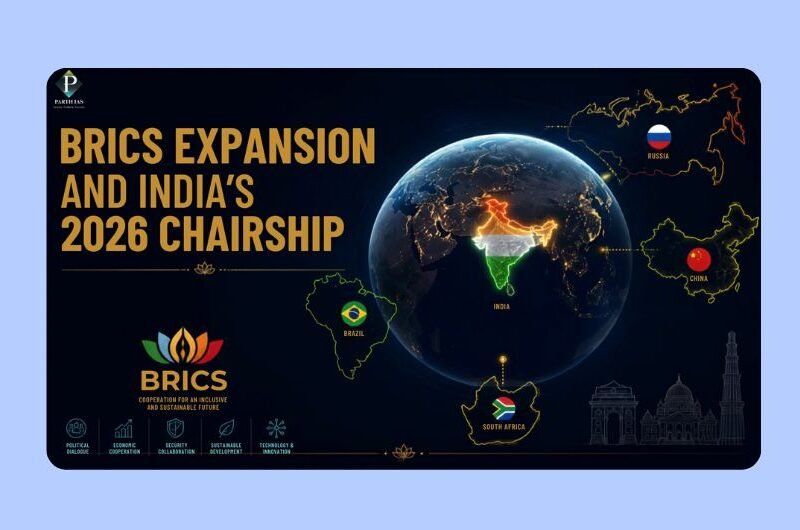
BRICS Expansion and India’s 2026 Chairship
1. The term BRIC was coined by Goldman Sachs in 2001 in its paper titled “The World Needs Better Economic BRICs.”
2. The original BRIC countries were Brazil, Russia, India and China.
3. BRIC was formally established as a political cooperation forum in 2006.
4. The first BRIC Summit was held in Yekaterinburg, Russia, in 2009.
5. South Africa became a full member in 2011, transforming BRIC into BRICS.
6. Egypt, Ethiopia, Iran, Saudi Arabia and the United Arab Emirates joined BRICS as full members in January 2024.
7. Indonesia joined BRICS in January 2025, becoming its eleventh full member.
8. BRICS members collectively account for approximately 49.5% of the global population, 40% of global Gross Domestic Product (GDP) and 26% of global trade.
9. Ten countries became BRICS Partner Countries in 2025: Belarus, Bolivia, Cuba, Kazakhstan, Malaysia, Nigeria, Thailand, Uganda, Uzbekistan and Vietnam.
10. The BRICS Presidency rotates annually, with each term running from 1 January to 31 December.
11. India previously chaired BRICS in 2012, 2016 and 2021 and assumed its fourth Chairship on 1 January 2026.
12. India is scheduled to host the 18th BRICS Summit in New Delhi on 12–13 September 2026.
13. India’s 2026 BRICS Chairship follows the theme “Building for Resilience, Innovation, Cooperation and Sustainability.”
14. India’s 2012 BRICS Chairship proposed the creation of a new development bank and laid the foundation for the Contingent Reserve Arrangement (CRA).
15. During India’s 2026 Chairship, more than 350 BRICS meetings and high-level engagements were held across 25 Indian cities.
Must Know Terms :
1.BRICS
A cooperation platform of major emerging economies. The name represents Brazil, Russia, India, China and South Africa, though the grouping has expanded to include additional members from Asia, Africa and the Middle East.
2. Global South
A broad term for developing and emerging economies across Asia, Africa and Latin America. BRICS seeks to strengthen their representation in global economic and political institutions.
3. New Development Bank (NDB)
A multilateral development bank established by BRICS countries. It finances infrastructure and sustainable development projects in BRICS members and other emerging economies.
4. Contingent Reserve Arrangement (CRA)
A BRICS financial safety mechanism that provides short-term liquidity support to member countries facing balance-of-payments or financial pressures.
5. BRICS Partner Country
A category that allows selected countries to participate in BRICS cooperation without becoming full members. Ten countries joined this framework in 2025.
6. BRICS Presidency
The leadership of BRICS rotates annually among member countries. The country holding the Presidency sets annual priorities, organises the summit and coordinates ministerial and working-group meetings.
MCQ :
1. The term “BRIC” was originally coined by:
(a) Goldman Sachs
(b) World Bank
(c) International Monetary Fund
(d) United Nations Development Programme
2. Which of the following constituted the original BRIC grouping?
(a) Brazil, Russia, Indonesia and China
(b) Brazil, Russia, India and China
(c) Brazil, Romania, India and China
(d) Brazil, Russia, India and Canada
3. The first BRIC Summit was held in 2009 at:
(a) New Delhi, India
(b) Beijing, China
(c) Yekaterinburg, Russia
(d) Brasília, Brazil
4. South Africa’s admission as a full member transformed BRIC into BRICS in:
(a) 2006
(b) 2009
(c) 2010
(d) 2011
5. With reference to the expansion of BRICS, consider the following statements:
1. Egypt and Ethiopia became full members in January 2024.
2. Iran and the United Arab Emirates became full members in January 2024.
3. Indonesia became a full member in January 2025.
Which of the statements given above are correct?
(a) 1, 2 and 3
(b) 1 and 2 only
(c) 2 and 3 only
(d) 1 and 3 only
6. Which country became the eleventh full member of BRICS in January 2025?
(a) Malaysia
(b) Indonesia
(c) Thailand
(d) Vietnam
7. With reference to the economic and demographic significance of BRICS, consider the following statements:
1. Its members represent approximately 49.5% of the global population.
2. They account for approximately 40% of global Gross Domestic Product.
3. They account for approximately 26% of global trade.
Which of the statements given above are correct?
(a) 1 and 2 only
(b) 2 and 3 only
(c) 1, 2 and 3
(d) 1 and 3 only
8. Which one of the following countries was not included among the ten BRICS Partner Countries admitted in 2025?
(a) Belarus
(b) Nigeria
(c) Vietnam
(d) Argentina
9. With reference to the BRICS Partner Country category, consider the following statements:
1. It enables structured participation in BRICS cooperation.
2. A Partner Country does not automatically become a full member.
3. Ten countries joined this category in 2025.
Which of the statements given above are correct?
(a) 1, 2 and 3
(b) 1 and 2 only
(c) 2 and 3 only
(d) 1 and 3 only
10. The term of the BRICS Presidency ordinarily runs from:
(a) 1 April to 31 March
(b) 1 January to 31 December
(c) 1 July to 30 June
(d) The date of one summit to the next summit
11. Before assuming the BRICS Presidency in 2026, India had chaired the grouping in:
(a) 2009, 2014 and 2019
(b) 2010, 2015 and 2020
(c) 2012, 2016 and 2021
(d) 2011, 2017 and 2022
12. India is scheduled to host the 18th BRICS Summit in 2026 at:
(a) Mumbai
(b) Goa
(c) Bengaluru
(d) New Delhi
13. What is the theme of India’s 2026 BRICS Chairship?
(a) Building for Resilience, Innovation, Cooperation and Sustainability
(b) Inclusive Growth through Digital Transformation
(c) Global Stability, Security and Prosperity
(d) Building Responsive, Inclusive and Collective Solutions
14. The New Development Bank was created primarily to finance:
(a) Military alliances and security operations
(b) Infrastructure and sustainable development projects
(c) Only short-term balance-of-payments support
(d) Election-management programmes in developing countries
15. Which of the following correctly describes the Contingent Reserve Arrangement?
(a) A permanent common currency of BRICS
(b) A trade agreement for eliminating all customs duties
(c) A financial mechanism providing short-term liquidity support
(d) A fund exclusively for climate-change adaptation

0 comment