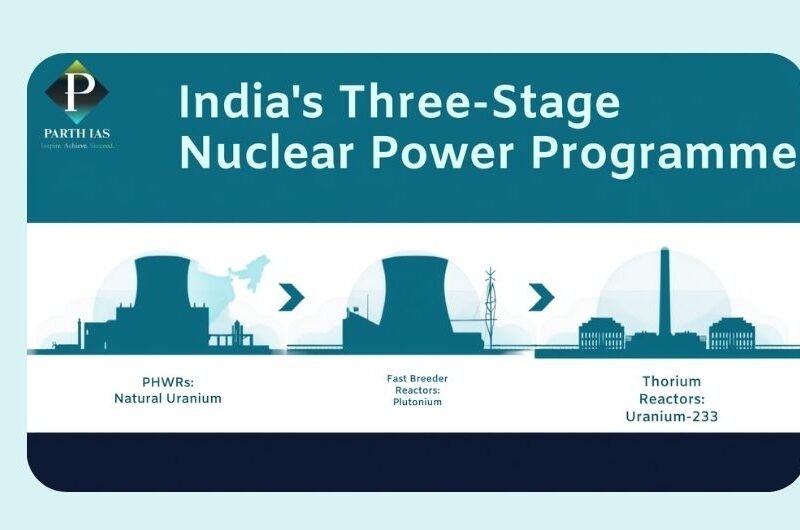
India’s Three-Stage Nuclear Power Programme
1. India operates 24 nuclear power reactors with a total installed capacity of 8.78 gigawatts (GW).
2. Nine reactor units with a combined capacity of 7.5 GW are under construction.
3. The Government has approved 10 indigenous Pressurised Heavy Water Reactors (PHWRs) in fleet mode and pre-project activities for two 500 MW Fast Breeder Reactors (FBRs).
4. India aims to achieve 100 GW of nuclear power capacity by 2047 under the Nuclear Energy Mission for Viksit Bharat.
5. Nuclear power provides stable baseload electricity, which is essential for continuous operation of hospitals, communication networks, defence establishments, industries and other critical services.
6. Nuclear power plants generate electricity through controlled nuclear fission, in which heat produces steam that drives turbines connected to generators.
7. India mainly uses natural uranium as fuel in PHWRs; these reactors do not require uranium enrichment.
8. India’s uranium reserves are relatively low grade and are supplemented through imports, whereas thorium reserves are abundant.
9. Major thorium-bearing coastal sand deposits occur in Kerala, Tamil Nadu, Andhra Pradesh, Odisha, West Bengal and Jharkhand.
10. Thorium-232 is fertile, not fissile. Inside a reactor, it can absorb a neutron and transform into fissile Uranium-233.
11. Dr. Homi J. Bhabha proposed India’s three-stage nuclear power programme in 1954 to utilise indigenous uranium and thorium resources.
12. In the first stage, PHWRs use natural uranium, while reprocessing of spent fuel recovers plutonium for use in the second stage.
13. In the second stage, Fast Breeder Reactors use plutonium and breed additional fissile material, including Uranium-233 from thorium.
14. In April 2026, the Prototype Fast Breeder Reactor at Kalpakkam attained first criticality, marking a key milestone in the second stage of the programme.
15. India follows a closed nuclear fuel cycle: spent fuel is reprocessed for reuse, while high-level radioactive waste is converted into stable glass through vitrification for long-term management.
Must Know Terms :
1.Three-Stage Nuclear Power Programme
Proposed by Dr. Homi J. Bhabha in 1954 to use India’s limited uranium and abundant thorium reserves. The three stages are: natural-uranium PHWRs, plutonium-fuelled Fast Breeder Reactors, and thorium-based reactors using Uranium-233.
2. Pressurised Heavy Water Reactor (PHWR)
A reactor that uses heavy water as both moderator and coolant, and natural uranium as fuel. PHWRs form the mainstay of India’s current nuclear-power fleet and produce plutonium in their spent fuel for the second stage.
3. Fast Breeder Reactor (FBR)
An advanced reactor that uses plutonium-based fuel and produces more fissile material than it consumes. It also converts thorium into Uranium-233, supporting the transition towards the third stage of India’s programme.
4. Thorium-232
A fertile radioactive material found in India’s coastal sands, especially in Kerala, Tamil Nadu, Andhra Pradesh, Odisha, West Bengal and Jharkhand. It cannot sustain a chain reaction directly but can be converted into fissile Uranium-233.
5. Uranium-233
A fissile isotope produced when Thorium-232 absorbs a neutron inside a reactor. It is the key fuel intended for thorium-based reactors in the third stage of India’s nuclear power programme.
6. Closed Nuclear Fuel Cycle
A system in which spent nuclear fuel is reprocessed to recover useful materials, such as plutonium and uranium, for reuse in reactors. The remaining high-level radioactive waste is vitrified and stored safely for long-term management.
MCQ :
1. India’s present installed nuclear power capacity is:
(a) 6.78 GW
(b) 8.78 GW
(c) 10.78 GW
(d) 12.78 GW
2. With reference to India’s nuclear power programme, consider the following statements:
1. Nine reactor units with a combined capacity of 7.5 GW are under construction.
2. Ten indigenous Pressurised Heavy Water Reactors have been approved in fleet mode.
3. Pre-project activities are underway for two 500 MW Fast Breeder Reactors.
Which of the statements given above are correct?
(a) 1, 2 and 3
(b) 1 and 2 only
(c) 2 and 3 only
(d) 1 and 3 only
3. India aims to achieve 100 GW of nuclear power capacity by:
(a) 2030
(b) 2035
(c) 2040
(d) 2047
4. Baseload electricity refers to:
(a) Electricity generated only from renewable sources
(b) Electricity supplied solely during peak demand
(c) The minimum uninterrupted power required to keep an electricity grid operational
(d) Electricity produced only by nuclear reactors
5. Nuclear power plants generate electricity by:
(a) Using heat from controlled fission to produce steam that drives turbines
(b) Directly converting nuclear fuel into electricity without turbines
(c) Using nuclear fusion to rotate generators
(d) Producing electricity through chemical reactions in fuel rods
6. India mainly uses which one of the following fuels in its Pressurised Heavy Water Reactors?
(a) Low-enriched uranium
(b) Natural uranium
(c) Thorium-232
(d) Uranium-233
7. Which one of the following is a correct feature of Pressurised Heavy Water Reactors?
(a) They use graphite as both moderator and coolant
(b) They use only plutonium as fuel
(c) They require uranium enrichment before fuel use
(d) They use heavy water as moderator and coolant
8. India’s long-term interest in thorium-based nuclear energy arises mainly because:
(a) India has abundant thorium reserves but relatively low-grade uranium reserves
(b) Thorium is directly fissile and needs no conversion
(c) Thorium can be used only in Light Water Reactors
(d) India has no uranium resources of any kind
9. Thorium-bearing coastal sand deposits in India occur in all of the following states except:
(a) Odisha
(b) Kerala
(c) Punjab
(d) Tamil Nadu
10. Thorium-232 is best described as:
(a) A fissile isotope used directly in all Indian reactors
(b) A fertile material that can be converted into Uranium-233
(c) A non-radioactive mineral used as reactor coolant
(d) A by-product of uranium enrichment
11. India’s three-stage nuclear power programme was proposed by:
(a) Vikram Sarabhai
(b) Homi J. Bhabha
(c) Raja Ramanna
(d) A. P. J. Abdul Kalam
12. In the first stage of India’s three-stage nuclear power programme:
(a) PHWRs use natural uranium and spent fuel is reprocessed to recover plutonium
(b) FBRs use Uranium-233 as their main fuel
(c) Thorium is directly used as the only fissile fuel
(d) Light Water Reactors produce plutonium from enriched uranium
13. The second stage of India’s three-stage nuclear power programme is based primarily on:
(a) Pressurised Heavy Water Reactors using natural uranium
(b) Thorium reactors using Uranium-233
(c) Fast Breeder Reactors using plutonium
(d) Small Modular Reactors using low-enriched uranium
14. The Prototype Fast Breeder Reactor that attained first criticality in April 2026 is located at:
(a) Tarapur
(b) Kudankulam
(c) Rawatbhata
(d) Kalpakkam
15. With reference to India’s closed nuclear fuel cycle, consider the following statements:
1. Spent nuclear fuel is reprocessed to recover useful materials for reuse.
2. High-level radioactive waste is vitrified into stable glass form.
3. Reprocessing eliminates the need for radioactive-waste management.
Which of the statements given above is/are correct?
(a) 1 and 2 only
(b) 2 and 3 only
(c) 1 and 3 only
(d) 1, 2 and 3


0 comment