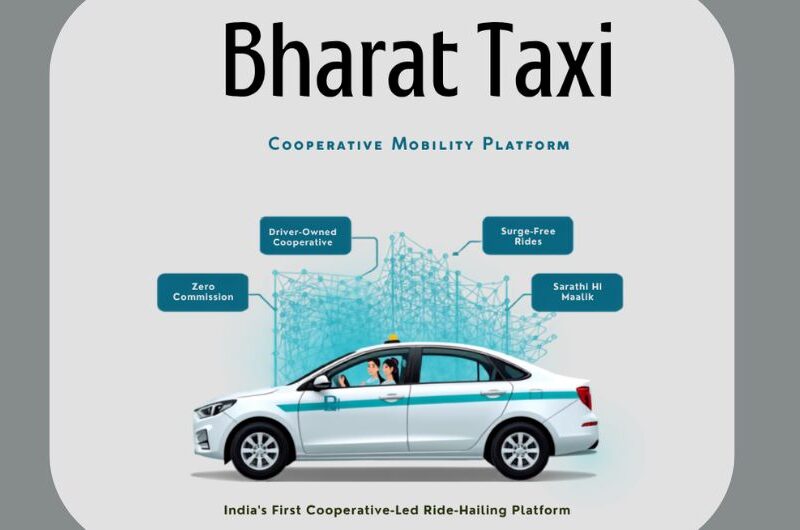
Bharat Taxi Cooperative Mobility Platform
1. Bharat Taxi is India’s first cooperative-led ride-hailing platform, established on 6 June 2025 under the Multi-State Cooperative Societies Act, 2002.
2. It was founded by eight national cooperative institutions: National Cooperative Development Corporation (NCDC), Indian Farmers Fertiliser Cooperative Limited (IFFCO), National Bank for Agriculture and Rural Development (NABARD), Krishak Bharati Cooperative Limited (KRIBHCO), Amul, National Agricultural Cooperative Marketing Federation of India Limited (NAFED), National Dairy Development Board (NDDB) and National Cooperative Export Limited (NCEL).
3. Bharat Taxi follows a cooperative ownership model in which drivers, called Sarathis, are member owners of the platform.
4. It operates on a zero-commission and surge-free model, allowing Sarathis to retain the full trip fare.
5. The platform uses a subscription-based system. Twenty percent of cooperative earnings is credited as Sarathis’ capital, while 80 percent is distributed according to kilometres travelled.
6. A 7 percent service charge is levied only at Bharat Taxi-operated airport prepaid booths for operational expenses.
7. Sarathis can become member owners by purchasing shares worth Rs. 500, with each share valued at Rs. 100.
8. Sarathi members have reserved representation on the Board of Directors, reflecting the principle of “Sarathi Hi Maalik”.
9. As of 25 July 2026, Bharat Taxi had nearly 8 lakh registered Sarathis and around 41 lakh registered customers.
10. It operates in Delhi-NCR (National Capital Region), Gujarat, Lucknow, Chandigarh, Mumbai, Jaipur, Kanpur and Pune, and aims for nationwide expansion by 2029.
11. Bharat Taxi offers Bike Taxi, Auto, Economy Cab, Premium Sedan, XL Cab, Rentals, Out-Station Travel and Scheduled Rides.
12. Sarathi Didi allows women passengers to choose women drivers, while Bike Didi promotes women’s employment in the transport sector.
13. Its safety system includes Know Your Customer (KYC) verification, background checks, safety training, live tracking, SOS (emergency assistance) support, police integration and control-room monitoring.
14. Bharat Taxi is integrated with DigiLocker, Unified Mobile Application for New-Age Governance (UMANG) and Application Programming Interface Setu (API Setu) under Digital India for paperless verification and digital service delivery.
15. Sarathis can register on the e-Shram portal and access welfare support, including health coverage up to Rs. 5 lakh under Ayushman Bharat–Pradhan Mantri Jan Arogya Yojana (AB-PMJAY) and personal accident insurance of Rs. 5 lakh through IFFCO Tokio.
Must Know Terms :
1. Bharat Taxi
Bharat Taxi is India’s first cooperative-led ride-hailing platform. It combines digital transport services with driver ownership and cooperative governance.
2. Multi-State Cooperative Societies Act, 2002
This Act regulates cooperative societies that operate in more than one State. Bharat Taxi was registered under this law on 6 June 2025.
3. Sarathi
Sarathi is the term used for a Bharat Taxi driver. Sarathis can become member owners and participate in the platform’s governance and earnings.
4. Zero-Commission Model
Under this model, Sarathis retain the full fare paid for a ride. Bharat Taxi does not charge drivers a commission on normal app-based trips.
5. Sarathi Didi
Sarathi Didi is a feature through which women passengers can book rides operated by women drivers. It supports safer and more inclusive mobility for women.
6. e-Shram Portal
The e-Shram portal is an Aadhaar-seeded national database of unorganised workers. It helps workers access targeted social-security and welfare schemes.
MCQ :
1. With reference to Bharat Taxi, consider the following statements:
1. It is India’s first cooperative-led ride-hailing platform.
2. It was established under the Multi-State Cooperative Societies Act, 2002.
3. It was established on 6 June 2025.
Which of the statements given above are correct?
(a) 1 and 2 only
(b) 2 and 3 only
(c) 1 and 3 only
(d) 1, 2 and 3
2. Which one of the following was not among the founding institutions of Bharat Taxi?
(a) National Bank for Agriculture and Rural Development
(b) National Dairy Development Board
(c) Securities and Exchange Board of India
(d) Indian Farmers Fertiliser Cooperative Limited
3. The term “Sarathi” in the Bharat Taxi platform refers to:
(a) A passenger using the platform
(b) A driver who can become a member owner
(c) An airport prepaid booth operator
(d) A government-appointed regulator
4. Bharat Taxi is based on which one of the following financial models?
(a) Commission-based and surge-priced model
(b) Subscription-based and zero-commission model
(c) Advertisement-based and fixed-commission model
(d) Free service model without any fare collection
5. With reference to the distribution of Bharat Taxi’s cooperative earnings, consider the following statements:
1. Twenty percent is credited as Sarathis’ capital.
2. Eighty percent is distributed among Sarathis according to kilometres travelled.
3. The distribution is based only on the number of rides completed.
Which of the statements given above are correct?
(a) 1 and 2 only
(b) 2 and 3 only
(c) 1 and 3 only
(d) 1, 2 and 3
6. A 7 percent service charge is levied by Bharat Taxi only for:
(a) All app-based taxi bookings
(b) Rides booked by women passengers
(c) Airport prepaid booths operated by Bharat Taxi
(d) All out-station trips
7. With reference to Sarathi membership in Bharat Taxi, consider the following statements:
1. Each share is valued at Rs. 100.
2. A Sarathi can obtain ownership rights by purchasing shares worth Rs. 500.
3. Sarathi members have reserved representation on the Board of Directors.
Which of the statements given above are correct?
(a) 1 and 2 only
(b) 2 and 3 only
(c) 1 and 3 only
(d) 1, 2 and 3
8. Which one of the following correctly reflects Bharat Taxi’s footprint as of 25 July 2026?
(a) Nearly 8 lakh registered Sarathis and around 41 lakh customers
(b) Nearly 41 lakh registered Sarathis and around 8 lakh customers
(c) Nearly 8 lakh customers and around 41,000 Sarathis
(d) Nearly 80 lakh Sarathis and around 4 lakh customers
9. Bharat Taxi aims to achieve nationwide presence by:
(a) 2027
(b) 2028
(c) 2029
(d) 2030
10. Which one of the following is not listed as a Bharat Taxi ride category?
(a) Premium Sedan
(b) Scheduled Rides
(c) XL Cab
(d) Metro Rail Ticket
11. Sarathi Didi is an initiative that enables:
(a) Women passengers to choose women drivers
(b) Women passengers to receive free taxi rides
(c) Only women to become Board members
(d) Women drivers to operate airport prepaid booths only
12. The Bike Didi initiative is mainly intended to:
(a) Provide bicycles to school students
(b) Promote women’s employment in the transport sector
(c) Create a separate taxi service for senior citizens
(d) Replace auto-rickshaws in urban areas
13. Which of the following are included in Bharat Taxi’s safety system?
1. Know Your Customer verification
2. Periodic background checks
3. Live ride tracking and SOS support
4. Police integration and control-room monitoring
Select the correct answer using the code given below:
(a) 1 and 2 only
(b) 3 and 4 only
(c) 1, 2 and 3 only
(d) 1, 2, 3 and 4
14. Bharat Taxi is integrated under Digital India with which of the following?
1. DigiLocker
2. Unified Mobile Application for New-Age Governance
3. API Setu
Select the correct answer using the code given below:
(a) 1 and 2 only
(b) 2 and 3 only
(c) 1, 2 and 3
(d) 1 and 3 only
15. With reference to welfare support for Bharat Taxi Sarathis, consider the following statements:
1. They can register on the e-Shram portal.
2. Eligible beneficiaries can receive health coverage up to Rs. 5 lakh under Ayushman Bharat-Pradhan Mantri Jan Arogya Yojana.
3. Personal accident insurance of Rs. 5 lakh is provided through IFFCO Tokio.
Which of the statements given above are correct?
(a) 1 and 2 only
(b) 2 and 3 only
(c) 1 and 3 only
(d) 1, 2 and 3



0 comment