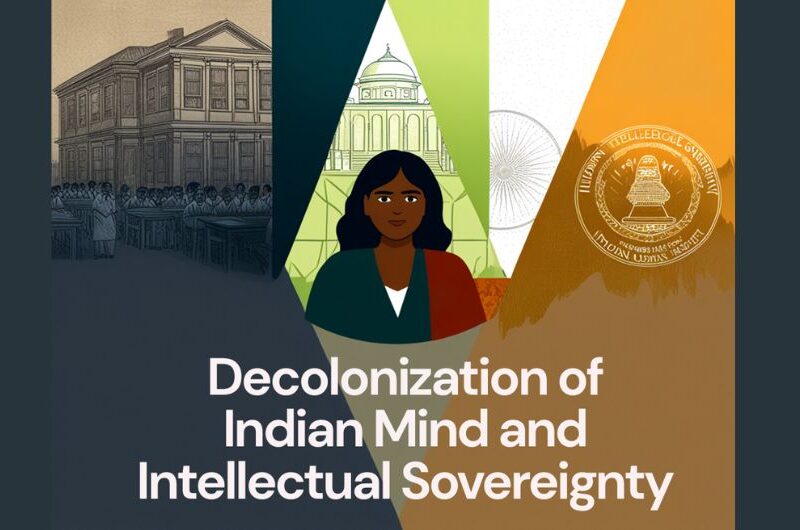
Decolonization of Indian Mind and Intellectual Sovereignty
1. Decolonization of the Indian mind means removing mental, cultural and intellectual dependence that developed during colonial rule. It encourages understanding Indian realities through Indian experiences, values and local contexts.
2. Intellectual sovereignty means the ability of a nation to create, validate and apply knowledge independently, based on its own civilizational roots, social needs and strategic interests.
3. The idea is not to reject all Western knowledge. It aims to end blind dependence on any one intellectual framework and promote equal respect for diverse knowledge systems.
4. Colonial education policies, especially Macaulay’s Minute on Education of 1835, promoted English education and reduced the status of many indigenous systems of learning.
5. Macaulay’s approach aimed to create a class of people who were Indian by birth but shaped by English tastes, opinions, morals and intellectual values.
6. Eurocentrism treated Western models of progress, science and governance as universal standards. It often placed Indian philosophy, art, medicine and knowledge traditions in a secondary position.
7. In education, decolonization requires moving beyond rote learning and excessive dependence on Eurocentric theories. It supports critical thinking, local research and the Indian Knowledge System.
8. Linguistic decolonization promotes the use of Indian languages and mother tongues in education, research, technical fields and public institutions, while recognising the practical value of English.
9. The National Education Policy 2020 supports multilingual learning, mother-tongue instruction at early stages and wider integration of Indian Knowledge Systems in education.
10. Legal and administrative decolonization aims to replace a control-oriented colonial mindset with citizen-centric governance, public participation and accountability.
11. The Bharatiya Nyaya Sanhita, Bharatiya Nagarik Suraksha Sanhita and Bharatiya Sakshya Adhiniyam replaced the Indian Penal Code, Code of Criminal Procedure and Indian Evidence Act respectively.
12. Symbolic decolonization includes renaming Rajpath as Kartavya Path, changing the Indian Navy ensign by removing the St George’s Cross, and giving greater recognition to local freedom fighters and historical figures.
13. Environmental decolonization promotes harmony between people and nature. It draws on ideas such as Prakriti and supports sustainable lifestyles through initiatives like Mission LiFE.
14. Intellectual sovereignty strengthens context-specific solutions for rural development, resource management, social welfare and economic growth. It also enhances India’s soft power through practices such as Yoga and Ayurveda and supports strategic autonomy against cognitive warfare and narrative manipulation.
15. Decolonization must remain balanced and evidence-based. It should not become xenophobia, cultural chauvinism or unscientific thinking. It must uphold scientific temper, humanism, inquiry and reform under Article 51A(h), while combining cultural rootedness with useful global knowledge.
Must Know Terms :
1.Intellectual Sovereignty
It is the capacity to develop and apply knowledge according to India’s own social conditions, civilizational values and national interests.
2. Macaulay’s Minute on Education
Lord Macaulay’s Minute of 1835 promoted English education in India. It gave priority to Western learning and weakened the status of many indigenous education systems.
3. Indian Knowledge System
The Indian Knowledge System includes India’s traditional knowledge in fields such as philosophy, mathematics, astronomy, medicine, agriculture, language and ethics.
4. National Education Policy 2020
The National Education Policy promotes multilingual education, learning in mother tongues and integration of Indian knowledge traditions with modern education.
5. Scientific Temper
Scientific temper means a spirit of inquiry, rational thinking and evidence-based understanding. Article 51A(h) makes it a Fundamental Duty to develop scientific temper, humanism and the spirit of inquiry and reform.
6. Mission LiFE
Mission LiFE means Lifestyle for Environment. It promotes environmentally responsible behaviour and sustainable living through individual and community action.
MCQ :
1. Decolonization of the Indian mind is best understood as:
(a) Removing colonial mental and intellectual dependence
(b) Rejecting all knowledge developed outside India
(c) Replacing all modern institutions with ancient institutions
(d) Promoting only one language in education
2. Intellectual sovereignty refers to the ability of a nation to:
(a) Isolate itself from global academic exchange
(b) Develop and apply knowledge based on its own context and interests
(c) Reject scientific research conducted abroad
(d) Restrict all foreign publications
3. With reference to decolonization of knowledge, consider the following statements:
1. It seeks to end blind dependence on a single intellectual framework.
2. It promotes respect for diverse knowledge systems.
3. It requires complete rejection of Western knowledge.
Which of the statements given above are correct?
(a) 1 only
(b) 1 and 2 only
(c) 2 and 3 only
(d) 1, 2 and 3
4. Macaulay’s Minute on Education is associated with:
(a) 1757
(b) 1813
(c) 1835
(d) 1858
5. Macaulay’s education policy primarily aimed to:
(a) Promote education only in Indian languages
(b) Create a class shaped by English tastes, opinions and intellect
(c) Establish technical universities in every province
(d) Introduce universal free and compulsory education
6. Eurocentrism refers to:
(a) Treating Western models as universal standards of progress and knowledge
(b) Promoting cooperation only among European countries
(c) Using European languages in international diplomacy
(d) Rejecting all scientific knowledge developed in Europe
7. Which of the following can support decolonization in education?
1. Critical thinking
2. Local research
3. Indian Knowledge System
4. Rote learning as the only method of education
Select the correct answer using the code given below:
(a) 1 and 2 only
(b) 1, 2 and 3 only
(c) 2, 3 and 4 only
(d) 1, 3 and 4 only
8. Linguistic decolonization mainly promotes:
(a) Removal of all foreign languages from India
(b) Use of only one Indian language in all institutions
(c) Greater use of Indian languages and mother tongues along with the practical use of English
(d) Replacement of all regional languages with English
9. With reference to the National Education Policy 2020, consider the following statements:
1. It promotes multilingual education.
2. It supports learning in mother tongues during early education.
3. It encourages the integration of Indian knowledge traditions with modern education.
Which of the statements given above are correct?
(a) 1, 2 and 3
(b) 1 and 2 only
(c) 2 and 3 only
(d) 1 and 3 only
10. Legal and administrative decolonization mainly seeks to promote:
(a) Greater secrecy in public administration
(b) Citizen-centric governance, participation and accountability
(c) Complete removal of all legal procedures
(d) Control-oriented administration without public consultation
11. Which of the following correctly matches the new criminal law with the law it replaced?
(a) Bharatiya Nyaya Sanhita — Indian Penal Code
(b) Bharatiya Nagarik Suraksha Sanhita — Indian Evidence Act
(c) Bharatiya Sakshya Adhiniyam — Code of Criminal Procedure
(d) Bharatiya Nyaya Sanhita — Code of Criminal Procedure
12. Which one of the following is an example of symbolic decolonization?
(a) Introduction of English-medium education
(b) Renaming Rajpath as Kartavya Path
(c) Adoption of the Indian Penal Code
(d) Establishment of the East India Company
13. Mission LiFE is related to:
(a) Military cooperation in the Indo-Pacific
(b) Promotion of environmentally responsible lifestyles
(c) Expansion of space research institutions
(d) Regulation of international trade
14. Article 51A(h) of the Constitution of India refers to the Fundamental Duty to develop:
(a) A Uniform Civil Code
(b) Free legal aid for all citizens
(c) Scientific temper, humanism and the spirit of inquiry and reform
(d) Cooperative societies in every village
15. Which of the following statements best reflects a balanced approach to decolonization?
(a) It should reject all global ideas and institutions.
(b) It should promote cultural chauvinism.
(c) It should treat heritage as superior to evidence-based reasoning.
(d) It should combine cultural rootedness with scientific temper and useful global knowledge.




0 comment