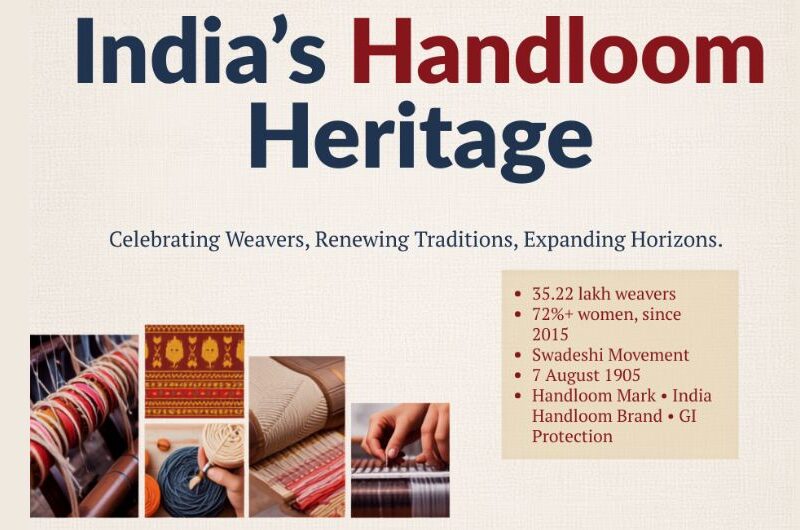
India’s Handloom Heritage
1. India observed the 12th National Handloom Day on 7 August 2026. The day is linked with the Swadeshi Movement, which was launched at Calcutta Town Hall on 7 August 1905 to encourage the use of indigenous goods and industries.
2. National Handloom Day was first declared by the Government of India in 2015. Its purpose is to recognise the contribution of handloom weavers, promote Indian handloom products and strengthen indigenous textile traditions.
3. The Ministry of Textiles is the nodal ministry responsible for policies, schemes and development programmes related to India’s handloom sector.
4. India’s handloom sector provides livelihood to around 35 lakh people. It is among the important sources of non-farm employment in rural and semi-rural areas.
5. Women form nearly 72% of the handloom workforce. Therefore, the sector plays an important role in women’s employment, income generation, skill development and economic empowerment.
6. More than 89% of handloom households are located in rural areas. This makes the sector important for decentralized employment and reducing migration from villages to cities.
7. The handloom sector protects India’s cultural heritage by preserving traditional weaving methods, local motifs, designs, fabrics and textile identities of different regions.
8. Handloom production supports sustainable fashion because it is generally based on low-energy, labour-intensive production methods and can use natural fibres, natural dyes and locally available materials.
9. The Handloom Mark is used to identify genuine handwoven products. It helps consumers distinguish authentic handloom goods from products made through powerlooms or machines.
10. The India Handloom Brand promotes high-quality handloom products. It focuses on quality assurance, product authenticity and building consumer confidence in Indian handloom items.
11. Geographical Indication (GI) tags provide legal protection to handloom products that have a special regional identity or reputation. Such protection is provided under the Geographical Indications of Goods Act, 1999.
12. Digital platforms such as the Indiahandmade portal and Government e-Marketplace (GeM) help weavers and handloom producers connect directly with buyers, improve market access and reduce dependence on middlemen.
13. The National Handloom Development Programme (NHDP) supports the overall development of the handloom sector through marketing assistance, design support, skill development, cluster development and welfare measures for weavers.
14. The Raw Material Supply Scheme (RMSS) helps weavers access yarn and other raw materials at reasonable prices. The Weaver MUDRA Scheme provides easier and affordable credit support for handloom weavers.
15. Major challenges before the sector include competition from cheaper powerloom products, limited access to credit, low global export presence, weak marketing networks, dependence on middlemen and insufficient use of modern design, digital tools and technology.
Must Know Terms :
1. National Handloom Day
It is observed every year on 7 August. The date commemorates the launch of the Swadeshi Movement at Calcutta Town Hall in 1905.
2. Handloom Mark
It identifies authentic handwoven products. It helps buyers distinguish genuine handloom goods from powerloom and machine-made products.
3. India Handloom Brand
It promotes high-quality handloom products that meet specified standards of quality, social responsibility and environmental values.
4. Geographical Indication (GI) Tag
A GI tag protects products that are linked with a particular geographical area and possess a distinct quality or reputation. It is governed by the Geographical Indications of Goods Act, 1999.
5. National Handloom Development Programme (NHDP)
It supports weavers through marketing assistance, design development, skill training, cluster development and welfare-related initiatives.
6. Weaver MUDRA Scheme
It provides concessional credit to handloom weavers to meet working-capital needs and support their handloom activity.
MCQ :
1. With reference to National Handloom Day, consider the following statements:
1. It is observed annually on 7 August.
2. It commemorates the launch of the Swadeshi Movement in 1905.
3. It was first declared by the Government of India in 2015.
Which of the statements given above are correct?
(a) 1 and 2 only
(b) 1 and 3 only
(c) 2 and 3 only
(d) 1, 2 and 3
2. The Swadeshi Movement, commemorated through National Handloom Day, was launched at:
(a) Bombay Town Hall
(b) Calcutta Town Hall
(c) Madras Town Hall
(d) Delhi Town Hall
3. Which ministry is the nodal ministry for the development of the handloom sector in India?
(a) Ministry of Rural Development
(b) Ministry of Micro, Small and Medium Enterprises
(c) Ministry of Textiles
(d) Ministry of Culture
4. With reference to India’s handloom sector, consider the following statements:
1. It provides livelihood to around 35 lakh people.
2. Women constitute nearly 72% of its workforce.
3. More than 89% of handloom households are located in rural areas.
Which of the statements given above are correct?
(a) 1 and 2 only
(b) 2 and 3 only
(c) 1 and 3 only
(d) 1, 2 and 3
5. Which of the following best explains the importance of the handloom sector in rural India?
(a) It is a major source of decentralized non-farm employment.
(b) It is limited only to urban textile clusters.
(c) It mainly depends on fully automated manufacturing.
(d) It discourages women’s participation in economic activities.
6. With reference to handloom production, consider the following statements:
1. It helps preserve traditional weaving techniques and regional textile identity.
2. It can support sustainable fashion through low-energy production methods.
3. It is based entirely on synthetic fibres and chemical dyes.
Which of the statements given above are correct?
(a) 1 only
(b) 1 and 2 only
(c) 2 and 3 only
(d) 1, 2 and 3
7. The Handloom Mark is mainly associated with:
(a) Identification of authentic handwoven products
(b) Export subsidy for textile manufacturers
(c) Registration of powerloom units
(d) Import of foreign textile machinery
8. Which one of the following is the primary purpose of the India Handloom Brand?
(a) To regulate cotton imports
(b) To certify only silk products
(c) To promote high-quality handloom products
(d) To provide crop insurance to cotton farmers
9. With reference to Geographical Indication (GI) tags, consider the following statements:
1. They protect products linked with a particular geographical area.
2. They recognise distinctive quality or reputation associated with that area.
3. They are governed by the Geographical Indications of Goods Act, 1999.
Which of the statements given above are correct?
(a) 1 and 2 only
(b) 2 and 3 only
(c) 1 and 3 only
(d) 1, 2 and 3
10. The Indiahandmade portal and Government e-Marketplace (GeM) are useful for handloom weavers because they:
(a) provide direct market access to buyers
(b) issue GI tags to textile products
(c) replace all physical handloom markets
(d) regulate the price of cotton yarn
11. The National Handloom Development Programme (NHDP) provides support in which of the following areas?
1. Marketing assistance
2. Design development
3. Skill training
4. Cluster development
Select the correct answer using the code below:
(a) 1 and 2 only
(b) 1, 2, 3 and 4
(c) 2 and 3 only
(d) 1, 3 and 4 only
12. The Raw Material Supply Scheme (RMSS) mainly aims to:
(a) provide raw materials such as yarn to weavers at reasonable prices
(b) provide free handloom products to consumers
(c) establish textile export zones abroad
(d) regulate the sale of machine-made fabrics
13. The Weaver MUDRA Scheme is primarily related to:
(a) concessional credit support for handloom weavers
(b) GI protection for local handloom products
(c) supply of imported machinery to powerloom units
(d) compulsory insurance for textile exporters
14. Which of the following are major challenges faced by the handloom sector?
1. Competition from cheaper powerloom products
2. Limited access to credit
3. Weak marketing networks
4. Inadequate use of modern design and digital tools
Select the correct answer using the code below:
(a) 1 and 2 only
(b) 2, 3 and 4 only
(c) 1, 2, 3 and 4
(d) 1, 3 and 4 only
15. Consider the following statements regarding the socio-economic significance of the handloom sector:
1. It supports women’s employment and income generation.
2. It can reduce rural-to-urban migration by creating local livelihoods.
3. It has no role in preserving India’s cultural heritage.
Which of the statements given above are correct?
(a) 1 and 2 only
(b) 2 and 3 only
(c) 1 and 3 only
(d) 1, 2 and 3




0 comment