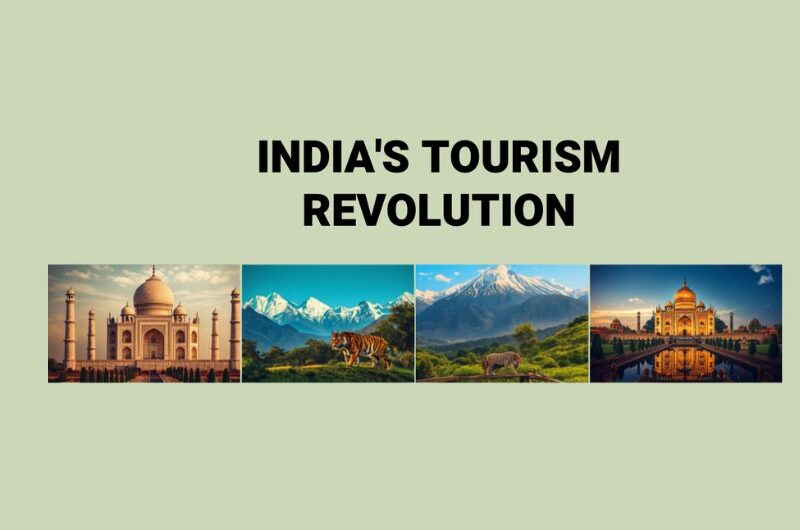
India’s Tourism Revolution
1. India recorded 2.9 billion domestic tourist visits in 2024, surpassing pre-pandemic levels and reflecting strong growth in domestic tourism.
2. Around 2.02 crore International Tourist Arrivals (ITAs) were recorded in 2025, indicating continued recovery and expansion of inbound tourism.
3. Tourism contributed approximately ₹15.73 lakh crore to India’s GDP during FY 2023–24, accounting for about 5.22% of the national economy.
4. The tourism and hospitality sector supported around 84.6 million jobs in 2023–24, making it one of India’s largest employment-generating sectors.
5. India earned nearly USD 31.7 billion in international tourism receipts during 2025.
6. India possesses 44 UNESCO World Heritage Sites, along with 106 National Parks and 18 Biosphere Reserves, making it one of the world’s richest tourism destinations in terms of cultural and natural heritage.
7. The Swadesh Darshan Scheme has sanctioned 76 tourism infrastructure projects worth over ₹5,295.24 crore across 14 thematic tourist circuits, of which 75 projects have been physically completed.
8. Swadesh Darshan 2.0 follows a destination-centric approach and has sanctioned 53 projects worth ₹2,207.08 crore to promote sustainable and experience-based tourism.
9. Under the PRASHAD Scheme, 54 projects worth over ₹1,726.24 crore have been sanctioned to improve infrastructure at major pilgrimage and heritage destinations.
10. Through the Special Assistance to States for Capital Investment (SASCI), 40 tourism projects across 23 States have been approved with an outlay of ₹3,295.76 crore to develop iconic tourist centres.
11. The Challenge-Based Destination Development (CBDD) initiative has approved 37 projects worth ₹687.99 crore to promote high-potential spiritual and eco-tourism destinations.
12. India’s e-Tourist Visa facility is available to nationals of 175 countries and permits entry through 33 airports, 19 seaports, and 4 land ports.
13. The National Integrated Database of Hospitality Industry (NIDHI+) is a unified digital platform that facilitates online registration, recognition, classification, and approval of tourism service providers.
14. As of 17 April 2023, India had 1,497 DPIIT-recognised tourism startups across 262 districts, generating employment for nearly 13,919 people, with about 58% located in Tier-II and Tier-III cities.
15. Tourism supports Sustainable Development Goals by promoting SDG 8.9 (sustainable tourism and employment), SDG 12.B (monitoring sustainable tourism impacts), and SDG 14.7 (economic benefits from sustainable marine tourism).
Must Know Terms :
1. Swadesh Darshan Scheme: Swadesh Darshan is the Government of India’s flagship tourism infrastructure development programme launched in 2014–15. It develops thematic tourist circuits such as Buddhist, Coastal, Desert, Eco, Himalayan, North East, Ramayana, Rural, Spiritual, and Tribal circuits. The scheme has sanctioned 76 projects worth over ₹5,295.24 crore.
2. PRASHAD Scheme: PRASHAD (Pilgrimage Rejuvenation and Spiritual, Heritage Augmentation Drive) aims to improve infrastructure and visitor amenities at major pilgrimage and heritage destinations. So far, 54 projects worth over ₹1,726.24 crore have been sanctioned under the scheme.
3. Swadesh Darshan 2.0: Swadesh Darshan 2.0 follows a destination-centric and sustainable tourism approach by focusing on high-quality visitor experiences, integrated planning, and local community participation. It has sanctioned 53 projects worth ₹2,207.08 crore.
4. e-Tourist Visa (e-TV): India’s e-Tourist Visa system enables hassle-free travel for foreign visitors. It is available to nationals of 175 countries and allows entry through 33 airports, 19 seaports, and 4 land ports, improving ease of travel and international tourism.
5. NIDHI+: The National Integrated Database of Hospitality Industry (NIDHI+) is a digital platform for online registration, recognition, classification, and approval of tourism service providers. It improves transparency, ease of doing business, and digital governance in the tourism sector.
6. MICE Tourism: MICE (Meetings, Incentives, Conferences and Exhibitions) Tourism focuses on business events, international conferences, exhibitions, and corporate meetings. With world-class convention centres such as Bharat Mandapam and successful hosting of G20 events, India is emerging as a major global MICE destination.
MCQ :
1. With reference to India’s tourism sector, consider the following statements:
1. India recorded 2.9 billion domestic tourist visits in 2024.
2. International Tourist Arrivals crossed 2 crore in 2025.
3. Tourism contributed more than 10% to India’s GDP in FY 2023–24.
Which of the statements given above is/are correct?
A. 1 and 2 only
B. 2 and 3 only
C. 1 only
D. 1, 2 and 3
2. Which of the following correctly describes India’s tourism sector in FY 2023–24?
A. Contributed ₹15.73 lakh crore to GDP and supported about 84.6 million jobs.
B. Contributed ₹5.22 lakh crore to GDP and supported about 42 million jobs.
C. Contributed ₹31.7 lakh crore to GDP and supported about 50 million jobs.
D. Contributed ₹10 lakh crore to GDP and supported about 70 million jobs.
3. With reference to India’s tourism resources, consider the following:
1. UNESCO World Heritage Sites
2. National Parks
3. Biosphere Reserves
Which of the above contribute significantly to nature and heritage tourism in India?
A. 1 only
B. 1 and 2 only
C. 2 and 3 only
D. 1, 2 and 3
4. The Swadesh Darshan Scheme is primarily aimed at:
A. Developing integrated thematic tourist circuits.
B. Promoting only medical tourism.
C. Developing airports for international tourists.
D. Providing financial assistance to private hotels.
5. Consider the following statements regarding Swadesh Darshan 2.0:
1. It adopts a destination-centric approach.
2. It emphasises sustainable and experience-based tourism.
3. It replaces the PRASHAD Scheme.
Which of the statements given above is/are correct?
A. 1 and 2 only
B. 2 and 3 only
C. 1 only
D. 1, 2 and 3
6. The PRASHAD Scheme primarily focuses on:
A. Cruise tourism infrastructure.
B. Pilgrimage and heritage destination development.
C. Wildlife tourism.
D. Coastal tourism.
7. Which one of the following schemes provides capital investment support to States for developing iconic tourist centres?
A. PRASHAD
B. Swadesh Darshan
C. SASCI
D. CBDD
8. The Challenge-Based Destination Development (CBDD) initiative mainly promotes:
A. Medical tourism and wellness tourism
B. Spiritual tourism and eco-tourism destinations
C. Cruise tourism and island tourism
D. Film tourism and sports tourism
9. With reference to India’s e-Tourist Visa facility, consider the following statements:
1. It is available to nationals of 175 countries.
2. Entry is permitted through designated airports, seaports, and land ports.
3. It is available only for neighbouring countries.
Which of the statements given above is/are correct?
A. 1 and 2 only
B. 2 and 3 only
C. 3 only
D. 1, 2 and 3
10. NIDHI+ is best described as:
A. A digital platform for registration and classification of tourism service providers.
B. A portal for issuing e-Tourist Visas.
C. A tourism startup funding programme.
D. A platform for UNESCO heritage conservation.
11. Consider the following statements regarding tourism startups in India:
1. More than 1,400 DPIIT-recognised tourism startups exist.
2. Nearly 58% are located in Tier-II and Tier-III cities.
3. They operate only in online hotel booking services.
Which of the statements given above is/are correct?
A. 1 and 2 only
B. 2 and 3 only
C. 1 only
D. 1, 2 and 3
12. MICE Tourism refers to:
A. Marine, Island, Coastal and Eco Tourism
B. Meetings, Incentives, Conferences and Exhibitions
C. Monuments, Infrastructure, Culture and Ecology
D. Medical, International, Cultural and Educational Tourism
13. Sustainable tourism directly contributes to which of the following Sustainable Development Goals (SDGs)?
1. SDG 8.9
2. SDG 12.B
3. SDG 14.7
Select the correct answer using the code below.
A. 1 and 2 only
B. 2 and 3 only
C. 1 only
D. 1, 2 and 3
14. Consider the following pairs:
Scheme — Primary Objective
1. Swadesh Darshan — Development of thematic tourist circuits
2. PRASHAD — Pilgrimage destination development
3. NIDHI+ — Digital governance of tourism services
How many of the above pairs are correctly matched?
A. Only one
B. Only two
C. All three
D. None
15. Which of the following statements is/are correct regarding India’s tourism policy initiatives?
1. Infrastructure development is increasingly destination-centric.
2. Digital platforms are improving tourism governance.
3. Tourism is being promoted as a tool for inclusive and sustainable development.
Select the correct answer using the code below.
A. 1 and 2 only
B. 2 and 3 only
C. 1 only
D. 1, 2 and 3

0 comment