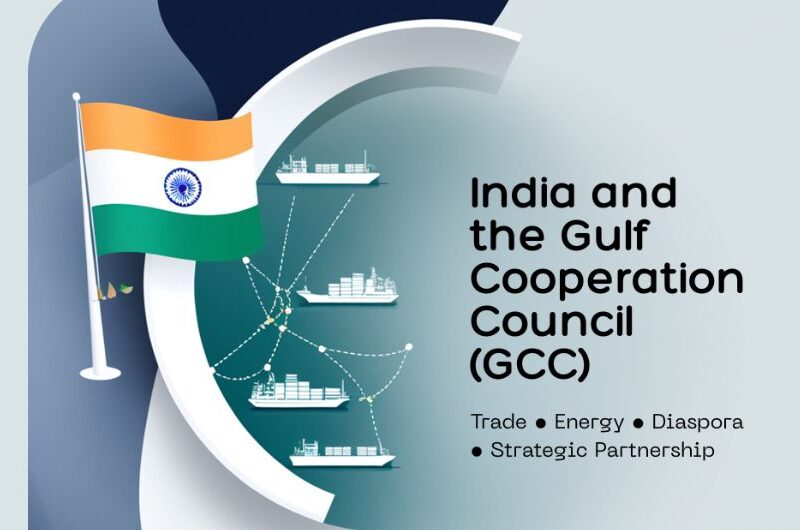
India and the Gulf Cooperation Council (GCC)
1. The Gulf Cooperation Council (GCC) comprises six member countries: Bahrain, Kuwait, Oman, Qatar, Saudi Arabia, and the United Arab Emirates (UAE).
2. India considers the GCC region a key part of its “Extended Neighbourhood” policy due to its strategic, economic, and energy importance.
3. The GCC is India’s largest regional trading bloc, accounting for more than 15% of India’s global trade.
4. Bilateral trade between India and the GCC stood at approximately USD 178.56 billion.
5. India and the GCC have officially launched negotiations for a comprehensive Free Trade Agreement (FTA).
6. India’s major imports from GCC countries include crude oil, liquefied natural gas (LNG), and precious metals.
7. Major Indian exports to the GCC include engineering goods, rice, textiles, and other manufactured products.
8. GCC countries supply a significant share of India’s crude oil and LNG requirements, making them crucial for India’s energy security.
9. Nearly 10 million Indians live and work in GCC countries, forming one of the largest overseas Indian communities.
10. Indian workers in the GCC contribute substantial remittances, strengthening India’s foreign exchange reserves.
11. GCC countries have invested over USD 31 billion in India through sovereign wealth funds and private investments.
12. India and the GCC cooperate closely in maritime security, counter-terrorism, and regional stability in the Indian Ocean and Red Sea regions.
13. The first India–GCC Joint Ministerial Meeting for Strategic Dialogue adopted the Joint Action Plan (2024–2028) to deepen cooperation in sectors such as health, agriculture, energy, and security.
14. Employment opportunities for Indian workers in GCC countries may be affected by localisation policies such as Saudi Arabia’s Nitaqat programme.
15. The ongoing global energy transition is encouraging India and GCC countries to diversify cooperation beyond oil and gas into emerging sectors.
Must Know Terms :
1. The Gulf Cooperation Council (GCC) consists of six member countries: Bahrain, Kuwait, Oman, Qatar, Saudi Arabia, and the United Arab Emirates (UAE).
2. The GCC is India’s largest regional trading bloc, accounting for more than 15% of India’s global trade, with bilateral trade valued at about USD 178.56 billion.
3. India and the GCC have officially launched negotiations for a comprehensive Free Trade Agreement (FTA) to strengthen economic cooperation.
4. Nearly 10 million Indians reside in GCC countries, making the region one of the largest destinations for the Indian diaspora and a major source of remittances.
5. India and the GCC adopted the Joint Action Plan (2024–2028) during the inaugural India–GCC Joint Ministerial Meeting for Strategic Dialogue to enhance cooperation in health, agriculture, energy, and security.
6. GCC countries are vital to India’s energy security as they supply a significant share of India’s crude oil and liquefied natural gas (LNG) imports.
MCQ :
1. With reference to the Gulf Cooperation Council (GCC), consider the following statements:
1. It comprises six member countries.
2. India is a member of the GCC.
3. The United Arab Emirates (UAE) is a member of the GCC.
Which of the statements given above is/are correct?
A. 1 and 3 only
B. 2 only
C. 1 only
D. 1, 2 and 3
2. Assertion (A): India considers the GCC an important part of its “Extended Neighbourhood” policy.
Reason (R): The GCC is strategically important for India’s trade, energy security, and regional engagement.
A. Both A and R are true, and R is the correct explanation of A.
B. Both A and R are true, but R is not the correct explanation of A.
C. A is true, but R is false.
D. A is false, but R is true.
3. Which of the following countries are members of the Gulf Cooperation Council (GCC)?
1. Bahrain
2. Kuwait
3. Oman
4. Iran
Select the correct answer using the code below.
A. 1 and 2 only
B. 1, 2 and 3 only
C. 2, 3 and 4 only
D. 1, 2, 3 and 4
4. Match List-I with List-II:
List-I List-II
A. Bahrain 1. GCC Member
B. Qatar 2. GCC Member
C. Saudi Arabia 3. GCC Member
D. Oman 4. GCC Member
Codes:
A. A-1, B-2, C-3, D-4
B. A-2, B-1, C-4, D-3
C. A-3, B-4, C-2, D-1
D. A-4, B-3, C-1, D-2
5. With reference to India–GCC economic relations, consider the following statements:
1. The GCC is India’s largest regional trading bloc.
2. The GCC accounts for more than 15% of India’s global trade.
3. Bilateral trade is approximately USD 178.56 billion.
Which of the statements given above are correct?
A. 1 and 2 only
B. 2 and 3 only
C. 1 and 3 only
D. 1, 2 and 3
6. India and the GCC have officially launched negotiations for:
A. Comprehensive Economic Partnership Agreement (CEPA)
B. Comprehensive Free Trade Agreement (FTA)
C. Regional Comprehensive Economic Partnership (RCEP)
D. Bilateral Investment Treaty (BIT)
7. Which of the following are India’s major imports from GCC countries?
1. Crude oil
2. Liquefied Natural Gas (LNG)
3. Precious metals
Select the correct answer using the code below.
A. 1 and 2 only
B. 2 and 3 only
C. 1 and 3 only
D. 1, 2 and 3
8. Assertion (A): GCC countries are crucial for India’s energy security.
Reason (R): They supply a significant share of India’s crude oil and LNG imports.
A. Both A and R are true, and R is the correct explanation of A.
B. Both A and R are true, but R is not the correct explanation of A.
C. A is true, but R is false.
D. A is false, but R is true.
9. Which of the following are major exports from India to GCC countries?
1. Engineering goods
2. Rice
3. Textiles
Select the correct answer using the code below.
A. 1 and 2 only
B. 2 and 3 only
C. 1, 2 and 3
D. 1 and 3 only
10. Approximately how many Indians reside and work in GCC countries?
A. Around 2 million
B. Around 5 million
C. Around 7 million
D. Around 10 million
11. Match List-I with List-II:
List-I List-II
A. LNG 1. Major GCC export to India
B. Rice 2. Major Indian export to GCC
C. Engineering Goods 3. Major Indian export to GCC
D. Crude Oil 4. Major GCC export to India
Codes:
A. A-1, B-2, C-3, D-4
B. A-2, B-1, C-4, D-3
C. A-3, B-4, C-1, D-2
D. A-4, B-3, C-2, D-1
12. Which one of the following best describes the Joint Action Plan (2024–2028) adopted by India and the GCC?
A. It focuses only on defence cooperation.
B. It aims to deepen cooperation in health, agriculture, energy, and security.
C. It establishes a common currency.
D. It creates a customs union between India and the GCC.
13. Consider the following statements:
1. India and the GCC cooperate in maritime security.
2. Their cooperation also includes counter-terrorism.
3. They work together for regional stability in the Indian Ocean and Red Sea.
Which of the statements given above are correct?
A. 1 and 2 only
B. 2 and 3 only
C. 1 and 3 only
D. 1, 2 and 3
14. Saudi Arabia’s “Nitaqat” programme is primarily associated with:
A. Maritime security
B. Labour localisation and employment
C. Renewable energy cooperation
D. Free Trade Agreement negotiations
15. With reference to India–GCC relations, consider the following statements:
1. GCC countries have invested over USD 31 billion in India.
2. The global energy transition is encouraging India and GCC countries to diversify cooperation beyond hydrocarbons.
3. Remittances from Indians working in GCC countries strengthen India’s foreign exchange reserves.
Which of the statements given above are correct?
A. 1 and 2 only
B. 2 and 3 only
C. 1 and 3 only
D. 1, 2 and 3




0 comment