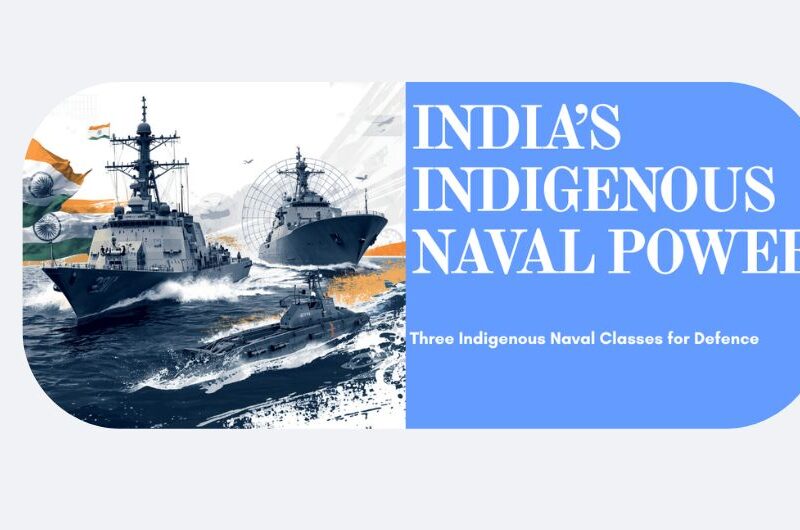
India’s Indigenous Naval Power
1. The Indian Navy safeguards a coastline of about 11,098 km, an Exclusive Economic Zone (EEZ) of nearly 2.4 million sq. km, and sea lanes carrying around 90% of India’s trade by volume.
2. On 21 June 2026, INS Dunagiri (Nilgiri-class), INS Sanshodhak (Sandhayak-class), and INS Agray (Arnala-class) were commissioned together at Kolkata.
3. On 11 July 2026, INS Mahendragiri, the sixth Nilgiri-class stealth frigate under Project 17A, was commissioned at Visakhapatnam.
4. Project 17A aims to build seven indigenous Nilgiri-class guided-missile stealth frigates designed for anti-air, anti-surface, and anti-submarine warfare.
5. The Nilgiri-class consists of INS Nilgiri, INS Himgiri, INS Taragiri, INS Udaygiri, INS Dunagiri, INS Mahendragiri, while INS Vindhyagiri is under construction.
6. Nilgiri-class frigates are approximately 149 metres long, displace about 6,670 tonnes, and use a Combined Diesel or Gas (CODOG) propulsion system with a maximum speed of 28 knots.
7. Nilgiri-class frigates are equipped with BrahMos supersonic missiles, medium-range air defence missiles, advanced radar, hull-mounted sonar, and helicopter facilities.
8. The Sandhayak-class Survey Vessel (Large) comprises INS Sandhayak, INS Nirdeshak, INS Ikshak, and INS Sanshodhak, all built by Garden Reach Shipbuilders and Engineers Limited (GRSE).
9. Sandhayak-class survey vessels are about 110 metres long, displace around 3,400 tonnes, have a crew of about 178 personnel, and an operational range of 6,500 nautical miles.
10. Sandhayak-class vessels carry multi-beam echo sounders, side-scan sonar, autonomous underwater vehicles, and can also function as hospital ships during emergencies.
11. The Arnala-class Anti-Submarine Warfare Shallow Water Craft comprises eight ships: Arnala, Androth, Anjadip, Amini, Abhay, Agray, Akshay, and Ajay.
12. Arnala-class vessels are around 77.6 metres long, displace about 900 tonnes, use waterjet propulsion, achieve a top speed of about 25 knots, and are armed with lightweight torpedoes and anti-submarine rockets.
13. A parallel Mahe-class of Anti-Submarine Warfare Shallow Water Craft is under construction at Cochin Shipyard, increasing the planned fleet strength to 16 vessels.
14. Project 17A frigates have about 75% indigenous content, Sandhayak-class vessels have over 80% indigenous content, and 64 of the Indian Navy’s 66 ships and submarines currently on order are being built in India.
15. India launched SAGAR (Security and Growth for All in the Region) in 2015 and expanded it into MAHASAGAR (Mutual and Holistic Advancement for Security and Growth Across Regions) in 2025 to strengthen maritime security, regional cooperation, and the Blue Economy.
Must know Terms :
1.Project 17A: Project 17A is the Indian Navy’s indigenous programme to build seven next-generation Nilgiri-class guided-missile stealth frigates. These warships are designed for anti-air, anti-surface, and anti-submarine warfare with advanced stealth features and around 75% indigenous content.
2. Nilgiri-class Frigate: The Nilgiri-class is India’s latest class of indigenous stealth frigates built under Project 17A. Equipped with BrahMos missiles, advanced radar, sonar, and helicopter facilities, these warships strengthen the Indian Navy’s surface combat capability in the Indian Ocean Region.
3. Sandhayak-class Survey Vessel: The Sandhayak-class comprises indigenous Survey Vessel (Large) ships that enhance India’s hydrographic capability by mapping the seabed, producing nautical charts, and supporting maritime security, the Blue Economy, and disaster relief operations.
4. Arnala-class ASW Shallow Water Craft: The Arnala-class is a new generation of Anti-Submarine Warfare (ASW) Shallow Water Craft designed to detect and neutralise submarines in coastal and littoral waters. These vessels replace the ageing Abhay-class corvettes and use waterjet propulsion for greater agility.
5. CODOG (Combined Diesel or Gas): CODOG is the propulsion system used in Nilgiri-class stealth frigates. It combines diesel engines for economical cruising with gas turbines for high-speed operations, providing both long operational range and rapid response capability.
6.SAGAR & MAHASAGAR: SAGAR (Security and Growth for All in the Region), launched in 2015, and MAHASAGAR (Mutual and Holistic Advancement for Security and Growth Across Regions), launched in 2025, are India’s maritime visions aimed at strengthening regional security, maritime cooperation, the Blue Economy, disaster response, and partnerships across the Indian Ocean and the Global South.
MCQ :
1. With reference to the Indian Navy’s indigenous warship programmes, consider the following statements:
1. Project 17A aims to build seven Nilgiri-class stealth frigates.
2. These frigates are designed for anti-air, anti-surface, and anti-submarine warfare.
3. Project 17A is India’s first indigenous stealth frigate programme.
Which of the statements given above is/are correct?
A. 1 and 2 only
B. 2 and 3 only
C. 1 only
D. 1, 2 and 3
2. Assertion (A): Nilgiri-class frigates form the backbone of the Indian Navy’s surface combat capability.
Reason (R): They integrate advanced weapons, sensors, stealth features, and helicopter facilities for multi-mission operations.
A. Both A and R are true, and R is the correct explanation of A.
B. Both A and R are true, but R is not the correct explanation of A.
C. A is true, but R is false.
D. A is false, but R is true.
3. Which of the following vessels belong to the Nilgiri-class?
1. INS Nilgiri
2. INS Himgiri
3. INS Dunagiri
4. INS Mahendragiri
Select the correct answer using the code below.
A. 1 and 2 only
B. 2 and 4 only
C. 1, 3 and 4 only
D. 1, 2, 3 and 4
4. Match List-I with List-II:
List-I List-II
A. INS Dunagiri 1. Nilgiri-class
B. INS Sanshodhak 2. Sandhayak-class
C. INS Agray 3. Arnala-class
D. INS Mahendragiri 4. Project 17A
Codes:
A. A-1, B-2, C-3, D-4
B. A-2, B-3, C-1, D-4
C. A-3, B-1, C-2, D-4
D. A-1, B-3, C-2, D-4
5. Which one of the following correctly describes the CODOG propulsion system?
A. Combined Diesel or Gas propulsion
B. Combined Diesel and Electric propulsion
C. Combined Gas and Nuclear propulsion
D. Combined Steam and Gas propulsion
6. With reference to Nilgiri-class stealth frigates, consider the following statements:
1. They are about 149 metres long.
2. They displace around 6,670 tonnes.
3. Their maximum speed is about 28 knots.
Which of the statements given above are correct?
A. 1 and 2 only
B. 2 and 3 only
C. 1 and 3 only
D. 1, 2 and 3
7. Match List-I with List-II:
List-I List-II
A. BrahMos 1. Surface strike capability
B. Hull-mounted sonar 2. Detects submarines
C. Radar 3. Air and surface surveillance
D. Helicopter 4. Extended operational capability
Codes:
A. A-1, B-2, C-3, D-4
B. A-2, B-1, C-4, D-3
C. A-3, B-4, C-2, D-1
D. A-4, B-3, C-1, D-2
8. Assertion (A): Sandhayak-class vessels strengthen India’s hydrographic capability.
Reason (R): They conduct seabed mapping and prepare nautical charts for safe navigation.
A. Both A and R are true, and R is the correct explanation of A.
B. Both A and R are true, but R is not the correct explanation of A.
C. A is true, but R is false.
D. A is false, but R is true.
9. Which of the following are part of the Sandhayak-class Survey Vessel (Large)?
1. INS Sandhayak
2. INS Nirdeshak
3. INS Ikshak
4. INS Sanshodhak
Select the correct answer using the code below.
A. 1 and 2 only
B. 2 and 3 only
C. 1, 3 and 4 only
D. 1, 2, 3 and 4
10. The Sandhayak-class survey vessels are built by:
A. Mazagon Dock Shipbuilders Limited
B. Garden Reach Shipbuilders and Engineers Limited
C. Cochin Shipyard Limited
D. Goa Shipyard Limited
11. With reference to the Arnala-class Anti-Submarine Warfare Shallow Water Craft, consider the following statements:
1. They replace the ageing Abhay-class corvettes.
2. They use waterjet propulsion.
3. They are equipped with lightweight torpedoes and anti-submarine rockets.
Which of the statements given above are correct?
A. 1 and 2 only
B. 2 and 3 only
C. 1 and 3 only
D. 1, 2 and 3
12. Which one of the following pairs is correctly matched?
A. Mahe-class — Aircraft Carrier
B. Sandhayak-class — Survey Vessel (Large)
C. Nilgiri-class — Destroyer
D. Arnala-class — Missile Boat
13. Consider the following statements:
1. Project 17A frigates have about 75% indigenous content.
2. Sandhayak-class vessels have over 80% indigenous content.
3. Sixty-four of the Indian Navy’s sixty-six ships and submarines on order are being built in India.
Which of the statements given above are correct?
A. 1 and 2 only
B. 2 and 3 only
C. 1 and 3 only
D. 1, 2 and 3
14. Match List-I with List-II:
List-I List-II
A. SAGAR 1. 2015
B. MAHASAGAR 2. 2025
C. EEZ 3. 2.4 million sq. km
D. Indian Coastline 4. About 11,098 km
Codes:
A. A-1, B-2, C-3, D-4
B. A-2, B-1, C-4, D-3
C. A-3, B-4, C-2, D-1
D. A-4, B-3, C-1, D-2
15. With reference to India’s maritime security, consider the following statements:
1. Around 90% of India’s trade by volume is carried through sea lanes.
2. The Indian Navy safeguards an Exclusive Economic Zone (EEZ) of nearly 2.4 million sq. km.
3. SAGAR was launched before MAHASAGAR.
Which of the statements given above are correct?
A. 1 and 2 only
B. 2 and 3 only
C. 1 and 3 only
D. 1, 2 and 3



0 comment