Census 2027 in India
1. Census 2027 will be the 16th Census in India and the 8th since Independence, making it the next enumeration after the Census delayed beyond 2021.
2. Census 2027 will mark India’s first digital Census, using mobile-based data collection, digital monitoring systems, self-enumeration options, and geo-referenced jurisdictions for faster data processing.
3. The first modern population census in India was conducted during 1865–1872, while the first synchronous nationwide Census was conducted in 1881.
4. The Cabinet Committee on Political Affairs decided on 30 April 2025 that caste enumeration would be included in Census 2027 during the Population Enumeration phase.
5. Census 2027 is governed by the Census Act, 1948 and the Census Rules, 1990, while Census remains a Union subject under the Seventh Schedule.
6. Section 15 of the Census Act protects personal information, preventing disclosure under the RTI Act, use as court evidence, or sharing with any institution.
7. The intent to conduct Population Census 2027 was notified in the Gazette of India on 16 June 2025, with an approved financial outlay of ₹11,718.24 crore.
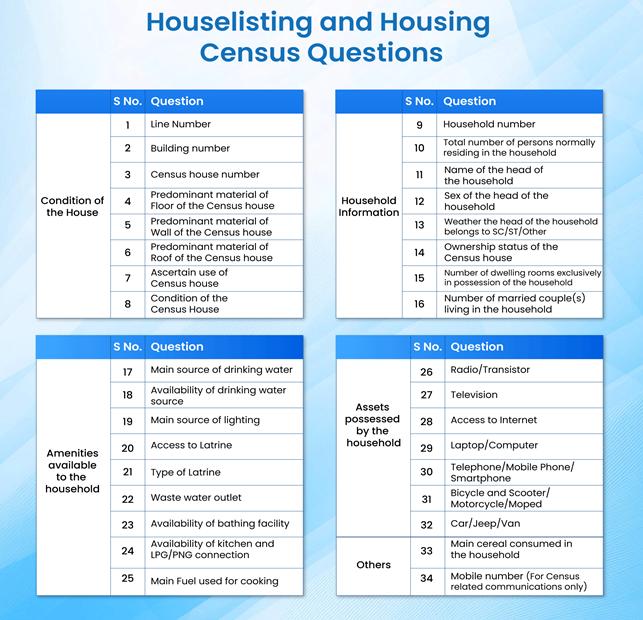
8. Phase I, the Houselisting and Housing Census, is scheduled between April and September 2026, with a 15-day self-enumeration window before the 30-day field exercise.
9. Phase II, the Population Enumeration, is scheduled for February 2027, while snow-bound areas of Ladakh, Jammu and Kashmir, Uttarakhand, and Himachal Pradesh will be covered in September 2026.
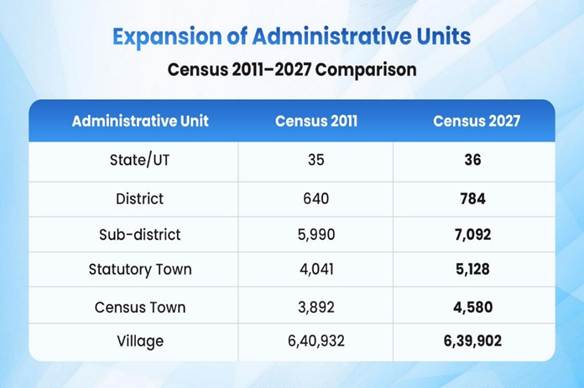
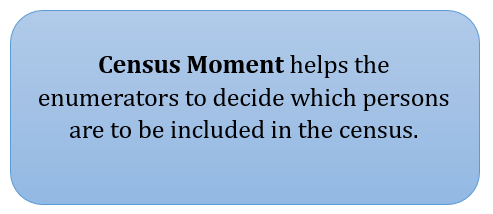
10. The Census Moment for most of India has been fixed at 00:00 hours on 1 March 2027, while snow-bound notified areas will use 1 October 2026.
11. The Census Management and Monitoring System portal has been developed for near real-time monitoring, allowing officials at sub-district, district, state, and national levels to track progress.
12. The Houselisting and Housing Census mobile application will work offline, supports Android and iOS platforms, and is available in 16 regional languages.
13. A nationwide pre-test covering around 5,000 census blocks was conducted in November 2025 to validate methodology, digital tools, and training systems before full implementation.
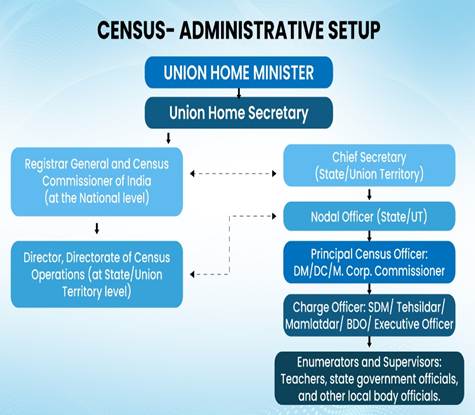
14. Census 2027 will involve about 31 lakh enumerators and supervisors, over 1 lakh census functionaries, and more than 80,000 training batches for each phase.
15. Around 18,600 technical personnel will be engaged for about 550 days, generating nearly 1.02 crore man-days of employment during Census 2027 operations.
Must Know Terms :
1.CMMS
CMMS stands for Census Management and Monitoring System, a dedicated portal developed for Census 2027. It enables near real-time monitoring of the entire census process through integrated dashboards. Officers at sub-district, district, state, and national levels can track field progress, operational readiness, and performance. The portal is central to digital coordination, supervision, and timely implementation of India’s first digital census.
2. SelfEnumeration
SelfEnumeration is an optional citizen facility introduced for Census 2027 through a secure online portal. It allows eligible household respondents to submit information independently before the enumerator’s visit. After successful submission, the system generates a unique Self-Enumeration ID for verification. The facility is available in 16 languages and includes user guides, validation checks, tool tips, FAQs, and tutorial videos inside.
3. CensusAct
CensusAct refers to the Census Act, 1948, which provides the legal basis for conducting the population census in India. It works with the Census Rules, 1990, within a centrally coordinated framework because census is a Union subject. A major protection under Section 15 keeps personal information confidential, strictly barring disclosure under RTI, court use, or institutional sharing of individual data.
4. CensusMoment
CensusMoment is the exact reference time used to determine which persons are included in the census count. For most of India in Census 2027, it has been fixed at 00:00 hours on 1 March 2027. For Ladakh and notified snow-bound areas of Jammu and Kashmir, Himachal Pradesh, and Uttarakhand, the reference time is 00:00 hours on 1 October 2026 there.
5. HLBC
HLBC stands for Houselisting Block Creator, a web mapping application to be used by Charge Officers in Census 2027. It helps create digital Houselisting Blocks using satellite imagery, improving geographic precision and coverage. The application aims to prevent omission and duplication during enumeration by ensuring that every census block is accurately identified, mapped, and assigned before field operations begin nationwide.
6.CII
CII stands for Critical Information Infrastructure, the designation given to the secure data centres hosting Census 2027 data. This status ensures heightened protection for collection, transmission, and storage systems. The security framework includes end-to-end encryption, secure transmission protocols, and compliance with ISO/IEC 27001:2022 standards. Regular audits by reputed agencies further strengthen confidentiality, resilience, and data integrity across all census operations.
Key Takeaways
a) Census 2027 will mark India’s first digital enumeration, leveraging mobile-based data collection to enable faster and more efficient nationwide data availability.
b) The Cabinet Committee on Political Affairs, in its meeting on 30th April 2025, decided to include caste enumeration in the Census 2027.
c) Backed by a strong institutional framework and ₹11,718.24 crore outlay, extensive preparatory measures – including training, pre-test, and administrative readiness – to ensure smooth nationwide implementation.
d) With secure Critical Information Infrastructure (CII)-designated data centres and a large workforce – Census 2027 will deliver reliable data for targeted and inclusive policymaking.
MCQ :
1. Census 2027 will be which numbered Census in India and which since Independence?
A) 15th overall and 7th since Independence
B) 16th overall and 8th since Independence
C) 17th overall and 8th since Independence
D) 16th overall and 9th since Independence
2. Which of the following is a major feature of Census 2027?
A) Paper-only enumeration with manual tabulation
B) Complete outsourcing to private agencies
C) First digital Census with mobile-based data collection
D) Census restricted to urban areas in the first phase
3. The first synchronous nationwide Census in India was conducted in:
A) 1872
B) 1881
C) 1891
D) 1865
4. The decision to include caste enumeration in Census 2027 was taken by the Cabinet Committee on Political Affairs on:
A) 16 June 2025
B) 1 January 2026
C) 30 April 2025
D) 1 March 2027
5. Census in India is governed by the Census Act, 1948 and the Census Rules, 1990, and is listed as a Union subject under the:
A) Fifth Schedule
B) Seventh Schedule
C) Ninth Schedule
D) Eleventh Schedule
6. Which provision protects personal information collected in Census by barring disclosure under RTI, court use, or sharing with institutions?
A) Section 10 of the Census Act
B) Section 12 of the Census Act
C) Section 14 of the Census Act
D) Section 15 of the Census Act
7. The approved financial outlay for Population Census 2027 is:
A) ₹10,718.24 crore
B) ₹11,718.24 crore
C) ₹12,718.24 crore
D) ₹9,718.24 crore
8. Phase I of Census 2027, namely Houselisting and Housing Census, is scheduled between:
A) January and March 2026
B) April and September 2026
C) October and December 2026
D) February and April 2027
9. Phase II of Census 2027, namely Population Enumeration, is scheduled for:
A) September 2026
B) April 2026
C) February 2027
D) March 2027
10. The Census Moment for most of India has been fixed at:
A) 00:00 hours of 1 October 2026
B) 00:00 hours of 1 March 2027
C) 00:00 hours of 16 June 2025
D) 00:00 hours of 30 April 2025
11. The Census Management and Monitoring System is primarily meant for:
A) issuing caste certificates
B) conducting court verification of census data
C) near real-time monitoring of census operations
D) replacing enumerators with automated surveys
12. The Houselisting and Housing Census mobile application will support:
A) only Android platform in 8 languages
B) Android and iOS platforms in 16 regional languages
C) only iOS platform in 22 languages
D) desktop-only use in English and Hindi
13. A nationwide pre-test covering around 5,000 census blocks was conducted in:
A) November 2025
B) January 2026
C) April 2025
D) September 2026
14. Census 2027 will involve approximately how many enumerators and supervisors?
A) 21 lakh
B) 25 lakh
C) 31 lakh
D) 41 lakh
15. Around 18,600 technical personnel engaged for about 550 days during Census 2027 operations are expected to generate nearly:
A) 1.02 crore man-days
B) 2.02 crore man-days
C) 55 lakh man-days
D) 18.6 lakh man-days




0 comment