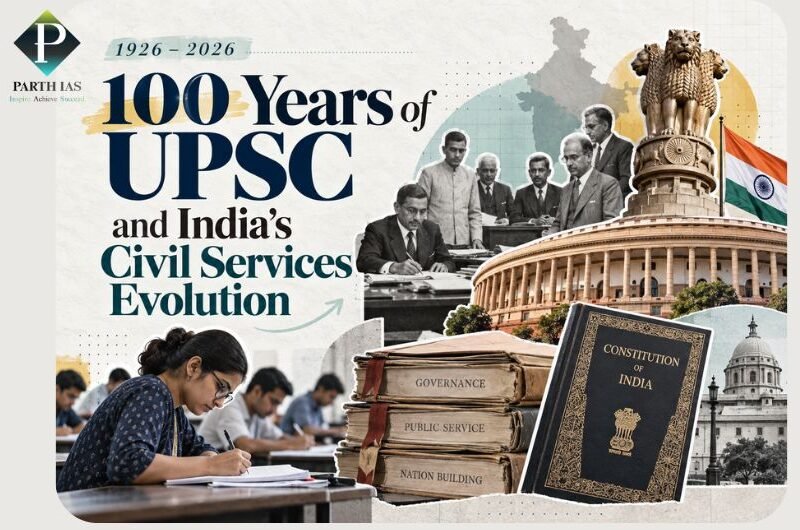
100 Years of UPSC and India’s Civil Services Evolution
1
India’s first Public Service Commission was constituted on 1 October 1926 under the Public Service Commission (Functions) Rules, 1926, framed under Sections 96B and 96C of the Government of India Act, 1919. Sir Ross Barker became its first Chairman, assisted by four Members, and the Commission functioned from Metcalfe House, Delhi.
2
Competitive entry into the Indian Civil Service (ICS) began in 1855 in London, replacing the East India Company’s nomination system. Satyendranath Tagore cleared the examination in 1863 and joined the service in 1864 as the first Indian ICS officer, while by 1919 only 78 of 1,255 ICS officers were Indian.
3
The Government of India Act, 1919 provided for a Public Service Commission. The ICS examination was held in India for the first time at Allahabad in 1922, the Indian centre shifted to Delhi in 1928, and the Lee Commission of 1924 recommended immediate establishment of a statutory Public Service Commission.
4
The Government of India Act, 1935 transferred appointment powers to the Governor-General, provided for a Federal Public Service Commission and Provincial Public Service Commissions, and made consultation with the Commission mandatory on recruitment, appointments, promotions, disciplinary matters and service rules. The body was renamed the Federal Public Service Commission on 1 April 1937.
5
After Independence, H.K. Kripalani became the first Indian Chairman in 1947. The first post-Independence examination was held in December 1947, the ICS gave way to the Indian Administrative Service (IAS), and the first batch of Indian Foreign Service officers was recruited through the combined examination in 1948.
6
On 26 January 1950, the Federal Public Service Commission became the Union Public Service Commission (UPSC), with R.N. Banerjee as Chairman. The first regular recruitment to the All India Services under the Constitution in 1950–51 recommended 29 candidates for the IAS and 31 for the Indian Police Service (IPS).
7
The constitutional provisions relating to Public Service Commissions are contained in Part XIV, Articles 315–323. Article 315 provides for Union, State and Joint Commissions; Article 316 deals with appointment of Chairman and Members; Article 317 with removal or suspension; Article 320 with recruitment and advisory functions; Article 322 charges Commission expenses on the Consolidated Fund of India; and Article 323 provides for an annual report to the President.
8
UPSC conducts recruitment examinations including the Civil Services, Indian Forest Service, Engineering Services, Combined Medical Services, National Defence Academy and Naval Academy, Combined Defence Services and Central Armed Police Forces (Assistant Commandants). It also conducts recruitment by selection for specialist posts requisitioned by Ministries and Departments.
9
UPSC advises the Government on Recruitment Rules, promotions through Departmental Promotion Committees, induction into the All India Services and disciplinary cases. During 2023–24, it processed records of 24,581 officers for promotion and 532 officers were inducted into the All India Services.
10
Major examination reforms included introduction of a three-stage Civil Services Examination — Preliminary, Main and Interview — in 1979; Optical Mark Recognition technology in 1989; Civil Services Aptitude Test in 2011; restructuring of the Main Examination in 2013 with four General Studies papers including Ethics, Integrity and Aptitude and one optional subject; and making CSAT qualifying with 33% marks in 2015.
11
The scale of UPSC’s work expanded from 42,727 applications across examinations and recruitment by selection in 1950–51 to a peak of 45,10,044 applications in 2022–23. In that year, 15 examinations accounted for 33,51,916 applications and 233 recruitment requisitions for 4,411 posts accounted for 11,58,128 applications.
12
Examination centres increased from 8 in 1950 to 86 in 2026. Women recommended in the Civil Services Examination increased from 3 of 83 in 1952 to 299 of 958 in 2025, while Persons with Benchmark Disabilities recommended increased from 3 in 2002 to 42 in 2025.
13
Inclusion measures expanded over time: Indian languages became available in the interview from 1980–81 with interpreters provided by the Commission; scribes for visually impaired candidates were introduced in 1994; Economically Weaker Sections were incorporated from CSE 2019; and a separate transgender category was introduced in the Online Recruitment Application form from 2020.
14
Technology and examination security measures included AI-enabled facial authentication piloted at selected Gurugram centres during NDA & NA (II) and CDS (II) examinations on 14 September 2025 and implemented at scale in the Civil Services Preliminary Examination on 24 May 2026 for about 5.50 lakh candidates. A fifteen-year candidate-data scan before the 2026 Preliminary examination also identified and rejected 569 applicants who had allegedly claimed extra attempts using false information.
15
Recent institutional changes included the Universal Registration Number portal in May 2025, randomised interview boards from the Combined Medical Services Examination 2025, a 30-channel Candidate Helpdesk from 1 February 2026, new examination centres in 2026, publication of a provisional Civil Services Preliminary answer key with online representations, development of an online Departmental Promotion Committee system, and strengthening of IT and cybersecurity infrastructure. As of the text, the Commission was headed by Chairman Dr. Ajay Kumar from 15 May 2025 with eight Members.
Must Know Terms
1. Lee Commission (1924)
The Lee Commission, chaired by Arthur Hamilton Lee, recommended the immediate establishment of a statutory Public Service Commission in India. It also proposed a recruitment arrangement involving British candidates, Indian candidates and officers promoted from provincial services.
2. Public Service Commission (Functions) Rules, 1926
These rules were framed under Sections 96B and 96C of the Government of India Act, 1919. They provided the legal framework for establishing India’s first Public Service Commission on 1 October 1926.
3. Federal Public Service Commission
The Government of India Act, 1935 provided for a Federal Public Service Commission and Provincial Public Service Commissions. The existing Commission was renamed the Federal Public Service Commission on 1 April 1937 and became the Union Public Service Commission on 26 January 1950.
4. Charged Expenditure
Under Article 322 of the Constitution, the expenses of the Union Public Service Commission are charged on the Consolidated Fund of India. This arrangement provides financial protection to the Commission and supports its institutional independence.
5. Departmental Promotion Committee (DPC)
A Departmental Promotion Committee examines eligible officers for promotion within government services. UPSC advises on promotions through DPCs and processed the records of 24,581 officers for promotion during 2023–24.
6. Pratibha Setu
Pratibha Setu is a recruitment-support initiative launched on 9 June 2025 by revamping the Public Disclosure Scheme introduced on 20 August 2018. It connects willing candidates who cleared every stage of an examination but were not included in the final selection list with verified employers, including government bodies, public sector undertakings and private organisations.
Multiple-Choice Questions
1. Arrange the following events in chronological order:
1. Introduction of competitive examination for the Indian Civil Service in London
2. Satyendranath Tagore clearing the Indian Civil Service examination
3. First Indian centre for the ICS examination at Allahabad
4. Recommendations of the Lee Commission
Select the correct answer using the code given below.
(a) 1-3-2-4
(b) 2-1-3-4
(c) 1-2-3-4
(d) 1-2-4-3
2. With reference to India’s first Public Service Commission, consider the following statements:
1. It was constituted on 1 October 1926.
2. It was established under rules framed using Sections 96B and 96C of the Government of India Act, 1919.
3. Sir Ross Barker was its first Chairman, assisted by four Members.
4. It was originally established under the Government of India Act, 1935.
Which of the statements given above are correct?
(a) 1, 2 and 4 only
(b) 1, 2 and 3 only
(c) 2, 3 and 4 only
(d) 1, 2, 3 and 4
3. With reference to the Lee Commission of 1924, consider the following statements:
1. It was chaired by Arthur Hamilton Lee.
2. It recommended the immediate establishment of a statutory Public Service Commission.
3. It recommended establishing the Federal Public Service Commission in 1926 under the Government of India Act, 1935.
4. It proposed a recruitment arrangement involving British candidates, Indian candidates and officers promoted from provincial services.
Which of the statements given above are correct?
(a) 1, 3 and 4 only
(b) 1, 2 and 3 only
(c) 2, 3 and 4 only
(d) 1, 2 and 4 only
4. With reference to the Government of India Act, 1935, consider the following statements:
1. It transferred the power of appointment to the Governor-General.
2. It provided for a Federal Public Service Commission and Provincial Public Service Commissions.
3. It made consultation with the Commission mandatory on recruitment, appointments, promotions, disciplinary matters and service rules.
4. The existing Public Service Commission was renamed the Federal Public Service Commission in 1935.
Which of the statements given above are correct?
(a) 1, 2 and 3 only
(b) 1, 3 and 4 only
(c) 2 and 4 only
(d) 1, 2, 3 and 4
5. Consider the following statements regarding the evolution of public service recruitment after Independence:
1. H.K. Kripalani became the first Indian Chairman of the Commission in 1947.
2. The first batch of Indian Foreign Service officers was recruited through the combined examination in 1948.
3. The Federal Public Service Commission became the Union Public Service Commission on 26 January 1950, with R.N. Banerjee as Chairman.
4. The first regular recruitment to the All India Services under the Constitution recommended 31 IAS and 29 IPS candidates.
Which of the statements given above are correct?
(a) 1, 2 and 4 only
(b) 1, 2 and 3 only
(c) 2 and 3 only
(d) 1, 2, 3 and 4
6. Consider the following pairs regarding the constitutional provisions relating to Public Service Commissions:
1. Article 315 — Public Service Commissions for the Union and States
2. Article 317 — Recruitment and advisory functions of Public Service Commissions
3. Article 322 — Expenses charged on the Consolidated Fund of India
4. Article 323 — Annual report submitted to the President
Which of the pairs given above are correctly matched?
(a) 1 and 2 only
(b) 2, 3 and 4 only
(c) 1, 2 and 3 only
(d) 1, 3 and 4 only
7. With reference to the functions of the Union Public Service Commission, consider the following statements:
1. It conducts examinations such as the Civil Services Examination, Combined Defence Services Examination and Central Armed Police Forces (Assistant Commandants) Examination.
2. It undertakes recruitment by selection for specialist posts requisitioned by Ministries and Departments.
3. It advises on Recruitment Rules, promotions through Departmental Promotion Committees and disciplinary matters.
4. Under Article 315, State Public Service Commissions are replaced by the UPSC for all recruitment functions.
Which of the statements given above are correct?
(a) 1, 2 and 3 only
(b) 1 and 4 only
(c) 2, 3 and 4 only
(d) 1, 2, 3 and 4
8. Consider the following statements regarding the scale of UPSC’s recruitment activities:
1. During 2023–24, the Commission processed records of 24,581 officers for promotion.
2. During 2023–24, 532 officers were inducted into the All India Services.
3. During 2022–23, the Commission conducted 15 examinations, accounting for 33,51,916 applications.
4. During 2022–23, recruitment by selection involved 233 requisitions for 4,411 posts and 11,58,128 applications.
How many of the statements given above are correct?
(a) Only one
(b) Only two
(c) All four
(d) Only three
9. Arrange the following reforms in chronological order:
1. Introduction of the three-stage Civil Services Examination
2. Introduction of Optical Mark Recognition technology
3. Introduction of the Civil Services Aptitude Test
4. Restructuring of the Civil Services Main Examination with four General Studies papers
5. Making CSAT a qualifying paper with 33% marks
Select the correct answer using the code given below.
(a) 2-1-3-4-5
(b) 1-3-2-4-5
(c) 1-2-4-3-5
(d) 1-2-3-4-5
10. Consider the following statements:
Statement-I:
The Union Public Service Commission is not exclusively an examination-conducting authority.
Statement-II:
The Commission also undertakes recruitment by selection and advises on Recruitment Rules, promotions, induction into the All India Services and disciplinary matters.
Which one of the following is correct?
(a) Both Statement-I and Statement-II are correct, but Statement-II does not explain Statement-I.
(b) Both Statement-I and Statement-II are correct, and Statement-II explains Statement-I.
(c) Statement-I is correct, but Statement-II is incorrect.
(d) Statement-I is incorrect, but Statement-II is correct.
11. Consider the following pairs regarding the expansion and inclusiveness of UPSC:
1. Applications in 1950–51 — 42,727
2. Examination centres in 2026 — 86
3. Women recommended in CSE 2025 — 299 out of 958
4. Persons with Benchmark Disabilities recommended in CSE 2002 — 42
How many of the pairs given above are correctly matched?
(a) Only three
(b) Only two
(c) All four
(d) Only one
12. With reference to inclusion-related measures introduced by UPSC, consider the following statements:
1. Indian languages became available for the interview from 1980–81, with interpreters provided by the Commission.
2. Scribes for visually impaired candidates were introduced in 1994.
3. The Economically Weaker Sections category was incorporated from Civil Services Examination 2019.
4. A separate transgender category was introduced in the Online Recruitment Application form in 2020.
Which of the statements given above are correct?
(a) 1 and 2 only
(b) 2, 3 and 4 only
(c) 1, 2, 3 and 4
(d) 1, 3 and 4 only
13. With reference to technological measures adopted by UPSC for examination security, consider the following statements:
1. AI-enabled facial authentication was piloted at selected centres in Gurugram during the NDA & NA (II) and CDS (II) examinations on 14 September 2025.
2. Facial authentication was implemented at scale during the Civil Services Preliminary Examination on 24 May 2026 for approximately 5.50 lakh candidates.
3. An analysis of fifteen years of candidate data resulted in the rejection of 569 applicants who had furnished false information to claim additional attempts.
4. The candidate-data verification exercise preceding CSE Preliminary 2026 examined records covering only five years.
Which of the statements given above are correct?
(a) 1, 2 and 3 only
(b) 1, 2 and 4 only
(c) 2, 3 and 4 only
(d) 1, 2, 3 and 4
14. With reference to the Pratibha Setu initiative, consider the following statements:
1. It originated from the Public Disclosure Scheme introduced on 20 August 2018.
2. The scheme was revamped and renamed Pratibha Setu on 9 June 2025.
3. It connects willing candidates who cleared every stage of an examination but were not included in the final selection list with verified employers.
4. Its employment network is restricted exclusively to Central Government Ministries and excludes private organisations.
Which of the statements given above are correct?
(a) 1, 2 and 4 only
(b) 2 and 3 only
(c) 1, 3 and 4 only
(d) 1, 2 and 3 only
15. Consider the following pairs regarding recent institutional developments in UPSC:
1. Universal Registration Number portal — May 2025
2. Randomised interview boards — Combined Medical Services Examination 2025
3. Thirty-channel Candidate Helpdesk — 1 February 2026
4. Appointment of R.N. Banerjee as UPSC Chairman — 15 May 2025
How many of the pairs given above are correctly matched?
(a) Only two
(b) Only three
(c) All four
(d) Only one




0 comment