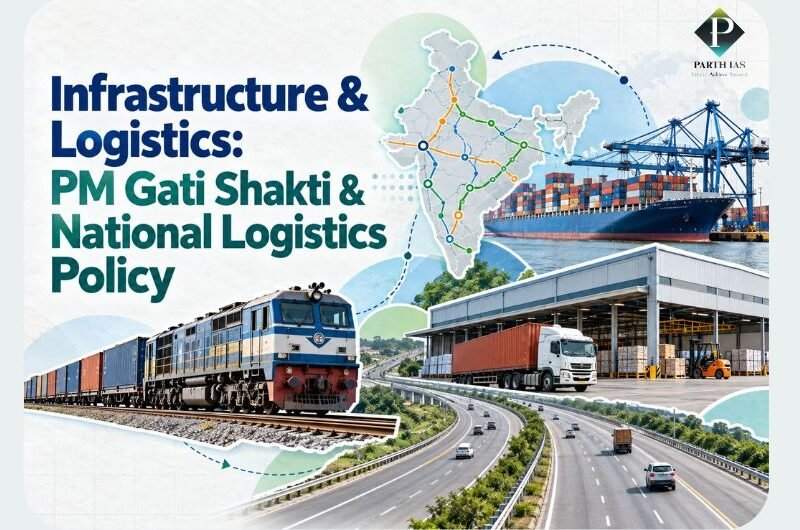
Infrastructure & Logistics: PM Gati Shakti & National Logistics Policy
PM Gati Shakti and the National Logistics Policy (NLP) function as
“double engines” driving India’s structural transformation in infrastructure and supply chain efficiency.
While PM Gati Shakti serves as the National Master Plan for physical, multi-modal infrastructure planning,
the National Logistics Policy provides the soft infrastructure, policy framework and digital ecosystem required
to optimize operations and reduce logistics costs.
1. Direct Comparison: Core Differences & Synergies
| Feature | PM Gati Shakti National Master Plan (PMGS-NMP) | National Logistics Policy (NLP) |
|---|---|---|
| Launch Date | 13 October 2021 | 17 September 2022 |
| Primary Focus | Hard Infrastructure Connectivity — integrated planning of roads, railways, airways, waterways and ports. | Soft Infrastructure & Systems — process reforms, skill-building, asset standardisation and service efficiency. |
| Core Platform | Dynamic GIS-based digital tool hosted on MEGHRAJ cloud, integrating over 3,200+ data layers across ministries. | Unified digital platforms for transaction tracking, data sharing and cross-departmental coordination. |
| Key Objective | Break departmental silos and ensure seamless first-and-last-mile connectivity for people and goods. | Reduce logistics costs to a single-digit target and place India in the Top 25 of the global Logistics Performance Index by 2030. |
2. Key Pillars of PM Gati Shakti
PM Gati Shakti is managed through a three-tier governance system consisting of the
Empowered Group of Secretaries (EGoS),
Network Planning Group (NPG) and
Technical Support Unit (TSU).
Integrates existing and planned initiatives from 58 Central Ministries and 36 State Master Plan portals into one centralised portal.
Allows different departments to prioritize cross-sectoral projects interactively through data-driven insights.
Assists ministries in selecting the most cost-effective and time-saving routes by analysing multi-modal data layers.
Coordinates execution schedules across departments, such as synchronising road construction and pipeline laying to prevent repeated digging.
Uses satellite imagery from ISRO, base maps from the Survey of India and advanced GIS tools developed by BISAG-N.
Provides real-time mapping, project tracking and satellite-based updates to cross-evaluate critical timelines.
3. Core Components of the National Logistics Policy
The National Logistics Policy improves operational efficiency through its
Comprehensive Logistics Action Plan (CLAP).
ULIP (Unified Logistics Interface Platform):
Integrates different digital systems across transport ministries into a single-window interface to streamline tracking and documentation.
LDB (Logistics Data Bank):
Uses RFID and IoT technology to provide end-to-end tracking for Export-Import (EXIM) containers.
LEADS (Logistics Ease Across Different States):
An annual framework that assesses and tracks State-level logistics performance and promotes competitive federalism.
E-LOGS & SIG:
Digital dashboard tools designed for inter-departmental issue resolution and industry grievance redressal.
Capacity Building:
Uses the iGOT Karmayogi platform to upskill government personnel and the logistics workforce.
Must Know Terms
1. PM Gati Shakti National Master Plan (PMGS-NMP)
A national master plan for integrated planning of physical and multi-modal infrastructure such as roads, railways, airways, waterways and ports.
2. National Logistics Policy (NLP)
A policy framework focused on soft infrastructure, process reforms, digital integration, skill development and improving logistics efficiency.
3. Unified Logistics Interface Platform (ULIP)
A digital platform that integrates different transport-related digital systems into a single interface for easier tracking, documentation and data sharing.
4. Logistics Data Bank (LDB)
A logistics tracking system that uses RFID and IoT technology for end-to-end tracking of Export-Import (EXIM) containers.
5. Logistics Ease Across Different States (LEADS)
An annual framework that assesses logistics performance across States and promotes competitive federalism in logistics development.
6. Comprehensive Logistics Action Plan (CLAP)
The implementation framework of the National Logistics Policy that focuses on improving logistics efficiency through coordinated reforms and digital systems.
Multiple-Choice Questions
1. With reference to PM Gati Shakti National Master Plan (PMGS-NMP), consider the following statements:
Which of the statements given above are correct?
2. Consider the following statements regarding PM Gati Shakti and the National Logistics Policy (NLP):
Which of the statements given above are correct?
3. Which one of the following correctly matches the initiative with its launch date?
4. With reference to the governance structure of PM Gati Shakti, consider the following:
How many of the above form part of its three-tier governance system?
5. Consider the following pairs:
How many of the pairs given above are correctly matched?
6. With reference to the Analytical pillar of PM Gati Shakti, consider the following statements:
Which of the statements given above are correct?
7. Which one of the following best describes the “Dynamics” pillar of PM Gati Shakti?
8. Consider the following statements regarding the National Logistics Policy (NLP):
Which of the statements given above are correct?
9. Consider the following pairs:
Which of the pairs given above are correctly matched?
10. With reference to the Logistics Data Bank (LDB), consider the following statements:
Which of the statements given above are correct?
11. Logistics Ease Across Different States (LEADS) is best associated with:
12. With reference to the Unified Logistics Interface Platform (ULIP), consider the following statements:
Which of the statements given above are correct?
13. Consider the following:
Statement-I:
PM Gati Shakti seeks to break departmental silos in infrastructure planning.
Statement-II:
It enables integrated and coordinated planning across different infrastructure sectors.
Which one of the following is correct in respect of the above statements?
14. Consider the following:
How many of the above are associated with the soft infrastructure and systems approach of the National Logistics Policy?
15. Consider the following statements:
Which of the statements given above are correct?




0 comment