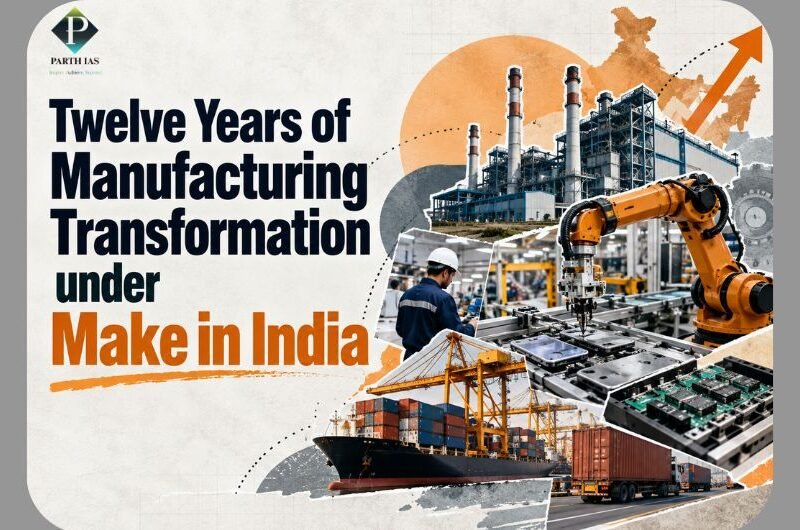
Twelve Years of Manufacturing Transformation under Make in India
1
Make in India was launched on 25 September 2014 to develop India as a global hub for manufacturing, design and innovation.
2
Make in India 2.0 now focuses on 27 sectors, including 15 manufacturing sectors and 12 service sectors.
3
Manufacturing Gross Value Added (GVA) at constant prices recorded a Compound Annual Growth Rate (CAGR) of 10.88% between 2022–23 and 2025–26.
4
The manufacturing component of the Index of Industrial Production (IIP) grew by 7.0% during April–July 2026 compared with the same period of 2025.
5
Electronics production increased from about ₹1.9 lakh crore in 2014–15 to about ₹13.11 lakh crore in 2025–26.
6
Mobile phone production increased around 32 times from about ₹18,900 crore in 2014–15 to about ₹6.3 lakh crore in 2025–26, making India the world’s second-largest mobile phone manufacturer by volume.
7
India’s pharmaceutical industry ranks third globally by volume and eleventh by value, with annual turnover reaching ₹5,08,630 crore in 2025–26.
8
Crude steel production increased from 81.7 million tonnes in 2014–15 to 170 million tonnes in 2025–26.
9
Indigenous defence production increased from ₹46,429 crore in 2014–15 to a record ₹1.78 lakh crore in Financial Year (FY) 2025–26.
10
A pilot plant for Neodymium-Iron-Boron (Nd-Fe-B) rare-earth permanent magnets was established at the International Advanced Research Centre for Powder Metallurgy and New Materials (ARCI), Hyderabad, in March 2026.
11
Indian Space Research Organisation (ISRO) and Semiconductor Laboratory (SCL) developed VIKRAM3201 and KALPANA3201 microprocessors for space applications; VIKRAM3201 is the first fully Make-in-India microprocessor qualified for launch-vehicle conditions.
12
Solar module manufacturing capacity increased from 2.3 Gigawatt (GW) in 2014 to 192 GW by June 2026, while solar-cell capacity increased from 1.2 GW to about 30 GW.
13
India permits 100% Foreign Direct Investment (FDI) through the automatic route in most sectors, while cumulative FDI reached USD 843 billion between 2014–15 and 2025–26.
14
Production Linked Incentive (PLI) schemes cover 14 sectors and, by June 2026, had attracted ₹2.6 lakh crore investment, generated ₹23.8 lakh crore in production and sales, supported exports above ₹15.5 lakh crore and created 14.6 lakh jobs.
15
Recent manufacturing initiatives include ₹7,280 crore for 6,000 Metric Tonnes Per Annum (MTPA) of rare-earth permanent magnet capacity, ₹33,660 crore under Bharat Audyogik Vikas Yojana (BHAVYA) for 100 industrial parks, ₹62,500 crore for the Mobile Phone Manufacturing Scheme, and ₹1,27,500 crore for Semicon 2.0.
Must Know Terms
1. Make in India
Make in India was launched on 25 September 2014 to promote manufacturing, investment, innovation and world-class industrial infrastructure in India.
2. Production Linked Incentive
Production Linked Incentive (PLI) schemes encourage incremental production and sales across 14 sectors, including electronics, automobiles, pharmaceuticals, solar modules and specialty steel.
3. National Single Window System
National Single Window System (NSWS) is a digital platform that helps businesses identify and apply for Central and State-level approvals through a common interface.
4. PM GatiShakti
PM GatiShakti National Master Plan is a digital infrastructure-planning framework that uses geospatial data, satellite imagery and integrated coordination for multimodal connectivity.
5. India Industrial Land Bank
India Industrial Land Bank (IILB) is a Geographic Information System (GIS)-enabled platform providing spatial and non-spatial information about industrial land and industrial parks across India.
6. Semicon 2.0
Semicon 2.0 provides long-term support for India’s semiconductor ecosystem, covering chip design, manufacturing, advanced packaging, materials, equipment, research and talent development.
Multiple-Choice Questions
1. With reference to Make in India, consider the following statements:
1. It was launched on 25 September 2014.
2. It seeks to develop India as a global hub for manufacturing, design and innovation.
3. Make in India 2.0 covers 27 sectors.
Which of the statements given above are correct?
(a) 1, 2 and 3
(b) 1 and 2 only
(c) 2 and 3 only
(d) 1 and 3 only
2. With reference to Make in India 2.0, consider the following statements:
1. It focuses on 27 sectors.
2. These include 15 manufacturing sectors.
3. These include 12 service sectors.
Which of the statements given above are correct?
(a) 1 and 2 only
(b) 1, 2 and 3
(c) 2 and 3 only
(d) 1 and 3 only
3. Manufacturing Gross Value Added (GVA) at constant prices recorded what Compound Annual Growth Rate (CAGR) between 2022–23 and 2025–26?
(a) 7.0%
(b) 9.2%
(c) 10.88%
(d) 15.8%
4. Consider the following statements regarding India’s manufacturing performance:
1. The manufacturing component of the Index of Industrial Production grew by 7.0% during April–July 2026.
2. Electronics production reached about ₹13.11 lakh crore in 2025–26.
3. Crude steel production reached 170 million tonnes in 2025–26.
Which of the statements given above are correct?
(a) 1 and 2 only
(b) 2 and 3 only
(c) 1 and 3 only
(d) 1, 2 and 3
5. With reference to electronics manufacturing in India, consider the following statements:
1. Electronics production increased from about ₹1.9 lakh crore in 2014–15 to about ₹13.11 lakh crore in 2025–26.
2. Mobile-phone production increased around 32 times over the same period.
3. India is the world’s second-largest mobile-phone manufacturer by volume.
Which of the statements given above are correct?
(a) 1, 2 and 3
(b) 1 and 2 only
(c) 2 and 3 only
(d) 1 and 3 only
6. Consider the following statements regarding India’s pharmaceutical industry:
1. India ranks third globally by pharmaceutical production volume.
2. India ranks eleventh globally by pharmaceutical value.
3. Annual pharmaceutical turnover reached ₹5,08,630 crore in 2025–26.
Which of the statements given above are correct?
(a) 1 and 2 only
(b) 1, 2 and 3
(c) 2 and 3 only
(d) 1 and 3 only
7. Consider the following pairs:
1. Crude steel production in 2025–26 — 170 million tonnes
2. Indigenous defence production in FY 2025–26 — ₹1.78 lakh crore
3. Electronics production in 2025–26 — About ₹13.11 lakh crore
How many of the pairs given above are correctly matched?
(a) Only one
(b) Only two
(c) All three
(d) None
8. With reference to rare-earth permanent magnets in India, consider the following statements:
1. A pilot plant for Neodymium-Iron-Boron magnets was established in March 2026.
2. It was established at the International Advanced Research Centre for Powder Metallurgy and New Materials.
3. The facility is located in Hyderabad.
Which of the statements given above are correct?
(a) 1 and 2 only
(b) 2 and 3 only
(c) 1 and 3 only
(d) 1, 2 and 3
9. VIKRAM3201 and KALPANA3201, recently associated with Make in India, are:
(a) Microprocessors developed for space applications
(b) Rare-earth permanent magnets
(c) Solar photovoltaic modules
(d) Electric-vehicle drive systems
10. With reference to India’s solar manufacturing capacity, consider the following statements:
1. Solar module manufacturing capacity increased from 2.3 GW in 2014 to 192 GW by June 2026.
2. Solar-cell manufacturing capacity increased from 1.2 GW in 2014 to about 30 GW by June 2026.
3. Both module and cell manufacturing capacities increased substantially during this period.
Which of the statements given above are correct?
(a) 1 and 2 only
(b) 1, 2 and 3
(c) 2 and 3 only
(d) 1 and 3 only
11. With reference to Foreign Direct Investment (FDI) in India, consider the following statements:
1. India permits 100% FDI through the automatic route in most sectors.
2. Cumulative FDI reached USD 843 billion during 2014–15 to 2025–26.
3. Certain strategic sectors remain outside the general automatic-route framework.
Which of the statements given above are correct?
(a) 1 and 2 only
(b) 2 and 3 only
(c) 1, 2 and 3
(d) 1 and 3 only
12. Consider the following statements regarding Production Linked Incentive (PLI) schemes:
1. They cover 14 sectors.
2. By June 2026, they had attracted ₹2.6 lakh crore in investment.
3. They generated ₹23.8 lakh crore in production and sales.
4. They supported more than ₹15.5 lakh crore in exports and created 14.6 lakh jobs.
Which of the statements given above are correct?
(a) 1, 2 and 3 only
(b) 2, 3 and 4 only
(c) 1, 3 and 4 only
(d) 1, 2, 3 and 4
13. Consider the following pairs:
1. National Single Window System — Digital platform for business approvals
2. India Industrial Land Bank — GIS-enabled platform for industrial land information
3. PM GatiShakti — Integrated infrastructure-planning framework
Which of the pairs given above are correctly matched?
(a) 1, 2 and 3
(b) 1 and 2 only
(c) 2 and 3 only
(d) 1 and 3 only
14. With reference to recent manufacturing initiatives, consider the following statements:
1. ₹7,280 crore has been allocated for 6,000 MTPA of rare-earth permanent magnet manufacturing capacity.
2. ₹33,660 crore has been allocated under Bharat Audyogik Vikas Yojana for developing 100 industrial parks.
3. ₹62,500 crore has been allocated for the Mobile Phone Manufacturing Scheme.
Which of the statements given above are correct?
(a) 1 and 2 only
(b) 1, 2 and 3
(c) 2 and 3 only
(d) 1 and 3 only
15. With reference to Semicon 2.0, consider the following statements:
1. It has an allocation of ₹1,27,500 crore.
2. It supports semiconductor design and manufacturing.
3. Its scope also includes advanced packaging, materials, equipment, research and talent development.
4. It is limited exclusively to semiconductor fabrication plants.
Which of the statements given above are correct?
(a) 1 and 4 only
(b) 2, 3 and 4 only
(c) 1, 2 and 3 only
(d) 1, 2, 3 and 4




0 comment