Best UPSC and MPPSC IAS Coaching Classes in Gwalior

Major Governance, Tax, Labour, and Rural Employment Reforms (2025)

Major Governance, Tax, Labour, and Rural Employment Reforms (2025)   Key Takeaways   2025 Economic reforms focused on outcome-driven governance, simplifying systems, and boosting growth, inclusivity, and ease of doing business. Labour reforms unified 29 laws under four Labour Codes, extending social security and workplace safety. Next-Gen GST simplified taxation, expanded the taxpayer base to 1.5 crore. The Export Promotion Mission (₹25,060 crore) strengthens MSME and first-time exporter support with finance, compliance, and market access. Rural employment reforms provide 125 days of guaranteed paid work.   1. 2025 reforms shifted governance from expanding regulations to measurable outcomes, simplifying systems, lowering compliance burdens, and improving predictability for citizens and                      businesses nationwide overall. 2.Union Budget 2025–26 exempted annual income up to ₹12 lakh under the new regime; salaried taxpayers effectively reach ₹12.75 lakh after standard deduction benefit. 3.Income Tax Act, 2025 overhauled the 1961 law, simplifying language, removing obsolete provisions, and restructuring sections, while keeping tax rates unchanged, to cut litigation. 4.A unified Tax Year, the financial year beginning 1 April, replaced Assessment Year and Previous Year concepts, improving clarity and reducing compliance disputes materially. 5.Twenty-nine labour laws were consolidated into four codes covering wages, industrial relations, social security, and occupational safety, health, and working conditions into one framework. 6.The codes expand wage security, social protection, and workplace safety for women, migrant, unorganized, gig, and platform workers, supporting inclusive formalisation for broader coverage. 7.Nearly ten million gig and platform workers receive annual social security support, alongside improved leave provisions, maternity benefits, and strengthened workplace safety each year. 8.Viksit Bharat Guarantee for Rozgar and Ajeevika Mission (Gramin) Act, 2025 replaced MGNREGA, integrating employment with community development and livelihoods with stronger statutory accountability. 9.Rural households receive up to 125 days of guaranteed wage employment yearly, balancing labour availability for peak agricultural seasons with worker security and resilience. 10.Wages must be paid weekly or within fifteen days of completing work, reducing delays and reinforcing income stability for rural workers under legal timelines. 11.All works flow from Viksit Gram Panchayat Plans approved by Gram Sabha, digitally linked with PM Gati Shakti for cross-ministry convergence and district-level coordination. 12.Administrative expenditure ceiling increased from 6% to 9%, strengthening staffing, training, technical capacity, and field support to improve implementation outcomes at the field level. 13.Quality Control Orders were phased with MSME relaxations: extra time for micro and small units, exemptions for certain imports, and legacy stock clearance safely. 14.Next-generation GST aimed for a two-slab structure, expanded the taxpayer base beyond 1.5 crore, and achieved ₹22.08 lakh crore collections in FY2024–25 for stability. 15.Export Promotion Mission, outlay ₹25,060 crore for FY2025–26 to FY2030–31, unifies support with trade finance, compliance, logistics, branding, and market access for MSMEs nationwide.     MCQ:   1. With reference to the Union Budget 2025–26 provisions mentioned, which one is correct regarding the new regime exemption threshold? A. ₹10 lakh, with no standard deduction relevance B. ₹12 lakh, with salaried effective threshold ₹12.75 lakh after standard deduction C. ₹12.75 lakh for all taxpayers regardless of salary status D. ₹15 lakh, with standard deduction removed 2. Consider the following statements about the Income Tax Act, 2025: I. It replaced the 1961 law with simplified language and a restructured layout. II. It changed tax rates to align with the new regime exemption threshold. III. It aimed to reduce litigation by removing obsolete provisions. Which of the statements given above are correct? A. I and II only B. II and III only C. I and III only D. I, II and III 3. The “Tax Year” introduced refers to: A. A calendar year beginning 1 January B. A financial year beginning 1 April, replacing Assessment Year and Previous Year concepts C. A half-yearly tax period for all taxpayers D. A quarterly filing period for GST-linked income tax assessment 4. Twenty-nine labour laws were consolidated into four codes covering: A. Wages; industrial relations; social security; occupational safety, health and working conditions B. Wages; taxation; consumer protection; environmental standards C. Industrial relations; competition law; social security; corporate governance D. Social security; wages; agriculture marketing; workplace harassment 5. Which of the following worker groups are explicitly indicated as beneficiaries of expanded coverage under the labour codes? A. Only government employees and retirees B. Women, migrant, unorganized, gig, and platform workers C. Only organized sector industrial workers D. Only small traders and MSME owners 6. Consider the following statements about annual social security support mentioned: I. It covers nearly ten million gig and platform workers annually. II. It is coupled with improved leave provisions and maternity benefits. Which of the statements given above are correct? A. I only B. II only C. Both I and II D. Neither I nor II 7. The Viksit Bharat Guarantee for Rozgar and Ajeevika Mission (Gramin) Act, 2025 is described as: A. A minor amendment within MGNREGA retaining its original statutory framework B. A replacement of MGNREGA integrating employment with community development and livelihoods C. A scheme limited to urban employment and apprenticeships D. A purely cash-transfer programme without work creation 8. Under the rural wage employment guarantee described, a rural household is entitled to: A. Up to 100 days of guaranteed wage employment yearly B. Up to 125 days of guaranteed wage employment yearly C. Up to 150 days of guaranteed wage employment yearly D. Up to 200 days of guaranteed wage employment yearly 9. Consider the following statements about wage payment timelines under the described rural employment framework: I. Wages must be paid weekly, or within fifteen days of completing work. II. Wages can be deferred up to thirty days if administrative expenditure exceeds the ceiling. Which of the statements given above are correct? A. I only B. II only C. Both I and II D. Neither I nor II 10. All works under the described rural employment framework are to be derived from: A. State secretariat directives only, without local approvals B. Viksit Gram Panchayat Plans approved by Gram Sabha C. District collector’s

More Details

Rare Earth Permanent Magnet Manufacturing Scheme

Rare Earth Permanent Magnet Manufacturing Scheme     Key Takeaways Government approves ₹7,280 crore scheme to establish domestic integrated REPM manufacturing ecosystem. Creates 6,000 MTPA domestic capacity covering the full value chain, from rare-earth oxides to finished magnets. Strengthens self-reliance for critical sectors such as electric mobility, renewable energy, electronics, aerospace and defence. Supported by strong rare-earth resource availability and policy initiatives including NCMM and MMDR Act reforms. Enhances India’s participation in global advanced-materials value chains while reducing import dependence and enabling long-term industrial growth.       1.Government approved a ₹7,280 crore scheme to promote sintered rare earth permanent magnet manufacturing, targeting expansion of national industrial capability and output overall capacity. 2.The scheme will create 6,000 MTPA integrated domestic REPM capacity, covering the full value chain from rare earth oxide to finished magnets in India. 3.REPMs deliver high magnetic strength and stability, enabling efficient use in EV motors, wind turbines, electronics, aerospace platforms, and defence systems globally today widely. 4.A domestic REPM ecosystem can cut import dependence for e-mobility, renewables, electronics, aerospace and defence, strengthening strategic supply-chain resilience at scale for India’s industries. 5.India holds about 13.15 million tonnes of monazite reserves, containing an estimated 7.23 million tonnes of rare earth oxides forming a substantial resource base. 6.Rare earth oxide resources occur in coastal beach sands, teri/red sands and inland alluvium across Andhra Pradesh, Odisha, Tamil Nadu, Kerala, West Bengal, Jharkhand. 7.Hard-rock regions of Gujarat and Rajasthan have identified 1.29 million tonnes of in-situ rare earth oxide resources, supporting longer-term domestic supply security and planning. 8.Geological Survey added 482.6 million tonnes of rare earth ore resources through exploration, indicating strong potential for downstream industry development nationally in coming years. 9.Despite progress in local magnet production, import dependence remained high during 2022–23 to 2024–25, reaching 59.6–81.3% value and 84.8–90.4% volume for these products overall. 10.REPM consumption is projected to double by 2030, driven by e-mobility growth, renewable deployment, electronics manufacturing expansion, and strategic defence applications worldwide by then. 11.Capacity will be allocated through global competitive bidding to up to five beneficiaries; each may receive up to 1,200 MTPA to ensure diversification adequately. 12.The incentive package includes ₹6,450 crore sales-linked incentives over five years and ₹750 crore capital subsidy to support advanced plant establishment nationwide implementation efforts. 13.Implementation spans seven years: two years for facility setup, followed by five years of REPM sales-based incentive payouts, ensuring timely capacity creation and delivery. 14.The initiative supports green technologies by supplying materials for energy-efficient motors and wind power systems, aligning directly with Net Zero 2070 vision targets also. 15.The scheme complements NCMM launched January 2025, MMDR Amendment 2023, MSP, IPEF, iCET partnerships, and KABIL efforts for overseas mineral acquisition and security goals.     MCQ:   1. With reference to the ₹7,280 crore initiative, consider the following statements: I) It targets sintered rare earth permanent magnet manufacturing. II) It aims to expand national industrial capability and output. Which of the statements given above is/are correct? A. I only B. II only C. Both I and II D. Neither I nor II   2. The integrated domestic capacity proposed under the scheme is: A. 1,200 MTPA B. 3,000 MTPA C. 6,000 MTPA D. 7,280 MTPA 3. The scheme’s integration across the value chain is best described as: A. Finished magnets only B. Rare earth oxide to finished magnets C. Mining to rare earth oxide only D. Component assembly to final products only 4. Rare earth permanent magnets are specifically described as having: A. Low magnetic strength and low stability B. High magnetic strength and stability C. High electrical conductivity and ductility D. Low density and high thermal insulation 5. Which of the following sectors are directly cited as key users of REPM? A. EV motors, wind turbines, electronics, aerospace, defence systems B. Cement, textiles, fertilizers, shipping, retail C. Agriculture, fisheries, forestry, hospitality, tourism D. Railways, ports, steel, banking, insurance 6. Consider the following statements about India’s monazite reserves: 1) They are about 13.15 million tonnes. 2) They contain an estimated 7.23 million tonnes of rare earth oxides. Which of the statements given above is/are correct? A. 1 only B. 2 only C. Both 1 and 2 D. Neither 1 nor 2 7. Rare earth oxide resources in coastal and inland settings are cited across several states. Which one of the following is NOT listed? A. Kerala B. Jharkhand C. Andhra Pradesh D. Punjab 8. Hard-rock in-situ rare earth oxide resources of about 1.29 million tonnes are identified in: A. Gujarat and Rajasthan B. Odisha and West Bengal C. Tamil Nadu and Kerala D. Maharashtra and Andhra Pradesh 9. Geological Survey exploration added rare earth ore resources of: A. 48.26 million tonnes B. 482.6 million tonnes C. 4,826 million tonnes D. 728.0 million tonnes 10. During 2022–23 to 2024–25, import dependence for magnets remained high. The stated ranges were: A. Value: 20–40%; Volume: 30–50% B. Value: 59.6–81.3%; Volume: 84.8–90.4% C. Value: 84.8–90.4%; Volume: 59.6–81.3% D. Value: 10–25%; Volume: 70–85% 11. REPM consumption is projected to: A. Halve by 2030 due to substitution B. Remain constant until 2030 C. Double by 2030, driven by e-mobility, renewables, electronics, strategic uses D. Double by 2047, driven only by electronics 12. Consider the following about beneficiary allocation: 1) Allocation is through global competitive bidding. 2) There can be up to five beneficiaries. 3) Each beneficiary can receive up to 1,200 MTPA. Which of the statements given above is/are correct? A. 1 and 2 only B. 2 and 3 only C. 1 and 3 only D. 1, 2 and 3 13. The incentive structure includes which of the following? A. ₹6,450 crore sales-linked incentives and ₹750 crore capital subsidy B. ₹7,280 crore sales-linked incentives and ₹6,450 crore capital subsidy C. ₹750 crore sales-linked incentives and ₹6,450 crore capital subsidy D. Only capital subsidy; no sales-linked incentives 14. The seven-year implementation is structured as: A. 5 years setup + 2 years incentive payouts B. 2 years setup + 5 years sales-based incentive payouts C. 7 years setup; incentives after completion D. 1 year setup + 6 years payouts 15. The scheme is stated to be

More Details

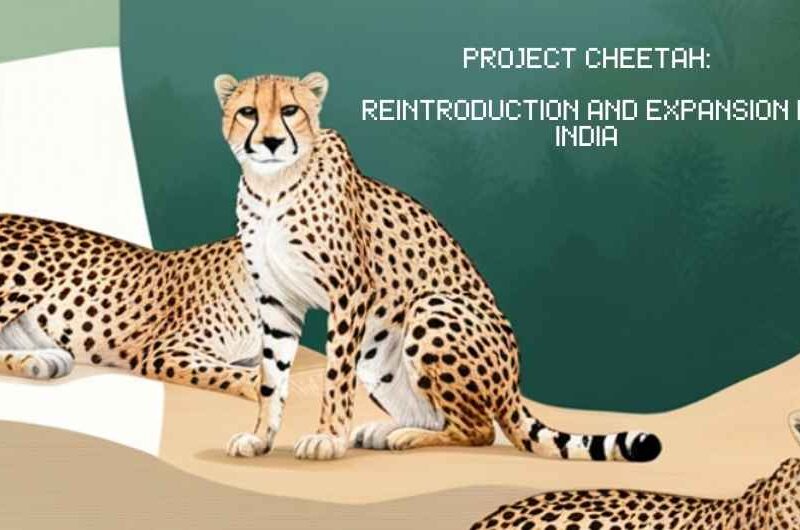
Project Cheetah: Reintroduction and Expansion in India

Project Cheetah: Reintroduction and Expansion in India   Snapshot   World’s first inter-continental translocation of a large carnivore successfully completed with 20 cheetahs from Namibia and South Africa (2022-23) coming to India. Prime Minister Shri Narendra Modi personally released the first eight cheetahs on 17 September 2022 As of December 2025, India has a total of 30 cheetahs – 12 adults, 9 sub-adults, and 9 cubs – comprising 11 founder animals and 19 India-born individuals. Mukhi, the first cheetah cub born on Indian soil, has herself become a mother to five healthy cubs. Over 450 Cheetah Mitras, 380 direct jobs, and 5% eco-tourism revenue share created for local communities around Kuno. India is on track to establish a self-sustaining metapopulation of 60–70 cheetahs across 17,000 km² by 2032, with Gandhi Sagar Wildlife Sanctuary ready for the next phase.         1.Project Cheetah began on 17 September 2022, reintroducing cheetahs to India at Kuno National Park through intercontinental wild-to-wild translocation as flagship grassland restoration programme. 2.Twenty cheetahs were brought during 2022–23: eight from Namibia and twelve from South Africa, establishing founder stock for population recovery efforts as founders. 3.As of December 2025, the Kuno population totals thirty cheetahs: twelve adults, nine sub-adults, and nine cubs, with nineteen India-born individuals within Kuno landscape. 4.The Asiatic cheetah was declared extinct in India in 1952, following severe hunting, poaching, habitat loss, prey decline, and low reproductive rates in landscapes. 5.The last confirmed wild cheetah sighting occurred in 1947, when three animals were shot in Koriya district forests in present-day Chhattisgarh in preindependence India. 6.Kuno was chosen after relocating twenty-four villages, moving 1,545 families and creating around 6,258 hectares of inviolate grassland habitat for cheetahs for future releases. 7.A phased approach uses quarantine, acclimatization bomas, and soft-release protocols, followed by monitored releases into open wilderness from 2024 onward guided by reintroduction standards. 8.The long-term target is a self-sustaining metapopulation of sixty to seventy cheetahs across about 17,000 square kilometres by 2032, linking multiple habitats nationally coordinated. 9.Gandhi Sagar Wildlife Sanctuary is planned as a second node, with 368 square kilometres sanctuary area and roughly 2,500 square kilometres potential habitat nearby. 10.Monitoring employs GPS collars, camera traps, and distance sampling on 734–816 kilometre transects to track prey, habitat conditions, movements, and survival regularly updated. 11.Early breeding indicates habitat suitability, with multiple litters recorded from 2023 onward, including second-generation births when an India-born female produced cubs with careful monitoring. 12.Mukhi, the first cub born on Indian soil, later delivered five cubs in November 2025, marking strengthened genetic continuity within the reintroduced population successfully. 13.Ranging data show large home ranges: Aasha covers 121 square kilometres, her male cubs 1,508, and the Agni–Vayu coalition 1,819 square kilometres also. 14.Community integration includes over 450 Cheetah Mitras across eighty villages, plus employment for trackers, patrol workers, and locally trained safari guides via local development. 15.The International Big Cat Alliance, launched 9 April 2023 and headquartered in India, has ₹150 crore support for five years till 2027–28 globally.     MCQ:   1. With reference to Project Cheetah, consider the following statements: 1. It began on 17 September 2022 at Kuno National Park. 2. It involved intercontinental wild-to-wild translocation. Which of the statements given above is/are correct? A. 1 only B. 2 only C. Both 1 and 2 D. Neither 1 nor 2 2. Consider the following: 1. Eight cheetahs were brought from Namibia. 2. Twelve cheetahs were brought from South Africa. The above numbers relate to cheetah translocations to India during: A. 2020–21 B. 2021–22 C. 2022–23 D. 2023–24 3. As of December 2025, the Kuno cheetah population totals 30, consisting of: A. 12 adults, 9 sub-adults, 9 cubs B. 9 adults, 12 sub-adults, 9 cubs C. 12 adults, 12 sub-adults, 6 cubs D. 10 adults, 10 sub-adults, 10 cubs 4. The Asiatic cheetah was declared extinct in India in: A. 1947 B. 1952 C. 1962 D. 1972 5. The last confirmed wild cheetah sighting in India (1947) is associated with: A. Gir forests in Gujarat B. Koriya district forests in present-day Chhattisgarh C. Sundarbans in West Bengal D. Corbett landscape in Uttarakhand 6. Kuno was selected after relocating: A. 12 villages and 750 families, creating about 3,000 hectares inviolate habitat B. 18 villages and 1,200 families, creating about 5,000 hectares inviolate habitat C. 24 villages and 1,545 families, creating about 6,258 hectares inviolate habitat D. 30 villages and 1,800 families, creating about 8,000 hectares inviolate habitat 7. Which of the following best describes the phased approach used in Project Cheetah? A. Immediate hard release without acclimatization or quarantine B. Quarantine, acclimatization bomas, soft-release, followed by monitored releases into wilderness C. Captive breeding in zoos first, then release after five generations D. Relocation only within India without any enclosure-based acclimatization 8. The long-term target under Project Cheetah is to establish: A. 30–40 cheetahs across 10,000 sq km by 2030 B. 60–70 cheetahs across about 17,000 sq km by 2032 C. 80–90 cheetahs across about 25,000 sq km by 2035 D. 100 cheetahs across 30,000 sq km by 2040 9. Gandhi Sagar Wildlife Sanctuary is planned primarily as: A. A third node with 700 sq km sanctuary and 5,000 sq km habitat B. A second node with 368 sq km sanctuary and ~2,500 sq km potential habitat C. A first node with 368 sq km sanctuary and 1,000 sq km habitat D. A corridor-only site without any sanctuary area 10. Monitoring under Project Cheetah includes which of the following? 1. GPS collars 2. Camera traps 3. Distance sampling on 734–816 km transects Select the correct answer using the code below: A. 1 and 2 only B. 2 and 3 only C. 1 and 3 only D. 1, 2 and 3 11. Evidence cited for habitat suitability at Kuno includes: A. Absence of predators and complete prey elimination B. Multiple litters recorded from 2023 onward, including second-generation births C. No dispersal outside bomas after release D. Zero mortality for all founders since introduction 12. Mukhi is known for which of the following? A. Being the first founder male from South Africa

More Details

Sanchar Saathi: Citizen-Centric Framework for Telecom Security

Sanchar Saathi: Citizen-Centric Framework for Telecom Security     Sanchar Saathi Mobile Application: Strengthening Telecom Security   The Sanchar Saathi mobile application was introduced in January 2025 to enhance transparency, safety, and citizen control within India’s expanding telecom ecosystem. With mobile phones central to banking, governance, education, healthcare, and digital services, the platform addresses growing risks related to identity misuse, device theft, and telecom-enabled fraud.   Rationale and Context   India’s telecom network serves over a billion subscribers and functions as critical digital infrastructure. Rising incidents of cyber fraud, forged identities, and deceptive communications created the need for a citizen-facing preventive mechanism. Sanchar Saathi responds by enabling users to verify, report, and protect their telecom identities directly.   Core Design Principles   The application follows a voluntary, consent-driven model. It activates only after user registration and allows full control over activation, deactivation, or deletion. Privacy protection is embedded by design, ensuring security enhancement without compromising personal data autonomy.   Measurable Outcomes   Since launch, the platform has recorded widespread adoption and tangible results. Millions of mobile devices reported as lost or stolen have been blocked, unauthorised connections disconnected, and fraudulent identifiers removed. These interventions have significantly reduced misuse of telecom resources and associated financial risks.   Financial Fraud Risk Indicator   An important component is the Financial Fraud Risk Indicator, which categorises mobile numbers based on their likelihood of financial misuse. This risk-based classification assists financial institutions and digital payment platforms in applying enhanced safeguards for high-risk numbers.   Citizen-Centric Functionalities   The application integrates multiple services on a single interface. Users can report suspicious calls, messages, or online communications, track and block lost devices, verify handset authenticity, identify unauthorised connections issued in their name, and report international calls disguised as domestic numbers.   Public Participation and Transparency   Citizen reporting plays a central role in enforcement actions against fraudulent telecom activities. Public dashboards display actions taken, reinforcing transparency, accountability, and trust in the system.   Legal and Privacy Safeguards   The platform operates within India’s cyber and data protection framework. It collects only essential information required for service delivery, avoids commercial profiling, and restricts data sharing strictly to lawful requirements, ensuring protection against unauthorised access or misuse.   Conclusion   Sanchar Saathi represents a comprehensive approach to telecom security by combining technology, legal safeguards, and citizen participation. It strengthens trust in digital communications while reducing fraud, identity misuse, and device-related crimes across the country.     MCQ: 1.The primary objective of the Sanchar Saathi mobile application is to: A. Expand mobile network coverage in rural regions B. Strengthen telecom security and protect digital identity C. Regulate mobile handset prices D. Promote domestic smartphone manufacturing 2.The Sanchar Saathi application was introduced in: A. 2023 B. 2024 C. 2025 D. 2026 3.The operational model of the Sanchar Saathi application is best described as: A. Mandatory and centrally controlled B. Subscription-based commercial service C. Voluntary and consent-driven D. Automated background monitoring system 4.Which of the following best explains the need for Sanchar Saathi? A. Declining telecom penetration B. Rising cyber fraud and identity misuse C. Shortage of telecom infrastructure D. Increasing handset imports 5.Activation of the Sanchar Saathi application occurs: A. Automatically on device startup B. After verification by service providers C. Only after user registration and consent D. Through police authorisation 6.One major outcome of Sanchar Saathi has been: A. Reduction in international roaming charges B. Blocking of lost or stolen mobile devices C. Expansion of broadband services D. Increase in handset resale value 7.The Financial Fraud Risk Indicator primarily: A. Calculates telecom revenue loss B. Predicts handset lifespan C. Classifies mobile numbers based on fraud risk D. Tracks user spending behaviour 8.The Financial Fraud Risk Indicator assists mainly: A. Device manufacturers B. Telecom equipment vendors C. Financial institutions and payment platforms D. Internet service resellers 9.Which activity can users perform through Sanchar Saathi? A. Upgrade mobile operating systems B. Report suspicious calls and messages C. Purchase insurance for devices D. Change telecom tariff plans 10.The application helps users identify: A. Network congestion zones B. Unauthorised mobile connections in their name C. International data tariffs D. Signal strength variations 11.Reporting international calls disguised as domestic numbers helps address: A. Spectrum allocation issues B. Illegal telecom setups C. Mobile manufacturing defects D. Data speed limitations 12.Citizen participation in Sanchar Saathi mainly supports: A. Market competition B. Enforcement against fraudulent telecom activity C. Reduction of handset prices D. Network infrastructure expansion 13.Transparency in Sanchar Saathi is ensured through: A. Automated alerts only B. Periodic media briefings C. Public dashboards displaying actions taken D. Confidential internal audits 14.The data collection approach of Sanchar Saathi is characterised by: A. Extensive profiling for analytics B. Collection of maximum user data C. Minimal data collection for legitimate purposes D. Commercial sharing of user information 15.The broader significance of Sanchar Saathi lies in its ability to: A. Replace telecom service providers B. Centralise all digital services C. Strengthen trust in digital communications D. Promote smartphone exports  

More Details

SHANTI Bill, 2025: India’s Modern Nuclear Energy Framework

SHANTI Bill, 2025: India’s Modern Nuclear Energy Framework     Overview of Nuclear Energy Nuclear energy is generated through controlled atomic reactions, primarily nuclear fission, which releases heat used to produce electricity. This process generates large-scale power without emitting greenhouse gases, making it a dependable and low-carbon energy source that complements intermittent renewables such as solar and wind, while ensuring base-load electricity supply.   Context and Legislative Background India’s nuclear programme has evolved through a carefully regulated legal framework focused on peaceful use, national security, and safety. Earlier legislations laid the foundation for state control, gradual capacity expansion, and liability management. With technological advancement and rising clean-energy ambitions, the existing framework required consolidation and modernization to align with present and future energy needs.   Need for a Modern Nuclear Framework Growing electricity demand, decarbonisation commitments, and the requirement for round-the-clock power have increased the strategic importance of nuclear energy. Existing laws limited flexibility, investment scale, and innovation. A unified framework enables capacity expansion, technological advancement, and integration of nuclear power into long-term energy planning while maintaining strict safety and security oversight.   Present Status of Nuclear Energy Nuclear power currently contributes a modest but stable share to electricity generation. Installed capacity remains limited but is projected to rise significantly with new reactor technologies, indigenous designs, and international cooperation. Planned expansion reflects the intent to position nuclear energy as a long-term pillar of clean and reliable power supply.   Long-Term Nuclear Energy Vision A national mission outlines the objective of achieving large-scale nuclear capacity by mid-century. Emphasis is placed on advanced reactor technologies, particularly small modular reactors, to enhance flexibility, safety, and decentralised deployment. These initiatives also support non-power applications such as hydrogen generation and industrial processes.   Key Structural Features of the New Framework The framework permits limited private participation in nuclear operations under strict regulatory supervision, including power generation, manufacturing, and selected fuel-cycle activities. Sensitive domains such as high-level waste management, spent fuel processing, and strategic materials remain exclusively under sovereign control, ensuring national security and strategic autonomy.   Regulatory and Safety Architecture A strengthened licensing system governs all nuclear activities, supported by enhanced safety authorisation mechanisms. Statutory recognition of the nuclear regulatory authority reinforces institutional independence, oversight capability, and accountability. Comprehensive systems for security, safeguards, emergency preparedness, and quality assurance are embedded across the sector.   Liability and Dispute Resolution Mechanism A graded civil liability structure replaces uniform liability limits, allowing responsibility to vary according to installation type and risk profile. Dedicated mechanisms are established for claims adjudication, compensation management, dispute resolution, and appellate review, ensuring clarity, fairness, and timely redressal in nuclear-related incidents.   Strategic Safeguards and Governance The framework balances sectoral openness with firm sovereign control over critical functions. Coordinated oversight mechanisms, reinforced safeguards, and clear acquisition rights ensure that expansion does not compromise national security, regulatory discipline, or independent decision-making in strategic nuclear matters.   Conclusion The modernised nuclear framework represents a structural shift toward efficiency, innovation, and long-term energy security. By consolidating governance, enabling controlled participation, and strengthening safety oversight, it establishes a robust foundation for expanding clean, reliable nuclear energy while preserving strategic control and public safety.       MCQ:   1.Nuclear energy primarily generates electricity by:A. Burning fossil fuels at high temperaturesB. Controlled atomic fission releasing heatC. Chemical reactions between radioactive elementsD. Fusion of light nuclei under extreme pressure 2.One major advantage of nuclear power generation is that it:A. Requires very small land area compared to all renewablesB. Produces electricity without greenhouse gas emissionsC. Depends entirely on imported technologyD. Operates only during peak demand hours 3.The primary objective of the SHANTI Bill, 2025 is to:A. Privatise the entire nuclear sectorB. Replace renewable energy policiesC. Modernise and consolidate the nuclear legal frameworkD. Eliminate government control over atomic energy 4.India’s nuclear energy contribution to total electricity generation has remained close to:A. 1 percentB. 3 percentC. 7 percentD. 12 percent 5.The present installed nuclear power capacity of India is approximately:A. 4.5 GWB. 6.2 GWC. 8.78 GWD. 12.5 GW 6.Planned nuclear capacity expansion aims to reach about 22 GW by:A. 2027–28B. 2029–30C. 2031–32D. 2035–36 7.Small Modular Reactors are emphasised mainly because they:A. Eliminate the need for regulatory oversightB. Are suitable only for military purposesC. Offer flexible, scalable, and safer deploymentD. Replace conventional large reactors entirely 8.Under the new framework, private participation in nuclear energy is:A. Completely unrestrictedB. Allowed under strict regulatory supervisionC. Limited only to foreign companiesD. Prohibited in power generation 9.Which of the following activities remains exclusively under central government control?A. Nuclear equipment manufacturingB. Electricity distributionC. Spent fuel reprocessing and waste managementD. Reactor maintenance services 10.The graded liability framework implies that:A. Liability limits are uniform for all installationsB. Operators bear unlimited liabilityC. Liability varies based on installation characteristicsD. Liability applies only to private operators 11.Statutory recognition is granted to which body to strengthen nuclear regulation?A. Department of Atomic EnergyB. Nuclear Power CorporationC. Atomic Energy Regulatory BoardD. Central Electricity Authority 12.Non-power applications of nuclear technology include use in:A. Defence manufacturing onlyB. Healthcare, agriculture, and industryC. Space exploration exclusivelyD. Telecommunications infrastructure 13.The strengthened regulatory framework focuses strongly on:A. Rapid construction over safetyB. Security, safeguards, and emergency preparednessC. Reducing inspection requirementsD. Decentralising all oversight powers 14.Dispute resolution under the framework includes the establishment of:A. A Parliamentary Standing CommitteeB. A Constitutional BenchC. An Atomic Energy Redressal Advisory CouncilD. A State-level Energy Tribunal 15.The long-term vision for nuclear energy expansion targets achieving large capacity by:A. 2030B. 2035C. 2047D. 2070    

More Details

VB-G RAM G Bill, 2025: A Revised Rural Employment Guarantee with Infrastructure Focus

GRAM G Bill, 2025: A Revised Rural Employment Guarantee with Infrastructure Focus 1) Viksit Bharat–G RAM G Bill, 2025 proposes replacing Mahatma Gandhi National Rural Employment Guarantee Act (MGNREGA) with a new statutory rural employment framework linked to the Viksit Bharat 2047 vision.   2) The Bill raises the guaranteed wage employment to 125 days per rural household per financial year, compared to the earlier 100-day entitlement under MGNREGA.   3) It introduces an aggregated 60-day “no-work” pause during sowing and harvesting seasons to avoid disrupting peak farm operations, while still ensuring 125 workdays within the remaining 305 days.   4) Wage payments are tightened: wages must be paid weekly, or at the latest within 15 days (a fortnight) after the work is completed.   5) Works are tied to durable rural assets under four priority verticals: water security works, core rural infrastructure, livelihood-linked infrastructure, and special works for extreme weather risk mitigation.   6) All created assets will be pooled into the Viksit Bharat National Rural Infrastructure Stack to enable unified tracking, coordination, and outcome monitoring at the national level.   7) Planning is decentralised through Viksit Gram Panchayat Plans prepared locally, and these plans are spatially linked with PM Gati Shakti for integrated infrastructure planning.   8) Funding shifts from demand-based releases to a normative allocation model to reduce budget uncertainty, while keeping legal entitlements intact.   9) Estimated annual funds requirement for wages, material, and administration is ₹1,51,282 crore (including State share), with estimated Central share at ₹95,692.31 crore.   10) Cost sharing is set at 60:40 between Centre and States; 90:10 for North Eastern and Himalayan States; and 100% Central funding for Union Territories without legislatures.   11) The administrative expenditure ceiling increases from 6% to 9% to strengthen staffing, pay, training, and technical capacity for planning, execution, and accountability.   12) Women’s participation under MGNREGA increased from 48% to 58.15% between FY 2013-14 and FY 2025-26, alongside near-universal electronic wage payments and wider Aadhaar-based governance.   13) Monitoring findings cited include works not found on ground, spending not matching physical progress, machine use in labour works, bypassing digital attendance, and accumulated misappropriation.   14) Unemployment allowance becomes payable if work is not provided: after 15 days, a daily allowance is due; liability rests on States; and rates and conditions will be set through rules.   15) Governance includes Central and State Gramin Rozgar Guarantee Councils, Steering Committees, Panchayati Raj Institutions, District Programme Coordinators, Programme Officers, and stronger Gram Sabha social audits at least once every six months.     Must Know Terms :     1) Normative Allocation: Funds are fixed in advance using standard norms (households, expected person-days, unit costs, admin limits), so money is sanctioned upfront instead of waiting for demand spikes. This reduces mid-year cash shortage, late wage payments, and sudden supplementary demands. Legal right to work remains, but budget flow becomes more predictable for States and districts.   2) Unemployment Allowance: If work is not given within 15 days of demand, a daily allowance becomes payable. Payment liability is on the State, so States lose money if they fail to provide work. The exact rate, eligibility rules, and payment process are notified through rules. This creates a direct financial penalty for delay in providing employment.   3) Viksit Gram Panchayat Plans: Village-level plans listing works, locations, and season-wise schedule, prepared locally by Gram Panchayat with Gram Sabha role. These plans prioritise practical works like water harvesting, drainage, rural roads, community assets, and livelihood-support works. They are mapped with PM Gati Shakti so village projects align with larger road/utility corridors and avoid duplication.   4) Rural Infrastructure Stack: A single national asset database where every created work is recorded with location and basic details for tracking. It is meant to show what asset was built, where, cost, stage, and expected use. This helps prevent “work not found on ground” cases, supports monitoring of physical progress versus spending, and improves transparency across districts and States.   5) Administrative Expenditure Ceiling: Maximum allowed share for admin costs such as field staff, technical measurements, training, supervision, and system support. Raising the ceiling from 6% to 9% increases money available for staffing and technical capacity. The intent is faster approvals, better worksite checks, stronger monitoring, and fewer payment delays and execution gaps.   6) Social Audit Frequency: Social audits must happen at least once every six months in Gram Sabha. Records like attendance, worksite existence, measurements, and wage payments are publicly checked. Regular audits reduce scope for fake works, machine use in labour works, and record manipulation. Findings are expected to trigger recovery, corrective action, and accountability steps faster. MCQ: 1. Under the GRAM G Bill, 2025, the proposed annual wage-work entitlement per rural household is: (a) 100 days (b) 110 days (c) 125 days (d) 150 days 2. The Bill introduces an aggregated “no-work” window of: (a) 30 days (b) 45 days (c) 60 days (d) 75 days 3. Wage payments are proposed to be made: (a) Monthly only (b) Weekly, or not later than a fortnight after work completion (c) Only after project completion (d) Quarterly through cash disbursement 4. The Bill explicitly links wage employment with durable rural infrastructure through how many priority verticals? (a) Two (b) Three (c) Four (d) Five 5. Which of the following is NOT listed among the priority verticals for infrastructure linkage? (a) Water security works (b) Core rural infrastructure (c) Livelihood-related infrastructure (d) Urban metro connectivity works 6. Planning is proposed to be decentralised through locally prepared: (a) District Vision 2035 Reports (b) Viksit Gram Panchayat Plans (c) State Capital Region Plans (d) Regional Industrial Master Plans 7. Assets created are proposed to be aggregated into a national rural infrastructure: (a) Ledger (b) Stack (c) Portal (d) Census 8. A major funding design shift proposed is moving from: (a) Normative allocation to demand-based funding (b) Demand-based funding to normative allocation (c) State-only funding to private funding (d) Cash funding to barter funding 9. The standard cost-sharing

More Details

India’s Labour Reforms: Simplification, Security, and Sustainable Growth

India’s Labour Reforms: Simplification, Security, and Sustainable Growth     Introduction   India’s labour ecosystem has undergone a significant structural transformation aimed at aligning worker welfare with the needs of a rapidly evolving economy. As employment expands across sectors and work arrangements diversify, the regulatory framework has been redesigned to ensure simplicity, security, and sustainability. The consolidation of multiple legislations into a streamlined structure reflects an effort to modernise labour governance while balancing economic growth with social protection.   Rationale for Labour Law Consolidation   Earlier labour regulations were fragmented across numerous laws, creating compliance complexity and enforcement challenges for both workers and enterprises. Many of these laws were rooted in outdated economic conditions and did not adequately reflect contemporary production systems, technological integration, or new forms of work. Consolidation was undertaken to simplify compliance, reduce administrative burden, improve enforcement efficiency, and align labour regulation with present-day economic realities.   Structure of the Four Labour Codes   The reformed framework groups existing provisions into four functional codes covering wages, industrial relations, social security, and occupational safety. This structure creates clarity by defining rights and obligations within a unified system rather than scattered statutes. The approach improves consistency in definitions, procedures, and standards, enabling smoother implementation and better understanding for stakeholders across the labour market.   Wage Security and Equality   The wage-related framework establishes universal wage protection, ensuring that minimum wage standards apply across sectors and categories of workers. It introduces mechanisms to ensure fairness, timely payment, and gender neutrality in remuneration. By standardising wage definitions and reducing ambiguity, the system strengthens income security and enhances transparency in employer–employee relationships.   Industrial Relations and Workforce Flexibility   The industrial relations framework seeks to balance enterprise continuity with worker protection. It simplifies processes related to trade unions, employment conditions, and dispute resolution. Provisions support structured collective bargaining, quicker resolution of disputes, and flexible employment arrangements, while maintaining safeguards against arbitrary practices. The objective is to create a stable industrial environment conducive to productivity and cooperation.   Expansion of Social Security Coverage   A key reform lies in extending social security beyond traditionally covered workers to include unorganised, gig, and platform workers. The framework integrates multiple welfare provisions under a common structure, covering health, maternity, provident fund, gratuity, and compensation benefits. Digital systems and dedicated funds improve accessibility, portability, and delivery of benefits across regions and occupations.   Occupational Safety and Working Conditions   The safety and working conditions framework consolidates diverse regulations into a single code addressing health standards, working hours, welfare facilities, and workplace safety. It introduces uniform registration and licensing systems, enhances protection for migrant and contract workers, and expands coverage to hazardous activities. Emphasis is placed on preventive safety, formal documentation, and shared responsibility between employers and workers.   Compliance, Governance, and Digitisation   The reforms prioritise ease of compliance through single registration, licensing, and return mechanisms. Technology-enabled processes, risk-based inspections, and facilitator-oriented enforcement improve transparency and reduce discretionary intervention. Decriminalisation of minor offences and emphasis on monetary penalties encourage voluntary compliance while maintaining accountability.   Conclusion   India’s labour reforms represent a shift toward a simplified, inclusive, and future-ready labour framework. By integrating worker protection with economic efficiency, the new structure supports employment generation, enterprise growth, and social security expansion. The emphasis on clarity, digitisation, and balanced governance strengthens the foundation for a resilient labour market capable of supporting long-term, inclusive economic progress.       Multiple Choice Questions   (1)The consolidation of India’s labour laws resulted in how many Labour Codes? (a) Two (b) Three (c) Four (d) Five   Employment in India increased from 47.5 crore in 2017–18 to approximately: 55.2 crore in 2023–24 60.1 crore in 2023–24 62.8 crore in 2023–24 64.33 crore in 2023–24   During the same period, the unemployment rate declined to: 4.8% 4.0% 3.5% 3.2%   The Code on Wages, 2019 consolidated provisions of how many earlier labour laws? Two Three Four Five   The statutory concept introduced to ensure a nationwide minimum standard of wages is known as: Living Wage Fair Wage Floor Wage Basic Wage   Under the Code on Wages, overtime work must be compensated at: 1.25 times the normal wage 1.5 times the normal wage 1.75 times the normal wage At least twice the normal wage   The Industrial Relations Code, 2020 amalgamates provisions of: Two labour laws Three labour laws Four labour laws Five labour laws   Fixed Term Employment under the Industrial Relations Code provides gratuity eligibility after: Six months One year Three years Five years   Approval threshold for lay-off, retrenchment, or closure under the Industrial Relations Code has been raised to: 100 workers 200 workers 250 workers 300 workers   The Code on Social Security, 2020 extends coverage explicitly to: Only organized sector workers Only industrial workers Gig and platform workers Only government employees   Aggregators under the Social Security Code are required to contribute: 0.5–1% of turnover 1–2% of turnover, subject to limits 3–5% of turnover A fixed annual contribution   Fixed-term employees become eligible for gratuity after: Six months of service One year of continuous service Three years of service Five years of service   The Occupational Safety, Health and Working Conditions Code sets a uniform registration threshold of: 5 employees 8 employees 10 employees 20 employees   Women are permitted to work during night hours under the new framework provided: Employer approval alone is obtained State notification is issued Consent and safety measures are ensured Only in manufacturing units   Normal working hours under the Occupational Safety Code are capped at: 7 hours per day and 42 hours per week 8 hours per day and 48 hours per week 9 hours per day and 50 hours per week 10 hours per day and 60 hours per week    

More Details

8.2% GDP: India’s Growth Story Strengthens

8.2% GDP: India’s Growth Story Strengthens     Introduction   India’s economy is experiencing a phase of strong and broad-based expansion, marked by high growth, easing inflation, rising production, and improving employment indicators. The country has emerged as one of the fastest-growing major economies globally, supported by domestic demand, policy reforms, and increasing integration with global markets. This growth phase reflects a combination of structural transformation, macroeconomic stability, and sustained public and private investment.   Robust GDP Performance   Economic output has shown notable acceleration, with real output growth remaining strong across consecutive quarters and half-yearly periods. Expansion has been supported by contributions from all major sectors of the economy. While agriculture has recorded moderate growth, industry and services have displayed sustained momentum, reinforcing overall output expansion. The performance indicates balanced growth rather than dependence on a single sector, strengthening the economy’s resilience to external shocks.   Inflation Moderation and Price Stability   Price levels have shown a sharp and broad-based moderation, with headline inflation easing significantly on a year-on-year basis. Food prices have played a key role in this decline, supported by improved supply conditions and policy measures. Both rural and urban inflation trends reflect stability, enhancing purchasing power and supporting consumption demand. The easing inflationary environment provides room for policy flexibility while reinforcing macroeconomic confidence.   Industrial Production and Manufacturing Revival   Industrial activity has continued to strengthen, driven primarily by growth in manufacturing. Key segments such as basic metals, electrical equipment, and transport-related industries have contributed significantly to production gains. From a use-based perspective, strong expansion in infrastructure goods, consumer durables, and intermediate goods highlights simultaneous growth in investment and consumption. This diversified industrial performance underpins sustained economic momentum.   Employment and Labour Market Trends   Labour market indicators point toward improving participation and stability. Workforce participation has increased, supported by rising employment opportunities across sectors. Female participation has also shown improvement, indicating gradual broadening of labour inclusion. Formal employment additions and hiring indicators suggest strengthening job creation, improved job quality, and growing alignment between skills and market demand.   Trade and External Sector Performance   The external sector has demonstrated resilience, with both merchandise and services exports contributing to overall growth. Services exports, particularly in knowledge-based segments, continue to be a key driver of external stability. Merchandise exports have benefited from strong demand in selected product categories and markets, even amid global trade uncertainties. Overall trade performance supports foreign exchange earnings and reinforces growth prospects.   Policy Support and Structural Reforms   Economic momentum has been reinforced by a range of policy initiatives aimed at manufacturing, trade facilitation, skill development, entrepreneurship, and tax reform. Incentive-based manufacturing policies, infrastructure development, and simplified tax structures have strengthened domestic capacity and competitiveness. Labour and skill initiatives have supported workforce readiness, while trade facilitation measures have eased export operations and market diversification.   Growth Outlook and Global Confidence   Growth projections by domestic and international institutions indicate sustained confidence in the economy’s medium-term trajectory. Upward revisions in growth estimates reflect strong domestic demand, reform momentum, and improved macroeconomic fundamentals. The outlook suggests continued expansion driven by consumption, investment, and productivity gains, positioning the economy for long-term structural growth.   Conclusion   India’s economic performance reflects a convergence of strong growth, price stability, rising production, and improving employment outcomes. Structural reforms, digital transformation, and policy coordination have strengthened the foundation for sustained expansion. With balanced sectoral contributions and growing global confidence, the economy appears well-positioned to maintain momentum while advancing toward higher productivity, resilience, and inclusive development.         Multiple Choice Questions   India’s real GDP growth in Q2 of FY 2025–26 has been estimated at: 7.2% 7.8% 8.0% 8.2%   Real GDP growth during the first half (April–September) of FY 2025–26 stood at: 6.1% 6.8% 7.5% 8.0%   India is projected to become the world’s third-largest economy by: 2027 2028 2030 2032   The nominal GDP growth rate in Q2 of FY 2025–26 was approximately: 7.5% 8.2% 8.7% 9.1%   Which sector recorded the highest real GVA growth in Q2 FY 2025–26? Primary sector Secondary sector Tertiary sector Agriculture sector   Headline CPI inflation in October 2025 eased to: 1.44% 0.88% 0.50% 0.25%   The sharp moderation in inflation during October 2025 was mainly driven by: Decline in fuel taxes Reduction in food prices Wage compression Import restrictions   India’s Index of Industrial Production (IIP) registered year-on-year growth of: 2.5% 3.2% 4.0% 4.8%   Which manufacturing segment recorded the highest growth in September 2025? Basic metals Electrical equipment Motor vehicles Intermediate goods   Infrastructure and construction goods grew by approximately: 6.5% 8.2% 9.4% 10.5%   Labour Force Participation Rate in October 2025 reached: 52.5% 54.2% 55.4% 56.8%   Net addition of EPFO members in July 2025 was about: 15.6 lakh 18.2 lakh 21.04 lakh 24.7 lakh   India’s cumulative exports (merchandise and services) during April–October 2025 grew by: 2.9% 3.7% 4.84% 6.2%   Services exports growth during April–October 2025 was approximately: 6.3% 7.8% 9.75% 11.4%   The RBI revised its GDP growth forecast for FY 2025–26 to: 6.3% 6.5% 6.7% 6.8%    

More Details

Banking Laws (Amendment) Act, 2025

Banking Laws (Amendment) Act, 2025   Introduction   India’s banking system forms the backbone of economic activity by mobilising savings, facilitating credit, enabling payments, and supporting investment. Over time, the sector has transitioned from manual, branch-centric operations to a technology-driven ecosystem that supports large-scale financial inclusion. As banking operations expand in scale, complexity, and digital intensity, regulatory frameworks require periodic updating to ensure stability, transparency, depositor confidence, and sound governance. The Banking Laws (Amendment) Act, 2025 represents a comprehensive legislative response to these evolving needs.   Evolution of Banking Regulation in India   Banking regulation in India has developed alongside the country’s institutional and economic growth. Foundational legislations such as the Reserve Bank of India Act, the Banking Regulation Act, and statutes governing public sector banks established a structured supervisory and governance framework. Subsequent amendments addressed emerging priorities such as nationalisation, liquidity management, capital adequacy, and oversight of cooperative banks. The 2025 amendment builds upon this legislative trajectory by updating provisions to reflect present-day operational realities, financial scale, and technological integration within the banking system.   Rationale for the 2025 Amendment   Rapid digitalisation, deepening financial inclusion, and increasing household reliance on banking services have highlighted limitations in existing legal provisions. Large volumes of unclaimed deposits, governance challenges in certain institutions, and procedural rigidities in reporting and compliance created the need for reform. The 2025 amendment seeks to simplify processes, improve clarity in asset succession, align statutory timelines with accounting cycles, and ensure uniform regulatory terminology. These changes aim to reduce manual burden, minimise disputes, and strengthen systemic efficiency.   Strengthening Depositor Protection   A central feature of the amendment is the modernisation of the nomination framework. Depositors are now provided greater flexibility to designate nominees in a manner aligned with their preferences. Provisions allow for multiple nominees, either simultaneously through percentage-based allocation or successively to ensure continuity in the event of a nominee’s death. This framework is designed to address delays in claim settlement, reduce legal disputes, and ensure faster access to deposits, lockers, and articles in safe custody for families.   Governance and Oversight Reforms   The amendment introduces important governance-related changes to improve regulatory oversight. The threshold defining “substantial interest” has been revised to reflect economic growth and inflation, strengthening transparency and accountability. In cooperative banks, the tenure of directors has been rationalised to align governance norms with constitutional principles of democratic functioning. These measures aim to improve board effectiveness, reduce concentration of control, and enhance institutional stability across the banking sector.   Audit and Transparency Measures   To improve audit quality and financial transparency, public sector banks have been granted greater flexibility in determining auditor remuneration, enabling them to attract qualified professionals. Additionally, unclaimed shares, interest, and bond redemption amounts are to be transferred to the Investor Education and Protection Fund, aligning banking practices with corporate sector standards. These provisions strengthen accountability, improve disclosure, and ensure better management of dormant financial assets.   Procedural and Operational Efficiency   The amendment streamlines several procedural aspects of banking operations. Statutory reporting dates have been rationalised by replacing references to specific weekdays with month-end or fortnight-end timelines. This shift facilitates automation, reduces compliance ambiguity, and improves consistency in reporting across institutions. By aligning legal requirements with modern banking operations, the Act enhances operational efficiency and regulatory clarity.   Broader Impact on the Banking System   The Banking Laws (Amendment) Act, 2025 is expected to reinforce public trust in financial institutions through stronger depositor safeguards and transparent governance norms. Enhanced audit standards, clearer succession mechanisms, and efficient reporting structures contribute to a more resilient banking system. These reforms support long-term stability, improve service delivery, and strengthen the legal foundation of India’s increasingly digital and inclusive financial ecosystem.   Conclusion   The 2025 amendment marks a significant step in aligning banking laws with contemporary economic conditions and technological advancements. By addressing depositor protection, governance standards, audit quality, and procedural efficiency, the legislation strengthens the institutional framework of the banking sector. Its implementation is likely to enhance confidence, transparency, and effectiveness within the financial system, supporting sustainable economic growth and financial stability.   Multiple Choice Questions   The Banking Laws (Amendment) Act, 2025 primarily aims to: Nationalize private banks Strengthen governance and depositor protection Reduce the role of the central bank Promote foreign ownership in banks   Under the amended nomination framework, a depositor can nominate: Only one person Up to two persons Up to three persons Up to four persons   Simultaneous nomination under the Act allows: Nominees to inherit sequentially Equal distribution only Percentage-wise allocation totaling 100 percent Transfer only after court approval   Successive nomination mainly ensures: Faster loan approval Seamless succession if a nominee dies Higher interest on deposits Automatic closure of accounts   The threshold for defining “substantial interest” has been revised to: ₹50 lakh ₹1 crore ₹2 crore ₹5 crore   The revision in “substantial interest” threshold is intended to: Encourage bank mergers Reflect inflation and growth in the economy Reduce regulatory oversight Promote foreign investment   Maximum tenure of directors in co-operative banks (excluding chairperson and whole-time directors) is now: 6 years 8 years 9 years 10 years   The revised tenure of co-operative bank directors aligns with: 42nd Constitutional Amendment 73rd Constitutional Amendment 97th Constitutional Amendment 101st Constitutional Amendment   One major audit reform introduced for public sector banks allows them to: Appoint foreign auditors only Fix auditors’ remuneration Skip statutory audits Reduce audit frequency   Unclaimed shares, interest, and bond redemption amounts will now be transferred to: Consolidated Fund of India Deposit Insurance Fund Investor Education and Protection Fund National Investment Fund   Reporting timelines under the Act have been aligned with: Weekly reporting cycles Quarterly reporting cycles Last day of the month or fortnight Financial year-end only   One key reason for introducing the 2025 amendments was: Decline in digital banking usage Rising complexity due to financial inclusion and technology Excess liquidity in banks Fall in household savings   The Banking Laws (Amendment) Act, 2025 amends how many major banking legislations?

More Details

Handicrafts at the Heart of India’s Rural Economy

Handicrafts at the Heart of India’s Rural Economy Handicrafts and Rural Livelihoods   India’s handicraft sector functions as a large, decentralized livelihood system rooted in rural and semi-urban areas. It supports artisan households through home-based or small-workshop production models that require relatively low capital but generate meaningful value addition. Beyond income, handicrafts sustain community skills transmitted across generations and reinforce cultural continuity through region-specific techniques, motifs, and materials. The sector’s breadth is reflected in hundreds of formally classified craft categories and a wide range of geographically distinctive products with recognized identity value.   What Makes a Product a Handicraft   Handicrafts are predominantly hand-made goods, even when tools or limited machinery assist certain steps. Their distinctiveness arises from visual appeal, aesthetic and artistic character, and cultural attachment, which differentiates them from mechanized products of similar utility. The sector is labour-intensive and widely dispersed, with production often organized around informal networks, local supply chains, and seasonal availability of raw materials. This structure allows households—especially those tied to agriculture—to supplement incomes during lean periods while maintaining flexible work arrangements within their local context.   Workforce Profile and Inclusion   The artisan workforce is large and includes substantial participation from women and social groups that have historically relied on informal, locally anchored occupations. Women form a major share of weavers and artisans, indicating the sector’s role in expanding economic participation within households and communities. Craft work also draws participation from communities across social categories, making it an avenue of livelihood diversification and inclusion. Identification and registration initiatives strengthen visibility of artisans, improve access to formal benefits, and create a basis for targeted support, training, and market linkage interventions.   Exports, Markets, and Demand Trends   Handicrafts contribute to external demand alongside the broader textiles and apparel ecosystem, with exports spanning multiple categories such as woodwares, art metal wares, handprinted textiles, embroidered goods, and imitation jewellery. Market concentration remains significant in major importing countries, while a substantial share also goes to diversified global destinations. Demand is increasingly shaped by preferences for authentic, sustainable, and handmade products, creating space for India to expand value realization through design innovation, quality assurance, branding, and reliable supply fulfillment. Strengthening consistency in finishing, packaging, and compliance can improve unit value while sustaining artisanal character.   Institutional Support and Sector Development   Public interventions focus on cluster development, skill upgradation, tool support, marketing platforms, and social security coverage. Cluster-based models aim to bring scattered artisans into collective frameworks supported by common facilities, modern infrastructure, and structured training to improve productivity and competitiveness. Skill programmes emphasize design and technology development, apprenticeship-style transmission of traditional knowledge, structured upgradation aligned with recognized qualification frameworks, and distribution of improved toolkits to enhance output quality and efficiency. Marketing and exhibition support provides platforms for visibility, buyer linkages, and discovery of new demand segments, complementing local retail channels and emerging digital avenues.   Clusters, Collectives, and Enterprise Pathways   A cluster approach enables artisans and small enterprises to achieve economies of scale without losing craft specificity. Common facility centres, raw material banks, design support, and professional program management can reduce transaction costs and improve market readiness. Collective structures such as producer companies and artisan groups improve bargaining power, help standardize processes where appropriate, and facilitate access to finance and formal schemes. The broader objective is to shift artisans from vulnerability to resilience by building enterprise capabilities while safeguarding heritage and region-specific craft identities.   Policy Enablement and Market Competitiveness   Reforms affecting taxation, labour welfare, and export competitiveness influence the sector’s ability to scale. Rationalized tax treatment for selected craft items can reduce cost pressures, while welfare-oriented frameworks can improve dignity of work and stability for craft workers. Export support instruments and promotional missions aim to reduce embedded costs, strengthen competitiveness, and expand international presence. At the same time, the sector’s long-term gains depend on combining authenticity with modern market expectations—quality consistency, timely delivery, contemporary design adaptation, and credible branding.   Conclusion Handicrafts constitute a high-impact rural economy segment that blends livelihood creation with cultural stewardship. With rising global interest in handmade products, the sector’s growth potential is strong if support focuses on skills, infrastructure, clusters, market access, and social protection. Strengthening value chains, enhancing product innovation while preserving identity, and improving formal inclusion of artisans can raise incomes and ensure sustained expansion. The sector’s future competitiveness will be shaped by its ability to scale responsibly—protecting heritage, improving productivity, and integrating with wider domestic and global markets.     Multiple Choice Questions   Which feature best distinguishes handicrafts from mechanically produced goods? High capital investment Predominant use of machines Hand-based production with cultural and aesthetic value Standardized mass production   India’s handicraft sector is characterized mainly by: Capital-intensive factory systems Labour-intensive and decentralized production Complete dependence on urban markets Exclusive export orientation   How many GI-tagged handicraft products are associated with India? About 150 About 220 About 318 About 450   National Handicrafts Week is observed annually during: January 1–7 August 15–21 December 8–14 October 2–8   The Shilp Guru Award is best described as: A regional marketing incentive A training certification The highest honour in the handicrafts sector An export-linked subsidy   Which group constitutes the largest share of artisans in the handicrafts sector? Urban industrial workers Women artisans Foreign skilled workers Corporate designers   Approximately how many handloom and handicraft artisans are estimated to be engaged in India? 32 lakh 45 lakh 64.66 lakh 90 lakh   The handicrafts sector supports rural livelihoods mainly by: Replacing agricultural activity entirely Providing seasonal and supplemental income Promoting large-scale mechanization Eliminating household-based work   The Pehchan Artisan Identification programme primarily aims to: Promote exports directly Register artisans for taxation Formalize artisans and link them to welfare benefits Replace traditional crafts   In 2024–25, handicraft exports excluding hand-knotted carpets reached approximately: ₹18,000 crore ₹25,000 crore ₹33,122 crore ₹45,000 crore   Which country accounts for the largest share of India’s handicraft exports? United Kingdom Germany United States Japan   The National Handicraft Development Programme primarily focuses on: Import

More Details

Free IAS Guidance
Start Your Journey Today 🇮🇳

Fill out the form below, and we will be in touch shortly.