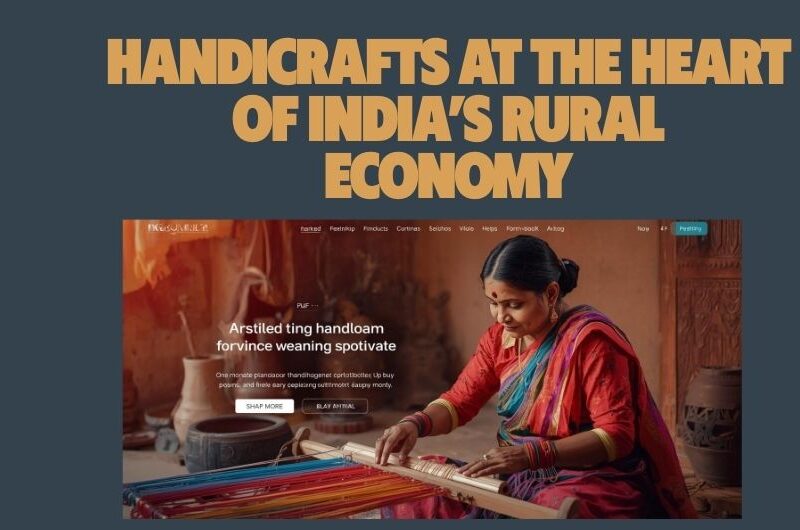
Handicrafts at the Heart of India’s Rural Economy
1. India’s handicrafts sector supports rural and semi-urban livelihoods through home-based and small-workshop production, combining low capital needs with value addition, flexible employment, and region-specific cultural skills across generations.
2. The sector includes around 455 formally classified craft categories and 318 Geographical Indication (GI)-tagged handicraft products, showing exceptional product diversity and strong identity value across Indian regions today nationally.
3. India had an estimated 64.66 lakh handloom and handicraft artisans by August 2025, making handicrafts one of the country’s largest decentralized non-farm livelihood systems in rural India today.
4. Women accounted for 64 percent of total artisans and 71 percent of handloom weavers as of August 2025, showing the sector’s major role in female economic participation nationally.
5. Over 32 lakh artisans had been registered under the Pehchan artisan identification programme by 2024, including nearly 20 lakh women, improving visibility for benefits and formal support access.
6. Handicraft exports excluding hand-knotted carpets reached ₹33,122.79 crore in 2024-25, up from ₹20,082.53 crore in 2014-15, indicating sustained expansion in overseas demand for Indian craft products over time.
7. The United States remained the biggest overseas market, taking around 37 percent of handicraft exports, while another 61 percent went to other major destinations across global retail channels.
8. In 2024-25, key export categories included woodwares at ₹8,524 crore, art metal wares at ₹4,386 crore, handprinted textiles at ₹3,217 crore, and embroidered goods at ₹4,350 crore respectively.
9. Handicrafts excluding handmade carpets recorded 29.7 percent growth in November 2025, outperforming several other textile segments and helping lift India’s broader textiles-and-apparel export performance during that month strongly.
10. The National Handicraft Development Programme (NHDP) carries an approved outlay of ₹837 crore for FY2022-26; in 2023-24, 2,325 sanctioned projects and events benefited more than 66,000 artisans across India.
11. Under NHDP in 2023-24, 786 domestic and international marketing events, 674 skilling events, and other interventions together benefited about 66,775 artisans through exhibitions, training, design and toolkit support.
12. The Comprehensive Handicrafts Cluster Development Scheme (CHCDS) has an outlay of ₹142.5 crore for FY2022-26, aimed at world-class infrastructure, productivity gains, and better export readiness in clusters for artisans.
13. India operates 67 Handicraft Service Centres under the Development Commissioner (Handicrafts) network, segmented across six regional offices, providing field-level support for training, design, and sector development to artisans.
14. The 2025 Indie Haat in New Delhi showcased 80 craft and handwoven product types, presented by 85 artisans and weavers from across the country in one curated event.
15. PM Vishwakarma Haat 2026 featured participation from more than 117 artisans representing all States and Union Territories, expanding market access and direct buyer visibility for traditional craft producers.
Must Know Terms :
1. Pehchan
Pehchan is an artisan identification programme used to register handicraft workers and improve their visibility within the formal support system. By 2024, more than 32 lakh artisans had been registered under it, including nearly 20 lakh women. Registration helps create a verified database for targeted welfare support, training, marketing access, and linkage with official schemes designed for artisan households.
2. NHDP
National Handicraft Development Programme (NHDP) is a major support framework for artisan development, marketing, training, design improvement, and infrastructure assistance. It carries an approved outlay of ₹837 crore for FY2022-26. In 2023-24, 2,325 sanctioned projects and events under this programme benefited more than 66,000 artisans. It also covered exhibitions, skill development, toolkit support, and design-oriented interventions.
3. CHCDS
Comprehensive Handicrafts Cluster Development Scheme (CHCDS) focuses on cluster-based strengthening of handicraft production through common infrastructure, productivity support, and export readiness. It has an outlay of ₹142.5 crore for FY2022-26. The scheme aims to improve artisan competitiveness without weakening craft identity. By working through clusters, it helps reduce transaction costs and supports better market preparedness, training access, and production quality.
4. GI
Geographical Indication (GI) is a formal recognition given to products linked to a specific place and known for distinct qualities, identity, or reputation. India has around 318 GI-tagged handicraft products. GI status increases identity value, supports regional branding, and helps protect the uniqueness of traditional craft goods from imitation. It also strengthens market recognition for products tied to local heritage.
5. Indie Haat
Indie Haat is a curated marketing and exhibition platform created to showcase Indian craft and handwoven products. In 2025, the New Delhi edition displayed 80 craft and handwoven product types presented by 85 artisans and weavers from across the country. Such events expand visibility, connect artisans with buyers, and create direct opportunities for market discovery beyond local retail channels and traditional fairs.
6. Handicraft Service Centres
Handicraft Service Centres are field-level institutional units that support artisans through training, design development, and sector assistance. India operates 67 such centres under the Development Commissioner (Handicrafts) network, divided across six regional offices. These centres act as decentralized support points for productivity improvement, craft promotion, and artisan capacity-building, helping translate policy support into direct technical and developmental assistance.’
Multiple Choice Questions
1. Which feature best distinguishes handicrafts from mechanically produced goods?
A) High capital investment
B) Predominant use of machines
C) Hand-based production with cultural and aesthetic value
D) Standardized mass production
2. India’s handicraft sector is characterized mainly by:
A) Capital-intensive factory systems
B) Labour-intensive and decentralized production
C) Complete dependence on urban markets
D) Exclusive export orientation
3. How many GI-tagged handicraft products are associated with India?
A) About 150
B) About 220
C) About 318
D) About 450
4. National Handicrafts Week is observed annually during:
A) January 1–7
B) August 15–21
C) December 8–14
D) October 2–8
5. The Shilp Guru Award is best described as:
A) A regional marketing incentive
B) A training certification
C) The highest honour in the handicrafts sector
D) An export-linked subsidy
6. Which group constitutes the largest share of artisans in the handicrafts sector?
A) Urban industrial workers
B) Women artisans
C) Foreign skilled workers
D) Corporate designers
7. Approximately how many handloom and handicraft artisans are estimated to be engaged in India?
A) 32 lakh
B) 45 lakh
C) 64.66 lakh
D) 90 lakh
8. The handicrafts sector supports rural livelihoods mainly by:
A) Replacing agricultural activity entirely
B) Providing seasonal and supplemental income
C) Promoting large-scale mechanization
D) Eliminating household-based work
9. The Pehchan Artisan Identification programme primarily aims to:
A) Promote exports directly
B) Register artisans for taxation
C) Formalize artisans and link them to welfare benefits
D) Replace traditional crafts
10. In 2024–25, handicraft exports excluding hand-knotted carpets reached approximately:
A) ₹18,000 crore
B) ₹25,000 crore
C) ₹33,122 crore
D) ₹45,000 crore
11. Which country accounts for the largest share of India’s handicraft exports?
A) United Kingdom
B) Germany
C) United States
D) Japan
12. The National Handicraft Development Programme primarily focuses on:
A) Import substitution only
B) End-to-end support for artisans and clusters
C) Automation of craft production
D) Export licensing reforms
13. Which initiative emphasizes transfer of traditional skills from master artisans to trainees?
A) Comprehensive Skill Upgradation Program
B) Improved Toolkit Distribution Program
C) Guru Shishya Hastshilp Prashikshan Program
D) Design and Technology Development Workshop
14. The Comprehensive Handicrafts Cluster Development Scheme aims to:
A) Centralize production in metro cities
B) Develop world-class infrastructure in craft clusters
C) Reduce the number of artisans
D) Eliminate SMEs from handicrafts
15. The One District One Product initiative supports handicrafts mainly by:
A) Promoting uniform national designs
B) Encouraging import of raw materials
C) Highlighting and marketing region-specific craft products
D) Shifting production to industrial estates



0 comment