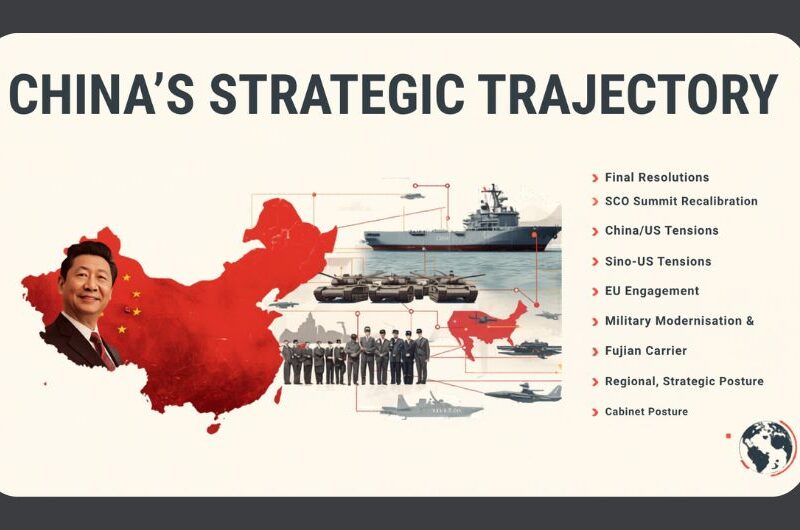
China’s Strategic Trajectory
- 1. In 2025, China recalibrated its foreign policy under Xi Jinping amid intensifying competition with the United States, transatlantic frictions, and a shifting regional security environment.2. China hosted the SCO Summit in Tianjin on 31 August–1 September 2025 and also participated in the BRICS Summit and the ASEAN–GCC–China Summit.3. Beijing strengthened its “no-limits” partnership with Russia in 2025 by deepening energy and defence cooperation and aligning diplomatically through platforms such as the SCO and BRICS.4. Sino–U.S. relations in 2025 were marked by tariff escalation, followed by a fragile truce at Busan in October that paused new Chinese controls on rare earths and supply-chain inputs.
5. China deepened engagement with the European Union in 2025 through joint green energy and infrastructure initiatives despite continuing frictions over technology and market access.
6. Cross-Strait tensions continued in 2025, with Beijing reaffirming peaceful “reunification” with Taiwan while signalling intent through symbolic political and policy measures.
7. The SCO Summit in Tianjin produced 20 major documents, including the Tianjin Declaration, the SCO Development Strategy 2026–2035, and reforms such as a development bank and security centres.
8. Laos joined the SCO framework as a new partner in 2025, while China also opened its BeiDou satellite system to member states.
9. India and China maintained diplomatic engagement in 2025 through the 24th Special Representatives’ meeting on 19 August and the 23rd Corps Commander-level dialogue on 25 October.
10. Direct flights between India and China resumed after five years on 26 October 2025, beginning with IndiGo’s Kolkata–Guangzhou service.
11. China increased its defence budget by 7.2 percent in 2025 and advanced military modernisation through the full operational deployment of the Fujian aircraft carrier.
12. China’s GDP growth slowed to around 4.8 percent in 2025, missing the official 5 percent target despite fiscal stimulus and continued export strength.
13. In October 2025, Beijing ratified its 15th Five-Year Plan for 2026–2030, focusing on technological self-reliance, domestic demand expansion, and high-quality development.
14. China deepened centralisation in 2025 through stronger party discipline, expanded surveillance, and anti-corruption purges in sectors such as finance, health, and local government.
15. For 2026, the IMF projected China’s GDP growth at around 4.2 percent, with continued pressure from property-sector distress, weak domestic consumption, and worsening global trade conditions.
Must Know Terms :
1.SCO
SCO stands for Shanghai Cooperation Organisation, a Eurasian multilateral grouping in which China played a prominent role in 2025 by hosting the summit at Tianjin on 31 August–1 September. The summit produced 20 major documents, including the Tianjin Declaration and the SCO Development Strategy 2026–2035. China also promoted institutional reforms such as a development bank, security centres, and SCO Plus expansion.
2.Fujian
Fujian is China’s aircraft carrier whose full operational deployment was highlighted in 2025 as part of Beijing’s continuing military modernisation. Its deployment reflects China’s push toward stronger blue-water naval capability, long-range power projection, and maritime deterrence. The carrier’s operationalisation occurred alongside a 7.2 percent rise in China’s defence budget and broader emphasis on missiles, drones, cyber warfare, and AI-enabled systems.
3.BeiDou
BeiDou is China’s satellite navigation system, comparable to other global navigation constellations, and in 2025 Beijing opened it to SCO member states. This move carried strategic significance because it expanded China’s technological influence across Eurasia while supporting navigation, positioning, timing, and geospatial applications. It also aligned with China’s larger effort to promote sovereign equality, multipolarity, and non-Western institutional alternatives through regional platforms.
4.NSSChina
NSSChina is best understood as a shorthand label for China’s broader strategic-security orientation in 2025 rather than a formally named document in the passage. This orientation centred on technological self-reliance, military modernisation, domestic political centralisation, maritime assertiveness, and strategic hedging abroad. It combined economic resilience, support for frontier technologies, stronger surveillance, and calibrated diplomacy to protect stability, sovereignty, and great-power influence in a changing world.
5.NoLimitsPartnership
NoLimitsPartnership refers to China’s deepening strategic partnership with Russia, which in 2025 continued through stronger energy cooperation, defence links, and diplomatic coordination in platforms such as BRICS and the SCO. The partnership reflected shared resistance to the Western-led order and closer alignment on major geopolitical questions. It also gave China added leverage in Eurasian politics while reinforcing Moscow during continued confrontation with the West.
6.TaiwanStrait
TaiwanStrait remained a major security flashpoint in 2025 as Beijing reaffirmed peaceful reunification with Taiwan while simultaneously increasing political signalling and strategic pressure. Cross-Strait tensions continued alongside China’s wider military modernisation and maritime assertiveness. The issue remained central to regional security calculations because any crisis there would affect Indo-Pacific stability, great-power rivalry, sea lanes, alliance politics, and broader Asian security architecture.
MCQ
1. In 2025, China recalibrated its foreign policy under Xi Jinping mainly amid:
A) declining ties with Russia and stable U.S. relations
B) intensifying competition with the United States and a shifting regional security environment
C) complete withdrawal from multilateral diplomacy
D) a major domestic constitutional crisis
2. The SCO Summit hosted by China in 2025 was held at:
A) Beijing
B) Shanghai
C) Tianjin
D) Shenzhen
3. China’s “no-limits” partnership in 2025 was strengthened primarily with:
A) Iran
B) Russia
C) Pakistan
D) North Korea
4. Sino–U.S. relations in 2025 were marked by tariff escalation followed by a fragile truce at:
A) Busan
B) Tianjin
C) Moscow
D) Geneva
5. In 2025, China deepened engagement with which of the following through joint green energy and infrastructure initiatives?
A) African Union
B) European Union
C) SAARC
D) Gulf Cooperation Council alone
6. Which of the following best describes Beijing’s stance on Taiwan in 2025?
A) It formally abandoned reunification
B) It recognised Taiwan as an independent state
C) It reaffirmed peaceful reunification while signalling intent through symbolic measures
D) It suspended all cross-Strait policy activity
7. The SCO Summit in Tianjin produced how many major documents?
A) 10
B) 15
C) 20
D) 25
8. Which country joined the SCO framework as a new partner in 2025?
A) Myanmar
B) Laos
C) Mongolia
D) Nepal
9. Direct flights between India and China resumed after five years on:
A) 19 August 2025
B) 25 October 2025
C) 26 October 2025
D) 31 August 2025
10. China increased its defence budget by what percentage in 2025?
A) 5.2 percent
B) 6.2 percent
C) 7.2 percent
D) 8.2 percent
11. The full operational deployment of which aircraft carrier was highlighted in 2025?
A) Liaoning
B) Shandong
C) Fujian
D) Type-004
12. China’s GDP growth in 2025 slowed to around:
A) 3.8 percent
B) 4.8 percent
C) 5.8 percent
D) 6.8 percent
13. Beijing ratified its 15th Five-Year Plan in October 2025 for the period:
A) 2025–2030
B) 2026–2030
C) 2026–2035
D) 2025–2035
14. For 2026, the IMF projected China’s GDP growth at around:
A) 3.2 percent
B) 4.2 percent
C) 5.2 percent
D) 6.2 percent
15. Which of the following was opened by China to SCO member states in 2025?
A) CIPS payment platform
B) Digital yuan retail network
C) Fujian naval support system
D) BeiDou satellite system




0 comment