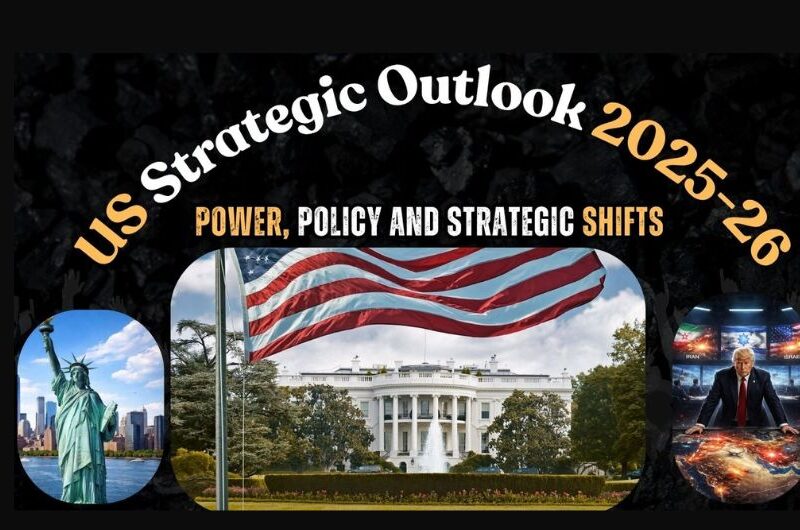
US Strategic Outlook 2025-26
1. In 2025, the return of President Donald J. Trump was marked by assertive governance, deep political polarisation, and extensive use of executive authority in domestic and foreign policy.
2. The Trump administration used executive orders to reshape institutions, including a directive to review historical narratives in national museums and restore monuments under a “truthful” history framework.
3. Congressional polarisation in the United States remained severe in 2025, reinforced by gerrymandering and geographic sorting, which reduced electoral competitiveness and made bipartisan compromise increasingly difficult.
4. Internal issues such as migration, narcotics, and violent crime were increasingly treated by the administration as national security matters, supported through federal deployments and emergency declarations.
5. Gallup polling in late 2025 showed that nearly half of Americans considered crime an extremely serious national problem, reinforcing the administration’s law-and-order narrative.
6. U.S. economic policy in 2025 balanced tariffs and subsidies for domestic industry against persistent inflation, while fiscal policy remained constrained by congressional gridlock and repeated stopgap measures.
7. Emerging technologies such as artificial intelligence, quantum computing, and critical infrastructure were increasingly viewed in the United States through a national security lens, leading to stronger investment and tighter regulation.
8. The United States continued Indo-Pacific engagement in 2025 through the Quad and bilateral partnerships, including the launch of the Quad Critical Minerals Initiative in July 2025.
9. Under Secretary of State Marco Rubio, the State Department was significantly downsized, losing more than 1,100 civil servants and hundreds of Foreign Service officers, including many working on Asia and multilateral affairs.
10. U.S. Defence Secretary Pete Hegseth described China as an “imminent” threat and urged Indo-Pacific allies to raise defence spending to 5 percent of GDP.
11. Washington increasingly used military tools against non-state actors and criminal networks, especially drug cartels in the Western Hemisphere, while maintaining maritime security operations in regions such as the Red Sea.
12. The U.S. National Security Strategy 2025 emphasised homeland security, technological and economic competitiveness, strategic engagement, and conditional burden-sharing from allies and partners.
13. Under this strategy, the Western Hemisphere was treated as a central security theatre, with U.S.–Venezuela tensions escalating from sanctions to coercive military measures including naval deployments and oil tanker interdictions.
14. For India, the U.S. commitment to the Indo-Pacific and the Quad, including the Critical Minerals partnership, created opportunities for deeper economic, strategic, and defence cooperation.
15. For 2026, Deloitte projected U.S. GDP growth at around 1.5 percent, with slowing growth, easing inflation, modestly higher unemployment, and continued uncertainty from tariffs and fiscal conditions.
Must Know Terms :
1.TrumpDoctrine
TrumpDoctrine in 2025 reflected a transactional, security-first, and increasingly nationalist approach to governance and foreign policy. It relied heavily on executive authority, prioritised homeland security, burden-sharing by allies, and issue-based economic leverage. Domestically, it linked migration, narcotics, and crime with national security. Internationally, it preferred tariffs, sanctions, and bilateral pressure over broad multilateral diplomacy and consensus-building processes globally.
2. QuadMinerals
Quad Critical Minerals Initiative was launched in July 2025 as part of the United States effort to deepen Indo-Pacific cooperation through the Quad. The initiative linked economic resilience with strategic competition by focusing on supply chains for rare earths and other critical minerals. It signalled a move toward industrial-security coordination among Quad members, with implications for technology, defence manufacturing, and trusted resource networks.
3. NSS2025
NSS2025 refers to the U.S. National Security Strategy 2025, which reoriented grand strategy toward homeland security, technological competitiveness, economic resilience, and selective strategic engagement. It promoted a doctrine of conditional hegemony by linking support to allied burden-sharing and alignment with American priorities. The strategy also elevated the Western Hemisphere as a central security theatre while continuing pressure on rivals and regional challengers.
4. BurdenSharing
BurdenSharing became a central element of U.S. security diplomacy in 2025, as Washington demanded greater defence contributions from allies and partners. Under this approach, support was increasingly tied to measurable commitments. NATO countries, under U.S. pressure, agreed to raise defence spending to 5 percent of GDP by 2035. The same logic also shaped U.S. expectations from Indo-Pacific allies in confronting security threats.
5. RubioRestructuring
RubioRestructuring refers to the State Department downsizing carried out under Secretary of State Marco Rubio in 2025. The department shed more than 1,100 civil servants and hundreds of Foreign Service officers, including many handling Asia and multilateral affairs. This restructuring reflected a shift toward great-power rivalry and technology competition, but critics argued that it weakened institutional capacity and America’s broader diplomatic image.
6. PeteHegseth
PeteHegseth, as U.S. Defence Secretary in 2025, described China as an imminent threat and called on Indo-Pacific allies to increase defence spending to 5 percent of GDP. His position reflected a stronger deterrence-oriented posture in American strategy. It also highlighted Washington’s expectation that allies should share more of the security burden amid rising great-power rivalry, especially in the Indo-Pacific strategic theatre.
MCQ
1. In 2025, the return of President Donald J. Trump in the United States was marked by:
A) reduced use of executive authority and broad bipartisan consensus
B) assertive governance, deep political polarisation, and extensive use of executive authority
C) complete withdrawal from foreign policy engagement
D) suspension of all major domestic policy initiatives
2. The Trump administration used executive orders in 2025 to:
A) abolish the Federal Reserve
B) end all museum funding
C) review historical narratives in national museums and restore monuments
D) dissolve Congress
3. Congressional polarisation in the United States in 2025 was reinforced by:
A) federalism and judicial review
B) gerrymandering and geographic sorting
C) universal proportional representation
D) decline of partisan media
4. Internal issues such as migration, narcotics, and violent crime were increasingly treated by the administration as:
A) social welfare issues only
B) state subjects with no federal role
C) national security matters
D) purely judicial matters
5. Gallup polling in late 2025 showed that nearly what share of Americans viewed crime as an extremely serious national problem?
A) one-fourth
B) one-third
C) nearly half
D) nearly three-fourths
6. In 2025, emerging technologies such as AI, quantum computing, and critical infrastructure were increasingly viewed in the United States through a:
A) cultural diplomacy lens
B) national security lens
C) humanitarian law lens only
D) public health lens
7. The Quad Critical Minerals Initiative was launched in:
A) January 2025
B) July 2025
C) September 2025
D) December 2025
8. Under Secretary of State Marco Rubio, the U.S. State Department in 2025:
A) expanded significantly in Asia-focused staff
B) was merged with the Pentagon
C) was significantly downsized, losing over 1,100 civil servants
D) shifted entirely to climate diplomacy
9. U.S. Defence Secretary Pete Hegseth described which country as an “imminent” threat?
A) Russia
B) Iran
C) North Korea
D) China
10. Pete Hegseth urged Indo-Pacific allies to raise defence spending to what level of GDP?
A) 3 percent
B) 4 percent
C) 5 percent
D) 6 percent
11. The U.S. National Security Strategy 2025 emphasised:
A) disarmament and non-alignment
B) homeland security, technological and economic competitiveness, and conditional burden-sharing
C) complete retreat from alliances
D) global welfare and climate-first diplomacy
12. Under NSS 2025, which region was treated as a central security theatre?
A) Western Hemisphere
B) East Africa
C) Central Asia
D) Arctic region
13. U.S.–Venezuela tensions under this strategy escalated from sanctions to:
A) trade liberalisation agreements
B) coercive military measures including naval deployments and oil tanker interdictions
C) a permanent military alliance
D) joint energy cooperation
14. For India, U.S. commitment to the Indo-Pacific and the Quad created opportunities for deeper:
A) agricultural and cultural federal integration
B) economic, strategic, and defence cooperation
C) immigration harmonisation only
D) monetary union arrangements
15. For 2026, Deloitte projected U.S. GDP growth at around:
A) 0.5 percent
B) 1.5 percent
C) 2.5 percent
D) 3.5 percent




0 comment