Best UPSC and MPPSC IAS Coaching Classes in Gwalior

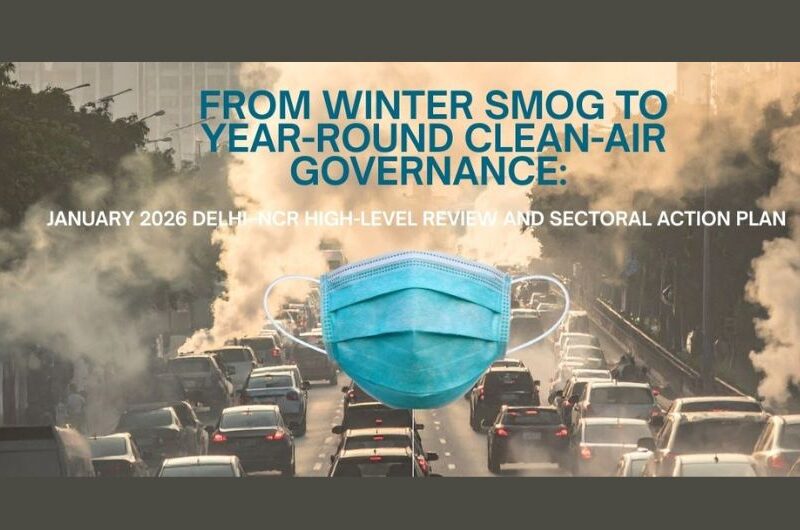
From Winter Smog to Year-Round Clean-Air Governance: January 2026 Delhi–NCR High-Level Review and Sectoral Action Plan

From Winter Smog to Year-Round Clean-Air Governance: January 2026 Delhi–NCR High-Level Review and Sectoral Action Plan 1. Delhi–NCR’s winter pollution remains extreme; on 28 December 2025, Delhi recorded “hazardous” air with AQI 530, highlighting repeated seasonal spikes and worsening multi-year deterioration trends. 2. Short-term controls have included GRAP (Graded Response Action Plan) and routine mist-spray systems on central road verges to suppress dust, yet overall ambient air quality has not improved to acceptable levels. 3. A high-level NCR air-pollution review was held on 12 January 2026, chaired by the Union Environment Minister, with Delhi’s Chief Minister and senior Union/Delhi officials. 4. A fresh scientific source-apportionment effort was announced to precisely identify pollution contributors, enabling targeted structural action instead of repeated emergency restrictions and scattered, short-duration interventions. 5. A reduction target was articulated: cut air pollution across the National Capital Region by 15–20% by end-2026, implying measurable outcomes across sectors and agencies. 6. The source-identification study began in January 2026, led by institutions including TERI (The Energy and Resources Institute), IIT Delhi, IITM (Indian Institute of Tropical Meteorology, Pune), and ARAI (Automotive Research Association of India) to generate updated datasets. 7. Vehicular emissions received priority; smart traffic management is planned at 62 identified congestion hotspots to reduce idling, stop–go movement, and concentrated emission build-up corridors. 8. Proposed transport enforcement includes strict action against polluting vehicles, a special registration drive, and expanded ANPR (Automatic Number Plate Recognition) systems for detection, compliance tracking, and penalties. 9. Demand-management options were also discussed, including staggered office timings, alongside strengthening public transport and last-mile connectivity to reduce reliance on private vehicles. 10. Industrial controls noted progress: 227 of 240 NCR industrial estates have shifted to PNG (Piped Natural Gas), yet unplanned industrial activity outside designated zones remains problematic. 11. Directions were issued for strict action against illegally operating and non-conforming industrial units, aiming to curb emissions from units bypassing fuel norms, siting rules, and compliance checks. 12. The Central Pollution Control Board issued notices to 88 units lacking OCEMS (Online Continuous Emission Monitoring Systems); closure actions were set to commence from 23 January 2026 for non-installation. 13. Road dust was treated as a core contributor: end-to-end paving and mission-mode plantation of local shrub varieties were emphasized, involving youth groups and civic bodies. 14. Over 3,300 km of Delhi roads are planned for redevelopment within the coming year, with dust-control measures and traffic management integrated into execution and monitoring frameworks. 15. Construction and demolition waste controls were stressed: designate C&D waste sites, halt demolition during peak pollution periods, and partner with recycling associations to reduce open dumping. Must Know Terms :   1.#SourceApportionmentStudy Delhi PM2.5 source split (IIT-Kanpur study cited in public summaries): road dust 38%, vehicular 20%, domestic 12%, industrial 11%, concrete batching 6%, hotels/restaurants 3%, MSW burning 3%, diesel gensets 2%, industrial-area sources 2%, and cremation/aircraft/medical incinerators 1% each. Same study’s Delhi PM10 split (widely cited): road dust 56%, vehicular 9% (other shares distributed across construction, industry, biomass/garbage burning, etc.). These percentages are used as “receptor-model” style outputs: they convert measured chemical fingerprints in PM into source contributions. 2.#CongestionHotspotMapping City traffic choke-point identification (Delhi official statement reported by PTI): 233 traffic choke points identified; 123 of these fall under PWD. Hotspot mapping (pollution-source mapping at priority locations): 13 hotspots mapped with 57 distinct pollution sources identified; Mundka and Anand Vihar recorded 7 sources each in that mapping. A later Delhi government update reported identification of 62 hotspots for PM10-focused actions (dusty roads, construction activity, and traffic congestion flagged as dominant drivers). 3.#ANPREnforcement ANPR-led enforcement was linked with a sharp jump in PUC e-challans: ~163,000 PUC challans issued in 2025 (till late July), versus 68,000 in all of 2024; 43,500 in 2022; and 36,000 in 2021. GRAP enforcement snapshot (late Dec 2025): 1,114 challans generated via ANPR cameras during a focused enforcement drive; 2,500+ vehicles penalised for PUC-related violations over two days; 28 PUC centres suspended in the same action window. 4.#OCEMSCompliance OCEMS = real-time stack emission monitoring connected to the central server for continuous tracking of key pollutants. Compliance gap figure reported by CPCB leadership (Delhi–NCR): 2,254 “highly polluting” industries had not installed and connected OCEMS to the CPCB server at the time of the statement. Deadline-based direction reported for Delhi–NCR red-category units: installation of OCEMS and surveillance/PTZ cameras to be ensured by end-2025 in specified sectors (food/food processing, textiles, metal processing). 5.#MechanisedRoadSweeping Identified road-length target (Delhi compiled multi-agency data, Feb 2024): 7,964.69 km of roads identified for mechanised sweeping per day. Actual mechanised sweeping achieved (same dataset): 3,055.7 km/day on average → 38.37% of identified daily road-length. Planning norm cited in enforcement meetings: approximately 1 sweeping machine per 40 km to close the coverage gap. 6.#CNDWasteRecycling Processing capacity and plant count (Delhi civic system, reported figures): 5 C&D waste processing plants (Burari, Rani Khera, Shastri Park, Bakkarwala, Okhla) with combined capacity reported at ~5,500 tonnes/day. Plant-wise capacities reported in Delhi news records: Burari 2,000 TPD; Bakkarwala 1,000 TPD; Shastri Park 1,000 TPD; Rani Khera reported around 1,000–1,500 TPD in different updates. Daily generation benchmark often used for Delhi: ~5,500–6,000 tonnes/day of C&D waste, implying near-full utilisation is required to avoid open dumping and secondary dust.   MCQ: 1. Delhi experienced “hazardous” air quality with an AQI of 530 on: A) January 12, 2026 B) December 28, 2025 C) January 23, 2026 D) February 6, 2023 2. The high-level review meeting on Delhi–NCR air pollution was chaired by: A) Shri Kirti Vardhan Singh B) Shri Bhupender Yadav C) Shri Manjinder Singh Sirsa D) Smt. Rekha Gupta 3. The meeting took place on: A) Monday, January 12, 2026 B) Monday, January 23, 2026 C) Monday, December 28, 2025 D) Monday, October 12, 2024 4. The stated target to curb air pollution in the NCR by end-2026 is: A) 5–10% B) 10–12% C) 15–20% D) 25–30% 5. The new scientific study to pinpoint sources of pollution was initiated from: A) October 2024 B) January 2026 C) December 2025 D) March 2026 6. Which of the following

More Details
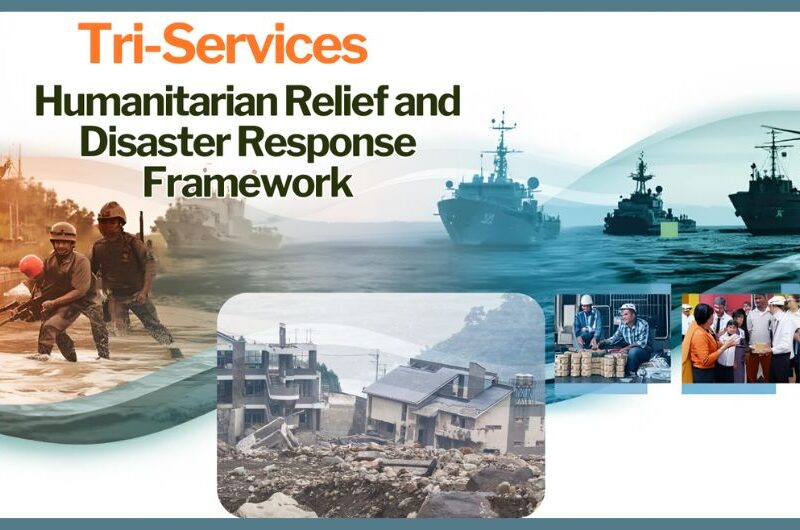
Tri-Services Humanitarian Relief and Disaster Response Framework

Tri-Services Humanitarian Relief and Disaster Response Framework   1. Indian Armed Forces safeguard sovereignty yet also act as first responders, delivering humanitarian, medical, and disaster relief, augmenting civilian capacities during major emergencies across India and partner countries. 2. The 2004 Indian Ocean tsunami was a watershed for India’s HADR, requiring tri-services coordination; Army, Navy, Air Force, and Coast Guard mobilised manpower, equipment, and logistics across land, sea, and air. 3. During Operation Seawave on 26 December 2004, the IAF launched search-and-rescue missions with Mi-8 helicopters from Car Nicobar, sustaining intensive Andaman operations using IL-76, AN-32, HS-748 aircraft, and helicopters. 4. After the tsunami, about 20,900 personnel were deployed; 40 naval/coast guard ships, 34 aircraft, and 42 helicopters participated; 28,734 people were rescued on the mainland, and over 6,000 stranded persons were evacuated from islands. 5. Operation Castor aided Maldives after the tsunami: INS Mysore, INS Udaygiri, and INS Aditya sailed to Malé with helicopters, water purification plants, medical teams, supplies, and relief equipment. 6. Operation Rainbow assisted Sri Lanka after the tsunami: a Dornier aircraft delivered a medical team and 600 kg of supplies to Colombo on 26 December; naval vessels reached Galle and Trincomalee on 27 December. 7. The Disaster Management Act, 2005 governs domestic response through NDMA, SDMAs, and DDMAs; states hold primary responsibility while the Centre provides support; the NCMC under the Cabinet Secretary oversees command, control, and coordination. 8. International HADR policy follows the Prime Minister’s 10-point DRR agenda (Agenda 10); NDMA issued International HADR Guidelines in October 2024, stressing sovereignty, transparency, accountability, ethics, and inclusivity as operational principles. 9. The MEA is the nodal ministry for overseas HADR; its Rapid Response Cell, established in 2021, coordinates with NDMA, NDRF, Armed Forces, and the Airports Authority, enabling faster diplomatic and logistics integration. 10. The MHA operates a 24×7 Integrated Control Room for Emergency Response, coordinating with NDRF, NDMA, and MEA for HADR activities; NDMA manages central control room operations and mission coordination nationwide. 11. Operation Samudra Setu began on 5 May 2020; over about 55 days, the Indian Navy repatriated 3,992 citizens by sea using INS Jalashwa, Airavat, Shardul, and Magar, covering around 23,000 km. 12. Operation Ganga during the Ukraine conflict (Feb–Mar 2022) evacuated 18,282 citizens through 90 flights, including 76 commercial and 14 IAF flights, with government funding ensuring zero evacuation cost. 13. Operation Dost responded to the 6 February 2023 Türkiye–Syria earthquake; India sent over 250 personnel and more than 135 tonnes of aid on five C-17 aircraft, and established an army field hospital at Iskenderun with specialist teams. 14. Operation Brahma, after the 28 March 2025 Myanmar earthquake, delivered around 750 tonnes of aid; a field hospital treated over 2,500 patients; six aircraft and five naval ships transported relief material. 15. Operation Sagar Bandhu was launched on 28 November 2025 after Cyclone Ditwah in Sri Lanka; it delivered 1,058 tonnes of relief, evacuated 264 people by Mi-17 helicopters, and opened a Bailey Bridge on 23 December. Must Know Terms :   1.Humanitarian Assistance and Disaster Relief (HADR) HADR: Relief support activated when civilian capacity is strained, focused on life-saving assistance, evacuation, medical care, logistics, and restoration of essential services. Overseas assistance is routed through the Ministry of External Affairs, which receives the request and coordinates with national disaster-management authorities, armed forces, civil aviation and port/airport operators. The Home Ministry maintains a 24×7 emergency control-room mechanism for coordination with national response forces and state administrations. Standard military contributions include airlift/medevac (Air Force), sealift and offshore evacuation (Navy), engineering and medical units (Army), and maritime search-and-rescue (Coast Guard). During Cyclone Fani (May 2019), deployment figures included 19 Army columns, 09 Engineering Task Force, 27 aircraft/helicopters, and 16 armed forces ships for relief and rescue operations. 2.Operation Seawave (2004) Operation Seawave: India’s large tri-services response after the Indian Ocean tsunami of 26 December 2004, covering mainland support, Andaman & Nicobar operations, and external assistance. Immediate search-and-rescue began on 26 December 2004 with Mi-8 helicopters operating from Car Nicobar airfield, followed by sustained air effort using IL-76, AN-32, HS-748 aircraft and multiple helicopter types for relief airlift, evacuation, and reconnaissance. The overall response scale is recorded as around 20,900 personnel mobilised, with 40 naval/coast-guard ships, 34 aircraft, and 42 helicopters. Recorded outcomes include 28,734 persons rescued on the mainland, more than 6,000 stranded people moved from Andaman & Nicobar to the mainland, and about 6.36 lakh people shifted to safer locations and housed in 930 relief camps. Regional assistance included Maldives support (ships arriving 28–30 December 2004) and Sri Lanka support with medical teams and supplies delivered starting 26 December 2004, and ships reaching Galle and Trincomalee on 27 December 2004. 3.Disaster Management Act, 2005 Disaster Management Act, 2005: The legal basis for India’s disaster governance architecture at national, state, and district levels. NDMA was constituted by executive order on 30 May 2005 and later notified under Section 3(1) on 27 September 2006. The National Executive Committee is constituted under Section 8, chaired by the Union Home Secretary, with secretary-level members from key ministries and the Chief of Integrated Defence Staff as an ex-officio member. The National Disaster Response Force is constituted under Section 44; the current structure is 16 battalions, each with 1,149 personnel. The National Disaster Response Fund is constituted under Section 46 to supplement State Disaster Response Funds in disasters of severe nature when state resources are inadequate. SDRF is constituted under Section 48(1)(a); states may use up to 10% of SDRF for local disasters not in the notified list, subject to state norms and approvals. 4.National Crisis Management Committee (NCMC) NCMC: The highest-level crisis coordination body chaired by the Cabinet Secretary for major disasters with serious or national ramifications. It coordinates inter-ministerial actions, reviews resource mobilisation, and issues directions for national-level response execution. Statutory recognition for this crisis coordination mechanism was formalised through amendments notified to take effect on 9 April 2025, embedding it more clearly within the national disaster-management legal framework. 5.Rapid Response Cell (RRC) Rapid Response Cell (RRC): An

More Details

Weaving Growth: Budget 2026–27 and India’s Textile Value Chain

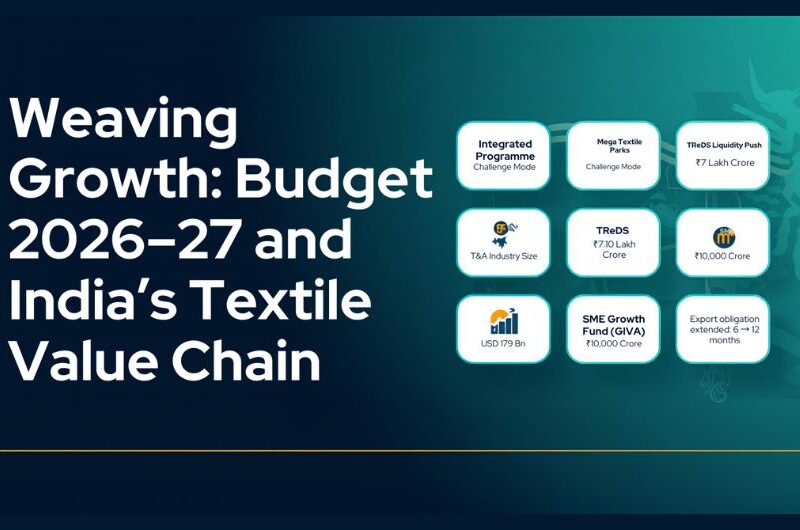
Weaving Growth: Budget 2026–27 and India’s Textile Value Chain   1. Union Budget 2026–27 places textiles at the centre of growth, prioritising jobs, exports, rural livelihoods, and sustainable manufacturing, with integrated policy focus from fibre production to fashion markets. 2. India’s fibre strengths include largest cotton acreage, largest jute output, second-largest silk and cotton production, major MMF hub, and second-largest polyester and viscose fibre production worldwide among nations. 3. An Integrated Programme is proposed to bolster the textile value chain, organised into five components spanning fibre self-reliance, cluster modernisation, artisan support, sustainability compliance, and skilling upgrades nationwide. 4. National Fibre Scheme supports silk, wool, jute, man-made fibres, and new-age fibres, aiming to diversify beyond cotton, spur advanced material innovation, and reduce import dependence for specialised textiles. 5. Textile Expansion and Employment Scheme modernises traditional clusters, providing capital for machinery and technology upgrades, plus common testing and certification centres, to raise productivity, quality compliance, and employment. 6. National Handloom and Handicraft Programme merges existing schemes to improve artisan incomes and market linkages, while supporting natural and vegetable dyes and dye houses via clusters and infrastructure. 7. Tex-Eco Initiative promotes globally competitive, environmentally sustainable textiles and apparel manufacturing, aligning production with international sustainability standards and enabling access to emerging green markets and responsible sourcing requirements. 8. Samarth 2.0 upgrades the skilling framework through deeper collaboration with industry and academic institutions, aiming to supply industry-ready manpower across spinning, weaving, processing, garmenting, and allied services nationwide. 9. Mega Textile Parks will be set up in challenge mode, offering infrastructure and efficiencies, promoting value addition, and supporting technical textiles for industrial, medical, defence, and infrastructure uses. 10. Mahatma Gandhi Gram Swaraj Initiative strengthens khadi, handloom, and handicrafts via branding, market linkages, training, skilling, quality improvement, and process modernisation, benefiting weavers, village industries, youth, and ODOP. 11. Export obligation period is extended from six to twelve months for exporters using duty-free inputs in textile garments and leather goods, improving compliance flexibility and working-capital management overall. 12. TReDS is an electronic platform for financing and discounting MSME trade receivables through multiple financiers, against dues from corporates, government departments, and PSUs, including other buyers across markets. 13. Liquidity push targets textile MSMEs by mandating CPSE procurement invoices on TReDS, providing CGTMSE credit guarantees for invoice discounting, and linking GeM with TReDS for faster, cheaper finance. 14. TReDS receivables will be introduced as asset-backed securities, encouraging secondary-market participation and improving liquidity, which can widen financier interest and smooth credit flow to MSMEs during demand fluctuations. 15. Indian textile and apparel industry is estimated at USD 179 billion, contributes about 2% of GDP, around 11% of manufacturing GVA, and 8.63% of exports in the economy. Must Know terms : 1) Integrated Programme for Textile Sector (Union Budget 2026–27) — Announced as an integrated policy framework for the labour-intensive textile sector, covering value chain “fibre to fashion” and “village industries to global markets”. Built as an umbrella with 5 sub-parts: National Fibre Scheme; Textile Expansion & Employment Scheme; National Handloom & Handicraft Programme; Tex-Eco Initiative; Samarth 2.0. Stated policy objectives: competitiveness + self-reliance + employment generation. Sector context often quoted in govt briefs: textiles & apparel ~2% of GDP; ~11% of manufacturing GVA; direct employment “more than 45 million”. Export context used in official notes: textiles & apparel (incl. handicrafts) 8.63% of India’s merchandise exports in 2024–25; value about USD 37.7 billion. 2) National Fibre Scheme (Budget 2026–27) — Explicit fibre coverage listed: natural fibres (silk, wool, jute) + man-made fibres (MMF) + “new-age fibres”. Core framing: “self-reliance across the fibre spectrum” and strengthening domestic fibre availability. Intended outcomes: reduce import dependence; diversify beyond cotton; support innovation in advanced textile materials. scheme is not cotton-only; it is positioned as diversification + high-performance/specialised textiles capability building. Linkage: it sits inside the 5-part Integrated Programme for Textile Sector (not a standalone unrelated scheme). 3) Textile Expansion and Employment Scheme (Budget 2026–27) — Designed specifically for modernising “traditional clusters” (cluster-focused, not single-factory only). Support types mentioned: capital support for machinery + technology upgradation. Also includes: “common testing and certification centres” (standards/compliance infrastructure). Stated intention: employment-intensive push—modernisation tied with job creation and competitiveness. Lcombines (i) capex support + (ii) shared testing/certification—both appear together in the scheme description. 4) National Handloom and Handicraft Programme (Budget 2026–27) — Announced to “integrate and strengthen existing schemes” (consolidation/umbrella approach). Target group clearly stated: weavers and artisans (handloom + handicraft ecosystem). Design idea: targeted support with better coherence (less fragmentation across multiple schemes). Positioning within Budget: part of the same 5-part textile integrated programme (not separate from it). Question-worthy distinction: this is about integrating schemes + ensuring targeted support; not described as machinery capex or fibre R&D. 5) Tex-Eco Initiative (Budget 2026–27) — Purpose line: promote “globally competitive and sustainable textiles and apparels”. Sustainability is framed as competitiveness enabler (export-market readiness + sustainable manufacturing). Included as the 4th sub-part inside the 5-part Integrated Programme. name suggests ecology; official wording ties it directly to sustainable textiles + global competitiveness (not only pollution control). Differentiator vs other sub-parts: focuses on sustainability + competitiveness, whereas “Expansion & Employment” focuses on clusters/capex/testing. 6) TReDS (Trade Receivables Discounting System) — RBI definition: an electronic platform to facilitate financing/discounting of MSME trade receivables through multiple financiers. Receivables can be due from: corporates and other buyers including Government Departments and PSUs. Key participants (RBI framing): MSME sellers, buyers, and financiers (banks/NBFC-Factors/other RBI-permitted institutions). Legal/regulatory base commonly cited: operated under RBI framework for payment systems (PSS Act, 2007 referenced in RBI-guideline explainers). invoice/bill is uploaded by MSME → buyer acceptance → financiers bid/discount → MSME gets early payment. Platform ecosystem (SIDBI page): TReDS platforms include RXIL; the other two platforms are M1xchange and Invoicemart. Key Takeaways a.The Union Budget 2026-27places Textiles at the centre of growth strategy with focus on employment, exports, rural livelihoods and sustainable manufacturing. b.Push for scale and modern manufacturingthrough mega textile parks and support for MMF and technical textiles. c.MSMEs and artisans supportedthrough liquidity measures, cluster modernisation and skilling initiatives. d.Policy direction emphasises scale, sustainability

More Details

Bangladesh–Pakistan Relations, Ideological Shifts, and Security–Economy Risks

Bangladesh–Pakistan Relations, Ideological Shifts, and Security–Economy Risks   1. In 1974, Bangladesh and Pakistan established diplomatic relations under Sheikh Mujibur Rahman, despite discomfort among liberation supporters and war survivors, prioritising state interests, recognition, and stability. 2. From 1974 through 2025, relations persisted despite political upheavals; the Awami League governed roughly two decades, yet ties were never severed, indicating institutional continuity in Dhaka. 3. After Mujib’s assassination, Pakistan gained strategic benefit as orientations shifted; pro-Pakistan segments inside Bangladesh became more confident, and engagement rose when political Islam and anti-India narratives strengthened. 4. Official diplomacy maintained embassies, visas, and formal channels, but broad social trust remained limited, as 1971 memories stayed politically sensitive and symbolically charged across generations and institutions. 5. Pakistan avoided sustained outreach to Bangladesh’s progressive mainstream; cultural soft power like music, literature, and theatre was rarely leveraged, leaving engagement dominated by politics and symbolism. 6. Cricket became a high-visibility influence channel, especially during India–Pakistan fixtures, amplifying emotional mobilisation and sometimes sharpening anti-India sentiment within media discourse beyond conventional diplomatic messaging. 7. Legal travel to Pakistan can trigger future visa scrutiny elsewhere, discouraging students and professionals; reduced mainstream travel allows politically motivated networks to dominate cross-border contacts and narratives. 8. Concerns persist about clandestine financing via informal transfers, intermediaries, and smuggling corridors; early destabilisation tactics reportedly used ultra-left violence when overt religious militancy lacked domestic space. 9. From the 1980s onward, fundamentalist organisations increased visibility and external linkages; after 2024 upheavals, closer engagement coincided with stronger Islamist political influence in interim arrangements. 10. Bangladesh’s traditional Muslim practice blended Sufi devotion and riverine culture; Jamaat ideology draws on Maududi’s political Islam, prioritising state-centric order over plural social traditions. 11. Empowerment of hardline actors can pressure mainstream Muslims, minorities, and cultural practitioners; reports of attacks on temples and shrines signal contestation over heritage, freedom, and communal security. 12. Multiple militant organisations are reported operating in Bangladesh; leadership nodes in Pakistan enable training linkages and ideological diffusion across South Asian militant ecosystems over time. 13. Instability interacts negatively with investment confidence: growth slowed from about six percent to under four; FDI retreats, buyers reduce orders, and firms pivot toward trading over manufacturing. 14. Security spending can crowd out welfare, health, and education; border insecurity can trigger arms-spiral dynamics, while Teknaf disruptions and Rohingya camp violence heighten recruitment vulnerability. 15. Myanmar frontiers, coastal smuggling, Sundarbans policing challenges, and Hill Tracts fragility can compound risk; durable stability needs balanced diplomacy, pluralism, border management, and economic confidence.   Must Know Terms : 1.Normalisation and Institutional Continuity Normalisation and Institutional Continuity: “Normalisation” is the shift from ad-hoc, personality-driven rule to routine, rules-based governance where institutions keep functioning across leadership changes. A widely used cross-country proxy is the World Bank’s Worldwide Governance Indicators (WGI), published annually since 1996 and covering 200+ economies through 2024. WGI aggregates 35 data sources into six comparable dimensions (Voice & Accountability, Political Stability, Government Effectiveness, Regulatory Quality, Rule of Law, Control of Corruption), allowing continuity to be tracked year-on-year. 2.Soft Power and Selective Appeal Soft Power and Selective Appeal: Soft power is the ability to secure preferred outcomes through attraction rather than coercion or payment. Quantification is now routine: Brand Finance’s Global Soft Power Index 2025 measures all 193 UN member states via public perception scoring. In 2025, the United States ranked #1 with an overall score of 79.5/100; China ranked #2 with 72.8/100; the UK ranked #3. “Selective appeal” means a state’s attractiveness is not uniform—scores can mask sharp differences by audience, region, or issue-pillar. 3.Informal Finance and Covert Networks Informal Finance and Covert Networks: Informal value transfer systems (IVTS) like hawala move value without conventional bank settlement, often using brokers and netting across locations. The IMF and World Bank have documented hawala as a major informal funds-transfer channel, particularly in the Middle East and South Asia, and a policy focus post-9/11 due to misuse risks. FATF typologies classify “hawala and similar service providers” and document how weak licensing/registration, thin records, and limited suspicious-transaction reporting make them vulnerable to money laundering and terrorist financing when unregulated or complicit. 4.Maududism and Political Islam Maududism and Political Islam: Maududism refers to the political thought associated with Mawlana Abul A‘la Mawdudi (1903–1979), who founded Jamaʿat-i Islami in 1941. Britannica notes his core political project was reforming society toward an Islamic political system and influencing Pakistan’s constitutional direction after 1947. His writings popularised modern Islamist vocabulary around God’s sovereignty as the source of law, an Islamic state as an organising principle, and party-based cadre mobilisation for societal Islamisation through education, organisation, and politics. 5.Investment Confidence and Manufacturing Horizon Investment Confidence and Manufacturing Horizon: A hard metric for forward-looking investor intent is the Kearney FDI Confidence Index (FDICI), which ranks markets likely to attract the most FDI over the next three years. The 2025 FDICI is based on a proprietary survey of 536 senior executives (surveyed January 2025), all from firms with US$500 million+ annual revenues, headquartered in 30 countries across sectors. “Manufacturing horizon” in practice reflects this planning window: capex decisions lock in supply-chain geography, permitting, and workforce ramp-up typically over multi-year (often 2–5 year) cycles. 6.Border-Security Spillovers Border-Security Spillovers: Cross-border security shocks routinely spill into refugee flows, smuggling corridors, and fiscal/administrative stress in neighbouring states. UNHCR reports that by end-2024, 123.2 million people were forcibly displaced worldwide; reported refugees total 42.7 million. These displacement magnitudes become border-security variables: screening capacity, camp logistics, policing of trafficking networks, and management of grey-zone flows (cash, fuel, arms, narcotics) along frontier districts, especially when conflicts persist without political settlement. MCQ   1. Bangladesh and Pakistan established diplomatic relations in: (a) 1965 (b) 1971 (c) 1974 (d) 1985 2. The text states relations persisted from 1974 through: (a) 2010 (b) 2015 (c) 2020 (d) 2025 3. Cricket is described as influencing sentiment mainly during: (a) Bangladesh–Sri Lanka fixtures (b) India–Pakistan fixtures (c) Australia–England fixtures (d) IPL auctions 4. Legal travel to Pakistan may discourage mainstream travel because it can: (a) Lower fuel prices (b) Trigger future visa scrutiny elsewhere

More Details

Big-Cat Conservation as Climate Resilience: Integrated Governance, Technology, and Community Stewardship

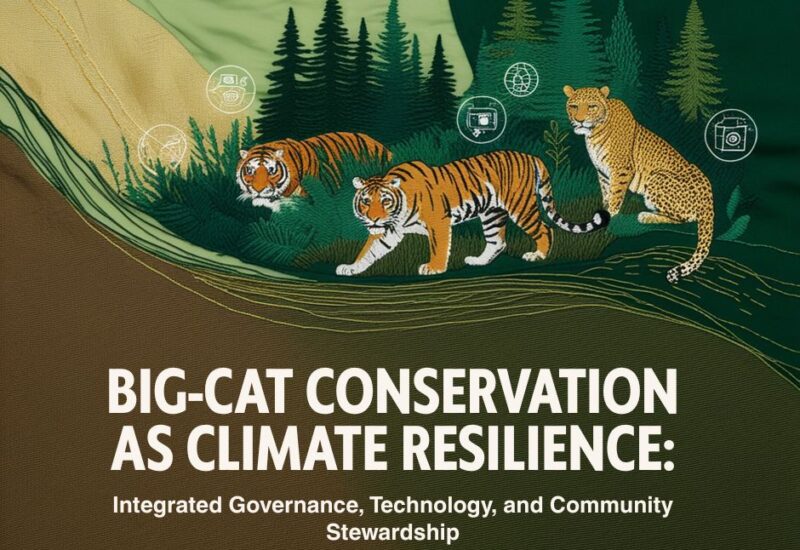
Big-Cat Conservation as Climate Resilience: Integrated Governance, Technology, and Community Stewardship     1. Climate action is described as increasingly linking conservation, technology, and diplomacy into a holistic governance approach, reducing fragmented planning and improving coherence across sectors and landscapes. 2. Biodiversity protection is treated as a climate instrument, aligning habitat security with mitigation, adaptation, and long-term resilience, supported by statutory protections for continuity beyond political cycles. 3. Conservation frames ecosystems as living assets, emphasising stewardship and interdependence; climate and biodiversity positions prioritise ecological integrity beyond narrow human welfare measures alone. 4. Biodiversity goals reinforce climate commitments by protecting carbon sinks, stabilising hydrology, and reducing vulnerability to extremes, positioning conservation as risk management against floods, droughts, and heat. 5. Climate strategies aim for integrated outcomes—emissions reduction, biodiversity health, water security, and livelihoods—supported by coordinated monitoring, enforcement, research, and policy screening across institutions. 6. A big-cat conservation alliance is described as an international platform to protect flagship species while strengthening wider habitat and biodiversity outcomes across multiple landscapes and governance contexts. 7. The framework focuses on seven major big cats, using their ecological roles to anchor protection of forests, grasslands, mountains, and river catchments through shared responsibility and cooperation. 8. Protecting apex predator landscapes safeguards entire food webs; predators regulate herbivore pressure, enabling regeneration and preserving vegetation that supports carbon storage and ecosystem stability. 9. Protected habitats deliver ecosystem services including microclimate stability, soil retention, moisture conservation, reduced erosion and landslide risks, and stronger catchment protection for water security. 10. Mountain predators serve as indicators of high-altitude ecosystem stability; declines can signal warming impacts, habitat shrinkage, and downstream hydrological disruption affecting seasonal river flows. 11. Conservation supports long-term social and economic value via regulated climates, reduced disaster impacts, and protection of genetic resources that can strengthen future food security under climate stress. 12. Protected landscape expansion includes inviolate core zones, buffers for managed use and coexistence, and corridors that maintain genetic exchange and reduce fragmentation under climate-driven shifts. 13. Conservation planning extends beyond park boundaries to farms, rivers, grasslands, and meadows; infrastructure in sensitive zones requires mitigation to reduce mortality and ecological disruption. 14. Wildlife-friendly infrastructure uses underpasses and overpasses to maintain connectivity while preserving traffic efficiency; large mitigation structures are described as demonstration sites for compatibility. 15. Modern conservation systems use camera traps, statistical models, AI image processing, satellite tracking, thermal surveillance, GIS mapping, and app-based smart patrols, anchored by community benefits and stewardship. Must Know Terms : 1.Conservation–Climate Integration Conservation–Climate Integration: The evidence base treats biodiversity protection as a climate tool and climate action as a biodiversity tool. IPCC AR6 WGII states safeguarding biodiversity and ecosystems is fundamental to climate-resilient development. The Kunming–Montreal Global Biodiversity Framework sets a quantified 2030 conservation benchmark: at least 30% of terrestrial, inland water, and coastal/marine areas to be effectively conserved through “well-connected” and equitably governed systems, integrated into wider landscapes. 2.Big-Cat Alliance Framework Big-Cat Alliance Framework: India’s International Big Cat Alliance (IBCA) is framed around conservation of seven big cats: Tiger, Lion, Leopard, Snow Leopard, Puma, Jaguar, and Cheetah. The platform logic is cross-border: shared best practices, capacity building, and coordinated actions against habitat loss, poaching, and illegal wildlife trade across range states, with a single umbrella for multiple flagship big-cat programmes rather than species-wise silos. 3.Apex Predators and Trophic Balance Apex Predators and Trophic Balance: Large carnivores regulate prey and mesopredators, stabilising food webs via direct predation and “fear effects.” A landmark Science review documents cascading ecosystem changes after predator guild loss, including shifts in pollinators, seed dispersers, herbivory pressure, woody recruitment, bird abundance, and even soil carbon/nitrogen ratios (example case: Lago Guri islands after fragmentation). In Indian landscapes, tiger recovery metrics also reflect top-predator status—All India Tiger Estimation 2022 reports a minimum of 3,167 tigers. 4.Corridors and Connectivity Corridors and Connectivity: Connectivity is operationalised as mapped movement linkages between source populations to reduce isolation and enable dispersal. Government reporting states NTCA and WII mapped 32 major tiger corridors at macro/landscape scale, with management interventions operationalised through Tiger Conservation Plans mandated under Section 38V of the Wildlife (Protection) Act, 1972. Corridor thinking is now integrated into land-use screening, mitigation siting, and conflict-response planning around source areas. 5.Wildlife-Compatible Infrastructure Mitigation Wildlife-Compatible Infrastructure Mitigation: The highest-evidence package is crossing structures plus exclusion fencing. A synthesis reports ~86% reduction in reported wildlife-vehicle collisions when crossings are paired with adequate fencing. A frequently cited real-world example is Banff National Park: along a 23-km highway section, crossing structures plus fencing reduced wildlife collisions by ~80% overall and by ~96% for common large ungulates (deer/elk), demonstrating measurable safety and conservation returns. 6.Tech-Enabled Monitoring and Smart Patrols Tech-Enabled Monitoring and Smart Patrols: India’s core protected-area field platform is M-STrIPES (Monitoring System for Tigers – Intensive Protection and Ecological Status). Technical stack reported by WII: GPS + GPRS + remote sensing for field data capture, database creation, GIS/statistical analysis, and patrol-route mapping to tighten spatial coverage and response. The governance intent is measurable: digitised patrol effort, geo-tagged observations, and faster detection of threats (signs, camps, snares, wildlife crime indicators) for action by reserve management.   MCQ   1. The passage frames biodiversity protection primarily as: (a) Separate from climate policy (b) A climate instrument supporting mitigation and adaptation (c) Only a tourism strategy (d) Only a legal compliance issue 2. Conservation is positioned as risk management because it lowers exposure to: (a) Only earthquakes (b) Floods, droughts, heat stress, and ecological collapse (c) Only market volatility (d) Only urban congestion 3. The alliance framework described focuses on: (a) Three large herbivores (b) Seven major big cats (c) Ten marine mammals (d) Five migratory birds 4. Protecting apex predator landscapes is described as safeguarding: (a) Only single-species outcomes (b) Whole food webs and ecosystems (c) Only hunting revenues (d) Only urban parks 5. Predators contribute to trophic balance mainly by: (a) Increasing overgrazing (b) Regulating herbivore numbers and enabling regeneration (c) Eliminating vegetation (d) Replacing soil organisms 6. Protected habitats are described as supporting water security mainly through: (a) Removing

More Details

India’s Climate Diplomacy: Coalition Leadership Across Solar, Resilience, and Biofuels

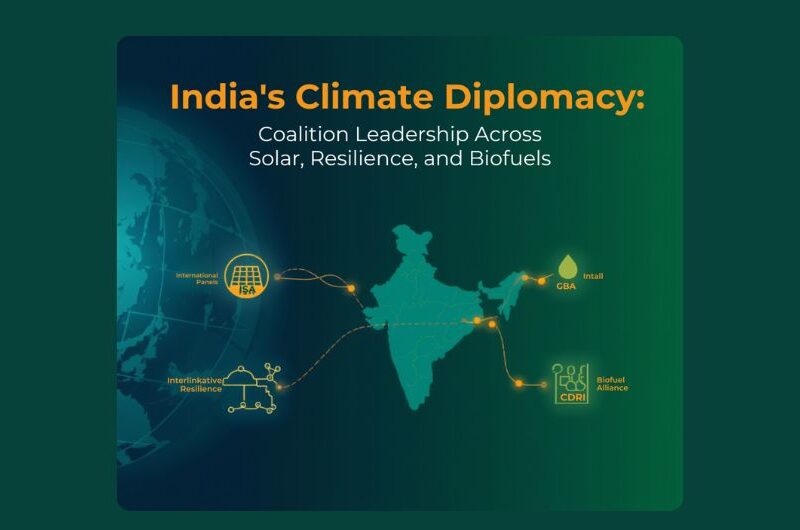
India’s Climate Diplomacy: Coalition Leadership Across Solar, Resilience, and Biofuels   1. India’s climate diplomacy balances development for 1.4 billion people with climate goals, using low per-capita emissions and equity framing to argue for developmental space with ambition. 2. India commits to cut GDP emissions intensity 45% from 2005 by 2030 and targets net zero by 2070; early 50% installed non-fossil electricity capacity strengthens credibility internationally. 3. Diplomatic posture is described as shifting from defensive burden-sharing to proactive coalition building, offering deployable solutions, training, and affordability-oriented implementation lessons to partners. 4. Domestic action combines renewables expansion, efficiency programmes, and sustainable lifestyles, while regulators increasingly integrate climate risks to strengthen resilience and support green investments and transition finance. 5. International Solar Alliance (ISA) launched in 2015 with France; treaty-based headquarters in India boosts convening power and continuity within India’s diplomatic architecture. 6. ISA’s “Towards 1000” agenda targets mobilising $1 trillion and enabling 1,000 GW solar by 2030; it supports access via decentralised solar while avoiding long-term carbon lock-in. 7. ISA uses demand pooling, procurement aggregation, and standardisation to de-risk projects; training strengthens planning, installation, operations, and regulatory capacity across members. 8. ISA faces constraints: limited dominance in low-cost manufacturing, supply concentration, policy volatility, grid weakness, and permitting delays that can erode investor confidence despite pooled demand. 9. CDRI launched in 2019 to shift from response to prevention, focusing on cascading failures across power, transport, telecom, and water to maintain lifeline continuity during extremes. 10. CDRI develops toolkits, standards, and risk-assessment methodologies; resilient island initiatives support small islands facing cyclones, sea-level rise, and service disruptions in critical systems. 11. Resilience finance is framed around quantifying avoided losses, but fragmentation across ministries, weak hazard mapping, and difficulty converting plans into bankable projects slow execution. 12. Nature-based solutions—wetlands, mangroves, and urban green spaces—are treated as protective assets complementing engineered infrastructure and strengthening service reliability during shocks. 13. Global Biofuels Alliance (GBA) launched in 2023 to align policies and standards for sustainable biofuels; it links mitigation with energy security by reducing oil import dependence. 14. GBA targets hard-to-electrify sectors via SAF and advanced biodiesel; second/third-generation biofuels use residues and algae but require safeguards against land conversion and biodiversity loss. 15. Combined platforms (ISA, CDRI, GBA) widen India’s leadership across mitigation, adaptation, and hard-sector transition, but delivery depends on concessional finance, risk-sharing, storage, skills, standards, data, and just transition. Must Know Terms : 1.Equity and Climate Justice Frame Equity and Climate Justice Frame: Anchored in Paris Agreement Article 2.2, which states implementation will reflect “equity” and CBDR–RC “in the light of different national circumstances.” In practice, it frames burden-sharing using measurable axes: historical cumulative emissions, per-capita emissions, capability/HDI, and vulnerability. It drives claims on (i) grant-based finance vs loans, (ii) adaptation priority, (iii) loss-and-damage support, and (iv) technology transfer on fair terms. 2.International Solar Alliance (ISA) International Solar Alliance (ISA): Treaty-based intergovernmental organisation headquartered in Gurugram (India) at NISE. Its official portal currently displays 112 Member Countries and 14 Signatory Countries. ISA’s core function is to scale solar deployment via programmatic support, standardisation, and finance mobilisation across member states; membership is open to UN members. It is widely cited as one of India’s flagship climate institutions with a dedicated international legal framework. 3.One Sun One World One Grid One Sun One World One Grid: Proposed by India in October 2018 at the first ISA Assembly as a transnational clean-power grid concept to move renewable electricity across time zones. In May 2021, India and the UK agreed to merge OSOWOG with the UK’s Green Grids Initiative and jointly launch the combined initiative at COP26 (Glasgow, Nov 2021). The operational logic is measurable: higher renewable utilisation, lower curtailment, and smoother peak balancing through cross-border interconnections. 4.Coalition for Disaster Resilient Infrastructure (CDRI) Coalition for Disaster Resilient Infrastructure (CDRI): Launched in September 2019 (UN Climate Action Summit, New York) to strengthen resilience of infrastructure systems to climate and disaster risks. CDRI’s official “About” page states 53 member countries and 12 partner organizations; CDRI’s site dashboard currently shows 65 members (plus project and funding counters). It functions as a coalition platform—standards, knowledge, technical support, and pipeline development for resilient infrastructure investments. 5.Global Biofuels Alliance (GBA) Global Biofuels Alliance (GBA): Launched on 9 September 2023 on the sidelines of the G20 Summit in New Delhi as India’s Chair initiative. Official releases state 19 countries and 12 international organisations agreed to join at launch. The coalition’s stated purpose is to accelerate global biofuel uptake through (i) technology advancement, (ii) stronger standards/certification, (iii) capacity-building and technical support for national programmes, and (iv) acting as a knowledge repository/expert hub. 6.Risk-Sharing and Sovereign Guarantees Risk-Sharing and Sovereign Guarantees: A Risk Sharing Facility (RSF) is a bilateral loss-sharing structure where a guarantor (e.g., IFC) reimburses a lender/originator for an agreed portion of principal losses on a defined portfolio of eligible assets—used to expand lending into new/underserved segments without full risk retention. Sovereign (government) guarantees are legally binding state commitments to backstop specified obligations or losses if defined triggers occur; IMF treats guarantees as contingent liabilities that can create significant fiscal risk if called. MCQ 1. India’s 2030 emissions-intensity commitment in the passage is: (a) 33% from 2019 levels (b) 40% from 2010 levels (c) 45% from 2005 levels (d) 50% from 1990 levels 2. India’s stated net-zero target year is: (a) 2050 (b) 2060 (c) 2070 (d) 2100 3. The passage states India achieved 50% installed electricity capacity from non-fossil sources: (a) After 2030 (b) Exactly in 2030 (c) Earlier than the 2030 timeline (d) Not achieved 4. ISA is described as launched in: (a) 2010 (b) 2015 (c) 2019 (d) 2023 5. ISA is described as launched with: (a) Sweden (b) France (c) Japan (d) Brazil 6. ISA’s “Towards 1000” agenda targets: (a) $100B and 100 GW by 2030 (b) $1T and 1,000 GW by 2030 (c) $1T and 500 GW by 2040 (d) $500B and 1,000 GW by 2050 7. ISA aims to improve bankability primarily through: (a) Ending private investment (b) Demand pooling

More Details

Indian Ocean Region: Trade Artery, Climate Stress, and Cooperative Security

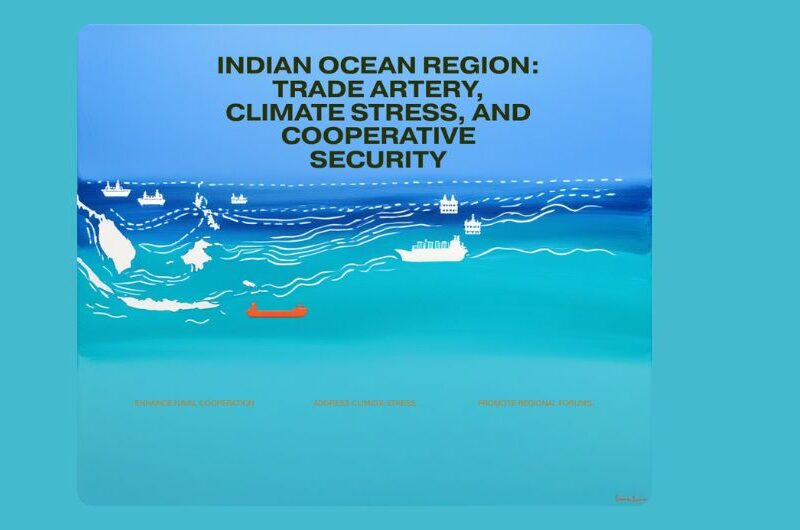
Indian Ocean Region: Trade Artery, Climate Stress, and Cooperative Security   1. The Indian Ocean spans Bay of Bengal to Antarctica and South Africa to Western Australia; it covers about 21.45 million square nautical miles, roughly one-fifth of Earth’s water surface. 2. The Indian Ocean Region includes 36 countries and about 2.5 billion people, around 35% of global population, forming a vast canvas linking littorals, islands, and major trade routes. 3. Roughly 100,000 ships cross the region yearly, carrying about 30% of global container traffic; maritime security is central to trade continuity and global market stability. 4. The region transports about 42% of global crude oil and petroleum products; littorals hold over half proven oil-gas reserves and contribute roughly 40% of offshore output. 5. Major refining hubs include Jubail, Jamnagar, and Singapore, together supporting about 20% of world refining capacity; Singapore alone handles near one-seventh of transshipment annually. 6. Three of the world’s twenty largest merchant fleets belong to Indian Ocean littorals; chokepoints Hormuz, Bab el Mandeb, and Malacca can rapidly raise freight and fuel costs. 7. The Indian Ocean is warming faster than other oceans; sea surface temperatures rose over 1.5°C since the industrial era, intensifying sea-level rise and extreme weather risks. 8. Projections of 1.7–3.8°C warming elevate threats to monsoon timing, rainfall extremes, fisheries, coral systems, and livelihoods across coasts, deltas, and islands. 9. Warmer waters intensify cyclones, storm surge, flooding, and wind damage; rising seas accelerate erosion and salt intrusion into aquifers and deltas, harming freshwater and agriculture. 10. Heat and acidification weaken coral reefs, reducing biodiversity and fish nurseries; warming shifts fish distribution, increasing competition among fleets and pressures on nearshore coastal incomes. 11. Low-lying islands face inundation, erosion, and freshwater loss, complicating habitation, sovereignty, land tenure, and long-term development planning under rising sea levels. 12. Recurrent floods, cyclones, and heat shocks drive migration, disrupting labour markets and services; cross-border displacement can strain diplomacy and demand humanitarian cooperation frameworks. 13. Declining fisheries and seabed mineral prospects increase rivalry; IUU fishing provokes detentions, protests, and tougher policing; shifting coastlines complicate baselines and EEZ claims. 14. Climate hazards threaten ports, refineries, pipelines, and telecom networks; disasters disrupt shipping and logistics hubs, raising insurance premiums, delaying cargo, and stressing supply chains. 15. Regional responses emphasise SAGAR, IORA, BIMSTEC, INCOIS alerts, and coalitions like ISA, CDRI, GBA, IBCA, focusing on early warning, resilient ports, nature-based defenses, and governance. Must Know Terms : 1.Indian Ocean Trade Artery Indian Ocean Trade Artery: The Indian Ocean is described as a trade-route “lifeline” carrying (i) about half of the world’s container ships, (ii) about one-third of global bulk cargo traffic, and (iii) about two-thirds of the world’s oil shipments. These are commonly used strategic metrics to show why disruption in the Indian Ocean quickly impacts global energy and freight prices. 2.Maritime Chokepoints Maritime Chokepoints: Narrow passages where a disruption can block or delay huge trade flows. Key Indian Ocean-linked chokepoints include: Strait of Hormuz: In 2023, flows through Hormuz were “more than one-quarter” of total global seaborne traded oil; also around one-fifth of global LNG transited the strait. Strait of Malacca: In 2016, petroleum and other liquids transiting Malacca reached about 16 million barrels/day; at its narrowest point it is about 1.7 miles wide—making it a physical bottleneck. 3.Rapid Indian Ocean Warming Rapid Indian Ocean Warming: Government climate assessment summaries report the tropical Indian Ocean has warmed faster than the global ocean average. Basin-wide sea surface temperature (SST) warming over 1951–2015 is cited at about 0.15°C per decade in the tropical Indian Ocean versus about 0.11°C per decade for globally averaged SST over the same period, implying faster heat accumulation in this basin. 4.Saltwater Intrusion Saltwater Intrusion: A measurable coastal groundwater risk where saline water moves landward into freshwater aquifers. USGS explains the mechanism clearly: when too much freshwater is pumped from a coastal aquifer, the freshwater–saltwater interface migrates inland, and pumping wells near the interface can start producing saline-contaminated water. This directly affects drinking-water quality and irrigation suitability in coastal belts. 5.IUU Fishing IUU Fishing (Illegal, Unreported and Unregulated): FAO notes IUU fishing represents up to 26 million tonnes of fish caught annually. A widely used global estimate puts illegal/unreported catch in the range 11–26 million tonnes per year, with an estimated value of about US$10–23 billion, and notes that IUU can account for up to 20% of the world’s catch (higher in some fisheries). It is treated as both a conservation and transnational-crime problem. 6.CDRI (Coalition for Disaster Resilient Infrastructure) CDRI: A global coalition launched by India at the UN Climate Action Summit in New York in September 2019 to strengthen resilience of infrastructure systems against climate and disaster risks. CDRI’s official “About” page states current scale as 53 member countries and 12 partner organizations, spanning governments and international bodies, to support knowledge exchange, research, and investment for disaster-resilient infrastructure.   MCQ 1. The Indian Ocean is described as the world’s: (a) Largest oceanic basin (b) Second largest oceanic basin (c) Third largest oceanic basin (d) Fifth largest oceanic basin 2. The Indian Ocean is stated to cover about: (a) 11.45 million sq nautical miles (b) 21.45 million sq nautical miles (c) 31.45 million sq nautical miles (d) 41.45 million sq nautical miles 3. The Indian Ocean Region includes about: (a) 16 countries and 1.5 billion people (b) 26 countries and 2.0 billion people (c) 36 countries and 2.5 billion people (d) 46 countries and 3.5 billion people 4. About how many ships cross the region yearly? (a) 10,000 (b) 50,000 (c) 100,000 (d) 250,000 5. The region carries about what share of global container traffic? (a) 10% (b) 20% (c) 30% (d) 50% 6. The region transports about what share of global crude oil and petroleum products? (a) 22% (b) 32% (c) 42% (d) 62% 7. Indian Ocean littorals are stated to hold: (a) Less than 10% of proven oil-gas reserves (b) About one-third of proven reserves (c) More than half of proven reserves (d) Nearly all proven reserves 8.

More Details

Climate Finance to EV Affordability: Bridging Global Architecture and Household Realities

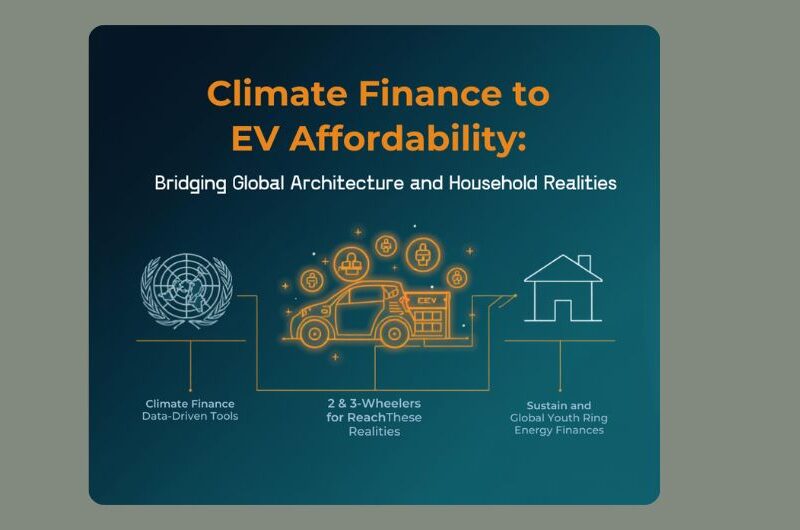
Climate Finance to EV Affordability: Bridging Global Architecture and Household Realities   1. India’s climate transition funding links global mechanisms with domestic innovation, especially electric mobility, creating a finance tension that requires simultaneous action across diplomacy, markets, and institutions. 2. India’s climate financing need is estimated at $1.5–$2.5 trillion by 2030, far above current inflows; India rejected a $300 billion NCQG baseline by 2035 as inadequate. 3. International climate finance is described as loan- and equity-heavy with limited grants, increasing repayment burdens; debt servicing in many LMICs exceeds estimated NDC spending needs. 4. MDBs provide large climate volumes mainly via debt while not matching debt-relief participation; private mobilisation biases funds toward commercially viable projects, underserving LDCs and SIDS. 5. India frames climate finance as obligation tied to historical responsibility, seeking predictable concessional flows for adaptation and loss; weak global terms raise local capital costs. 6. India sold over 1.5 million EVs in FY2024, but affordability constraints remain, especially in two- and three-wheelers, because upfront prices dominate purchase decisions. 7. EVs are described as costing 1.5–2× comparable ICE models; EV loan rates often exceed 20% while ICE loans are near 10%, sharply worsening monthly affordability. 8. Lenders price EV risk higher due to unclear resale values, battery degradation variation, and thin secondary markets; mainstream banks lack experience in 2W/3W lending. 9. NBFCs dominate vehicle credit but often delay EV entry due to technology risk and valuation doubts; early losses from low-quality e-rickshaw batteries reinforced caution and pricing. 10. Risk-sharing tools like credit guarantees and first-loss facilities can reduce default risk and enable longer tenors and cheaper rates; an SBI-managed instrument withdrew on viability concerns. 11. Implementation moved to SIDBI, reflecting need for development-finance intermediaries; high rates and sparse channels risk excluding tier II/III households and deepening transport poverty. 12. A domestic climate finance taxonomy can standardise climate-aligned activities; country-determined criteria can include realistic transition pathways aligned to development priorities, not imported templates. 13. A government-backed EV finance institution could refinance NBFCs and micro-lenders, using blended capital from budgets and multilateral concessional funds to lower cost of capital. 14. Market design options include battery-as-a-service, battery identifiers and health records, cashflow-matched loans, charging-linked finance, insurance pools, clear swapping standards, and data-driven underwriting. 15. Co-benefits include lower oil imports and air pollution; scaling needs local capacity, procurement levers, resale ecosystems, carbon-market revenues, targeted interest subvention, and accountability reporting. Must Know Terms :   1.NCQG Baseline NCQG Baseline: The New Collective Quantified Goal (NCQG) is the post-2025 climate-finance goal set “in extension” of the earlier USD 100-billion goal under the Paris decision framework. The agreed headline level is at least USD 300 billion per year by 2035 for developing countries’ climate action, with developed countries taking the lead, and alongside a wider scaling pathway to enable at least USD 1.3 trillion per year by 2035 from all sources (public/private, bilateral/multilateral, including alternative sources). 2.Loan-Heavy Climate Finance Loan-Heavy Climate Finance: Public climate finance to developing countries has been dominated by loans, especially for middle-income recipients. Over 2016–2022, loans represented about 85% of public climate finance provided to LMICs, 87% to UMICs, and 92% to high-income developing countries; grants were much higher mainly in LICs (about 64% grants). Concessionality differs by channel: over 2016–2022, about 79% of bilateral-provider loans were concessional, while only about 41% of multilateral climate-fund loans and about 23% of MDB climate loans were concessional. 3.EV Interest Rate Spread EV Interest Rate Spread: The measurable difference in borrowing cost between EV loans and comparable ICE vehicle loans, usually expressed in percentage points or basis points (bps). Example (India, May 2025): EV car-loan rates were reported as low as 8.15% versus 8.30% for non-electric car loans, implying an EV “green discount” spread of 0.15 percentage points = 15 bps (before borrower credit-score and tenure adjustments). 4.Risk-Sharing Facilities Risk-Sharing Facilities: Structured finance vehicles where a public/DFI partner shares a defined portion of credit losses with lenders or investors to unlock longer-tenor lending at lower risk. Standard definition (portfolio RSF): the guarantor reimburses the originator for an agreed share of principal losses on a portfolio of eligible assets. Example (GCF–IDB FP048): a climate-smart agriculture risk-sharing facility for MSMEs in Guatemala and Mexico approved with USD 20 million GCF support, within a total stated project investment of about USD 158 million, designed to help lenders offer longer-term loans for climate-smart investments. 5.Climate Finance Taxonomy Climate Finance Taxonomy: A classification system that defines which activities qualify as “climate-aligned” (mitigation, adaptation, transition, etc.) to guide capital flows and reduce greenwashing. India’s draft “Climate Finance Taxonomy” framework was released for public consultation by the Department of Economic Affairs (Ministry of Finance) in May 2025, explicitly linked to enabling larger resource flows for climate-friendly activities while maintaining reliable and affordable energy access. In practice, taxonomies are used by banks, bond issuers, and regulators to standardise disclosure and product labels. 6.Battery-as-a-Service and Data Infrastructure Battery-as-a-Service (BaaS): A model where the battery is owned/managed by a battery provider (not the EV buyer) and the user pays for energy/service (swap/lease/rent), reducing upfront EV cost and enabling faster “refuel” via swapping. India’s draft Battery Swapping Policy (20 Apr 2022) mandates lifecycle traceability: a Unique Identification Number (UIN) assigned at manufacturing for each battery pack; required technical data mapped to the UIN; swapping operators must store usage history and performance data against the UIN across the battery lifecycle; UINs also for swapping stations. It also specifies data/communication standards (e.g., open protocols such as OCPP for back-end interoperability), encourages data-sharing agreements, allows nodal authorities access to tracked information, and requires certain consumer-facing information (availability, battery type, compatibility, performance) to be made openly available in a standard format.   MCQ   1. India’s estimated climate financing need by 2030 is stated as: (a) $0.5–$1.0 trillion (b) $1.0–$1.5 trillion (c) $1.5–$2.5 trillion (d) $3.0–$4.0 trillion 2. India rejected which NCQG baseline level and timing? (a) $100B annually by 2030 (b) $200B annually by 2040 (c) $300B annually by 2035 (d) $500B annually by 2050 3. International climate finance is

More Details

India’s Climate Milestones, Coal Reality, and Coalition Strategy

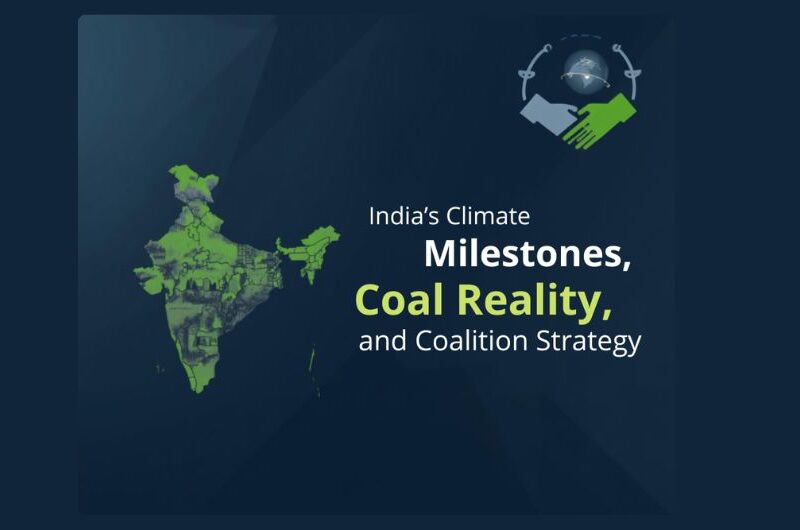
India’s Climate Milestones, Coal Reality, and Coalition Strategy     1. India’s climate pathway balances development and sustainability through renewable expansion, emissions-intensity reduction, and coalition leadership, while confronting coal dependence, financing gaps, bottlenecks, and rising energy demand. 2. India targeted 175 GW renewables for 2022 but achieved 119 GW excluding large hydro, missing the mark yet creating momentum; by October 2025 renewables reached about 242 GW. 3. India’s emissions are about 4,195 MtCO2e, roughly 7.6% globally; per capita near 1.85 tCO2e supports equity claims; cumulative since 1850 totals 169,900 MtCO2e. 4. India pledged a 45% GDP emissions-intensity cut from 2005 by 2030 and 50% cumulative installed non-fossil capacity; it targets net-zero 2070 and promotes Mission LiFE. 5. In 2023 non-fossil capacity neared 49%: solar ~123 GW, wind 52 GW, large hydro 50 GW; yet renewable generation including hydro is ~22% amid coal-dominant dispatch. 6. FY2024–25 added 29.52 GW renewables, led by ~24 GW solar; April–September 2025 added ~25 GW, including 21.7 GW solar and 3.09 GW wind. 7. India reached 50% installed capacity from non-fossil sources about five years before 2030; nevertheless energy-related CO2 emissions rose about 5.3% in 2024 amid demand growth. 8. First-half 2025 power-sector CO2 fell about 1% year-on-year, linked to record clean additions and favorable weather; 2015–2020 policies reportedly avoided about 440 MtCO2. 9. Between 2005 and 2019, India cut GDP emissions intensity about 33%, advancing its 2030 pledge; leadership is pursued via ISA, CDRI, GBA, LeadIT, and IBCA with implementation focus. 10. ISA began at COP21 in November 2015 with France; 100+ signatories and 90+ ratifications. CDRI launched September 2019; ~60 members support 180+ resilience projects worldwide, with Delhi secretariat. 11. GBA launched September 2023 with the G20 in New Delhi and expanded by mid-2025. LeadIT, co-launched 2019 with Sweden, entered a new phase at COP28 globally. 12. IBCA launched April 2023; Cabinet approval came March 2024. An April 2025 Headquarters Agreement established its secretariat in India; by 2025, over 12 countries formally joined as members. 13. Coal supplies ~73% of electricity generation and ~44% of primary energy; energy demand may roughly double from 2020 to 2040, complicating transition sequencing for states and workers nationally. 14. Net-zero pathways need about $10 trillion (2020–2070). Finance flows near $44B annually versus needs ~$260B; transmission lags cause curtailment; FY2024 solar imports exceeded $12B value overall. 15. Opportunities include Morena solar-plus-storage at ₹2.70/kWh, PM Suryaghar adding ~6 GW rooftop for two million households, more storage and corridors, managed coal transition, skills. Must Know Terms   1.NDC and Net Zero NDC and Net Zero: India’s updated NDC (submitted Aug 2022) commits to (i) reduce emissions intensity of GDP by 45% by 2030 from 2005 levels, and (ii) achieve about 50% cumulative electric power installed capacity from non-fossil sources by 2030. Separately, India announced a net-zero target year of 2070 at COP26 (2 Nov 2021), alongside “Panchamrit” milestones including 500 GW non-fossil power capacity by 2030. 2.Dispatch Gap Dispatch Gap: The hard shortage at peak—Peak Demand minus Peak Met (MW), also expressed as “Demand Not Met (%)”. Official all-India data show: FY 2022-23 peak demand 215,888 MW vs peak met 207,231 MW → gap 8,657 MW (4.0%). FY 2023-24 gap 3,340 MW (1.4%). FY 2024-25 gap 2 MW (0.0%). FY 2025-26 (Apr–Dec 2025) peak demand 242,773 MW vs peak met 242,493 MW → gap 280 MW (0.1%). 3.International Solar Alliance (ISA) International Solar Alliance (ISA): Treaty-based intergovernmental organisation headquartered at the National Institute of Solar Energy (NISE), Gurugram. It became treaty-based when its Framework Agreement entered into force on 6 Dec 2017 after the 15th ratification. ISA’s official portal currently shows 112 Member Countries and 14 Signatory Countries (public count on the site home page). 4.Coal Reliance and Just Transition Coal Reliance and Just Transition: Coal remains the backbone of India’s electricity generation even as non-fossil installed capacity rises. In 2024, India generated about 2,030 TWh of electricity; coal contributed a record ~1,517.9 TWh (renewables ~240.5 TWh). Coal is also a jobs-and-regional-economy issue: a Government of India document lists workforce in major coal companies as Coal India Limited 330,318; SCCL 40,893; NLC India 20,811. “Just transition” focuses on planned worker reskilling, social protection, and district-level economic diversification as coal use gradually declines. 5.Climate Finance Gap Climate Finance Gap: Two hard numbers show the “gap”. First, the long-standing developed-country pledge: OECD reported developed countries provided and mobilised USD 115.9 billion in climate finance for developing countries in 2022 (first time exceeding USD 100 billion). Second, the needs scale: UNFCCC notes the Standing Committee on Finance (2021 Needs Determination Report) found nearly USD 6 trillion is needed to implement developing countries’ climate action plans by 2030 (and this does not fully cost adaptation). COP29 also agreed a new post-2025 finance goal architecture: scale up climate finance for developing countries to at least USD 1.3 trillion annually by 2035 (all actors) and developed countries to take the lead in mobilising at least USD 300 billion annually by 2035. 6.Transmission, Storage, Curtailment Transmission, Storage, Curtailment: Grid constraints show up as curtailment and delayed evacuation. CEA’s transmission plan for integrating 500+ GW renewables by 2030 is officially costed at about ₹2.44 lakh crore and is designed for ~537 GW RE integration. Curtailment has become measurable: an Ember analysis reported about 2.3 TWh of solar power was curtailed in India over May–December 2025 for grid-security reasons. Storage is being pushed as the balancing tool, but deployment is still small versus tenders: Reuters reported only ~500 MWh operational as of Sept 2025 out of ~83 GWh tendered since 2021, and noted bids in some tenders falling below ₹1.5/kWh, raising viability concerns. MCQ 1. India’s net-zero target year stated in the passage is: (a) 2030 (b) 2047 (c) 2070 (d) 2100 2. India’s 2022 renewable deployment target was: (a) 119 GW (b) 175 GW (c) 242 GW (d) 500 GW 3. By 2022, renewable capacity excluding large hydro was stated as: (a) 100 GW (b) 119 GW (c) 175 GW (d) 242 GW 4. India’s greenhouse gas emissions

More Details

Growth with Climate Action: India’s Equity, Health, and Green Leapfrogging Pathway  

Growth with Climate Action: India’s Equity, Health, and Green Leapfrogging Pathway       1. India is at a crossroads where poverty reduction goals coincide with intensifying climate risks, making integrated choices unavoidable and shifting the core question to whether growth and climate action can advance together. 2. India’s catch-up legacy leaned on coal, steel, and cement; replicating Western growth is described as impractical under climate constraints, yet halting development is framed as unfair given unmet basic needs. 3. The development-versus-climate framing is treated as a false dichotomy, proposing a combined programme integrating climate action into growth through technology, finance, diplomacy, and inclusive governance mechanisms. 4. Climate action is positioned as enabling development by sustaining health systems, protecting agriculture, preserving the demographic dividend, and improving resilience because repeated shocks can erase progress quickly. 5. India is described as the third largest greenhouse gas emitter, about seven percent of global CO₂, yet per capita emissions are less than half the global average and about one seventh of the United States. 6. India must reduce emissions while meeting basic needs for about 1.4 billion people; around 230 million are described as multidimensionally poor, keeping development requirements and equity constraints large. 7. Nearly forty percent of the workforce is described as dependent on agriculture, with heatwaves, erratic monsoons, floods, and droughts directly threatening output, rural incomes, and food stability. 8. Health burdens such as air pollution and malnutrition are described as intersecting with climate stresses, compounding inequality; slowing growth is described as unacceptable, but climate inaction is equally dangerous. 9. South Asia is described as a hotspot for heat extremes, water shortages, and food insecurity, increasing urgency for resilience building to protect human capital and development gains. 10. Heat-related deaths among older Indians are described as rising by 55% over two decades; heat exposure drives productivity losses, reducing wages and output for outdoor and informal workers. 11. Climate shocks are described as reversing SDG progress: crop failures and health shocks push households into poverty, while dengue and malaria risks shift with higher temperatures and unstable rainfall patterns. 12. Women are described as facing heavier burdens from water scarcity and fuel shortages; farmers, construction labourers, and vendors lose working hours in extreme heat, directly reducing incomes. 13. Air pollution is described as India’s second largest disease risk factor linked to about 1.6 million deaths annually; clean energy and urban planning reduce admissions, raise productivity, and improve lives. 14. Heat Action Plans are described as emerging in Ahmedabad after the 2010 heatwave, saving lives via early warning, outreach, and cooling measures, but often missing mental health and gender integration. 15. India is described as able to leapfrog into green development: targets include 500 GW non-fossil capacity by 2030 and net zero 2070; constraints include intermittency, land, grid integration, storage, and transport emissions. Must Know Terms: 1.False Dichotomy False Dichotomy: A logical fallacy where only two choices are presented as if they are the only options, while feasible alternatives exist. Common policy examples include “growth vs environment” or “coal vs blackout,” ignoring efficiency, demand response, diversified renewables, storage, and grid upgrades. In arguments, it is detected by “either–or” framing that excludes middle paths, sequencing, or mixed strategies.   2.Emissions Equity Context Emissions Equity Context: Equity framing compares (a) historical contribution, (b) per-capita emissions, and (c) capacity to pay. India’s per-capita CO₂ is around ~2 tonnes, and is less than half of the global average; the U.S. and EU remain far higher per person. Historically, the U.S. has contributed more than one-quarter of cumulative CO₂ emissions since the industrial era, shaping claims on “responsibility.” Equity language in global talks is anchored in CBDR–RC principles and “different national circumstances.”   3.Heat Action Plans Heat Action Plans: India’s heat governance tool built around early warning + public advisories + health system readiness. NDMA notes that 17 heat-wave-prone states have prepared Heat Wave Action Plans and that more than 120 districts/cities across 14 states have prepared local action plans. Ahmedabad’s Heat Action Plan launched in 2013 is cited as South Asia’s first city heat plan and is periodically updated. A published evaluation linked Ahmedabad’s plan with reduced hot-day mortality, estimating over ~1,100 deaths avoided per year after implementation.   4.Air Pollution Burden Air Pollution Burden: Air pollution is quantified as premature deaths, DALYs, and disease shares attributable to PM2.5 and household air pollution. State of Global Air (GBD 2021) reports ~8.1 million deaths globally in 2021 from air pollution, with India around ~2.1 million deaths (about one-quarter of the global total). India-specific estimates for 2019 attribute ~1.67 million deaths to air pollution and ~17.8% of all deaths. Child burden is large: reported ~169,400 under-5 deaths in India in 2021 linked to air pollution (≈ 464 per day).   5.Great Nicobar Project Great Nicobar Project: The officially cleared “Holistic/Integrated Development of Great Nicobar Island” includes (i) an International Container Transshipment Terminal (ICTT) at Galathea Bay with stated planned capacity of 14.2 million TEU, (ii) township/area development, and (iii) a 450 MVA gas-and-solar power plant. Project documents cite an overall project area of about 16,610 hectares. Environmental and CRZ clearance documentation is dated 11.11.2022 (File No. 10/17/2021-IA.III).   6.Integrated Planning Integrated Planning: A method to align land use, transport, housing, water, waste, energy, environment, and disaster risk so sector decisions do not conflict. It is operationalised through a single baseline (population, demand, hazards), scenario modelling, and phased capex sequencing across agencies. Outputs are measurable: service coverage targets, emission intensity targets, resilience targets, and infrastructure capacity thresholds (water balance, mobility capacity, waste processing capacity) with timelines and budgets. MCQ 1. The passage frames India’s current policy situation primarily as: (a) A post-growth stabilisation phase (b) A crossroads where poverty reduction coincides with intensifying climate risks (c) A period of declining climate hazards (d) A phase where development can be halted without equity issues 2. India’s historical catch-up narrative is described as leaning on: (a) Hydropower and geothermal (b) Coal, steel, and cement (c) Nuclear-only expansion (d) Biomass and peat 3. Replicating the

More Details

Free IAS Guidance
Start Your Journey Today 🇮🇳

Fill out the form below, and we will be in touch shortly.