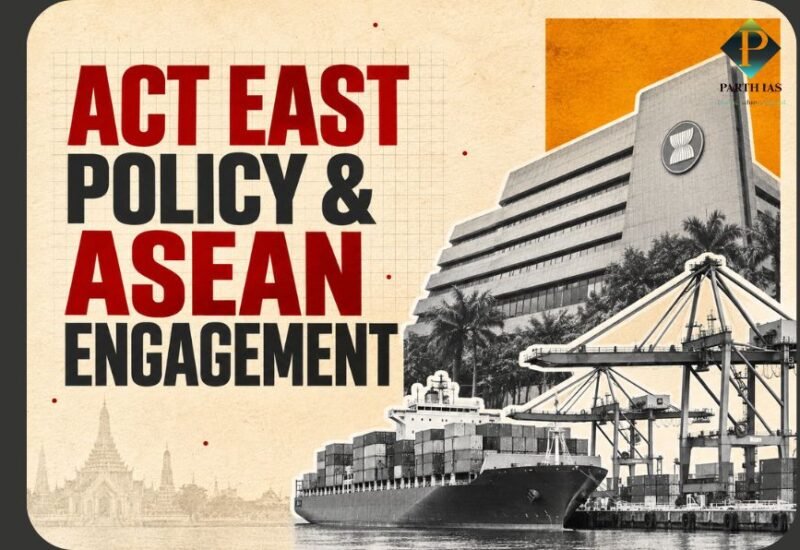
Act East Policy & ASEAN Engagement
India’s Act East Policy (AEP) and ASEAN Engagement
India’s Act East Policy (AEP), launched in 2014 as an expanded and action-oriented version of the Look East Policy of 1991, places ASEAN (Association of Southeast Asian Nations) at the centre of India’s Indo-Pacific strategy. The policy focuses on strengthening economic cooperation, regional connectivity, cultural relations, diplomatic engagement and security partnerships with East and Southeast Asian countries.
Evolution: Look East vs. Act East Policy
The Look East Policy primarily focused on economic integration with Southeast Asia following the end of the Cold War. The Act East Policy expanded this approach by giving greater importance to defence cooperation, regional connectivity, maritime security and strategic partnerships.
| Dimension | Look East Policy (1991) | Act East Policy (2014) |
|---|---|---|
| Launch Context | Initiated by Prime Minister P.V. Narasimha Rao during India’s economic liberalization. | Launched by Prime Minister Narendra Modi at the 12th ASEAN–India Summit. |
| Core Pillars | Primarily focused on economic and trade integration. | Four major pillars (4Cs): Culture, Commerce, Connectivity and Capacity Building. |
| Geographic Scope | Mainly focused on Southeast Asia. | Expanded to East Asia, Oceania and the wider Indo-Pacific region. |
| Security & Defence | Primarily focused on diplomatic engagement and confidence-building. | Greater emphasis on defence cooperation, maritime security and joint military exercises. |
| Domestic Linkage | Relatively limited emphasis on the development and connectivity of border states. | Recognizes Northeast India as a strategic gateway to Southeast Asia. |
Core Pillars of ASEAN Engagement
India’s engagement with ASEAN focuses on four major areas: strategic and maritime security, physical and digital connectivity, economic integration, and cultural and institutional cooperation.
Strategic & Maritime Security: India supports ASEAN Centrality, which recognizes ASEAN’s leading role in regional cooperation, and the AOIP (ASEAN Outlook on the Indo-Pacific). Defence cooperation includes naval exercises such as SIMBEX (Singapore–India Maritime Bilateral Exercise) and MILAN, defence exports such as BrahMos missiles to the Philippines, and support for freedom of navigation in the South China Sea in accordance with UNCLOS (United Nations Convention on the Law of the Sea).
Physical & Digital Connectivity: India is developing infrastructure projects to connect Northeast India with Southeast Asia. Major initiatives include the IMT (India–Myanmar–Thailand) Trilateral Highway and the Kaladan Multi-Modal Transit Transport Project. India also promotes DPI (Digital Public Infrastructure) through cross-border digital payment arrangements such as the UPI (Unified Payments Interface)–PayNow linkage between India and Singapore.
Economic & Trade Integration: ASEAN is one of India’s largest trading partners. Following India’s decision not to join the RCEP (Regional Comprehensive Economic Partnership), India has prioritized the review of AITIGA (ASEAN–India Trade in Goods Agreement) to address trade imbalances, improve market access and strengthen regional supply chains.
Cultural & Institutional Ties: India’s historical and civilisational connections with Southeast Asia are reflected in the spread of Buddhism, the Ramayana and shared cultural traditions. Initiatives such as Mekong–Ganga Cooperation (MGC), academic collaboration through Nalanda University and the Delhi Dialogue strengthen cultural exchanges, educational cooperation and institutional relationships.
Recent Developments (2026)
23rd ASEAN–India Summit & 21st East Asia Summit (November 2026): Held in Manila under the Philippines’ chairmanship, the summits focused on strengthening regional cooperation and aligning India’s Viksit Bharat 2047 vision with the ASEAN Community Vision 2045.
Year of Maritime Cooperation: The year 2026 was designated as the ASEAN–India Year of Maritime Cooperation. Major areas of cooperation included a new Maritime Cooperation Plan and joint initiatives in cyber forensics, which involves the identification, examination and analysis of digital evidence.
Expansion of ASEAN: India’s engagement with ASEAN now extends to all 11 member countries following the inclusion of Timor-Leste as a full member of the organization.
People-to-People Initiatives: India announced free electronic visas (e-Visas) for ASEAN citizens, a Space Hackathon to encourage innovation in space technology, and a Maritime Heritage Festival at Lothal, Gujarat, to promote shared maritime history and cultural connections.
Key Challenges & Way Forward
Implementation Delays: Internal conflict and political instability in Myanmar have delayed important sections of the IMT Trilateral Highway and the Kaladan Multi-Modal Transit Transport Project. Timely completion of these projects is essential for improving connectivity between Northeast India and Southeast Asia.
Asymmetric Trade Deficit: India’s imports from ASEAN exceed its exports to the region, resulting in a trade deficit. Completing the AITIGA review, improving market access and strengthening domestic manufacturing can help achieve more balanced trade relations.
Geopolitical Balancing: China’s extensive economic and infrastructure engagement in Southeast Asia through the BRI (Belt and Road Initiative) creates strategic challenges for India. India can strengthen its regional position by promoting financially sustainable infrastructure projects, transparent development partnerships, technological cooperation and capacity-building programmes.
Must Know Terms :
1. Act East Policy (AEP)
India’s foreign policy initiative launched in 2014 as an expanded version of the Look East Policy of 1991. It focuses on economic cooperation, defence partnerships, regional connectivity and cultural engagement with East and Southeast Asian countries and the wider Indo-Pacific region.
2. ASEAN Centrality
The principle that ASEAN (Association of Southeast Asian Nations) should play a leading role in shaping regional cooperation, security and diplomatic institutions in the Indo-Pacific. India supports ASEAN Centrality to promote an inclusive, stable and rules-based regional order.
3. India–Myanmar–Thailand (IMT) Trilateral Highway
A regional connectivity project designed to connect Moreh in Manipur with Mae Sot in Thailand through Myanmar. It aims to strengthen cross-border trade, transportation and economic integration between Northeast India and Southeast Asia.
4. Kaladan Multi-Modal Transit Transport Project
A connectivity project linking India’s eastern coast with Mizoram through Myanmar using maritime, inland waterway and road transport. It provides an alternative transport route to Northeast India and strengthens regional trade connectivity.
5. ASEAN–India Trade in Goods Agreement (AITIGA)
A trade agreement that came into force in 2010 to promote trade in goods between India and ASEAN through tariff reductions and preferential market access. Its review aims to address trade imbalances, improve market access and strengthen regional supply chains.
6. Mekong–Ganga Cooperation (MGC)
A regional cooperation initiative launched in 2000 involving India, Cambodia, Laos, Myanmar, Thailand and Vietnam. It promotes cooperation in tourism, culture, education, transportation and connectivity while strengthening historical and civilisational ties between India and Southeast Asia.
MCQ :
1. Consider the following statements regarding the evolution of India's Look East Policy and Act East Policy:

1. The Look East Policy was initiated in 1991 during the economic liberalization of India.

2. The Act East Policy reduced India's geographical engagement from the wider Indo-Pacific to Southeast Asia.

3. The Act East Policy places greater emphasis on defence cooperation, regional connectivity and maritime security.

4. The Look East Policy was launched at the 12th ASEAN–India Summit.

How many of the above statements are correct?

(a) Only four

(b) Only one

(c) Only two

(d) Only three
2. With reference to the four major pillars of India's Act East Policy, consider the following statements:

1. Culture, Commerce, Connectivity and Capacity Building constitute the four major pillars of the policy.

2. The policy identifies Western India as the principal geographical gateway to Southeast Asia.

3. Capacity building under the policy is restricted to military infrastructure development.

4. The policy replaces economic cooperation with a framework exclusively focused on maritime security.

How many of the above statements are correct?

(a) Only one

(b) Only three

(c) Only four

(d) Only two
3. Consider the following statements regarding ASEAN Centrality and India's Indo-Pacific strategy:

1. ASEAN Centrality recognizes ASEAN's leading role in regional cooperation and diplomatic institutions.

2. India supports the ASEAN Outlook on the Indo-Pacific (AOIP).

3. The principle of ASEAN Centrality requires India to become a full member of ASEAN.

4. The ASEAN Outlook on the Indo-Pacific seeks to replace the United Nations Convention on the Law of the Sea (UNCLOS).

How many of the above statements are correct?

(a) Only three

(b) Only four

(c) Only one

(d) Only two
4. With reference to India's strategic and maritime engagement with Southeast Asia, consider the following statements:

1. SIMBEX is a bilateral maritime exercise conducted between India and Vietnam.

2. India's defence cooperation with the Philippines includes the export of BrahMos missiles.

3. India supports freedom of navigation in the South China Sea independently of the provisions of UNCLOS.

4. MILAN is a regional trade negotiation mechanism established to review tariff concessions between India and ASEAN.

How many of the above statements are correct?

(a) Only two

(b) Only one

(c) Only three

(d) Only four
5. Consider the following statements regarding the India–Myanmar–Thailand (IMT) Trilateral Highway:

1. The highway is designed to connect Moreh in Manipur with Mae Sot in Thailand through Myanmar.

2. The project connects India with Thailand through Bangladesh and Vietnam, bypassing Myanmar.

3. The project aims to strengthen cross-border trade and economic integration between Northeast India and Southeast Asia.

4. The highway primarily functions as a maritime transport corridor connecting ports along the Bay of Bengal.

How many of the above statements are correct?

(a) Only four

(b) Only one

(c) Only two

(d) Only three
6. With reference to the Kaladan Multi-Modal Transit Transport Project, consider the following statements:

1. The project links India's eastern coast with Mizoram through Myanmar.

2. It combines maritime transport, inland waterways and road transportation.

3. Its primary objective is to connect Moreh directly with Mae Sot through a continuous road corridor.

4. The project provides an alternative transport route to Northeast India through Thailand rather than Myanmar.

How many of the above statements are correct?

(a) Only three

(b) Only two

(c) Only four

(d) Only one
7. Consider the following statements regarding digital connectivity under India's Act East Policy:

1. The UPI–PayNow linkage facilitates cross-border digital payments between India and Singapore.

2. The UPI–PayNow linkage is an institutional mechanism established under the ASEAN–India Trade in Goods Agreement.

3. Digital Public Infrastructure cooperation under the Act East Policy excludes financial technology and payment systems.

4. PayNow is a digital payment platform jointly developed by India and Myanmar for the Kaladan project.

How many of the above statements are correct?

(a) Only one

(b) Only three

(c) Only four

(d) Only two
8. Consider the following statements regarding the ASEAN–India Trade in Goods Agreement (AITIGA):

1. AITIGA came into force in 2010 to promote trade in goods between India and ASEAN.

2. The agreement entered into force following India's withdrawal from the Regional Comprehensive Economic Partnership (RCEP) negotiations.

3. The review of AITIGA aims to address trade imbalances and improve market access.

4. India's participation in AITIGA makes it a member of RCEP.

How many of the above statements are correct?

(a) Only three

(b) Only four

(c) Only one

(d) Only two
9. With reference to the Mekong–Ganga Cooperation (MGC), consider the following statements:

1. The initiative was launched in 2000 to strengthen cooperation between India and five Southeast Asian countries.

2. Singapore and Malaysia are founding participants of the Mekong–Ganga Cooperation.

3. The initiative promotes cooperation in culture, education, tourism, transportation and connectivity.

4. The Mekong–Ganga Cooperation was established primarily as a collective maritime defence alliance.

How many of the above statements are correct?

(a) Only four

(b) Only two

(c) Only three

(d) Only one
10. Consider the following statements regarding cultural and institutional engagement between India and ASEAN:

1. The spread of Buddhism and the Ramayana reflects historical civilisational connections between India and Southeast Asia.

2. The Delhi Dialogue is primarily a mechanism for negotiating tariff reductions under AITIGA.

3. Nalanda University collaborations support educational and academic engagement with Southeast Asian countries.

4. Cultural cooperation under the Act East Policy is confined to countries sharing a land boundary with India.

How many of the above statements are correct?

(a) Only three

(b) Only one

(c) Only two

(d) Only four
11. Consider the following statements regarding the challenges associated with India's regional connectivity projects:

1. Political instability and internal conflict in Myanmar have affected the implementation of the IMT Trilateral Highway and Kaladan Project.

2. The Kaladan Project and the IMT Trilateral Highway follow identical geographical routes and use the same transport modes.

3. Connectivity projects under the Act East Policy primarily aim to reduce economic interaction between Northeast India and Southeast Asia.

4. The IMT Trilateral Highway was designed to bypass Myanmar in order to avoid political and security risks.

How many of the above statements are correct?

(a) Only one

(b) Only four

(c) Only two

(d) Only three
12. With reference to the expansion of ASEAN, consider the following statements:

1. Timor-Leste became the eleventh member of ASEAN.

2. Timor-Leste's admission reduced the total membership of ASEAN from eleven to ten.

3. India's Act East Policy was launched after Timor-Leste acquired full ASEAN membership.

4. India's engagement with the expanded ASEAN includes all eleven member countries.

How many of the above statements are correct?

(a) Only three

(b) Only four

(c) Only one

(d) Only two
13. Consider the following statements regarding ASEAN–India maritime cooperation:

1. The year 2026 was designated as the ASEAN–India Year of Maritime Cooperation.

2. ASEAN–India maritime cooperation seeks to replace UNCLOS with a separate bilateral maritime legal framework.

3. Maritime cooperation forms an important component of India's Act East Policy and Indo-Pacific engagement.

4. The ASEAN–India Year of Maritime Cooperation was established under the Mekong–Ganga Cooperation framework.

How many of the above statements are correct?

(a) Only one

(b) Only four

(c) Only two

(d) Only three
14. Consider the following statements regarding India's economic and geopolitical challenges in Southeast Asia:

1. India's trade deficit with ASEAN indicates that its imports from the region exceed its exports.

2. The AITIGA review primarily aims to address regional maritime disputes rather than trade-related concerns.

3. China's Belt and Road Initiative (BRI) is an infrastructure programme administered jointly by India and ASEAN.

4. India's decision not to join RCEP resulted in the automatic termination of AITIGA.

How many of the above statements are correct?

(a) Only three

(b) Only one

(c) Only four

(d) Only two
15. With reference to the strategic objectives and future direction of India's Act East Policy, consider the following statements:

1. Improving infrastructure connectivity in Northeast India can strengthen India's economic integration with Southeast Asia.

2. Sustainable infrastructure projects and capacity-building programmes can strengthen India's development partnerships in the region.

3. India's Act East Policy requires the replacement of existing cultural and institutional cooperation mechanisms with a collective defence alliance.

4. Strengthening regional supply chains under the policy requires India to discontinue preferential trade arrangements with ASEAN.

How many of the above statements are correct?

(a) Only two

(b) Only four

(c) Only one

(d) Only three



0 comment