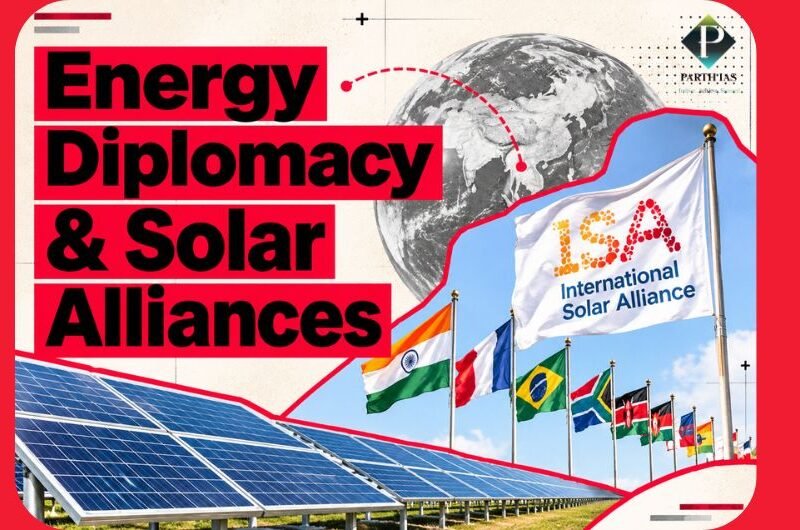
Energy Diplomacy & Solar Alliances
India’s Energy Diplomacy and the International Solar Alliance (ISA)
India’s energy diplomacy has gradually evolved from securing traditional fossil fuel imports to promoting renewable energy, international clean energy cooperation and sustainable development. Through initiatives such as the International Solar Alliance (ISA), India seeks to strengthen its energy security, reduce dependence on imported fossil fuels and promote affordable clean energy solutions across developing countries.
1. India’s Energy Diplomacy: Strategic Shifts
Import Vulnerability: India imports over 85% of its crude oil requirements and roughly 50% of its natural gas requirements. This dependence makes the Indian economy vulnerable to global energy price fluctuations, geopolitical tensions and disruptions along important maritime routes such as the Strait of Hormuz.
Supplier Diversification: India is diversifying its energy imports beyond West Asia by sourcing oil and natural gas from Russia, the United States, Latin America and Africa. India also acquires ownership stakes in overseas oil and gas projects through ONGC Videsh, the international investment arm of ONGC (Oil and Natural Gas Corporation).
Strategic Buffers: India is expanding its SPR (Strategic Petroleum Reserves) to maintain emergency crude oil supplies during international supply disruptions. It is also exploring trade settlements in local currencies to reduce exposure to geopolitical sanctions and exchange rate fluctuations.
Green Transition & Critical Minerals: India’s energy diplomacy increasingly focuses on securing supplies of lithium, cobalt and rare earth elements required for renewable energy technologies, electric vehicles and battery storage. Initiatives such as KABIL (Khanij Bidesh India Limited) and the MSP (Minerals Security Partnership) support international cooperation in critical mineral supply chains.
Neighbourhood Energy Connectivity: India promotes regional energy cooperation through cross-border electricity grids, power trade and energy infrastructure projects involving Nepal, Bhutan, Bangladesh and Sri Lanka. These initiatives strengthen regional economic interdependence under India’s Neighbourhood First policy.
2. International Solar Alliance (ISA)
Origin & Headquarters: The ISA was jointly launched by India and France at COP21 (21st Conference of the Parties) in Paris in November 2015. It is the first treaty-based intergovernmental organization headquartered in India, located in Gurugram, Haryana.
Membership & Status: Following an amendment to its Framework Agreement in 2020, ISA membership was opened to all United Nations (UN) member states. The organization was granted observer status in the UNGA (United Nations General Assembly) in 2021 and has more than 120 signatory countries. In early 2026, the United States announced its withdrawal from the ISA alongside several other multilateral organizations.
Governance Structure:
- ISA Assembly: The highest decision-making body of the organization, consisting of representatives of member countries. It meets annually to determine policies, priorities and programmes. India was re-elected to the presidency for a third consecutive term.
- Secretariat: Responsible for implementing the organization’s programmes and administrative functions. It is headed by the Director-General, who serves a renewable four-year term. Ashish Khanna serves as the Director-General.
Towards 1000 Strategy (by 2030):
The ISA aims to achieve four major objectives:
Mobilize USD (United States Dollar) 1,000 billion in solar energy investments.
Provide clean energy access to 1,000 million people.
Install 1,000 GW (Gigawatts) of solar energy capacity.
Reduce annual CO₂ (Carbon Dioxide) emissions by 1,000 million tonnes.
3. Key Initiatives & Recent Developments (2025–2026)
Several major programmes have been advanced through the ISA to promote solar energy deployment, international investment, technological cooperation and capacity building.
One Sun, One World, One Grid (OSOWOG): A three-phase international electricity grid initiative that aims to connect solar-rich regions across Asia, West Asia, Europe and Africa. It seeks to enable cross-border electricity transmission and balance fluctuations in solar energy generation across different geographical regions and time zones.
Africa Solar Facility: A USD 200 million catalytic financing facility, managed in association with Africa50, designed to reduce investment risks and attract private capital for solar energy projects across Africa. It focuses on decentralized solar rooftops, mini-grids and solar-powered agricultural pumps.
SIDS Solar Procurement Platform: A joint initiative with the World Bank that combines solar equipment demand from SIDS (Small Island Developing States) to reduce procurement costs and improve access to affordable solar technologies. The platform is supported by a project pipeline worth USD 500 million.
ISA SHINE & STAR-C: ISA SHINE focuses on developing a Global Capability Centre for electricity grid digitization, technological innovation and AI (Artificial Intelligence)-enabled energy planning. The STAR-C (Solar Technology and Application Resource Centres) programme supports technical training, skill development and institutional capacity building in LDCs (Least Developed Countries).
SUNRISE Initiative: An initiative promoting a circular economy in the solar energy sector. It focuses on recycling solar panels and batteries at the end of their operational life, recovering valuable critical minerals and improving electronic waste management.
Exporting Domestic Models: India shares its experience in implementing domestic solar energy programmes with other developing countries. These include PM-KUSUM (Pradhan Mantri Kisan Urja Suraksha evam Utthaan Mahabhiyan), which promotes solar-powered agricultural pumps, and PM Surya Ghar: Muft Bijli Yojana, which supports residential rooftop solar installations.
4. Strategic Significance & Challenges for India
| Dimension | Strategic Significance for India | Key Challenges & Bottlenecks |
|---|---|---|
| Geopolitics & Soft Power | Strengthens India’s position in international energy governance and its leadership of the Global South. It offers a cooperative, clean energy-focused alternative to China’s BRI (Belt and Road Initiative). | Withdrawal of major economies such as the United States and trade-related concerns arising from domestic measures such as BCD (Basic Customs Duty) and ALMM (Approved List of Models and Manufacturers). |
| Energy Security | Reduces long-term dependence on imported fossil fuels and improves India’s ability to withstand energy price shocks and geopolitical instability in West Asia. | Continued dependence on Chinese supply chains for polysilicon, solar wafers, solar manufacturing components and critical mineral processing. |
| Climate Finance | Promotes blended finance, investment guarantees and risk-reduction mechanisms to support solar-rich but financially constrained countries in Africa and SIDS. | Slow disbursement of climate finance commitments by developed countries and the high cost of financing renewable energy projects in developing economies. |
| Grid & Technology Integration | Supports cross-border electricity trade through OSOWOG and promotes resource recovery and solar waste recycling through the SUNRISE Initiative. | Technical difficulties in synchronizing international electricity grids, political and regulatory risks, and inadequate battery storage capacity to support reliable renewable electricity supplies. |
Way Forward
De-risking Supply Chains: India needs to expand domestic manufacturing across the entire solar value chain, including polysilicon, ingots, wafers, solar cells and modules, through the PLI (Production Linked Incentive) scheme. Critical mineral partnerships with Australia, African countries and South American countries can further reduce dependence on concentrated supply chains.
Blended Finance Mechanisms: Expanding credit guarantees and risk-mitigation facilities, such as the MIGA-ISA Solar Facility involving MIGA (Multilateral Investment Guarantee Agency), can attract private and institutional investment into solar energy projects across the Global South. Combining public and private financing can improve the availability of affordable capital.
Sub-Regional Grid Diplomacy: India can implement OSOWOG gradually by strengthening electricity grid connections within the BBIN (Bangladesh, Bhutan, India and Nepal) framework and developing energy connectivity through IMEC (India–Middle East–Europe Economic Corridor) before expanding towards a wider international electricity grid.
Must Know Terms :
1. Energy Diplomacy
The use of international agreements, strategic partnerships and diplomatic negotiations to secure reliable and affordable energy supplies. India’s energy diplomacy focuses on diversifying fossil fuel imports, securing critical minerals and promoting international renewable energy cooperation.
2. International Solar Alliance (ISA)
A treaty-based intergovernmental organization jointly launched by India and France in 2015 to promote solar energy deployment, investment and technological cooperation. Headquartered in Gurugram, Haryana, it aims to improve access to affordable and sustainable solar energy, particularly in developing countries.
3. Strategic Petroleum Reserves (SPR)
Emergency stocks of crude oil maintained by a country to ensure energy security during supply disruptions, geopolitical conflicts and sudden increases in international oil prices. These reserves help reduce the economic risks associated with dependence on imported crude oil.
4. One Sun, One World, One Grid (OSOWOG)
An international initiative aimed at connecting electricity grids across different countries and geographical regions. It promotes cross-border transmission of solar electricity and utilizes differences in time zones to address fluctuations in solar energy generation.
5. Critical Mineral Security
The strategy of ensuring reliable and diversified supplies of essential minerals such as lithium, cobalt and rare earth elements. These minerals are important for solar technologies, electric vehicles, battery storage and other clean energy applications. India promotes international mineral partnerships to reduce supply chain risks.
6. Blended Finance
A financing mechanism that combines public funds, development finance and private investment to support projects that face high financial risks. It uses instruments such as credit guarantees and concessional financing to attract private capital and reduce investment costs for renewable energy projects in developing countries.
MCQ :
1. Consider the following statements regarding India's Energy Diplomacy:

1. India's energy diplomacy extends beyond securing fossil fuel imports to include critical mineral security and renewable energy cooperation.

2. The Strait of Hormuz is strategically insignificant for India's energy security because India imports most of its crude oil through the Pacific Ocean.

3. ONGC Videsh contributes to India's energy security by acquiring ownership stakes in overseas oil and gas projects.

4. The diversification of energy suppliers has eliminated India's dependence on imported crude oil.

How many of the above statements are correct?

(a) Only four

(b) Only one

(c) Only two

(d) Only three
2. With reference to India's Strategic Petroleum Reserves (SPR), consider the following statements:

1. Strategic Petroleum Reserves are primarily intended to store electricity generated through renewable energy sources.

2. Strategic Petroleum Reserves help maintain emergency crude oil supplies during international supply disruptions.

3. Local currency trade settlements directly increase the physical storage capacity of Strategic Petroleum Reserves.

4. Strategic Petroleum Reserves permanently eliminate India's exposure to international crude oil price fluctuations.

How many of the above statements are correct?

(a) Only one

(b) Only three

(c) Only four

(d) Only two
3. Consider the following statements regarding India's critical mineral diplomacy:

1. Khanij Bidesh India Limited (KABIL) supports India's efforts to secure overseas critical mineral resources.

2. The Minerals Security Partnership is primarily concerned with maintaining emergency petroleum reserves among participating countries.

3. International cooperation in lithium, cobalt and rare earth supply chains can support India's clean energy transition.

4. The development of domestic solar manufacturing automatically eliminates the need for international critical mineral partnerships.

How many of the above statements are correct?

(a) Only three

(b) Only four

(c) Only one

(d) Only two
4. With reference to the International Solar Alliance (ISA), consider the following statements:

1. The ISA was jointly launched by India and France at the 21st Conference of the Parties (COP21) in Paris.

2. The ISA was established as a specialized agency of the United Nations rather than an independent treaty-based intergovernmental organization.

3. Membership of the ISA continues to be restricted to countries located entirely or partially between the Tropics of Cancer and Capricorn.

4. The permanent headquarters of the ISA is located in Paris, France.

How many of the above statements are correct?

(a) Only two

(b) Only one

(c) Only three

(d) Only four
5. Consider the following statements regarding the institutional framework of the International Solar Alliance:

1. The amendment to the ISA Framework Agreement in 2020 opened its membership to all United Nations member states.

2. The United Nations General Assembly granted observer status to the ISA in 2021.

3. Observer status in the United Nations General Assembly makes the ISA a principal organ of the United Nations.

4. The expansion of membership in 2020 restricted participation to countries with existing large-scale solar manufacturing facilities.

How many of the above statements are correct?

(a) Only four

(b) Only one

(c) Only two

(d) Only three
6. With reference to the governance structure of the International Solar Alliance, consider the following statements:

1. The ISA Secretariat is the highest decision-making body of the organization, while the Assembly performs only administrative functions.

2. The ISA Assembly consists of representatives of member countries and meets annually to determine policies and priorities.

3. The Director-General of the ISA is appointed for a non-renewable lifetime term.

4. The ISA Secretariat is institutionally subordinate to the United Nations General Assembly in implementing solar energy programmes.

How many of the above statements are correct?

(a) Only three

(b) Only two

(c) Only four

(d) Only one
7. Consider the following statements regarding the 'Towards 1000' Strategy of the International Solar Alliance:

1. It aims to mobilize USD 1,000 billion in solar energy investments by 2030.

2. It aims to provide clean energy access to 1,000 million people.

3. It targets the installation of only 1,000 MW of solar energy capacity worldwide.

4. It aims to reduce annual carbon dioxide emissions by 1,000 billion tonnes.

How many of the above statements are correct?

(a) Only one

(b) Only two

(c) Only four

(d) Only three
8. With reference to One Sun, One World, One Grid (OSOWOG), consider the following statements:

1. OSOWOG seeks to connect electricity grids across different geographical regions to facilitate international solar electricity transmission.

2. Its functioning depends on all participating countries having identical local time zones and solar generation patterns.

3. Its principal objective is to establish a common international petroleum pipeline network.

4. The initiative eliminates the need for technical coordination and synchronization among participating electricity grids.

How many of the above statements are correct?

(a) Only one

(b) Only four

(c) Only two

(d) Only three
9. Consider the following statements regarding international solar energy financing and procurement initiatives:

1. The Africa Solar Facility seeks to reduce investment risks and attract private capital for decentralized solar energy projects.

2. The SIDS Solar Procurement Platform combines equipment demand from Small Island Developing States to improve procurement efficiency and reduce costs.

3. The Africa Solar Facility focuses exclusively on centralized fossil fuel-based power generation.

4. The SIDS Solar Procurement Platform requires participating island countries to undertake entirely independent procurement without demand aggregation.

How many of the above statements are correct?

(a) Only three

(b) Only one

(c) Only four

(d) Only two
10. Consider the following statements regarding ISA SHINE, STAR-C and the SUNRISE Initiative:

1. ISA SHINE primarily focuses on recovering critical minerals from discarded solar panels.

2. STAR-C (Solar Technology and Application Resource Centres) supports technical training, skill development and institutional capacity building.

3. The SUNRISE Initiative primarily focuses on establishing cross-border electricity transmission infrastructure.

4. STAR-C is principally designed to maintain emergency crude oil supplies in Least Developed Countries.

How many of the above statements are correct?

(a) Only four

(b) Only three

(c) Only one

(d) Only two
11. With reference to India's domestic solar energy programmes and their international relevance, consider the following statements:

1. PM-KUSUM promotes the use of solar energy in the agricultural sector, including solar-powered agricultural pumps.

2. PM Surya Ghar: Muft Bijli Yojana primarily provides financial assistance for large-scale commercial nuclear power projects.

3. Both PM-KUSUM and PM Surya Ghar focus exclusively on the import of solar equipment rather than its deployment.

4. India's experience with domestic solar energy programmes can support knowledge-sharing and capacity building in developing countries.

How many of the above statements are correct?

(a) Only two

(b) Only four

(c) Only one

(d) Only three
12. Consider the following statements regarding blended finance and international solar energy investment:

1. Blended finance combines public or development finance with private investment to support projects facing financial barriers.

2. Credit guarantees are designed to increase investment risks and discourage private participation in renewable energy projects.

3. Blended finance mechanisms can operate only in developed countries with established capital markets.

4. The Multilateral Investment Guarantee Agency (MIGA) is primarily responsible for determining India's domestic solar equipment manufacturing standards.

How many of the above statements are correct?

(a) Only three

(b) Only four

(c) Only two

(d) Only one
13. Consider the following statements regarding challenges to India's energy transition:

1. Dependence on concentrated international supply chains for polysilicon and solar wafers can create strategic vulnerabilities.

2. The expansion of domestic solar module assembly necessarily eliminates dependence on imported upstream manufacturing components.

3. Inadequate battery storage capacity and difficulties in grid synchronization can affect the reliability of renewable electricity supplies.

4. The establishment of international electricity grids automatically removes political and regulatory risks associated with cross-border energy trade.

How many of the above statements are correct?

(a) Only one

(b) Only two

(c) Only three

(d) Only four
14. With reference to India's regional energy connectivity initiatives, consider the following statements:

1. The BBIN framework comprises Bangladesh, Bhutan, India and Nepal.

2. The India–Middle East–Europe Economic Corridor is geographically restricted to South Asian countries and excludes West Asia and Europe.

3. India's Neighbourhood First policy discourages cross-border electricity trade to prevent regional economic interdependence.

4. OSOWOG requires participating countries to discontinue all existing regional electricity trade arrangements before establishing international grid connectivity.

How many of the above statements are correct?

(a) Only one

(b) Only three

(c) Only four

(d) Only two
15. Consider the following statements regarding India's strategy for sustainable energy security:

1. The Production Linked Incentive (PLI) scheme can support domestic manufacturing across different stages of the solar value chain.

2. Critical mineral partnerships with Australia, Africa and South America necessarily increase India's dependence on a single geographical source.

3. Solar panel and battery recycling can contribute to resource recovery, critical mineral security and circular economy objectives.

4. International renewable energy cooperation requires India to abandon all strategic arrangements concerning conventional energy supplies.

How many of the above statements are correct?

(a) Only four

(b) Only one

(c) Only two

(d) Only three


0 comment